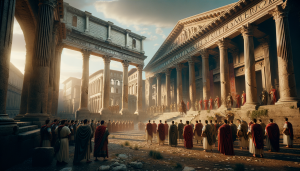
The Succession Trap: How a 10-Year War Over Nothing Destroyed Medieval Japan
The longest government shutdown in American history wasn’t about healthcare. It was a 43-day staring contest, a political siege where both sides dug in, refusing to yield, while the gears of the nation ground to a halt. For 43 days, federal paychecks vanished, food assistance for the vulnerable hung in the balance, and the very safety of our skies was questioned. All for what? A line item in a budget? A talking point for the Sunday shows?
We were told it was about principles, about the fundamental disagreements that define our political landscape. But what if it wasn’t? What if it was about something far more primal, something that has toppled empires and plunged nations into chaos for centuries?
What if it was just about power?
The Ōnin War: When Political Theater Burned a Nation
To understand the true nature of the shutdown, we must look not to the talking heads on cable news, but to the smoldering ruins of a once-great city: Kyoto, Japan, in the year 1467. Here, a succession crisis in the ruling Ashikaga shogunate ignited a decade-long conflict known as the Ōnin War. On the surface, it was a dispute over which child would inherit the title of shogun.
But beneath the surface, it was a brutal, pointless struggle for power that bled a nation dry.
[IMAGE: kyoto_burning.png – Kyoto in flames during the Ōnin War (1467-1477)]
The Succession Trap
In 1464, the shogun, Ashikaga Yoshimasa, a man more interested in art than in governance, had no heir. He persuaded his younger brother, Yoshimi, to leave a monastery and become his successor.
But just a year later, Yoshimasa’s wife, Hino Tomiko, gave birth to a son, Yoshihisa.
The stage was set for a showdown.
Two factions formed. The Eastern Army, led by the powerful Hosokawa Katsumoto, backed the brother, Yoshimi. The Western Army, led by the equally powerful Yamana Sōzen, backed the infant son, Yoshihisa, and his ambitious mother. The government, already weakened by internal conflicts and a series of financial crises, became completely paralyzed.
Neither side would budge.
Sound familiar?
The Twist That Reveals Everything
But here’s the twist that reveals the true, rotten core of the conflict.
Within a year, the factions switched sides.
[IMAGE: faction_switching.png – The absurdity of faction switching: It was never about the succession]
The Eastern Army, which had championed the brother, now supported the infant son. The Western Army, which had fought for the son, now backed the brother.
It was never about the succession. It was about which faction would control the puppet shogun. It was about power.
For ten years, the war raged. Kyoto was burned to the ground. The conflict outlived its instigators; both Hosokawa and Yamana died, yet the fighting continued, fueled by the inertia of hatred and the ambition of lesser lords.
The war ended not with a decisive victory, but with mutual exhaustion.
Everyone lost.
The Death of Central Authority
The Ōnin War was the death knell for the Ashikaga shogunate. The central government’s authority evaporated, and Japan plunged into the Sengoku period—the “Warring States”—a century of chaos and bloodshed where local warlords carved up the country for themselves.
The government in Kyoto became a ghost, a hollow symbol with no real power.
[IMAGE: institutional_decay.png – When the center cannot hold: Institutional decay across centuries]
Now, look back at our 43-day shutdown.
Democrats demanded enhanced Obamacare subsidies. Republicans refused. The government shut down.
And in the end?
The shutdown ended, and the Democrats didn’t get their subsidies.
The entire spectacle, the immense hardship inflicted on millions of Americans, was for nothing. It was political theater, a performance of principle that masked a raw, naked power struggle.
Just like in feudal Japan, our leaders were willing to paralyze the nation, not for a deeply held belief, but for a tactical advantage. They were willing to burn down the capital to rule over the ashes.
Build Your Own Center
When the government becomes a stage for pointless power struggles, when the well-being of the people is sacrificed for political gain, self-reliance is no longer a choice—it is a necessity.
The lesson of the Ōnin War is that when the center cannot hold, you must create your own center. You must become your own source of stability, your own provider, your own protector.
This is not a call to despair, but a call to action. It is a call to build a life that is resilient to the whims of a dysfunctional political class.
5 Things You Can Do Right Now
1. Secure Your Food Supply: The 4ft Farm Blueprint is a revolutionary system that allows you to grow your own food, even in a small space. It is the first and most important step towards true independence. CLICK HERE to learn more about the 4ft Farm Blueprint.
2. Prepare for the Unexpected: Survival Stronghold offers a wealth of knowledge on how to prepare for any crisis, from natural disasters to economic collapse. Visit Survival Stronghold to learn more.
3. Stay Informed: The Self-Reliance Report provides in-depth analysis and practical advice on how to live a more self-sufficient life. Read the latest from the Self-Reliance Report.
4. Take Control of Your Health: Seven Holistics offers natural and effective ways to improve your health and well-being, free from the control of big pharma and government bureaucracy. Discover the power of holistic health at Seven Holistics.
5. Build Your Homestead: Homesteader Depot is your one-stop shop for all things homesteading, from tools and supplies to expert advice. Start your homesteading journey with Homesteader Depot.