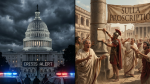
**A Modern Puzzle**
Something strange is happening at America’s best colleges. It’s not a loud protest. It’s a quiet threat in a government letter.
This week, the White House sent a “Compact for Academic Excellence” to nine top universities. It sounds good, right? But it’s a demand: follow our 10 rules, or lose billions in government money.
This is a new kind of power play. The government is using money to control what is taught. It wants to decide who gets hired and what ideas are allowed on campus. This could turn our colleges into echo chambers for the government.
But this has happened before. This same strategy was used almost 750 years ago. It had terrible results. To see the danger we face, we must go back in time. Not to the last century, but to the heart of the medieval world.
**A Trip Back in Time**
Imagine Paris in 1277. It’s not the city of lights. It’s a busy, medieval city. At its center is the University of Paris. It was the best place to learn in the world.
Scholars from all over Europe came here. They were excited to debate big ideas. They argued about God, the world, and our place in it. They were studying the works of the Greek thinker Aristotle. His ideas were new to them. They learned them from smart Islamic scholars like Averroes.
This new way of thinking was exciting. But it was also dangerous. It questioned the Church’s teachings. It said that reason, not just faith, could explain the world. The powerful men in the Church saw this as a threat. They thought it was a cancer in their holy city.
One man was very worried. His name was Étienne Tempier. He was the Bishop of Paris. He had a lot of power. And he was about to make a choice that would change history.
**The Shocking Parallel**
On March 7, 1277, Bishop Tempier did something huge. With the Pope’s blessing, he condemned 219 ideas being taught at the university. It was a massive act of censorship. It was a medieval “compact” to crush new ideas.
The link to today’s “Compact for Academic Excellence” is shockin