When America’s Government Echoes a 4,700-Year-Old Crisis That Broke the World’s First Democracy
By Shamus Gerry III
The Modern Mystery
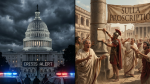
Something is wrong in Washington. You can feel it, can’t you? A strange paralysis has gripped the nation’s capital. For eight days, the federal government has been shut down, not with a bang, but with a whimper. It’s a quiet crisis, a slow-motion collapse of basic functions that hints at a much deeper institutional rot.
This isn’t just another political squabble. This is different. This is the sound of a system grinding to a halt. On one side, Democrats demand that any funding bill include an extension of healthcare tax credits that millions of Americans rely on. On the other, Republicans hold firm, demanding a “clean” bill with no additions. The result? Deadlock. Stalemate. A government of the people, by the people, for the people, has ceased to function for the people.
As the days tick by, the pressure mounts. Federal workers face the prospect of missed paychecks. National parks are closed. The gears of the American republic have seized up, rusted by the friction of partisan hatred. The rhetoric grows more toxic by the hour, with leaders on both sides hurling insults like “communists” and “Marxists.” It’s a dangerous game of chicken, played with the lives and livelihoods of ordinary Americans. And if you listen closely, you can hear an echo, a faint whisper from the dawn of civilization, warning us of what comes next.
The Time Portal
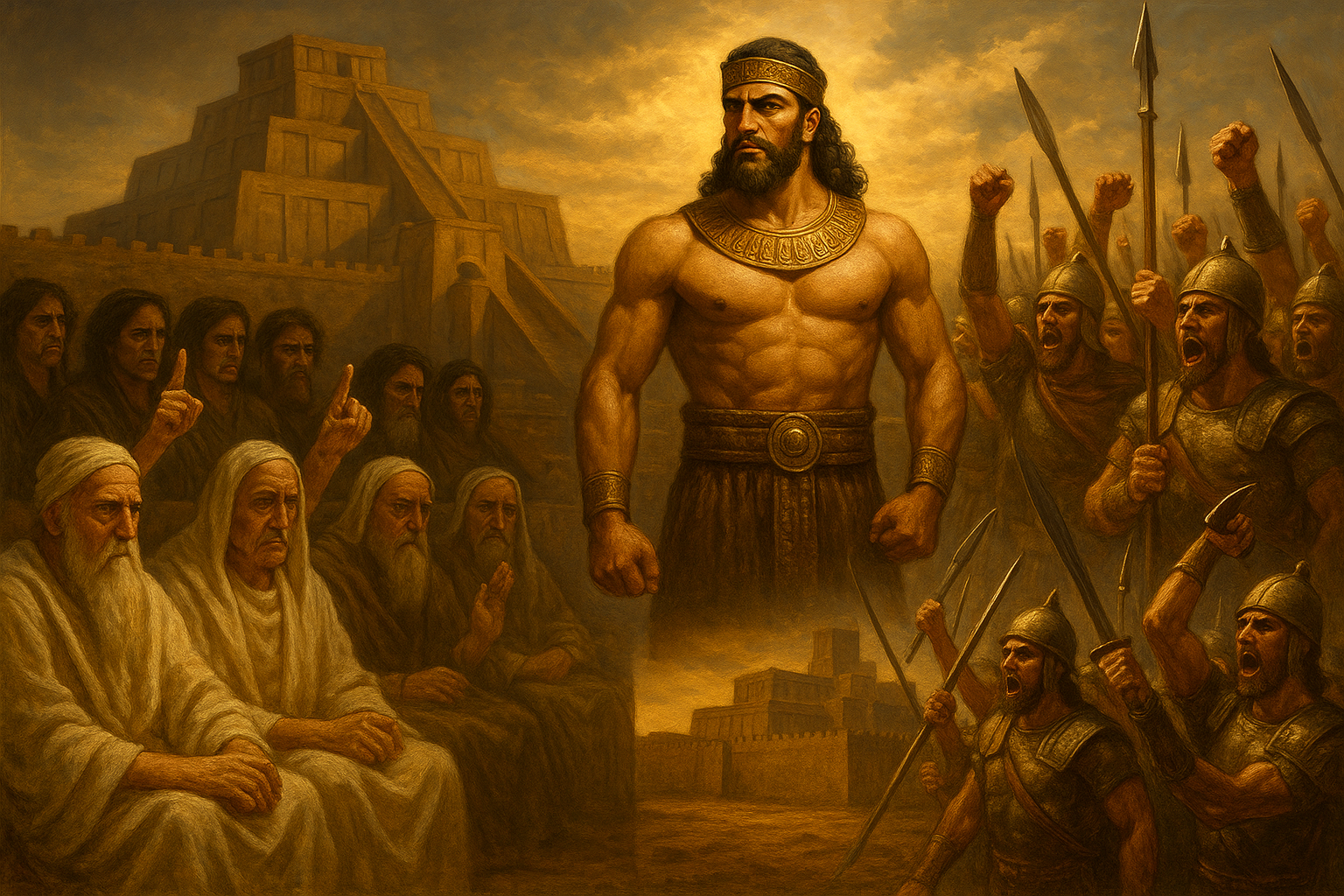
Let’s travel back in time. Not a few decades, or even a few centuries, but 4,700 years. We arrive in a city of sun-baked brick, rising from the fertile plains between the Tigris and Euphrates rivers. This is Uruk, the world’s first great city, a bustling metropolis of 50,000 souls. And it is here, in ancient Sumer, that humanity is conducting its first great experiment in self-government.
Uruk is not ruled by a single, all-powerful king. Instead, power is divided. There is an Assembly of Elders, wise and cautious men who have seen many seasons come and go. There is an Assembly of Young Men, the city’s warriors, full of fire and eager for glory. And there are other councils, representing the city’s women and its various trades. To make any great decision, to go to war or to build a new temple, these assemblies must come together. They must debate, they must argue, and they must, somehow, find consensus.
For a time, this system works. It is messy, it is loud, but it is a form of democracy, the first of its kind. The people of Uruk have a voice. But what happens when those voices refuse to agree? What happens when the assemblies are deadlocked, and a crisis looms on the horizon?
The Parallel Revelation
We find our answer in the world’s oldest story, the Epic of Gilgamesh. The city of Uruk faces a mortal threat. Akka, the king of the rival city-state of Kish, has sent an ultimatum: submit or be destroyed. The fate of Uruk hangs in the balance.
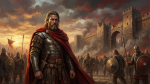
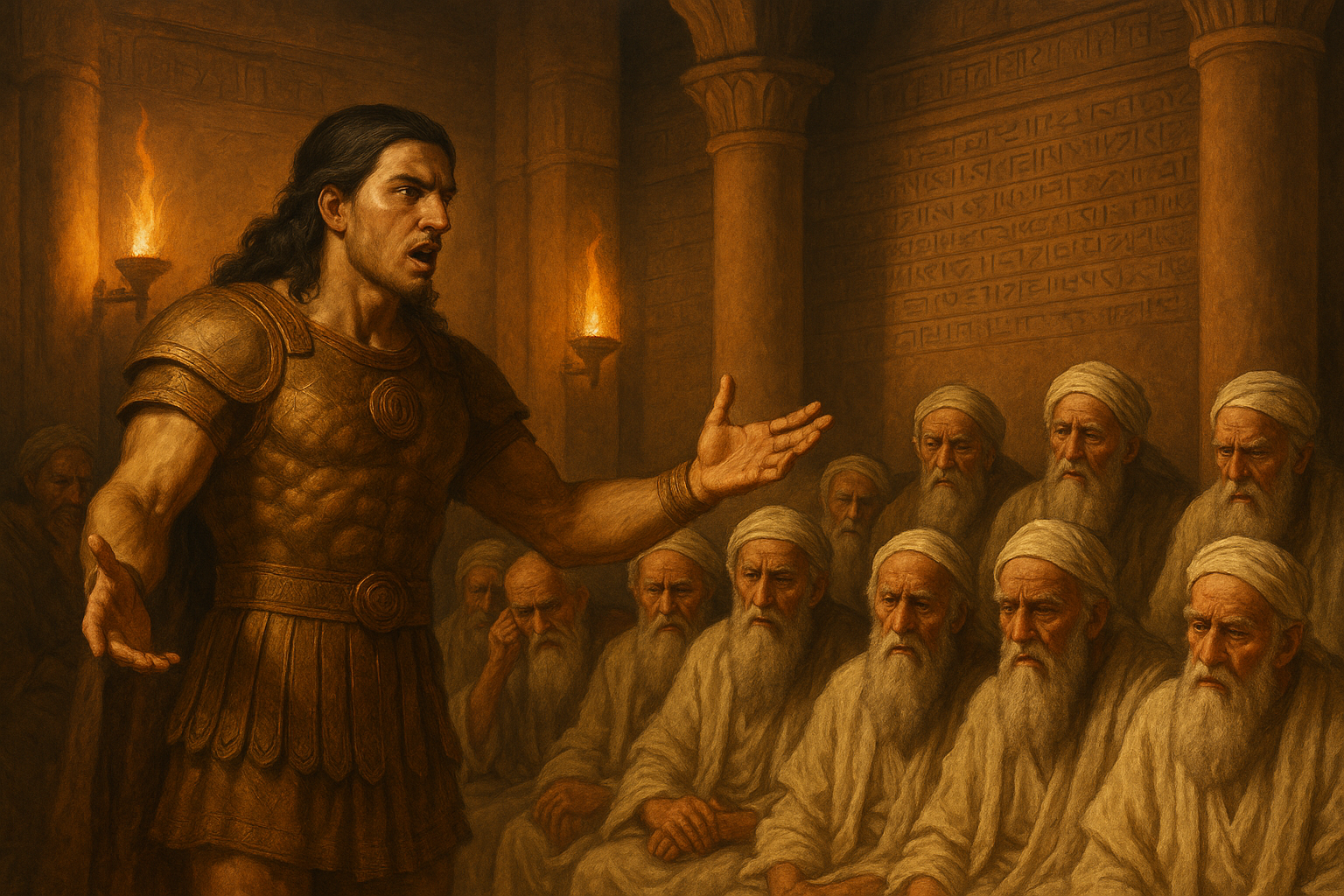
Gilgamesh, the city’s dynamic young leader, its lugal or war-leader, knows the danger. He goes first to the Assembly of Elders. He lays out the threat, the stark choice between servitude and war. But the Elders are cautious. They have seen war before. They have seen the fields burn and the young men die. They vote for peace, for submission. They will not fight.
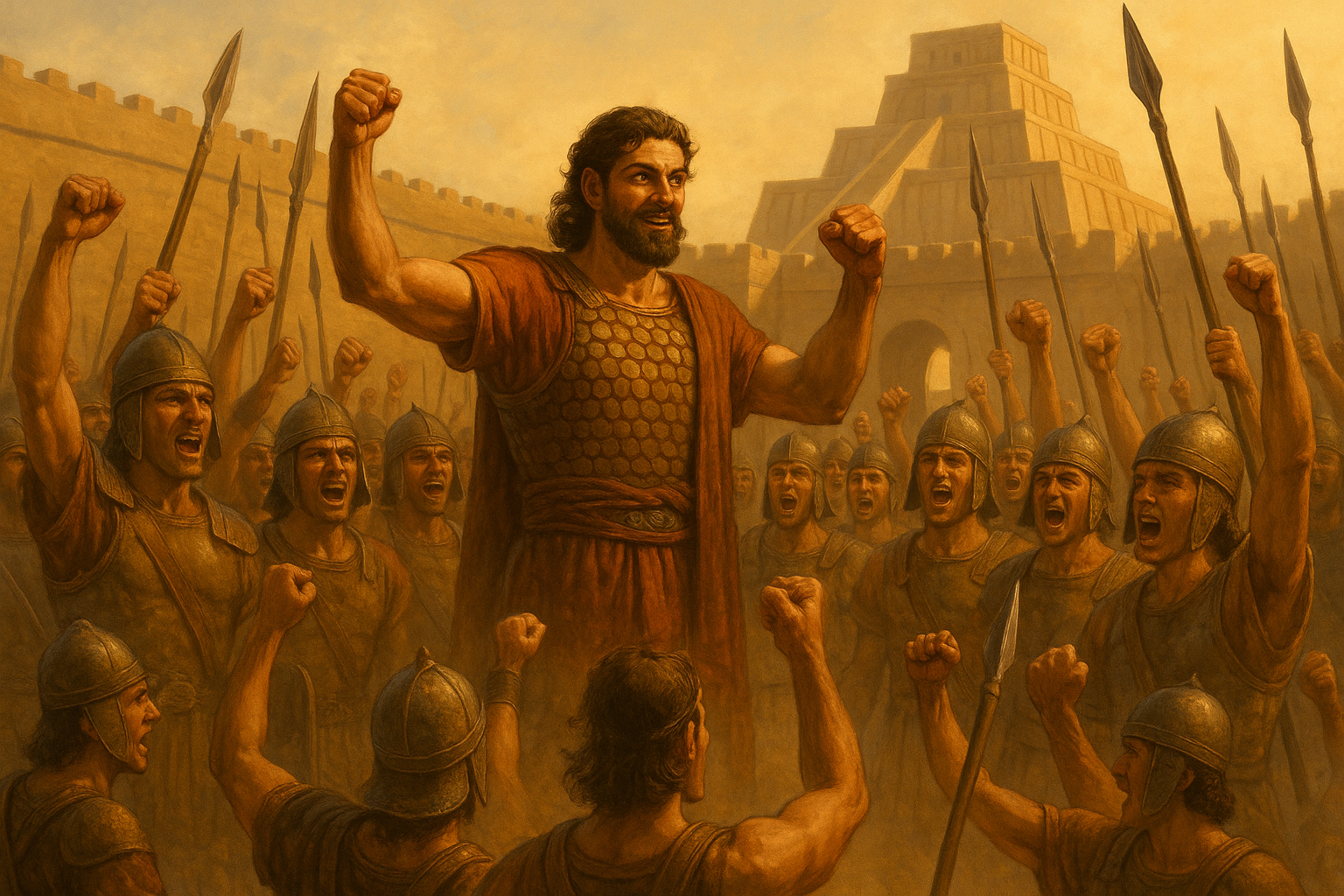
Frustrated, Gilgamesh goes to the Assembly of Young Men. He speaks to the warriors, the men of his own generation. He speaks of glory, of freedom, of the shame of surrender. Their response is immediate and thunderous. They vote for war. They will fight.
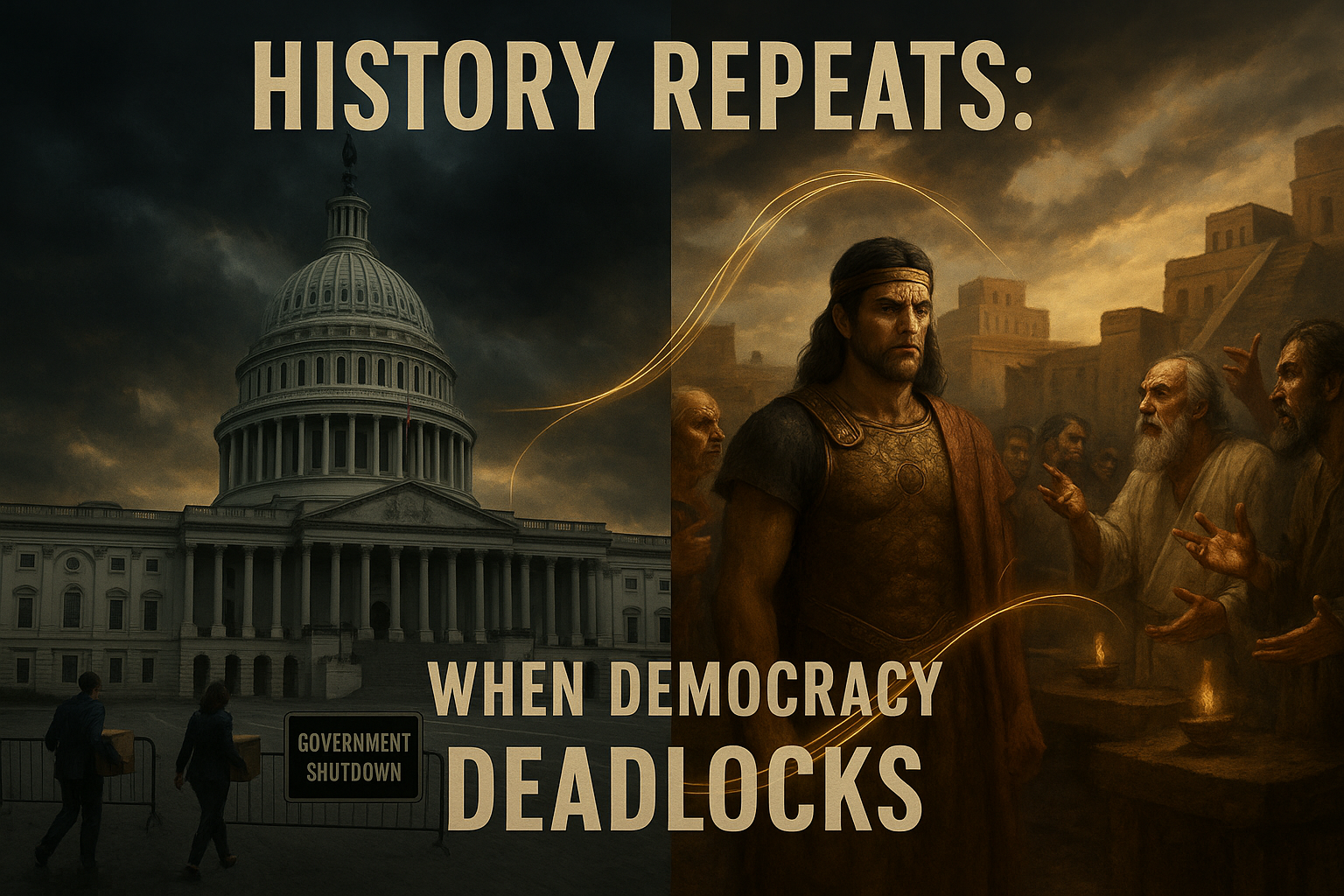
And so, the city is divided. The Assembly of Elders and the Assembly of Young Men are at an impasse. One votes for peace, the other for war. The government of Uruk is paralyzed, unable to act in the face of an existential threat. It is the exact same pattern we see in Washington today: two competing power centers, each with its own interests and its own vision, locked in a struggle that renders the entire system impotent.
The Pattern Recognition
Why does this pattern repeat? Why do societies, separated by nearly five millennia, fall into the same trap of institutional deadlock? The answer lies in the unchanging nature of human beings. We are tribal creatures. We form groups, we create identities, and we compete for power and resources.
In ancient Uruk, the tribes were the old and the young, the cautious and the bold. In modern America, the tribes are Democrats and Republicans, liberals and conservatives. Each tribe has its own story, its own vision of the world. And when those stories clash, when compromise becomes a dirty word, the system breaks down.
The founders of the American republic understood this danger. They created a system of checks and balances, of separated powers, designed to force compromise and prevent any one faction from seizing absolute control. But they could not have foreseen a time when the tribes would become so polarized, so hostile, that they would rather see the entire system collapse than give an inch to their rivals.
The Ancient Warning
What happened in ancient Uruk? The story of Gilgamesh and Akka has a happy ending. Gilgamesh, with the support of the young warriors, manages to rally the city and defeat the threat from Kish. But the crisis exposed a fatal flaw in Uruk’s democratic experiment.
The constant threat of war, the endless need for decisive action, could not be met by a system of competing assemblies. The paralysis, the deadlock, was too dangerous. And so, over time, power became more and more concentrated in the hands of a single figure: the king. The world’s first democracy withered, and the age of absolute monarchy began.
This is the ancient warning. When a system of government proves incapable of acting, when it is paralyzed by its own internal divisions, the people will eventually demand a leader who can cut through the gridlock. They will trade their freedom for order. They will welcome a strongman who can make the trains run on time, even if it means silencing the dissenting voices. The road from democratic paralysis leads to authoritarian rule. It is a road that has been traveled many times in human history. And we are on it now.
5 Things You Can Do This Week
History is not a spectator sport. The crisis unfolding in Washington is not just a story on the news. It is a threat to your freedom and your family’s future. Here are five things you can do this week to prepare for the storm that is coming:
1. Master the Basics of Preparedness: Don’t get caught off guard. Learn the fundamental steps to prepare for any emergency with these 10 Quick Preparedness Tasks for Better Emergency Readiness. These simple actions can make a world of difference when a crisis hits.
2. Secure Your Water Supply: In any emergency, clean water is your most valuable asset. Discover how to purify and store water safely with The Ultimate Guide to Bleaching Water for Emergency Preparedness. This is a critical skill that every American should know.
3. Protect Yourself and Your Family: Civil unrest can turn your neighborhood into a danger zone. Learn how to stay safe and protect your loved ones with this guide on Protecting Yourself During Civil Unrest.
4. Develop a Financial Survival Plan: When the government and banking systems fail, how will you manage your finances? Survival Finance: 10 Ways to Manage Money When Everything Goes Offline provides a roadmap for financial resilience in a world where traditional systems have collapsed.
5. Build Your Food Security: Empty grocery store shelves are becoming more common. Take control of your family’s food security with The Complete Emergency Food Storage Guide for Beginners. Learn how to store months of food safely and affordably.
Sponsor Spotlight: Prepare for What’s Coming
The parallels between ancient Uruk and modern America are not just academic curiosities. They are warnings. When democratic systems fail, chaos follows. And in chaos, only the prepared survive.
That’s why we recommend Self-Reliance Report, your essential guide to preparedness in uncertain times. From water purification to food storage, from home security to financial planning, Self-Reliance Report gives you the knowledge and tools you need to protect your family when the system fails.
Don’t wait for the crisis to hit. Start preparing today. Visit Self-Reliance Report and take the first step toward true independence.
References
US shutdown deadlock deepens as senators reject competing bills – The Guardian
Mesopotamian Government – World History Encyclopedia
Democracy in the Sumerian City States: The Assembly, the Elders, and the King – SpringerLink