When Empires Bet on a Monopoly, They Always Lose
By Shamus Gerry III
##
The Modern Mystery
Something is breaking in the world economy. You can feel the tremors, can’t you?
A high-stakes game of chicken is playing out between the United States and China. The global supply chain is the battleground. This isn’t just another headline; it’s a seismic shift with the power to reshape our world.
Just this week, the White House announced a staggering 100% tariff on all Chinese goods. It’s set to detonate on November 1st. This isn’t a warning shot; it’s a declaration of economic war.
The move comes in direct response to China’s own power play. A quiet but ruthless tightening of its grip on the world’s supply of rare earth minerals. These aren’t just obscure elements on the periodic table. They are the lifeblood of our modern world, essential for everything from iPhones and electric cars to advanced defense systems.
China now requires special permission for any product containing even a trace of these materials to leave its borders. They are effectively holding the global tech industry hostage.
This isn’t just a trade dispute. It’s a modern-day siege, a battle for control over the very building blocks of the 21st century. And as the walls close in, a chilling question emerges: has this happened before? Is this unprecedented, or are we merely the latest actors in a very old play?
##
The Time Portal
Let’s wind the clock back 500 years, to the glittering, cutthroat world of 15th-century Venice.
Imagine a city built on water, a labyrinth of canals and opulent palaces. Its wealth so vast it was the envy of the world. The source of this immense power wasn’t gold or armies, but something far more fragrant: spices.
In an age before refrigeration, spices like pepper, cloves, and cinnamon were not just a luxury. They were a strategic necessity. They preserved food, cured illnesses, and seasoned the bland diets of an entire continent.
And Venice, through a web of exclusive treaties and ruthless naval power, held a complete and total monopoly on this priceless trade. Every ounce of spice that reached Europe from the East had to pass through the hands of Venetian merchants. They marked it up by as much as 4,000 percent. They were the gatekeepers of flavor, the masters of preservation, and they grew fabulously wealthy by controlling the flow.
For centuries, the Venetian monopoly seemed unbreakable. They had the ships, the connections, and the political will to crush any rival. The rest of Europe could do nothing but pay the exorbitant prices and curse the Venetian stranglehold.
But in the halls of power in Lisbon and Madrid, a desperate plan was taking shape. A long-shot gamble to break the Venetian monopoly and find a new path to the riches of the East.
—
(Sponsor: The 4ft Farm Blueprint)
*Before we continue, a word from our sponsor. In a world of fragile supply chains and economic uncertainty, the ability to provide for yourself and your family is the ultimate freedom. The 4ft Farm Blueprint is a revolutionary system that teaches you how to grow your own food, even in a small space. It’s a step-by-step guide to food independence, a way to take back control from the fragile systems that are failing us. Don’t wait for the shelves to go empty. Click here to learn more about the 4ft Farm Blueprint and secure your family’s future.*
—
##
The Parallel Revelation
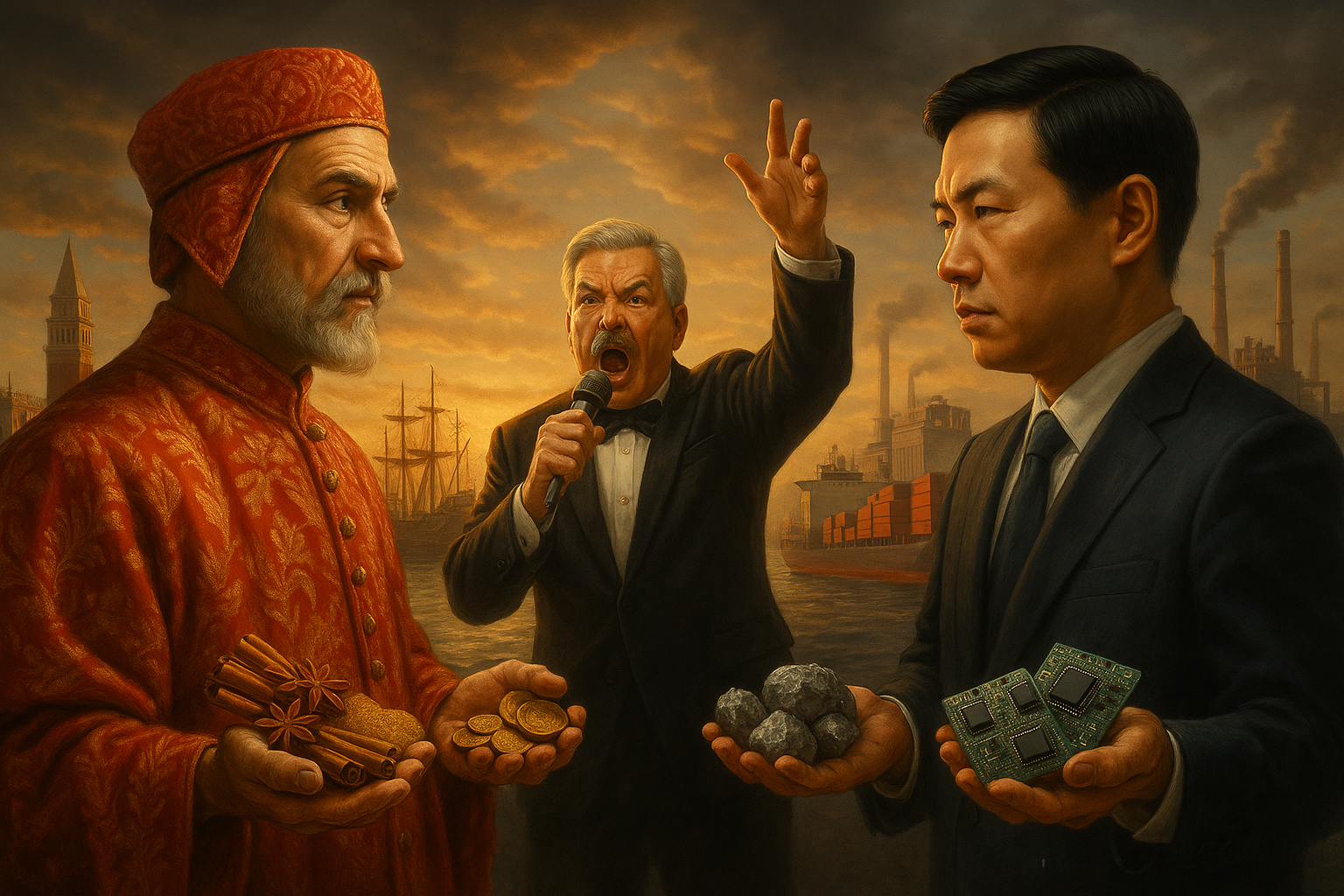
The parallels between 15th-century Venice and 21st-century China are as stunning as they are terrifying.
Just as Venice controlled the flow of spices, China now controls the flow of rare earth minerals. Just as spices were the strategic resource of the late Middle Ages, rare earths are the strategic resource of the digital age.
And just as Venice used its monopoly to extract maximum profit and exert political influence, China is now using its control over rare earths to bring the world to its knees.
The tactics are eerily similar. Venice used exclusive trade agreements with the Mamluk Sultanate in Egypt to lock down the overland spice routes. China has used state-sponsored industrial policy to dominate the mining and processing of rare earths, driving competitors out of business and creating a near-total dependency.
Both powers understood that when you control a resource that everyone needs and no one else can get, you control the world.
And now, we see the same reaction. Just as the kingdoms of Europe chafed under the Venetian yoke, the United States is now pushing back against China’s resource dominance. The 100% tariff is a modern-day broadside, a desperate attempt to break the siege and rewrite the rules of global trade.
The stage is set for a conflict that could dwarf the trade wars of the past. A high-tech, high-stakes battle for the future of the global economy.
##
The Pattern Recognition
History teaches us a crucial lesson: monopolies on critical resources are inherently unstable.
They breed resentment. They inspire innovation in their rivals. And ultimately, they sow the seeds of their own destruction. The very act of squeezing the world too tightly forces the world to find a way to slip through your fingers.
This isn’t about good guys and bad guys. It’s about the fundamental dynamics of power. When one entity accumulates too much control, the system naturally seeks to rebalance itself.
The more Venice tightened its grip on the spice trade, the more incentive the Portuguese and Spanish had to pour vast resources into finding an alternative. The more China leverages its rare earth monopoly, the more the rest of the world will invest in developing new sources and new technologies to break that dependency.
We are seeing this play out in real-time. The talk of stagflation, the wild swings in the stock market, the government shutdowns – these are all symptoms of a system under immense stress. The old order is breaking down, and a new, more volatile era is dawning.
The pattern is clear: resource wars, whether fought with galleons or tariffs, are a brutal and unpredictable business.
##
The Ancient Warning
For Venice, the end came with shocking speed.
In 1497, a Portuguese navigator named Vasco da Gama set sail from Lisbon with four small ships. His mission: to do the impossible, to sail around Africa and find a direct sea route to India.
After a perilous two-year voyage, he returned laden with spices, having paid a fraction of the Venetian price.
The effect was cataclysmic. The Cape Route was open. The Venetian monopoly was shattered. The spice trade, and the wealth it generated, shifted from the Mediterranean to the Atlantic.
Venice, the queen of the seas, began a long, slow decline from which it would never recover. The city that had built its empire on a resource monopoly was undone by a single, audacious act of exploration.
This is the ancient warning that echoes down to us today. China, in its quest for resource dominance, may be making the same mistake as Venice. By weaponizing its control over rare earths, it is forcing the world to seek alternatives, to innovate, to find its own Cape Route.
The 100% tariff, as drastic as it seems, is just the first shot in a long and costly economic war. And if history is any guide, the outcome is far from certain.
##
5 Things You Can Do This Week
History is not a spectator sport. The events of the past offer us a roadmap to navigate the challenges of the present. Here are five things you can do this week to prepare for the escalating resource war and the economic uncertainty it will bring:
1. Audit Your Supply Chain: Whether you run a business or a household, understand your dependencies. What products do you rely on that could be affected by a trade war with China? Start looking for alternatives now. For tips on building a resilient household, check out the resources at Self-Reliance Report.
2. Invest in Real Assets: In times of economic turmoil, tangible assets often hold their value better than paper investments. Consider diversifying into precious metals, real estate, or even productive land. Homesteader Depot has excellent guides on getting started with your own productive homestead.
3. Secure Your Health: A major economic downturn will put immense strain on our healthcare system. Take proactive steps to improve your health and reduce your reliance on a fragile system. Freedom Health Daily and Seven Holistics offer a wealth of information on natural health and wellness.
4. Build Your Fortress: In an uncertain world, a secure and self-sufficient home is your ultimate insurance policy. Learn the skills you need to protect your family and your property. Survival Stronghold is the premier resource for practical preparedness and home defense.
5. Grow Your Own: The 4ft Farm Blueprint is a revolutionary system that allows you to grow your own food, even in a small space. In a world of fragile supply chains, there is no greater security than the ability to feed yourself and your family. Click here to learn more about the 4ft Farm Blueprint and start your journey to food independence.
—
##
References
1. https://www.cbsnews.com/news/trump-china-tariff-extra-100-november/
2. https://en.wikipedia.org/wiki/Economic_history_of_Venice
3. https://en.wikipedia.org/wiki/Vasco_da_Gama
4. https://www.bbc.co.uk/history/british/tudors/vasco_da_gama_01.shtml