The Modern Mystery
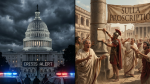
Something deeply unsettling is happening in America. You can feel it in the air, a tension that goes beyond normal politics. Just this week, the President of the United States invoked the Insurrection Act, sending 500 National Guard troops to Illinois. The stated reason? To combat “left-wing domestic terrorism” and “antifa.”
But a federal judge immediately blocked the deployment, stating there was “no substantial evidence that a danger of rebellion is brewing.” The judge even cited the Federalist Papers, the very foundation of our Republic, arguing that “resort to the military to execute the laws is not called for.”
This isn’t just a news headline. This is a Rubicon moment. For the first time in modern American history, the military is being positioned not against a foreign enemy, but against its own citizens. It’s a move that echoes a dark and almost forgotten moment in history, a moment that led to the death of a Republic and the birth of an Empire.
The Time Portal
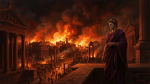
Let’s travel back in time, to 88 BCE. Rome is the undisputed superpower of the world, a Republic that has stood for over 400 years. But beneath the surface, the city is a powder keg of political rivalries and social unrest.
Lucius Cornelius Sulla, a brilliant and ambitious general, has just been given the most coveted prize in the Republic: command of the war against Mithridates in the East. It’s a campaign that promises unimaginable wealth and glory. But his rival, the aging but still powerful Gaius Marius, wants the command for himself.
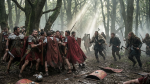
Through political maneuvering, Marius has the command stripped from Sulla and given to him. When Sulla hears the news, he is at Nola, not far from Rome, at the head of six legions of battle-hardened veterans. These soldiers are loyal not to the Senate, not to the Republic, but to Sulla himself. He is their patron, their source of pay and plunder.
Sulla tells his men that Marius will raise a new army, and they will lose their chance at Eastern riches. The soldiers, mostly landless and desperate, agree to do the unthinkable. They will march on Rome.
The Parallel Revelation
This had never happened before. For centuries, a sacred and inviolable law had protected Rome. No general was ever to cross the pomerium, the city’s sacred boundary, with an army. The military was for external enemies, never for use against fellow Romans. The taboo was so strong that nearly all of Sulla’s officers deserted him in horror. Only one, his quaestor Lucullus, remained.
But Sulla, driven by ambition and a sense of personal grievance, did not care. When envoys from the Senate met him on the Appian Way and asked why he was marching on his own city, he gave a chillingly familiar answer: “I am defending the city from tyrants.”
He was not saving the Republic. He was seizing power. He broke the sacred tradition, marched his private army into Rome, and declared his political opponents “enemies of the state.” The precedent was set. The Rubicon had been crossed, not by Caesar, but 40 years earlier by Sulla. The Republic would never recover.
The Pattern Recognition
Why does this pattern repeat? Why do great powers, at the height of their influence, suddenly turn their military might inward?
It happens when a leader convinces a segment of the population, and more importantly, the military, that their fellow citizens are the true enemy. The language changes from political disagreement to existential threat. Opponents are no longer just wrong; they are “tyrants,” “terrorists,” and “enemies of the state.”
Once that line is crossed, the institutions that were meant to protect the people become weapons to control them. The loyalty of the army shifts from the state to a single man. The sacred trust that a nation’s defenders will not be used against its own people is shattered.
We are seeing the echoes of this today. A federal judge warns that “the civil power has not failed,” yet the call to use military force against citizens grows louder. The language of war is being used to describe domestic problems. This is the same path that led Rome to its downfall.
The Ancient Warning
What happened after Sulla’s march? Chaos and bloodshed. Marius returned and unleashed a reign of terror. Sulla came back and did the same, posting “proscription lists” in the Forum, marking hundreds of Romans for death on sight. Murder squads roamed the streets.
Sulla’s march was the beginning of the end for the Roman Republic. It set in motion a century of civil wars that would only end when a single emperor, Augustus, finally consolidated all power. The Republic, with its checks and balances, its traditions, and its freedoms, was dead.
History’s warning is clear: when a nation’s army is turned against its own people, the end of the Republic is near. The very fabric of society unravels. Trust is destroyed. And the only thing that follows is tyranny and civil war.
Are You Prepared for What Comes Next?
When institutions begin to crumble, the first and most critical system to fail is always the food supply chain. History has proven this time and time again. The chaos that followed Sulla’s march led to widespread famine and instability.
That’s why over 500,000 self-reliant Americans have already secured their family’s food independence with the 4ft Farm Blueprint. This revolutionary system, developed by a veteran farmer, shows you how to grow a virtually unlimited supply of fresh, healthy food in just 4 square feet of space—on a patio, in a backyard, or even indoors.
You don’t need a green thumb. You don’t need a large plot of land. All you need is the desire to protect your family from the inevitable supply chain breakdowns that follow when a nation turns on itself.
Don’t wait until the grocery store shelves are empty. Click here to get your 4ft Farm Blueprint today and declare your independence from a fragile system.
5 Things You Can Do This Week to Prepare
History is not a spectator sport. The patterns of the past offer practical lessons for the present. Here are five concrete steps you can take this week to increase your family’s resilience and self-reliance.
- Build Your Own Food Supply. Don’t depend on a fragile, just-in-time delivery system. Learn how to grow your own food, even in a small space. The 4ft Farm Blueprint is the best place to start, giving you a step-by-step guide to food independence.
- Secure Your Health. When systems break down, access to medicine and healthcare becomes uncertain. Learn about natural remedies and holistic health practices that can keep your family healthy without relying on the pharmaceutical industry. Freedom Health Daily is an excellent resource for this.
- Learn Essential Skills. True self-reliance is about what you can do, not just what you have. Explore homesteading skills that can help you thrive in any environment. Homesteader Depot offers a wealth of knowledge on everything from preserving food to off-grid energy.
- Strengthen Your Community. In times of crisis, your neighbors are your most valuable allies. Get to know the people around you. Build local networks for mutual support and trade. A strong community is the best defense against systemic collapse.
- Stay Informed, Not Indoctrinated. Seek out information from a variety of sources. Understand the historical patterns that are playing out in the news. The Self-Reliance Report provides news and analysis focused on helping you understand the world and prepare for what’s next.
References
[1] Wasson, Donald L. “Sulla’s March on Rome.” World History Encyclopedia. Last modified January 16, 2023. https://www.worldhistory.org/article/2146/sullas-march-on-rome/.
[2] “March on Rome (88 BC).” Wikipedia. Accessed October 12, 2025. https://en.wikipedia.org/wiki/March_on_Rome_(88_BC).
[3] Levick, B.M. “Sulla’s March on Rome in 88 B.C.” Historia: Zeitschrift für Alte Geschichte 31, no. 4 (1982): 503–8. http://www.jstor.org/stable/4435825.
[4] “Court: National Guard Troops Sent to Illinois by Trump Can Stay but Can’t Be Deployed for Now.” U.S. News & World Report. Last modified October 11, 2025. https://www.usnews.com/news/us/articles/2025-10-11/court-national-guard-troops-sent-to-illinois-by-trump-can-stay-but-cant-be-deployed-for-now.