**Opening Hook**
In the labyrinth of today’s financial markets, a ghostly specter haunts the corridors of Wall Street — a trade war. Tariffs rise like a fortress, bordering nations, yet isolating economies. It’s a puzzling mystery. We live in the age of globalization, a time when the world is connected more than ever. So why do we see the resurgence of economic protectionism? As we grapple with this enigmatic issue, history cries out with a whispering echo, a tale of gold, salt, and a mighty empire.
**Time Portal**
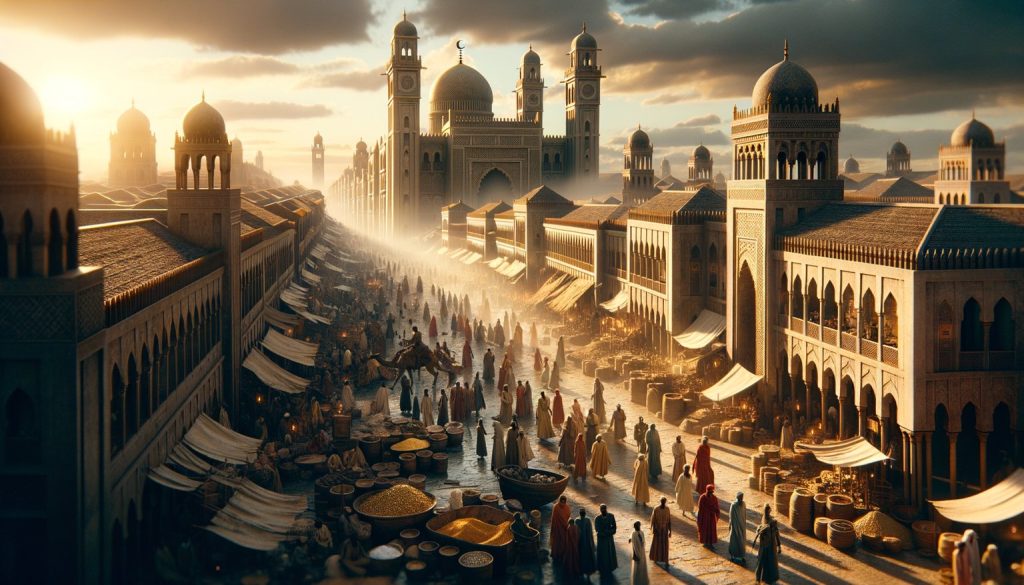
Wind back the clock to the 15th century, far from Wall Street, to the bustling marketplace of the Songhai Empire in West Africa. The empire is a powerhouse, built on trade, and the air vibrates with the afternoon heat as traders haggle over prices. Gold dust from the South exchanged for salt from the North, a trade as old as the empire itself. The Songhai Empire is a beacon of prosperity, largely due to its open trade policies.
Yet amidst this marketplace, one can detect a hint of tension. The empire, at its zenith, struggles to maintain its economic dominance. The ruler, the proud Askia the Great, sensing a threat to his kingdom’s wealth, imposes a trade embargo. The open marketplace, once the heart of the empire, shrinks like a dying star.
**Parallel Revelation**
Jump back to today. The parallels are startling. As the Songhai Empire did centuries ago, we are halting the flow of goods, hindering the lifeblood of our economies. The trade war, just like the Songhai trade embargo, stems from a fear — fear of losing economic dominance.
In Songhai, it was gold and salt; today it’s technology and manufacturing. Askia imposed restrictions on trade to protect his economy. Today, we see tariffs being imposed by nations to protect their industries. The Songhai Empire and our modern world, centuries apart, are eerily similar in their responses to economic threats.
**Pattern Recognition**
This pattern is not random; it’s a cycle as old as civilization itself. When economies feel threatened, they resort to protectionism. The Songhai Empire did it. We’re doing it now. It’s a knee-jerk reaction to safeguard our interests. But why?
Because it’s easier. It’s easier to erect walls, to close off, than to adapt. The Songhai Empire could have innovated, diversified its economy, but it chose the simpler route — an embargo. We are repeating history, choosing tariffs over adaptation.
**Ancient Warning**
What happened to the Songhai Empire? The embargo led to economic isolation. Trade dwindled, and with it, prosperity. The empire, once magnificent, crumbled into oblivion. It’s a cautionary tale that resonates in our time. Protectionism, while presenting a temporary solution, can lead to long-term decline.
**5 Action Steps**
1. **Educate Yourself:** Knowledge is power. Understand the implications of trade wars on your personal finances. Self Reliance Report offers resources to enhance your understanding and prepare for potential economic changes.
2. **Invest Wisely:** Diversify your investment portfolio. Consider buying commodities such as gold, which has historically proven to be a safe haven in times of economic turmoil.
3. **Become Self-Sufficient:** Create a self-reliant lifestyle. The 4ft Farm Blueprint provides a comprehensive guide on how to grow your own food and reduce dependency on the market.
4. **Strengthen Your Survival Skills:** In the event of an economic crisis, being prepared can make all the difference. Survival Stronghold offers tips and resources on survival strategies and emergency preparedness.
5. **Maintain Healthy Living:** A strong mind and body are your best weapons. Seven Holistics provides natural remedies for stress and anxiety, empowering you to tackle any challenge.
Remember, our actions determine the course of history. The Songhai tale is not destined to be our fate. By learning from the past, we can navigate the present and usher in a future of prosperity. By taking these steps, we can fortify our lives against any economic upheaval, and more importantly, ensure the continuation of economic progress for the generations to come.