ADVERTORIAL
The year is 2025. The U.S. Supreme Court is grappling with a constitutional crisis that strikes at the very heart of American liberty: can a President unilaterally impose taxes on the American people without the consent of their elected representatives in Congress? The case, Trump v. V.O.S., revolves around the use of emergency powers to levy tariffs, a move legal scholars are calling the most significant separation-of-powers battle in half a century. The core question is as old as the nation itself: who holds the power to tax?
But to truly understand the gravity of this moment, we must travel back in time—not to 1776, but further, to the sun-scorched sands of ancient Egypt, 2,221 years ago. There, in 196 BCE, a young pharaoh, a boy king, faced a crisis of legitimacy so profound it threatened to tear his kingdom apart. His story, etched into a slab of black granodiorite that would one day be known as the Rosetta Stone, serves as a chilling and timeless warning about the perils of executive overreach and the eternal cry for no taxation without representation.
The Boy King and the Great Revolt
Ptolemy V Epiphanes ascended to the throne of Egypt in 205 BCE, a mere child of five. By the time he was a teenager, his kingdom was in flames. A massive rebellion, known to history as “The Great Revolt of the Egyptians” (205-186 BCE), had erupted across the land. Native Egyptians, weary of foreign Greek rule under the Ptolemaic dynasty, rose up, with rebels controlling vast swaths of Upper Egypt for nearly two decades.
What fueled this fire? While the causes were complex, a central grievance was the oppressive and illegitimate system of taxation imposed by the Ptolemaic rulers. The Greek pharaohs, viewing Egypt as their personal estate, had established a complex bureaucracy to extract maximum revenue from the populace. Taxes were levied on a vast array of economic activities, collected by a system of tax farming notorious for its corruption and abuse. Crucially, this was done by royal decree, bypassing the traditional Egyptian priestly councils who had for centuries played a role in sanctioning such measures.
To the Egyptian people, this was not just an economic burden; it was a violation of the sacred order. A foreign king was taxing them without the consent of their traditional institutions. It was, in essence, taxation without representation.
The Rosetta Stone: Not a Key to Language, But a Concession to Power
The crisis came to a head in 196 BCE. After a brutal siege, Ptolemy V’s forces recaptured the rebel-held city of Lycopolis. The rebel leaders were brought to the capital of Memphis and, in a gruesome public display, executed on the very day of the young king’s coronation festival. But victory in battle was not enough to secure the peace. To legitimize his rule and quell the simmering unrest, the 13-year-old Ptolemy V needed to win back the hearts and minds of his people, particularly the powerful and influential priestly class.
The result was the Memphis Decree, a proclamation issued by a synod of priests and inscribed in three languages—Hieroglyphic, Demotic, and Greek—on a stone stele. We know it today as the Rosetta Stone. While celebrated for its role in deciphering ancient hieroglyphs, its original purpose was far more pragmatic: it was a piece of political propaganda, a list of concessions from a beleaguered king desperate to restore order.
What did the decree promise? As the text reveals, it was a litany of economic relief measures:
The decree…explicitly mentions the royal decision to reduce or entirely abolish specific “dues and taxes existing in Egypt,” framing these measures as deliberate attempts to cultivate “happiness” and contentment…Furthermore, the inscription details the relaxation of the financial burdens imposed upon temple lands and their associated revenues, the significant cancellation of outstanding debts owed to the royal treasury, and the just restoration of properties that had been previously confiscated by the state.
By forgiving debts and reducing the tax burden, especially for the powerful temples, Ptolemy V was acknowledging the central role that taxation had played in the rebellion. He was, in effect, admitting that a ruler cannot govern effectively when the people perceive his taxes as illegitimate.
A Timeless Parallel: From the Nile to the Potomac
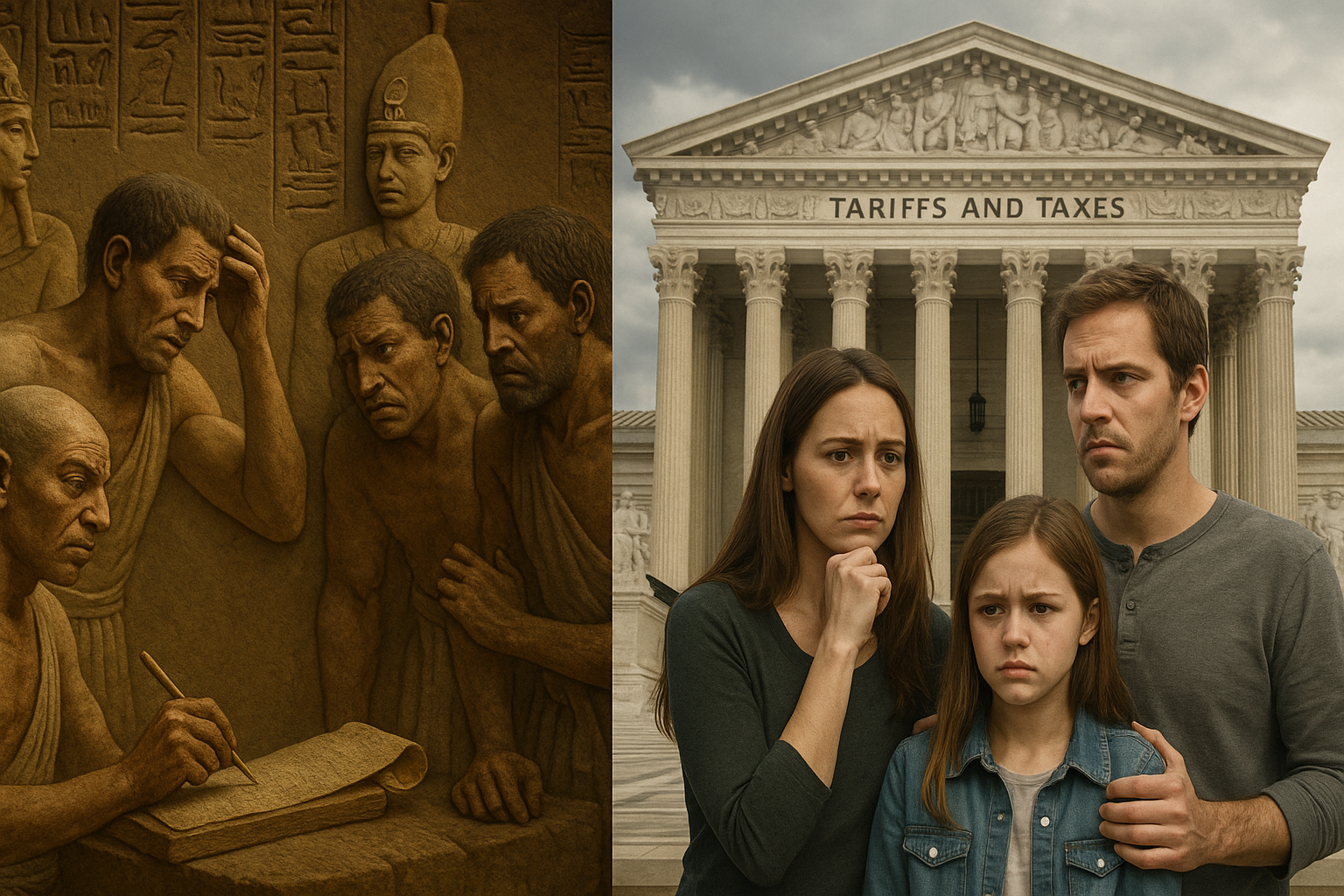
The struggle between executive power and the consent of the governed over taxation is not a relic of the ancient world. It is a recurring pattern in human history, and the parallels between Ptolemy V’s crisis and the current constitutional questions facing the United States are stark and undeniable.
| Feature | Ptolemy V Epiphanes (196 BCE) | Modern America (2025) |
|---|---|---|
| The Claim | A divine right to tax by royal decree, bypassing traditional councils. | A claim to impose tariffs (taxes) by invoking emergency powers (IEEPA). |
| The Conflict | A 20-year rebellion (“The Great Revolt”) fueled by illegitimate taxation. | A Supreme Court case (Trump v. V.O.S.) challenging the constitutionality of executive tariffs. |
| The Principle | A foreign king taxing native Egyptians without their consent. | A President taxing American citizens without the explicit consent of Congress. |
| The Justification | The inherent authority of a god-king to rule his domain. | National security and economic emergency. |
| The Consequence | Near-collapse of the kingdom, forcing the king to make major tax concessions. | A constitutional crisis that threatens the separation of powers defined in Article I, Section 8. |
This 2,200-year-old story reveals a fundamental truth: when rulers, whether ancient pharaohs or modern presidents, attempt to seize the power of the purse without the consent of a representative body, it inevitably leads to crisis. The principle of “no taxation without representation” is not just an American slogan; it is a universal prerequisite for stable and legitimate governance.
When You Can’t Trust the System, Trust Yourself
The parallels between ancient Egypt and modern America are a sobering reminder that the stability we take for granted can be fragile. When governments overreach and institutions are tested, the most fundamental aspects of our lives—our financial security, our access to goods, and even our food supply—can be thrown into uncertainty.
This is why true self-reliance has never been more critical. While politicians and judges debate the limits of power in Washington D.C., you have the power to secure your family’s future today. The ability to provide for yourself, independent of fragile supply chains and the whims of political power, is the ultimate form of freedom.
This is the principle behind the 4ft Farm Blueprint. It’s a revolutionary system that allows you to achieve complete food independence with a simple 4×4 foot garden. Developed for patriots who see the writing on the wall, this blueprint is your defense against food shortages, price hikes, and the uncertainty of a system that is increasingly failing to protect the average American.
Over 500,000 success stories prove that you don’t need a sprawling farm to feed your family. You just need a plan. When you can no longer trust the government to act in your best interest, it’s time to take back control. Click here to learn how the 4ft Farm Blueprint can secure your family’s food supply and declare your independence from a broken system.
The Enduring Warning
The Rosetta Stone is more than just an archaeological treasure; it is a political document of immense relevance. It stands as a testament to the fact that the power to tax is the power to destroy, and that no ruler can wield it for long without the consent of the governed. The twenty-year struggle of the ancient Egyptians against their Ptolemaic overlords was not just a fight over money, but a fight for legitimacy and representation.
As the Supreme Court deliberates on the extent of presidential power, they would do well to consider the lesson of the boy king of Egypt. The American Revolution was fought on this very principle. The idea that a single executive can impose financial burdens on the populace at will is antithetical to the foundations of a free republic. The warning from 2,200 years ago is clear: such power, once seized, is rarely relinquished without a fight, and it is the people who ultimately pay the price.
References
[1] McConnell, M. W. (2025, October 13). Professor Michael McConnell Breaks Down the Separation of Powers Fight at the Heart of the Trump Tariffs Case. Stanford Law School. https://law.stanford.edu/2025/10/13/professor-michael-mcconnell-breaks-down-the-separation-of-powers-fight-at-the-heart-of-the-trump-tariffs-case/
[2] The Great Revolt of the Egyptians (205–186 BC). (n.d.). University of California, Berkeley. https://www.lib.berkeley.edu/sites/default/files/files/TheGreatRevoltoftheEgyptians.pdf
[3] Tax Project Team. (2025, May 8). The Rosetta Stone: Lessons in Tax Policy. Tax Project Institute. https://taxproject.org/the-rosetta-stone-lessons-in-tax-policy/