The Modern Mystery
There’s a strange quiet in Washington D.C. this week. It’s not the quiet of peace, but the unnerving silence of a machine grinding to a halt. The U.S. government is seventeen days into a shutdown, the third-longest in its history, and the gears of the state are seizing up one by one.
The Supreme Court is about to lock its doors to the public. The Army Corps of Engineers has frozen over $11 billion in projects. And in the most chilling development, the National Nuclear Security Administration—the agency that safeguards America’s nuclear weapons—is furloughing 80% of its workforce. “These are not employees that you want to go home,” warned a visibly alarmed Congressman Mike Rogers. The guardians of the apocalypse have been sent home, unpaid, because the politicians can’t agree on a budget.
It feels unprecedented, a uniquely American brand of dysfunction. But it’s not. Almost 1,400 years ago, another world power, a mighty empire that stretched from the sands of Arabia to the mountains of Afghanistan, found itself in a terrifyingly similar position. It was a giant, powerful and feared, yet it was rotting from the inside out. And when the final crisis came, its strength meant nothing. This is the story of the Sassanid Persian Empire, and it’s a warning we cannot afford to ignore.
The Time Portal
Picture Persia in the year 628 AD. The Sassanid Empire is a colossus, the rival of Byzantium, a civilization of stunning art, advanced science, and immense military might. Its capital, Ctesiphon, is a sprawling metropolis of palaces and gardens on the banks of the Tigris River. For four hundred years, this empire has been a beacon of power and culture.
But a sickness has taken hold. A brutal, twenty-six-year war with the Byzantine Empire has just ended, leaving both sides exhausted and broke. The Sassanid King, Khosrow II, a man of once-great ambition, has been overthrown and executed by his own son, Kavad II. To secure his throne, Kavad, whose birth name is Sheroe, commits an unspeakable act: he murders nearly all his brothers and half-brothers, wiping out a generation of potential rulers.
As if this political bloodshed wasn’t enough, a real plague, a literal pestilence, begins to sweep through the western provinces. Known to history as the “Plague of Sheroe,” it kills over 100,000 in the capital alone. The plague doesn’t care about politics or power; it consumes everyone, from the lowest peasant to the highest noble. And then, in a stroke of grim irony, it claims its namesake. King Kavad II, the man who killed his own family to seize power, dies of the disease just months into his reign.
The Parallel Revelation
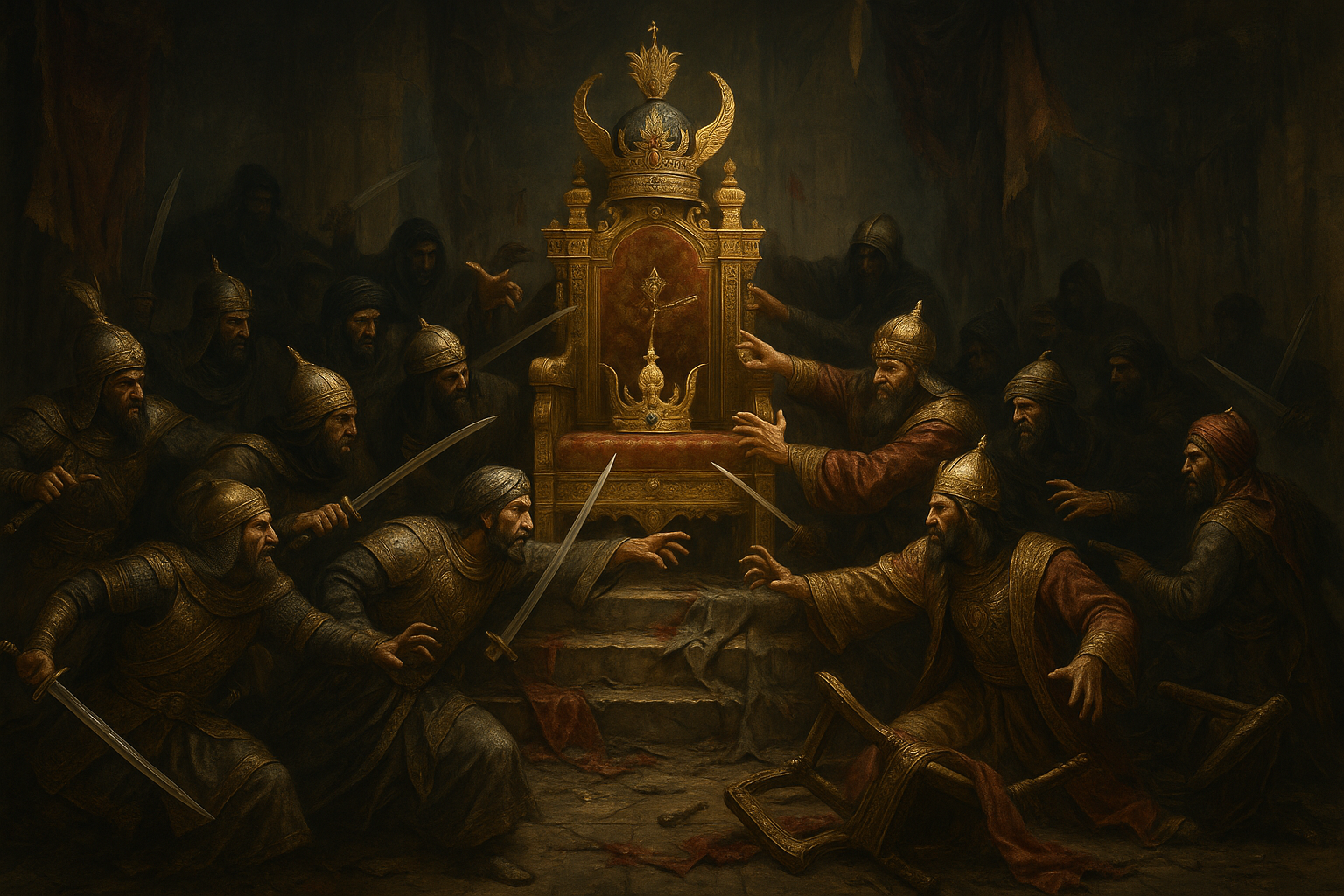
Chaos erupts. In the four years that follow Kavad’s death, ten different claimants scramble for the throne. The central government, once the unshakeable bedrock of the empire, dissolves into a bloody free-for-all. Warlords, nobles, and generals carve out their own fiefdoms. The bureaucracy that ran the empire, that collected taxes and maintained the armies, simply breaks down. The empire is paralyzed by internal conflict, its treasury empty, its leadership in turmoil. It is, as one historian wrote, “a shadow of its former self.”
Does this sound familiar? A government paralyzed by infighting. A nation exhausted by foreign wars and internal division. A treasury stretched to its breaking point. A critical breakdown in the basic functions of the state. The Sassanid civil war of 628-632 AD is a dark mirror to the partisan gridlock of 21st-century America. The ten claimants to the Persian throne are not so different from the factions in Washington, each willing to tear the country apart for a taste of power.
And just as the Sassanids faced a plague that decimated their population, we are still reeling from a global pandemic that exposed the fragility of our own systems. While our politicians bicker, the real threats gather. For the Sassanids, the threat came from the south. A new, unified force, fired by religious zeal and brilliant military leadership, was rising in the Arabian Peninsula. They saw an empire in chaos, its garrisons weakened by plague and neglect, its leadership distracted by petty squabbles. They saw an opportunity.
The Pattern Recognition
This is a pattern that repeats throughout history. A great power, seemingly invincible, becomes so consumed by its internal conflicts that it fails to see the real danger until it’s too late. The administrative breakdown is the key. It’s not the enemy at the gates that brings down an empire; it’s the rot within. It’s the failure to perform the basic functions of government: to pay the soldiers, to maintain the infrastructure, to protect the people.
When Congressman Rogers says of the nuclear security staff, “These are not employees that you want to go home,” he is echoing the fatal weakness of the Sassanids. The Persian Empire had a massive, battle-hardened army. But what good is an army if the government can’t pay it? What good are border forts if the garrisons have been wiped out by plague and their replacements never arrive because the bureaucracy has collapsed? The Sassanids had the strength to fight, but they had lost the ability to govern.
We are witnessing a similar failure today. The United States possesses the most powerful military in human history. But that military runs on the mundane machinery of government. It runs on budgets, on supply chains, on the quiet, essential work of thousands of civil servants. When we furlough the people who safeguard our nuclear arsenal, we are not just playing political games. We are willingly creating a vulnerability at the heart of our national security. We are telling the world that our internal squabbles are more important than our own survival.
The Ancient Warning
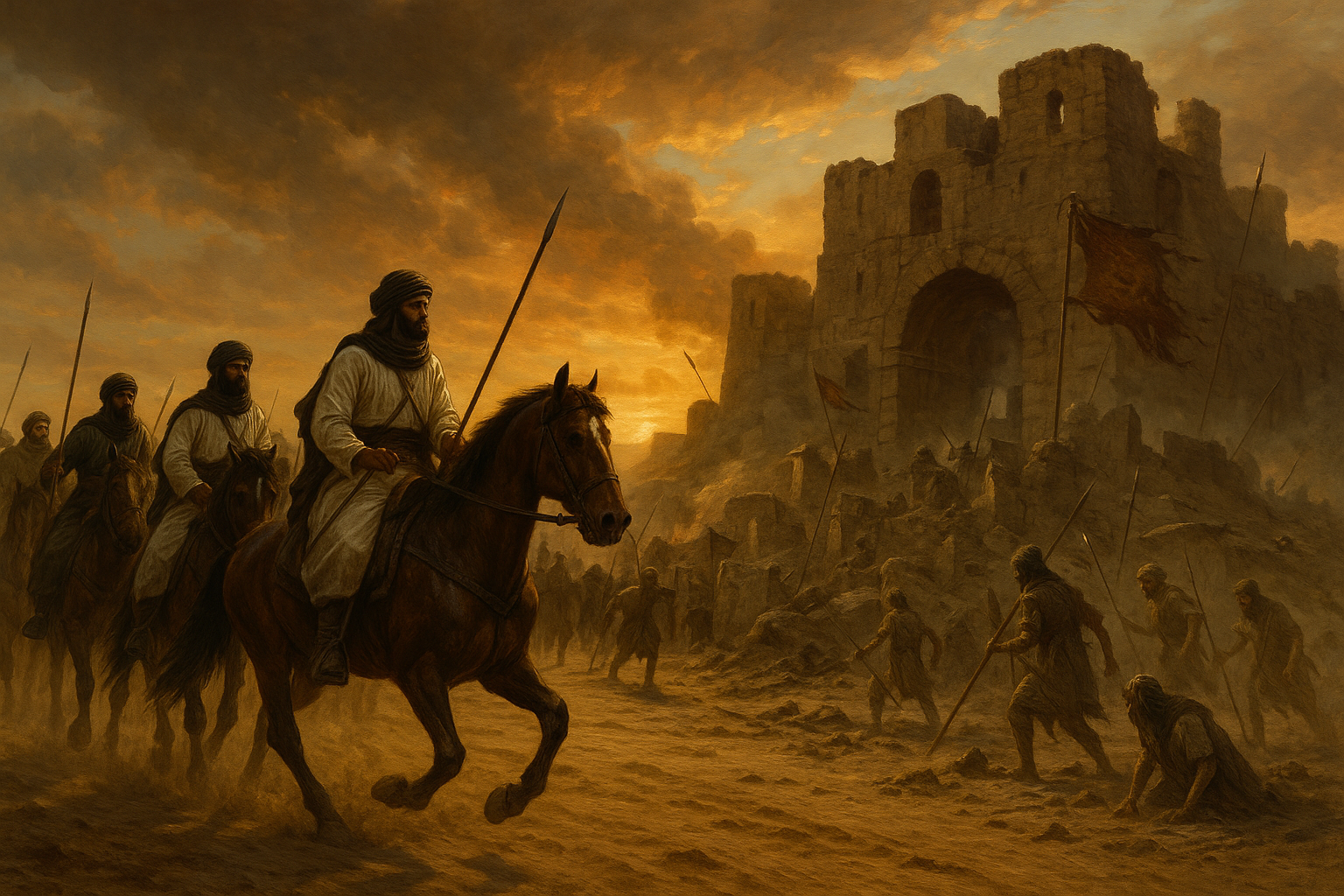
In 632 AD, the Arab armies of the Rashidun Caliphate poured across the border into Sassanid Mesopotamia. They faced an empire that was, on paper, still a superpower. But they found a hollow shell. The Persian armies, though brave, were disorganized and poorly supplied. The local population, ravaged by plague and disillusioned by the endless civil war, offered little resistance. In just over two decades, the mighty Sassanid Empire, a four-hundred-year-old dynasty, was completely conquered. The last king, Yazdegerd III, fled as a fugitive and was eventually murdered, a pathetic end to a once-glorious line.
The empire didn’t fall because it was weak. It fell because it was distracted. It died of neglect. It committed suicide by a thousand internal cuts. The warning from 1,400 years ago is crystal clear: when a nation’s leaders become so consumed with their own power struggles that they neglect the fundamental duties of the state, they invite disaster. The world is full of rising powers and opportunistic rivals who are watching our dysfunction with keen interest. They see a nation that can’t even keep its own government open, and they are drawing their own conclusions.
5 Things You Can Do This Week
History is not just a story; it’s a lesson. The collapse of the Sassanid Empire shows us what happens when administrative competence fails. While we can’t stop the political games in Washington, we can take steps to make our own families and communities more resilient. Here are five things you can do this week, inspired by the lessons of the past:
1. Build Your Own Granary. The Sassanids’ agricultural heartland was devastated by plague and war, leading to famine. Don’t depend on fragile supply chains. Learn how to grow your own food, even in a small space. The [4ft Farm Blueprint](https://4ftfarmblueprint.com/) offers an incredible system for producing a surprising amount of food in a tiny footprint. It’s not just a garden; it’s a strategic reserve of self-reliance.
2. Secure Your Castle. When the central government collapsed, local security became paramount. How secure is your home? This week, read up on practical home defense strategies. Our friends at [Survival Stronghold](https://survivalstronghold.com) have an excellent article on creating a layered defense system for your property. It’s about being prepared, not paranoid.
3. Master a Real-World Skill. The Sassanid bureaucracy was full of people with specialized but ultimately useless skills in a crisis. This week, learn a practical skill that doesn’t depend on a functioning government. Check out the articles on [Self-Reliance Report](https://selfreliancereport.com) for ideas, from basic first aid to off-grid water purification.
4. Know Your Neighbors. In the chaos of the Sassanid collapse, local communities were the only safety net. Do you know your neighbors? This week, make an effort to connect with the people on your street. A strong community is a powerful defense against any crisis. [Homesteader Depot](https://homesteaderdepot.com) has some great articles on building community and mutual aid networks.
5. Invest in Your Health. The Plague of Sheroe was the final blow to a weakened empire. Our own health is our most important asset. Are you prepared for a situation where hospitals are overwhelmed or inaccessible? Explore natural and holistic health strategies. [Freedom Health Daily](https://freedomhealthdaily.com) and [Seven Holistics](https://sevenholistics.com) offer a wealth of information on building a resilient immune system and taking control of your own well-being.
—
Sponsor:
In times of uncertainty, the most valuable asset is the ability to provide for yourself and your family. The [4ft Farm Blueprint](https://4ftfarmblueprint.com/) is more than just a gardening plan; it’s a complete system for food independence. Designed by master gardeners and survival experts, it teaches you how to turn a 4×4 foot space into a high-yield, organic food-producing powerhouse. Don’t wait for the supply chains to break. Secure your family’s future today. [Click here to learn more about the 4ft Farm Blueprint.](https://4ftfarmblueprint.com/)
—
References:
1. “Plague of Sheroe.” Wikipedia. Accessed October 18, 2025. https://en.wikipedia.org/wiki/Plague_of_Sheroe
2. “Fall of the Sassanid Empire: The Arab Conquest of Persia 633-654 CE.” The Collector. Accessed October 18, 2025. https://www.thecollector.com/fall-of-the-sassanid-empire-arab-conquest-persia/
3. “Sasanian civil war of 628–632.” Wikipedia. Accessed October 18, 2025. https://en.wikipedia.org/wiki/Sasanian_civil_war_of_628%E2%80%93632
4. Hashemi Shahraki, A., Carniel, E., & Mostafavi, E. (2016). “Plague in Iran: its history and current status.” Epidemiology and Health, 38, e2016033. https://www.ncbi.nlm.nih.gov/pmc/articles/PMC5037359/
5. Daryaee, T., & Rezakhani, K. (2017). “The Sasanian Empire.” In T. Daryaee (Ed.), King of the Seven Climes: A History of the Ancient Iranian World (3000 BCE – 651 CE). UCI Jordan Center for Persian Studies.