It’s a headline that feels impossible in modern America. This Saturday, 42 million Americans will wake up to find their food aid has vanished. The Supplemental Nutrition Assistance Program (SNAP), a lifeline for one in eight citizens, is set to run dry. There is no last-minute deal, no emergency funding. Just… silence.
For weeks, families have watched the political gridlock in Washington with a knot in their stomachs. Now, the unthinkable is here. How does this happen?
How does the wealthiest nation on Earth allow its own people to face empty cupboards and the real, gnawing fear of hunger? It feels like a glitch in the matrix, a shocking failure of a system we all assumed was too big to fail. But what if it’s not a glitch? What if it’s a pattern, a ghost from the past that has come back to haunt us?
The Time Portal
Let’s travel back in time, 4,300 years, to a place that was, in its day, the center of the world. The Akkadian Empire. The world’s first empire, a sprawling kingdom of stunning cities, advanced art, and a bureaucracy so sophisticated it would make a modern bean-counter weep with envy.
Imagine you are Ur-Nanshe, a scribe in the capital city of Akkad. Your life is one of order and predictability. Every day, you record the endless flow of grain into the royal granaries – vast, sun-baked structures that hold the lifeblood of the empire. From here, the grain is distributed to every corner of the kingdom, a testament to the genius of Sargon the Great, the empire’s founder.
You feel a sense of pride in this system. It is a marvel of human ingenuity, a guarantee of stability in a harsh and unforgiving world. The granaries are full. The people are fed. The empire is eternal.
The Parallel Revelation
But then, something changes. The rains, once as reliable as the sunrise, become a distant memory. The rivers, the twin arteries of your civilization, shrink to sluggish, muddy streams. A mega-drought, a climate catastrophe of epic proportions, has begun. At first, there is no panic. The granaries are full, a buffer against hard times. The system, you believe, will hold.
But the drought grinds on, year after year. The once-mighty administrative machine of Akkad begins to sputter. Officials in distant provinces, desperate to feed their own people, hoard grain. The central government, weakened by infighting and denial, can no longer enforce its decrees.
The flow of grain, once the lifeblood of the empire, slows to a trickle, then stops altogether. The granaries, the symbols of Akkadian power and foresight, become hollow monuments to a forgotten abundance. The system, the one you dedicated your life to, has not just bent – it has shattered.
The Pattern Recognition
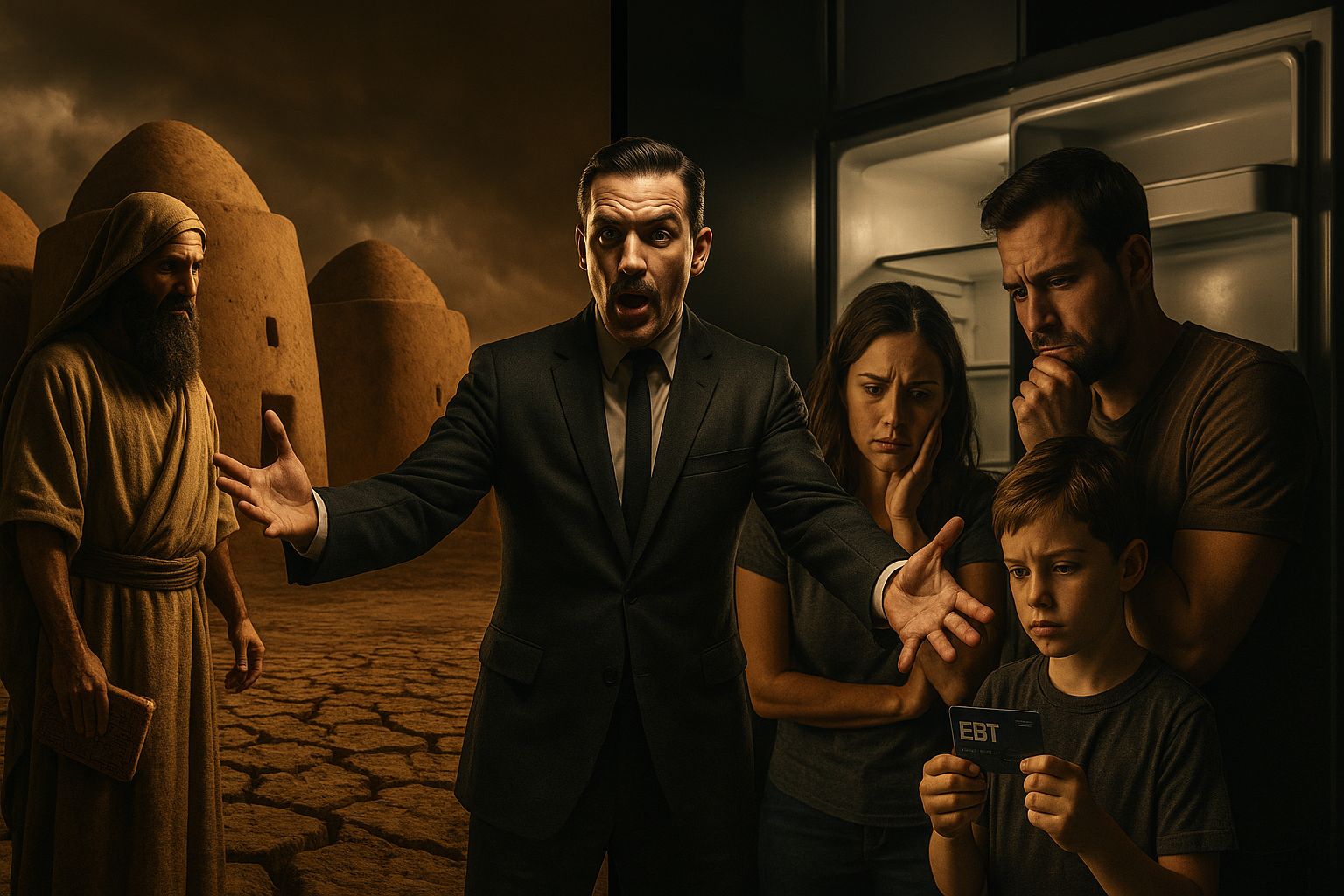
Does this sound familiar? A centralized system, a complex web of distribution, a belief in its own infallibility, and a sudden, catastrophic failure under stress. The Akkadian Empire and modern America are separated by four millennia, but the pattern is identical.
We, too, have built a complex, centralized food system, a marvel of modern logistics. And we, too, have become utterly dependent on it.
We don’t have royal granaries, but we have digital accounts and EBT cards. We don’t have scribes, but we have government agencies and political bodies. And just like the Akkadians, we are discovering that our system, for all its sophistication, is terrifyingly fragile. It is vulnerable not just to climate change, but to political dysfunction, economic shocks, and the simple, timeless human failings of greed and incompetence.
The Ancient Warning
What happened to the Akkadians? They starved. Their cities were abandoned, their civilization crumbled, and their empire, the first in human history, vanished from the face of the earth. It took centuries for the region to recover.
The collapse of their food system was not a temporary crisis; it was the end of their world. This is the ancient warning, the ghost at our feast. When a society can no longer feed its people, it is not just an emergency. It is an existential threat.
5 Things You Can Do This Week
History is not a prophecy, but it is a teacher. The story of the Akkadian Empire is a wake-up call. Here are five things you can do this week to prepare for a future that may be more uncertain than we ever imagined:
- Build a Food Reserve: Don’t wait for the shelves to go empty. Start building a reserve of non-perishable food that can last your family for at least a month. For tips on what to store and how, check out the in-depth guides at SurvivalStronghold.com.
- Learn a New Skill: In a crisis, practical skills are worth more than gold. Learn how to grow your own food, even in a small space. HomesteaderDepot.com has a wealth of information on urban gardening and self-sufficiency.
- Secure Your Health: A crisis is the worst time to have a health emergency. Take steps to improve your health now. FreedomHealthDaily.com offers practical advice on natural health and wellness.
- Connect with Your Community: In a crisis, your neighbors are your first responders. Get to know the people on your street. Build a network of mutual support. SelfRelianceReport.com has articles on building resilient communities.
- Stay Informed: Don’t rely on the mainstream media for the full story. Seek out independent news sources that are not afraid to tell the truth about the challenges we face. AmericanDownfall.com is a great place to start.
Sponsored by 4ft Farm Blueprint
Worried about the future of food? You should be. But you don’t have to be a victim. The 4ft Farm Blueprint is a revolutionary system that allows you to grow a massive amount of food in a tiny space, with minimal work.
It’s a complete, step-by-step guide to food self-sufficiency, designed for ordinary people who want to take control of their family’s future. Don’t wait for the system to fail you. Build your own system.