A quiet paralysis has gripped the heart of America’s economy. The Federal Reserve, the nation’s financial bedrock, is a house divided against itself. Inside its hallowed halls, the committee members who steer our economic destiny are locked in a bitter, unwinnable debate. With inflation stubbornly sitting at 3%—a full point above the target—and a deteriorating job market, they face an impossible choice: raise interest rates to crush inflation and risk a recession, or cut them to save jobs and risk hyperinflation?
The minutes from their latest meeting reveal a committee in turmoil, with “strongly differing views” and no clear path forward. The only thing they can agree on is that “monetary policy was not on a preset course.” The probability of a much-needed December rate cut has plummeted from a near-certainty to a mere 32% in a single month. The White House is fuming, the markets are holding their breath, and the American people are caught in the crossfire.
It feels unprecedented, a modern crisis for a modern age. But it’s not.
History whispers a chilling warning from 2,431 years ago, from a time when the world’s greatest empire faced the same impossible choice. And the path they chose led to their ruin.
The Time Portal
Picture Athens in 406 BCE. The city is the jewel of the ancient world, the heart of a sprawling maritime empire. But after 27 years of brutal war with its rival, Sparta, the Athenian empire is bleeding. The Peloponnesian War has drained its treasury, thinned its ranks, and frayed its nerves. The city’s fate hangs on its naval supremacy, but it is desperately short on trained sailors to man its fleet.
In a moment of crisis, the Athenian Assembly—the democratic body of all its citizens—is forced to make a terrible decision. To counter a Spartan naval blockade, they need every able-bodied man to row their warships. They make a radical, controversial proposal: offer freedom and citizenship to the thousands of slaves who work the fields and mines, if they will join the fleet for one last, desperate battle.
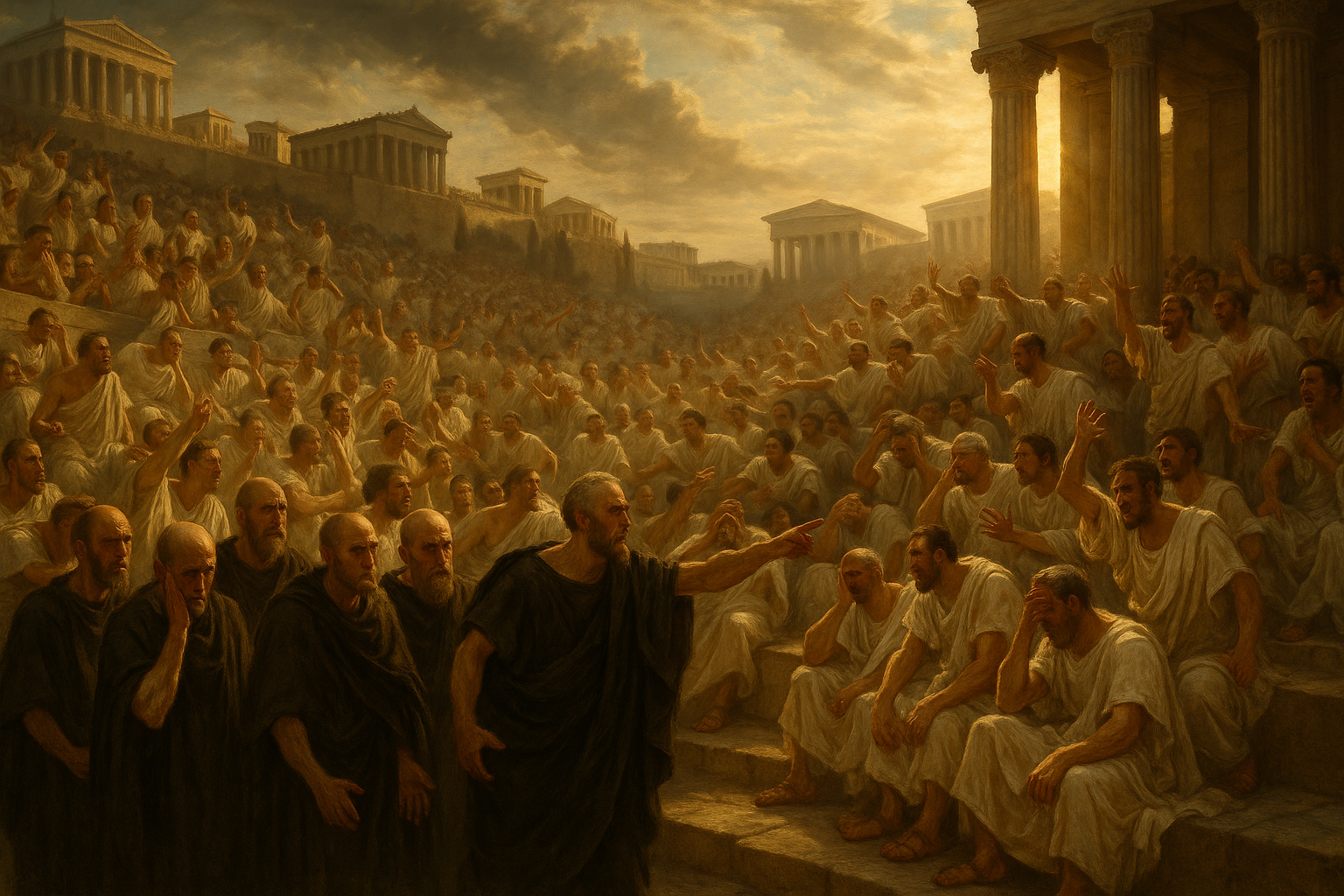
The decision tears the city in two. On one side are the military realists who see it as a necessary evil to save the empire. On the other are the wealthy landowners and aristocrats, who see their property—their very way of life—being stripped away by a tyrannical government. The Assembly is paralyzed by the same conflict that cripples our own Federal Reserve: an impossible choice between two mutually exclusive, yet equally vital, priorities.
The Parallel Revelation
Ultimately, the Assembly chooses military necessity. The slaves are freed, the fleet is manned, and in a stunning turn of events, the Athenians achieve a miraculous victory against the Spartans at the Battle of Arginusae. They have saved the empire, but the cost is about to come due.
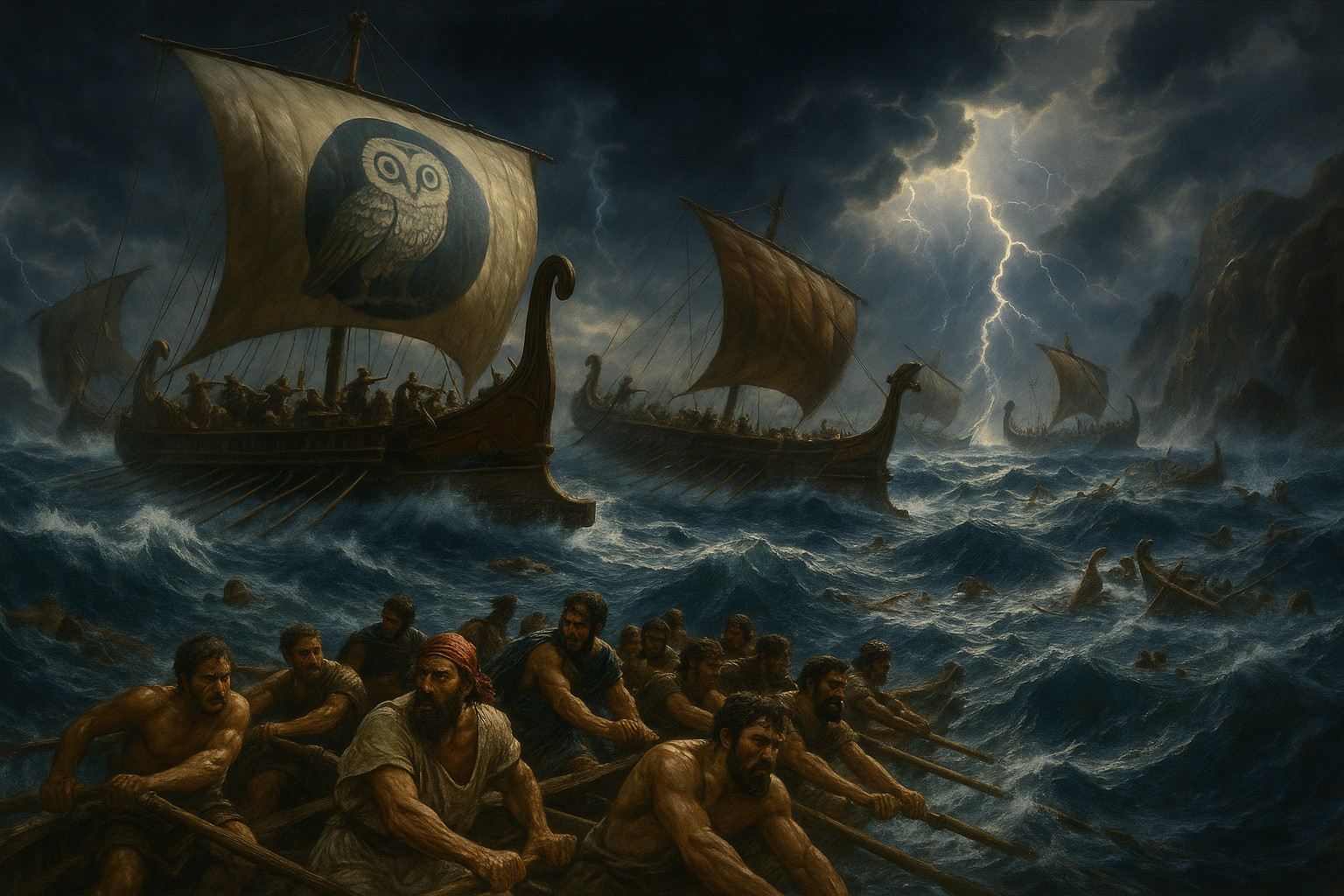
A violent storm descends after the battle, preventing the victorious generals from rescuing the sailors from 25 sunken or disabled ships. When the six victorious generals return to Athens, they are not greeted as heroes. Instead, they are met by a furious mob, led by political rivals and enraged slave owners who have been waiting for their moment of revenge.
The Assembly, the same body that forced the generals into an impossible situation, now turns on them. In a chaotic and unconstitutional trial, fueled by false witnesses and political maneuvering, the six generals are accused of negligence.
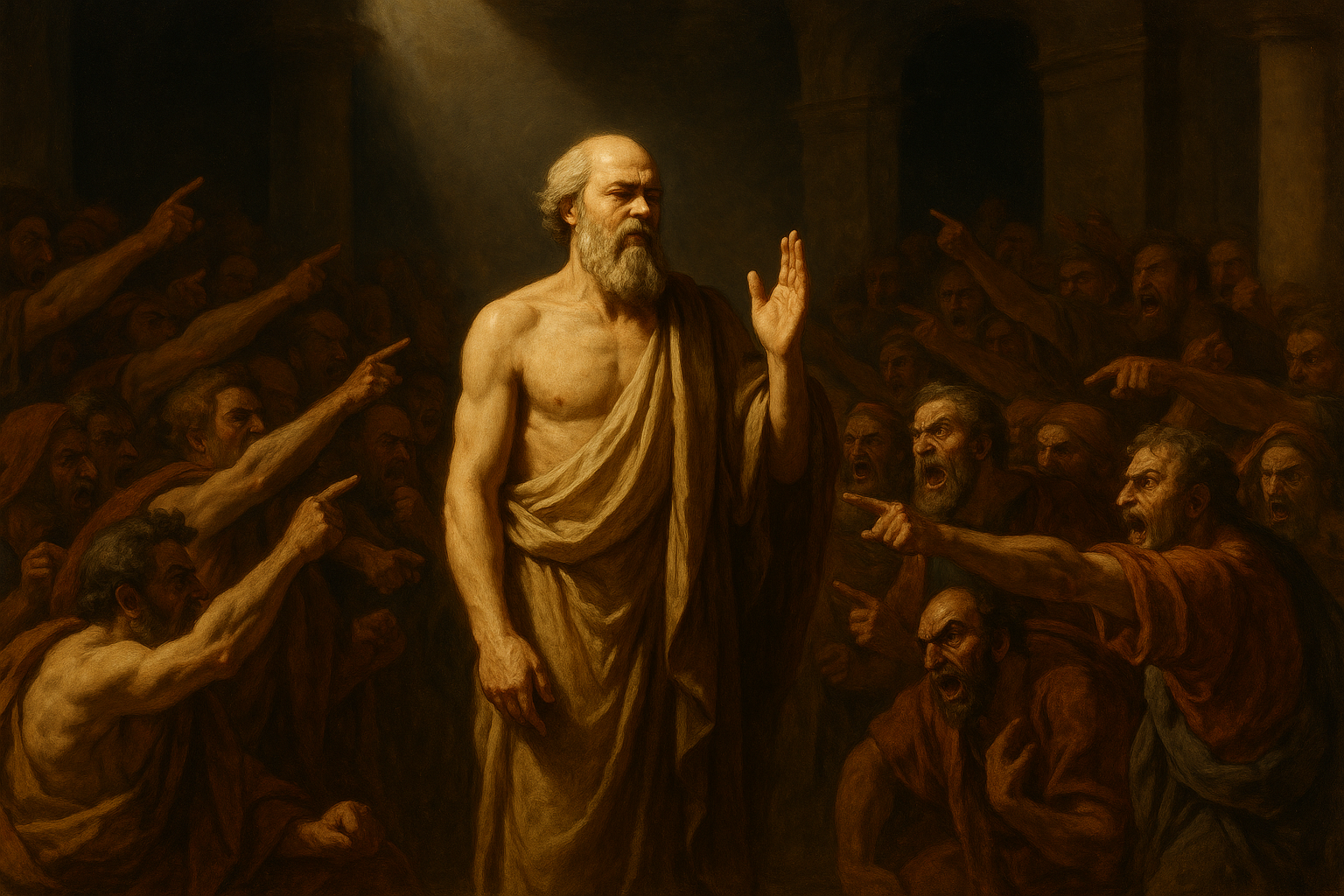
The philosopher Socrates, a member of the council at the time, is one of the few who stands against the madness, refusing to partake in the illegal vote. But his is a lone voice of reason. The Assembly, consumed by its own internal divisions and desperate to find a scapegoat, condemns its own victorious generals to death.
This is the chilling parallel to our own time. A governing body, paralyzed by an impossible choice, makes a decision that angers a powerful segment of the population. Then, when the inevitable, messy consequences arrive, instead of taking responsibility, they turn on the very people they tasked with executing their orders. The Federal Reserve is caught in the same trap. No matter what they do, they will be savaged by one side or the other. If they hold rates steady, the White House will crucify them for the slowing economy. If they cut rates, they will be blamed for the resulting inflation. Like the Athenian generals, they are set up to fail.
The Pattern Recognition
Why does this pattern repeat? Because human nature is constant. In times of extreme pressure, institutions often break down along pre-existing fault lines. The Athenian Assembly was not destroyed by the Spartans, but by its own internal divisions. The desire to avoid blame becomes more powerful than the desire to find a solution. The need for a scapegoat outweighs the need for justice.
We see this today in the finger-pointing between the White House and the Federal Reserve. We see it in the public’s declining trust in our institutions. When leaders are more focused on political survival than on sound policy, the system begins to eat itself. The Athenians, in their moment of crisis, chose to execute their most competent leaders rather than confront the consequences of their own impossible decisions. It was a fatal act of self-sabotage.
The Ancient Warning
What happened next in Athens is the final, stark warning. Within two years of executing their best generals, the Athenian navy was decisively defeated. In 404 BCE, Athens, the once-mighty empire that had dominated the Greek world for a century, surrendered unconditionally to Sparta. Its walls were torn down, its empire was dismantled, and its golden age came to a crashing, ignominious end. They had won the battle, but lost the war because they allowed their internal divisions to consume them.
Today, as the Federal Reserve stands paralyzed, we are witnessing the same ancient drama play out in modern dress. The stakes are just as high. A misstep in either direction could plunge the nation into a deep recession or a devastating inflationary spiral. The lesson from 2,400 years ago is clear: when a nation’s leaders become so divided that they can no longer make rational decisions for the common good, the end is near.
5 Things You Can Do This Week to Prepare
History is not a spectator sport. The patterns of the past offer a roadmap for the future, and a warning to those who are paying attention. Here are five practical steps you can take this week to insulate yourself and your family from the fallout of a system in crisis:
1. Declare Your Financial Independence. The government and the Fed are playing a high-stakes game with your money. It’s time to take control. Start by reading “The Ultimate Guide to Financial Freedom” on SurvivalStronghold.com. It provides a blueprint for building a resilient financial future that doesn’t depend on the whims of politicians or central bankers.
2. Build Your Own Lifeline. When institutions fail, the community is all we have. But what if your community isn’t prepared? Learn how to build a local mutual assistance group by reading “How to Build a Mutual Assistance Group (MAG) in Your Community” on SelfRelianceReport.com. It’s a practical guide to creating a network of support that can weather any storm.
3. Secure Your Food Supply. In times of economic turmoil, the food supply chain is one of the first things to break. Don’t be caught unprepared. The “4-Foot Farm Blueprint” shows you how to turn a tiny patch of land into a food-producing powerhouse. It’s the ultimate insurance policy against empty shelves and soaring prices.
4. Detoxify Your Medicine Cabinet. Our healthcare system is just as fragile as our financial system. Learn how to take control of your health with natural remedies by exploring the resources at SevenHolistics.com. Their article on “The Top 10 Essential Oils for Your Natural First Aid Kit” is a great place to start.
5. Fortify Your Homestead. A secure home is the foundation of self-reliance. Whether you live in the city or the country, there are steps you can take to make your home a fortress. HomesteaderDepot.com has a wealth of information, including their guide on “10 Essential Security Upgrades for Every Homestead.” It’s time to stop worrying and start preparing.
Sponsor
In an uncertain world, the one thing you can control is your ability to provide for yourself and your family. The 4-Foot Farm Blueprint is more than just a gardening guide; it’s a declaration of independence. In just 4 square feet, you can grow enough fresh, healthy food to slash your grocery bills and protect your family from the next supply chain shock. Stop being a pawn in their game. Click here to get your 4-Foot Farm Blueprint today.
References
[1] Pringle, Eleanor. “FOMC notes show Powell facing a divided Fed as odds of interest rate cut fall.” Fortune, November 20, 2025. https://fortune.com/2025/11/20/fed-minutes-divided-committee-rate-cut-december-wish/
[2] Federal Open Market Committee. “Minutes of the Federal Open Market Committee, October 29-30, 2025.” Federal Reserve.
[3] Hunt, Peter. “The Slaves and the Generals of Arginusae.” American Journal of Philology, vol. 122, no. 1, 2001, pp. 35-53. https://muse.jhu.edu/article/1335/summary
[4] Lunde, Haley. “The Trial of the Six Generals.” Molten Sulfur Blog, April 25, 2023. https://moltensulfur.com/post/the-trial-of-the-six-generals/
[5] Xenophon. Hellenica, Book 1, Chapter 7.
[6] Hamel, Debra. The Battle of Arginusae: Victory at Sea and Its Tragic Aftermath in the Final Years of the Peloponnesian War. Johns Hopkins University Press, 2015.