The following is a breaking analysis from American Downfall. The patterns of history are accelerating. Those who ignore them do so at their own peril.
The Last Time a Superpower Tried Trump’s Playbook
Washington D.C. – On December 4, 2025, the Trump administration unveiled a National Security Strategy that ripped up the diplomatic rulebook. It declared the entire Western Hemisphere a U.S. “sphere of influence,” demanding a permanent military presence to control its neighbors and criticizing long-standing European allies for a lack of deference.
The strategy reads like a modern-day ultimatum: neighboring countries must submit to American demands on migration, resources, and trade. In return, they receive protection. Those who resist face economic consequences and military pressure. It’s a playbook built on dominance, not partnership.
But this isn’t a new strategy. It’s a ghost from a fallen empire. Six hundred years ago, another superpower tried the exact same thing. And it led to their spectacular collapse.
The Dragon’s Demand
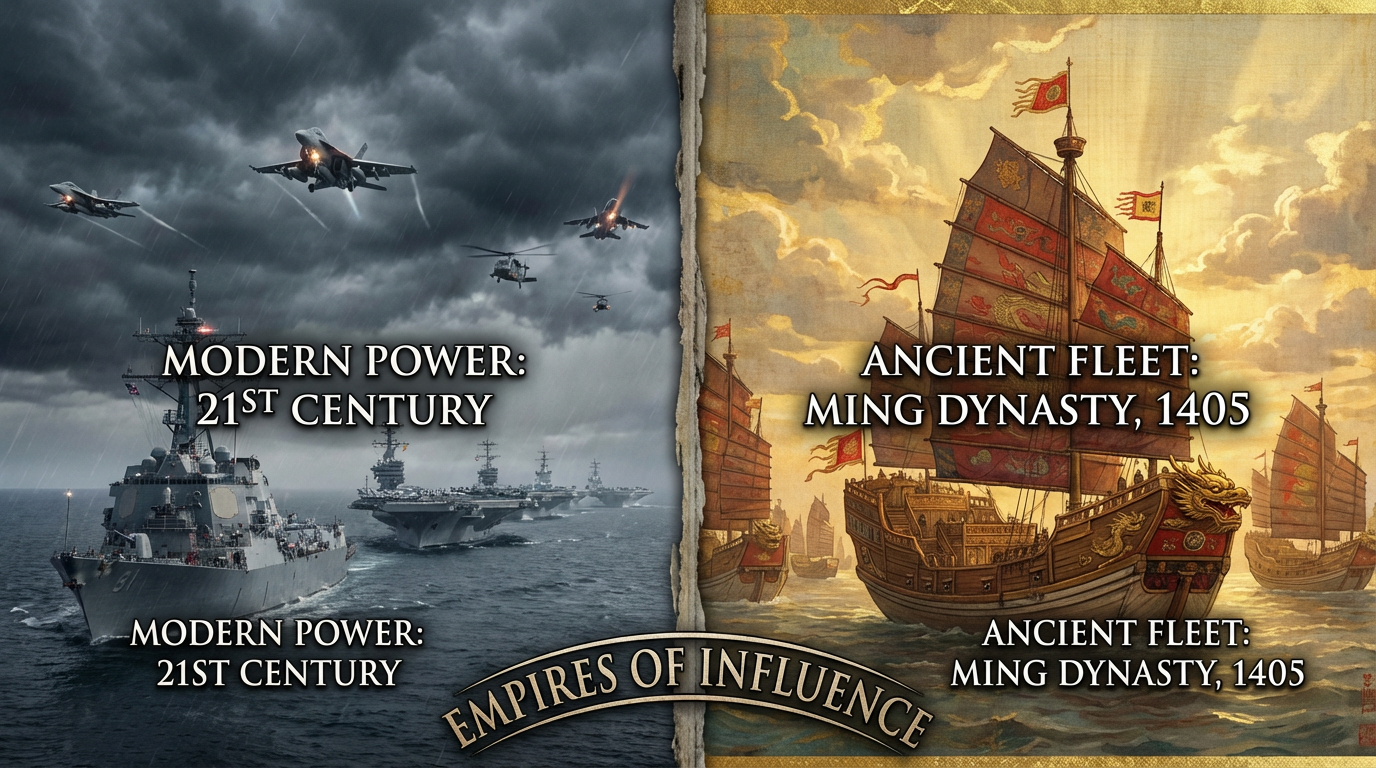
In 1405, while Europe was still clawing its way out of the Dark Ages, the Chinese Ming Dynasty was the undisputed master of the known world. The Yongle Emperor, determined to formalize this dominance, gave a stunning order to his most trusted admiral, Zheng He.
He was to build a fleet of ships grander than anything the world had ever seen and sail to the “Western Oceans” – not to conquer, but to demand submission.
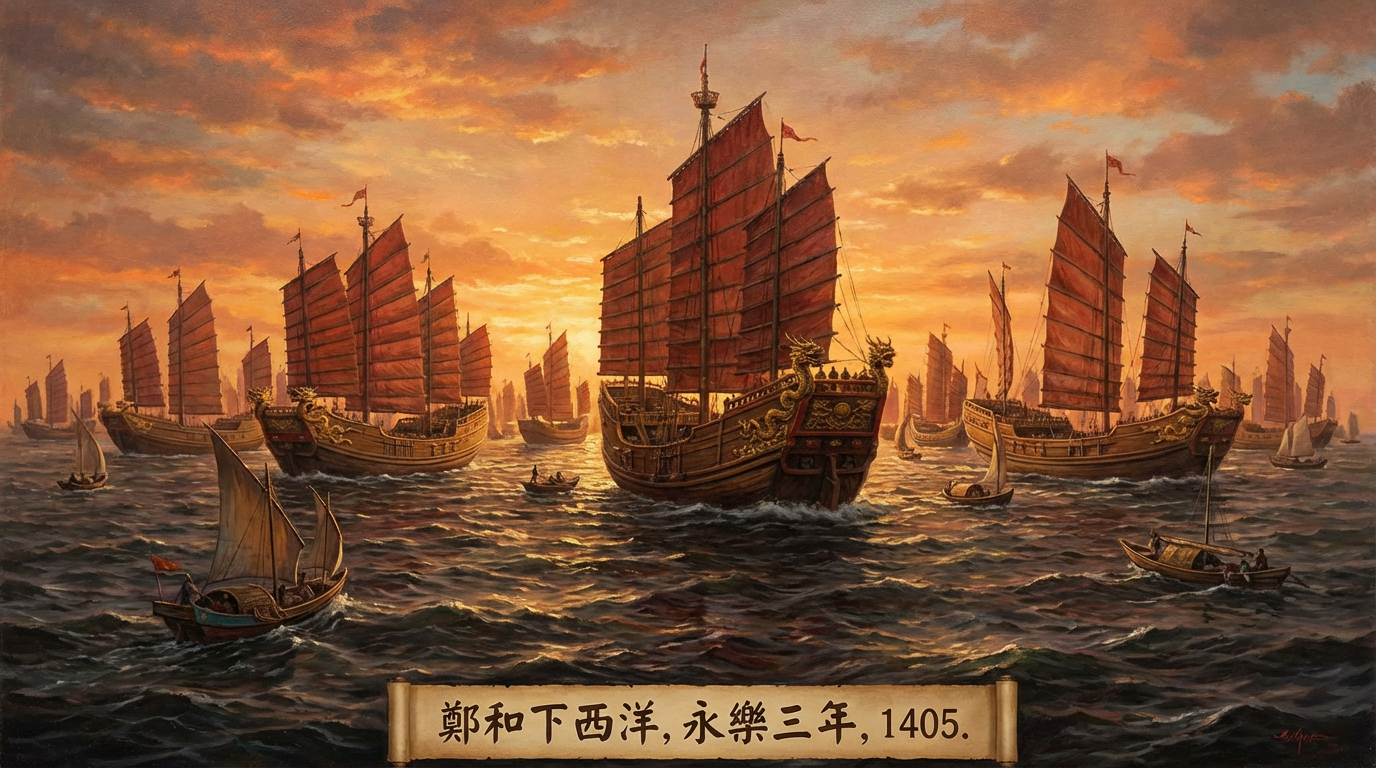
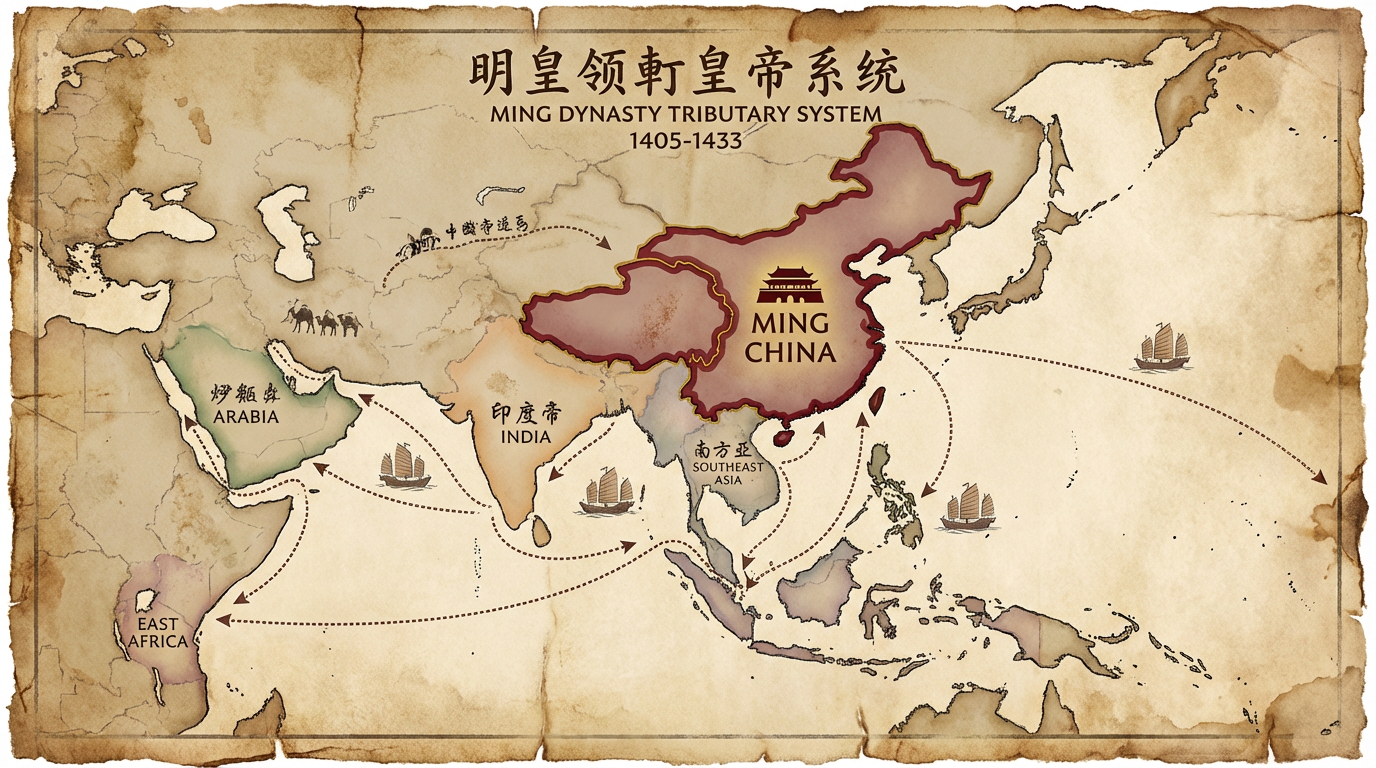
Zheng He’s “Treasure Fleet” was a breathtaking display of power. Over 300 ships, some of them colossal “treasure ships” over 400 feet long, dwarfing the vessels Columbus would use a century later. Aboard were 28,000 men: soldiers, diplomats, doctors, and translators. Their mission was to enforce the Tributary System.
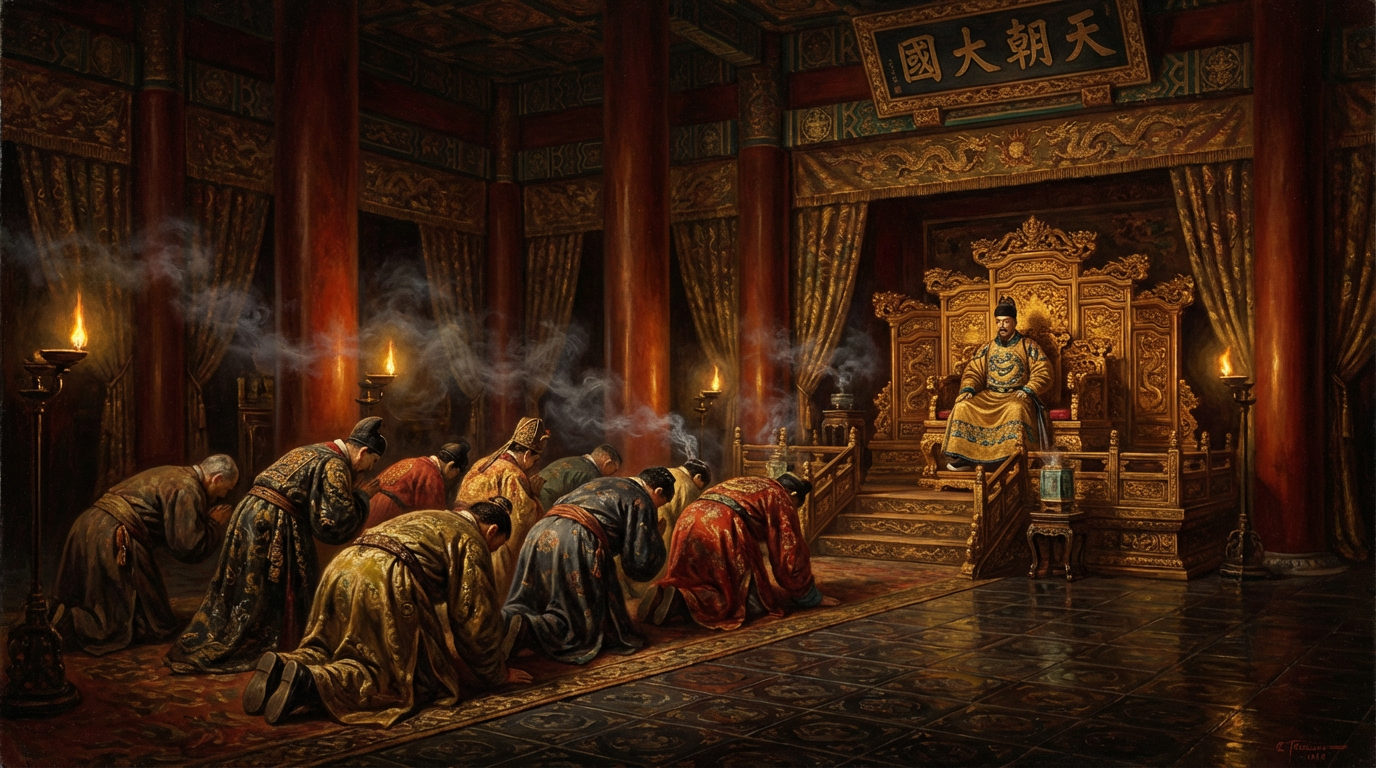
Foreign kings and sultans were given a simple choice. They could send envoys to the Ming capital, perform the “kowtow” – a full prostration before the Emperor – and offer gifts as a sign of their submission. In return, they would receive lavish presents of silk and porcelain, trade privileges, and the protection of the world’s mightiest navy.
Those who refused the offer found Zheng He’s diplomacy was backed by overwhelming force. The king of Ceylon (modern-day Sri Lanka), who scoffed at the demand, was captured, taken to China as a prisoner, and replaced with a more compliant ruler. Pirate fleets that threatened Ming trade routes were annihilated.
For nearly three decades, the system worked. From Vietnam to the Swahili Coast of Africa, over thirty kingdoms became tributary states. China’s sphere of influence was absolute. They were the center of the world, and everyone knew it.
The Blindness of Power
But the tributary system contained a fatal flaw. It was built on the arrogant assumption that China was, and always would be, the center of the universe. It created a strategic blindness that made the empire complacent and vulnerable.
The Ming court became obsessed with the ritual of submission. They mistook the kowtowing of terrified neighbors for genuine loyalty. They spent astronomical sums on the Treasure Fleet to project power, while ignoring the very real threat of Mongol horsemen on their northern border.
Most importantly, the system treated everyone as an inferior. There were no allies, only vassals. This bred resentment and ensured that when a true challenger arrived, China would face it alone.
In 1433, the voyages abruptly stopped. A new faction of Confucian scholars, who saw the expeditions as a costly vanity project, convinced the Emperor to dismantle the fleet. China turned inward, confident in its regional dominance. It was a catastrophic mistake.
Just a few decades later, Portuguese ships rounded the tip of Africa. They arrived in the Indian Ocean playing by a completely different set of rules. They didn’t come to demand tribute; they came to conquer. The tributary states, bound by fear rather than loyalty, quickly abandoned their Ming overlords for the new European powers.
China, having dismantled its great navy and alienated its neighbors, was helpless. The “sphere of influence” they had spent a century building evaporated in an instant. The stage was set for the “Century of Humiliation,” where a once-mighty empire was carved up by foreign powers it had once dismissed as barbarians.
The Echoes of a Fallen Empire
The pattern is repeating itself with chilling precision. A superpower, convinced of its own permanent dominance, turns its back on alliances and seeks to control its neighbors through intimidation rather than partnership.
Like the Ming, the new National Security Strategy focuses on controlling its immediate sphere – Latin America – while dismissing and criticizing its most powerful allies in Europe. It mistakes the forced compliance of weaker nations for genuine respect, and it creates a strategic blindness to the real global challengers: a rising China and a revanchist Russia, who are happily building the very alliances America is discarding.
History’s warning is clear: empires that become obsessed with demanding tribute from their neighbors are often the last to see the real threat coming over the horizon. By the time they do, it’s already too late.
Five Things You Must Do Before the Next System Collapse
The collapse of a global system doesn’t happen overnight, but the foundations are cracking. The time to prepare is now. Here are five steps you can take this week to secure your family’s future.
-
Build Your Own Alliances. Don’t rely on a distant, arrogant government for your security. Forge strong bonds with your local community. A network of trusted neighbors is more valuable than any federal promise. Learn how to start building your local network at HomesteaderDepot.com.
-
Recognize Strategic Blindness. When you see leaders fixated on symbolic displays of power while ignoring long-term threats, it’s a sign the system is failing. Stay informed about the real risks, not the manufactured distractions. Get unfiltered analysis at SelfRelianceReport.com.
-
Achieve Food Independence. The first casualty of systemic collapse is the supply chain. Your ability to feed your family is the ultimate measure of self-reliance. The 4ft Farm Blueprint shows you how to produce a shocking amount of food in a tiny, 4-foot space, making you independent of fragile supply lines. Click here to secure your food supply, no matter what happens to the global order.
-
Understand the Real Economy. National economies built on debt and intimidation are brittle. Protect your family from the inevitable financial shocks by learning how to build real wealth. Find out how at FreedomHealthDaily.com.
-
Learn the Patterns of History. The story of the Ming Dynasty is not a fluke. It’s a pattern that has repeated for millennia. Understanding these cycles is the key to anticipating what comes next. Deepen your knowledge of historical patterns at SurvivalStronghold.com.