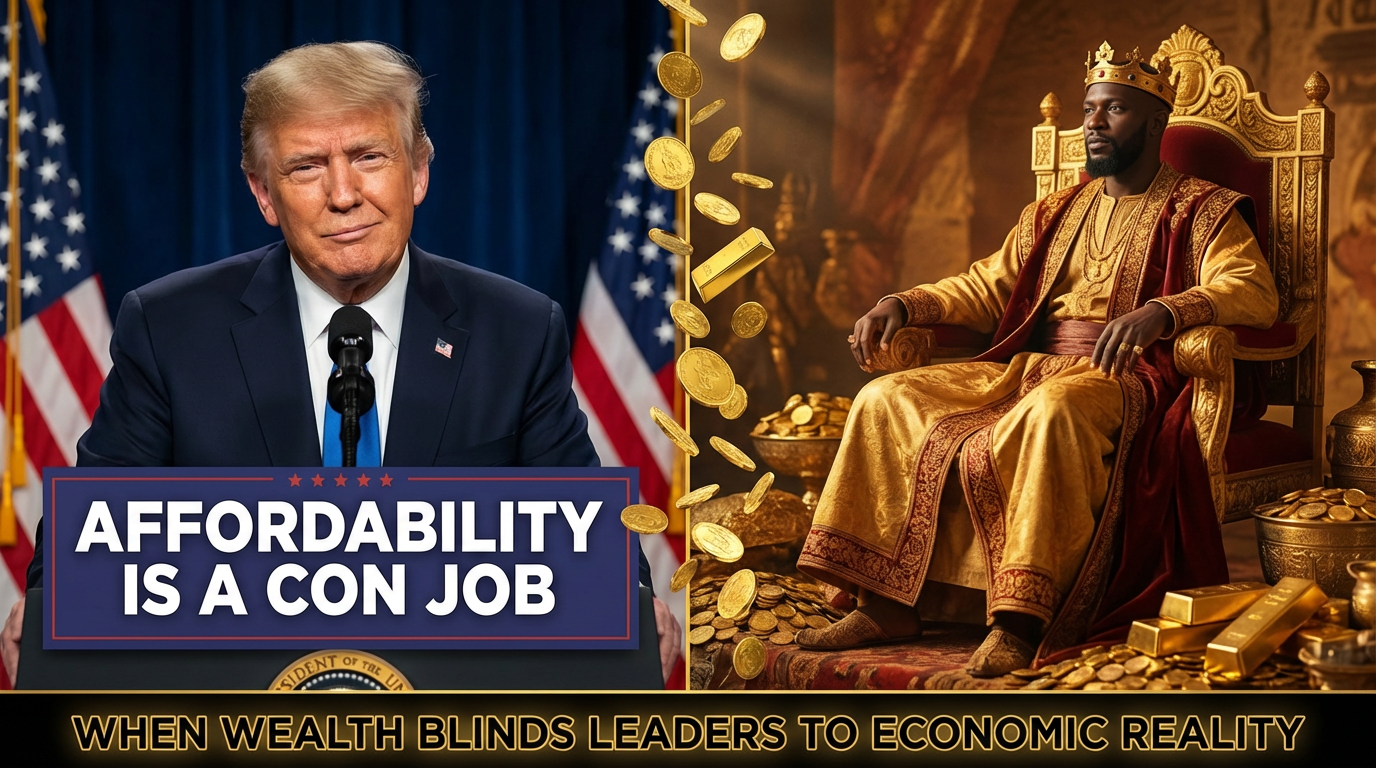
“I think affordability is the greatest con job.”
Those were the words from President Trump at the White House recently, a stunning dismissal of the crushing economic reality facing millions of Americans. While the President insists he has lowered prices, a recent Washington Post-ABC News-Ipsos poll found that a staggering 62 percent of Americans disapprove of his economic performance. Even more telling, a Politico poll revealed that 37% of his own voters say the cost of living is the worst they can ever remember.
It’s a shocking disconnect between a wealthy leader and the everyday pain of the people he governs. But this isn’t the first time in history a fabulously wealthy ruler has been so insulated by their own fortune that they couldn’t grasp the economic devastation they were causing. Seven hundred years ago, another powerful leader made the same catastrophic mistake, and his story serves as a chilling warning for us today.
The Pivot: The Richest Man Who Ever Lived
His name was Mansa Musa, the 14th-century emperor of the Mali Empire in West Africa. Adjusted for inflation, his wealth is estimated to have been over $400 billion, making him the richest person in human history. His kingdom was built on an inexhaustible supply of gold and salt, the two most valuable commodities of the medieval world.
In 1324, Mansa Musa embarked on a hajj, the sacred pilgrimage to Mecca, a 4,000-mile journey across the Sahara Desert. He was determined to show the world the unimaginable wealth of his empire. His procession was a river of gold flowing through the desert. It included tens of thousands of soldiers, civilians, and slaves. Five hundred heralds, draped in the finest Persian silk, each carried a staff of pure gold.
But it was his stop in Cairo, Egypt, that would go down in history as a lesson in the catastrophic consequences of a leader’s economic ignorance.
The Story: The Golden Deluge That Drowned an Economy
When Mansa Musa arrived in Cairo in July 1324, he intended to be generous. He gave away gold to everyone he met, from the city’s poorest residents to its most powerful merchants. He flooded the markets with so much gold that its value plummeted. The price of everything else skyrocketed. The Egyptian economy, which had been stable for centuries, was thrown into chaos.
For the first few days, the people of Cairo were thrilled. Gold was everywhere. But soon, the reality of the situation set in. The value of their savings was wiped out. The cost of food and basic necessities soared beyond their reach. The city was plunged into an economic crisis that would last for more than a decade.
The great irony? Mansa Musa, the man who had single-handedly crashed the Egyptian economy with his generosity, ran out of money on his way home. He had given away so much gold that he had to borrow from the very merchants he had tried to impress just to finance his return journey.
The Lesson: A Warning Across the Centuries
Mansa Musa’s story is a timeless lesson in the dangers of a leader who is so disconnected from the economic realities of their people that they can’t see the damage they are causing. He thought he was demonstrating his power and generosity, but he was actually destroying the livelihoods of the people he was trying to impress.
Today, we see a similar disconnect in President Trump’s dismissal of affordability concerns as a “con job.” Like Mansa Musa, he is a wealthy leader who seems unable to comprehend the economic pain of ordinary families. His focus on the stock market and big-picture economic numbers blinds him to the reality that for most people, the cost of living is a daily struggle.
When a leader is so insulated by their own wealth that they can’t understand the basics of household economics, they are bound to make catastrophic policy mistakes. Mansa Musa learned this lesson the hard way. We must not repeat his mistake.
The Action: Your Financial Fortress
We cannot rely on out-of-touch politicians to protect us from economic turmoil. We must take matters into our own hands. The first step is to secure your own food supply. The 4ft Farm Blueprint is a revolutionary system that allows you to grow your own food in a tiny space, with minimal effort. It’s the ultimate insurance policy against food shortages and soaring prices.
But self-reliance is about more than just food. It’s about building a resilient life that is not dependent on fragile systems. Here are five things you must do before the next economic shock:
- Secure Your Shelter: Your home is your castle. Learn how to fortify it and make it self-sufficient at SurvivalStronghold.com.
- Master Self-Reliance Skills: From basic first aid to off-grid energy, SelfRelianceReport.com has the information you need to become truly independent.
- Invest in Your Health: A strong body is your most important asset. Discover natural health solutions at SevenHolistics.com.
- Build Your Homestead: Whether you have a sprawling farm or a small backyard, HomesteaderDepot.com has the tools and knowledge you need to thrive.
- Take Control of Your Finances: Don’t be a victim of the next financial crisis. Learn how to protect your wealth and build a secure future.
History has shown us time and again that when leaders fail, the people must fend for themselves. The time to prepare is now. Don’t wait until it’s too late.