A special report from Shamus Gerry III
The Hook: A Government at War With Itself
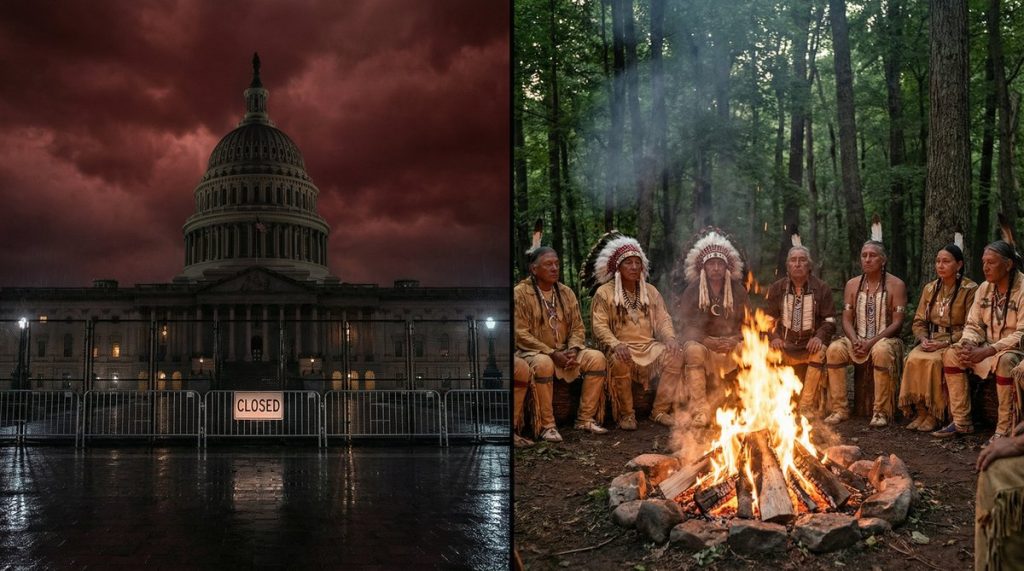
Washington is paralyzed. As of midnight, the Department of Homeland Security — the very agency tasked with protecting the nation — is grinding to a halt. The reason? A bitter, intractable feud between political factions that has left the government unable to perform its most basic function: funding itself. Senators trade blame on cable news, House members have already fled the city, and the machinery of the state sputters and dies not from an external attack, but from self-inflicted wounds.
This spectacle of dysfunction, of a system so consumed by internal rivalries that it chooses to tear itself apart, feels like a uniquely modern failure. But it is not. It is a story as old as power itself. And centuries before the United States Constitution was ever conceived, a similar crisis of division and endless warfare threatened to consume the people of the woodlands of what would become upstate New York. Their solution was not more conflict, but a radical act of peace and unity that created one of the most durable democracies the world has ever known.
This is the story of the Great Law of Peace, the constitution of the Iroquois Confederacy. It is a story of how five warring nations, trapped in a bloody cycle of revenge, found a way to unite under a common law, guided by a visionary prophet, a skilled orator, and a transformed warlord. It is a story that holds a chilling and vital lesson for an America that has forgotten how to make peace with itself.
The Pivot: The People of the Longhouse
Long before European settlement, the dense forests and shimmering lakes of the American Northeast were home to five powerful nations: the Mohawk, the Oneida, the Onondaga, the Cayuga, and the Seneca. They were known as the Haudenosaunee, the People of the Longhouse. For generations, however, they were not a united people. They were locked in a brutal, seemingly endless cycle of clan warfare, where blood feuds and revenge killings were a way of life. Mourning wars, launched to take captives to replace the dead, perpetuated the violence. Trust had evaporated, leaving only fear and hatred.
Into this world of darkness came a prophet, known as the Great Peacemaker. Born of a virgin mother among the Huron people, he came from the north in a white stone canoe, carrying a message of peace and unity from the Creator. He taught that all people were one, and that the cycle of violence was a poison that was destroying them from within. His vision was of a great longhouse, stretching from east to west, where all five nations would live together as one family, under the shelter of a single law.
The Story: The Uniting of the Five Nations
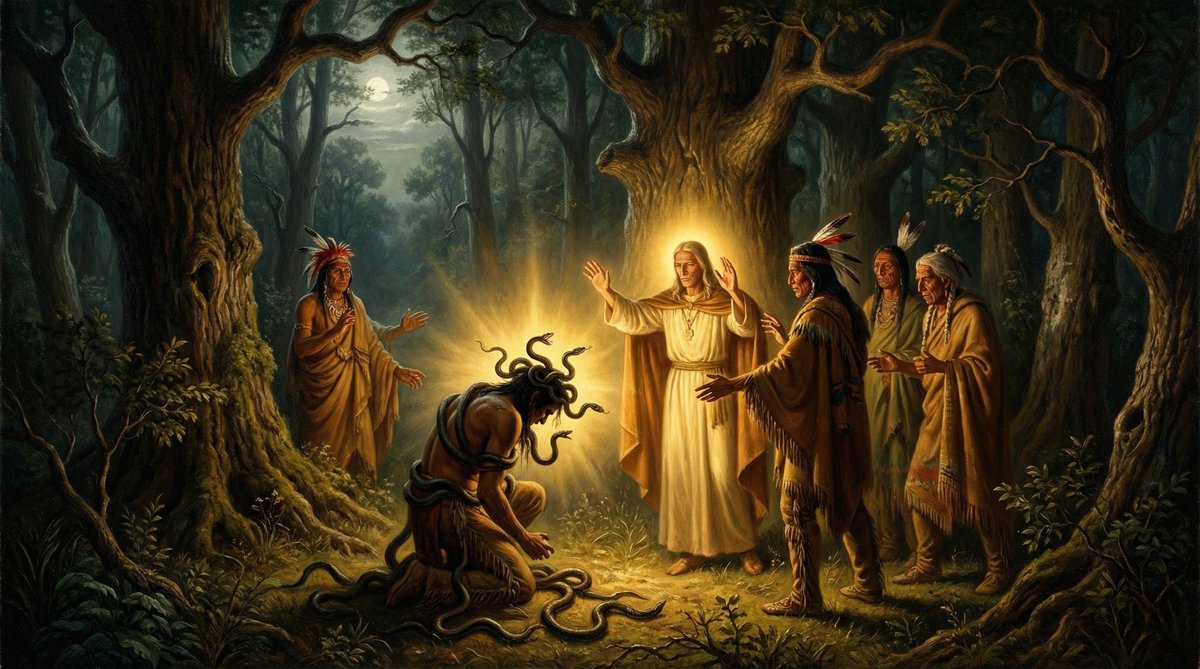
The Peacemaker’s message was radical, and at first, it was met with skepticism and hostility. His first convert was a woman, Jigonhsasee, who became known as the Mother of Nations and was instrumental in spreading the message of peace. His second was a fierce Mohawk warrior named Hiawatha, who had lost his family to the endless wars and was consumed by grief and a desire for revenge. The Peacemaker “combed the snakes” from Hiawatha’s hair — a symbolic act of healing his grief-stricken mind. With Hiawatha as his eloquent spokesman, the Peacemaker’s message began to gain traction among the nations.
One by one, they brought the nations into the fold. The Mohawk, the Oneida, the Cayuga, and the Seneca all agreed to join the proposed confederacy. But one obstacle remained: the fearsome Onondaga chief, Tadodaho. A powerful and malevolent sorcerer, his body was said to be twisted and his hair a mass of writhing snakes. He was the embodiment of the chaos and violence that the Peacemaker sought to overcome. Tadodaho had rejected all previous attempts at peace, and his continued hostility threatened to unravel the fragile alliance before it could even begin.
The Peacemaker and Hiawatha, now joined by the leaders of the other four nations, confronted Tadodaho. They did not meet him with force, but with compassion and the power of their united will. They sang songs of peace, and with great ceremony, they symbolically combed the snakes from Tadodaho’s hair, untwisting his mind and body. In that transformative moment, Tadodaho accepted the message of peace and was given the honored role of spiritual leader of the new confederacy — the keeper of the central council fire at Onondaga.
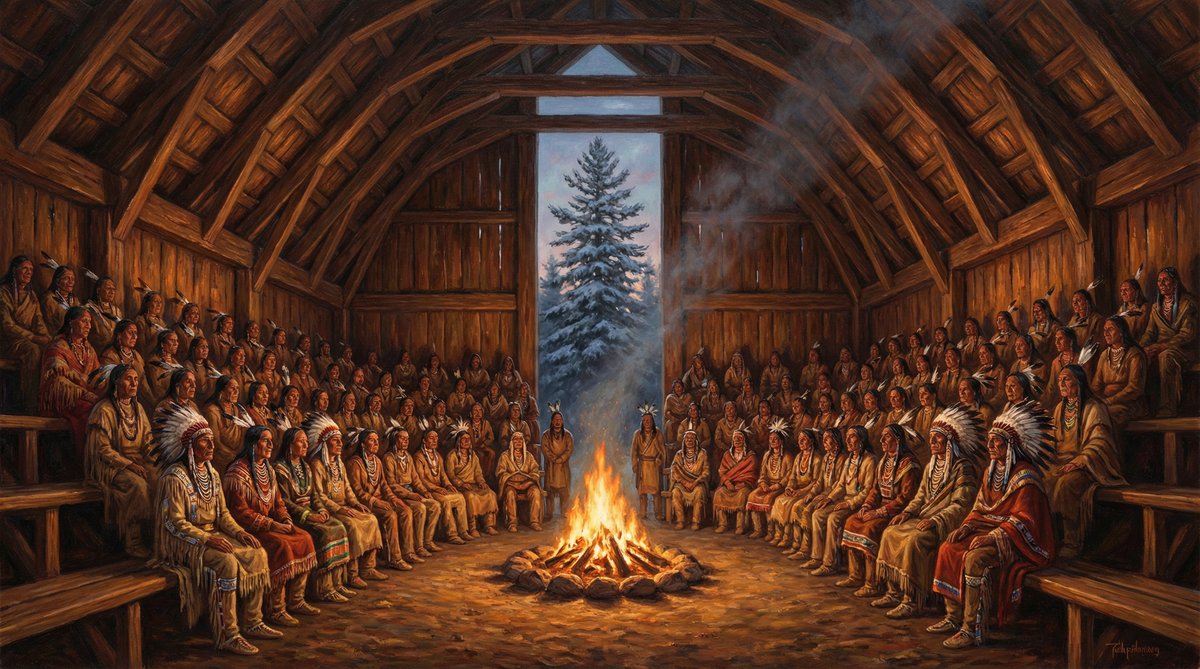
With the five nations finally united, the Peacemaker established the Great Law of Peace — the Kaianere’kó:wa. It was a complex constitution, an oral tradition passed down through generations, that established a federal system of government with checks and balances, separation of powers, and a council of 50 chiefs representing the different clans and nations. Clan Mothers held the power to appoint and remove chiefs. Decisions required consensus, not mere majority rule. It was a system designed to prevent the very kind of internal conflict that had plagued them for so long. The Great Law of Peace was not just a treaty; it was a new way of life, a commitment to reason, dialogue, and unity that would endure for centuries.
The Peacemaker planted a great white pine — the Tree of Peace — at Onondaga, the geographic center of the confederacy. He placed an eagle atop the tree to watch for danger. And he buried the weapons of war beneath its roots, declaring that the cycle of violence was over. The Iroquois Confederacy, founded around 1142 CE, is considered the oldest living participatory democracy on earth. Its principles of federalism, representative government, and the balance of power directly influenced the framers of the United States Constitution — a debt that was formally acknowledged by the U.S. Congress in 1988.
The Lesson: A Blueprint for Unity in an Age of Division
The story of the Iroquois Confederacy is a powerful reminder that even the most bitter and deep-seated conflicts can be overcome — but only when leaders choose to prioritize the survival of the whole over the ambitions of the few. The five nations were not just political rivals; they were locked in a cycle of generational warfare, mourning wars, and blood feuds that had consumed their people for decades. Yet, they found a way to transcend their differences and create a lasting peace. They did it by recognizing that their disunity was a greater threat than any external enemy. They did it by creating a system of government that prioritized consensus and the common good over factional interests.
Today, America faces a similar crisis of division. The shutdown of the Department of Homeland Security is not just a policy dispute; it is a symptom of a deeper political sickness. It is the result of a system that has become so polarized, so consumed by partisan warfare, that it can no longer perform its most basic functions. Like the warring nations of the pre-Iroquois Northeast, we are trapped in a cycle of conflict, where every issue becomes a battle, and every compromise is seen as a defeat. FEMA, the Coast Guard, the TSA, the Secret Service — the agencies that stand between ordinary Americans and catastrophe — are being held hostage by leaders who have forgotten what they are supposed to be protecting.
The Great Law of Peace offers a different path. It shows that it is possible to create a system of government that is designed for unity, not division. It shows that it is possible to build a society based on reason, dialogue, and mutual respect. It shows that even the most twisted and malevolent forces — even a Tadodaho — can be transformed when confronted not with more violence, but with the united will of a people who refuse to destroy themselves.
But the deeper lesson is this: the Haudenosaunee did not wait for their leaders to fix the problem. The Peacemaker was not a senator or a president. He was a prophet who arose from the people themselves. Hiawatha was a grieving warrior who chose healing over revenge. The transformation came from below, not from above. It came from individuals who decided that the cycle of destruction had to end, and who were willing to do the hard work of building something new.
The Action: Reclaiming Your Sovereignty
The lesson of the Iroquois is not to wait for a prophet to save us. The lesson is that we, the people, have the power to create our own systems of peace, cooperation, and resilience. The first step is to recognize the fragility of the systems we depend on. When the government shuts down, who will ensure your safety? When the supply chains break, who will feed your family? When the agencies tasked with disaster response are unfunded and understaffed, who will come to your aid?
The answer, as always, is self-reliance. The same spirit of ingenuity and cooperation that built the Iroquois Confederacy can be used to build resilient communities today. It starts with taking responsibility for your own well-being, and the well-being of your family and community.
This is the time to invest in real assets, in skills that matter, and in the local networks that will sustain you when the centralized systems fail. It is the time to learn how to grow your own food, secure your own water, and build the kind of local resilience that no government shutdown can take away.
For those ready to take that first step, the 4ft Farm Blueprint provides a proven, step-by-step guide to creating a sustainable food source in your own backyard — in as little as four square feet. It is a practical, actionable plan for reclaiming your independence from a broken system.
Explore these resources to further your journey to self-reliance:
- SurvivalStronghold.com — In-depth guides on all aspects of preparedness and emergency planning.
- SelfRelianceReport.com — Daily news and analysis from a self-reliant perspective.
- HomesteaderDepot.com — Tools, supplies, and knowledge for your homestead.
- SevenHolistics.com — Natural health and wellness solutions for the whole family.
- TheReadyReport.com — Premium analysis and exclusive preparedness intelligence.
Do not be a victim of a system at war with itself. The People of the Longhouse showed us that a better way is possible. They showed us that even in the darkest hour, when the snakes of division and hatred seem impossible to untangle, the power of unity and self-determination can prevail. It is time to start building your own longhouse.
The Iroquois Confederacy endured for over 500 years. The current American government cannot fund itself for 500 hours. The question is not whether the system will fail. The question is whether you will be ready when it does.