A special report from Shamus Gerry III
The Machine Seizes Up
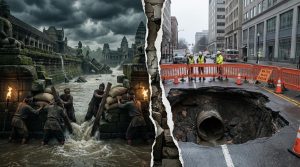
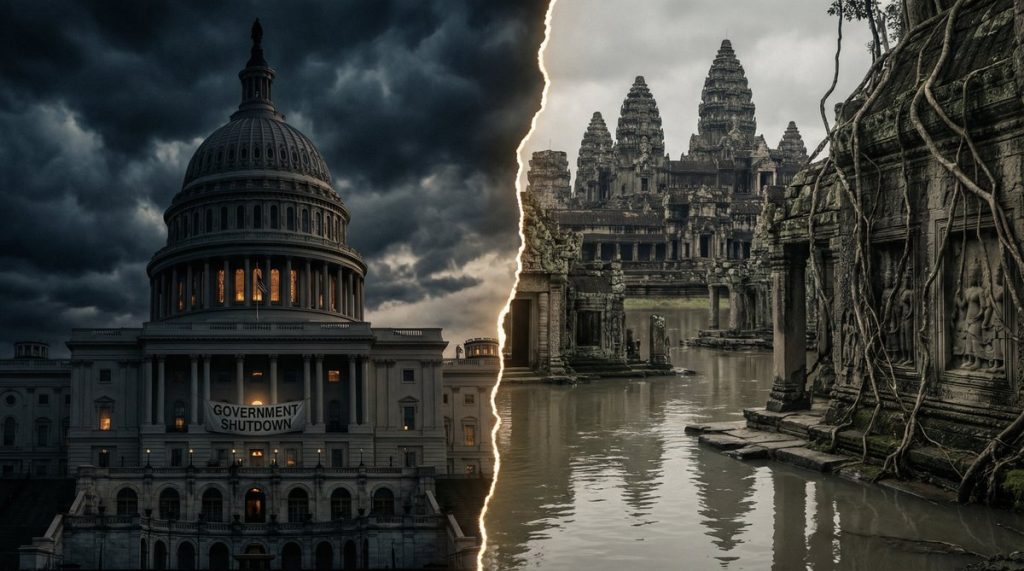
Washington D.C. is a ghost town. The Department of Homeland Security, the sprawling agency created to prevent another 9/11, has been shuttered. Not by a foreign adversary or a catastrophic attack, but by the petty squabbles of a political class that has lost the ability to govern. The machinery of the American state, once the most powerful and efficient in human history, has seized up, paralyzed by its own internal contradictions.
We watch this spectacle with a mixture of disgust and disbelief. We assume it is a uniquely modern phenomenon, a product of our hyper-partisan age. We are wrong. The story of a great power consuming itself from within is one of the oldest and most terrifying in the human record. And nearly a thousand years ago, on the other side of the world, another empire, far more ancient and in many ways more sophisticated than our own, faced a similar crisis. They had built a civilization on the absolute mastery of their environment, a “hydraulic city” that was the envy of the world. They believed their system was infallible. And then, in the blink of a historical eye, it was gone.
This is the story of the Khmer Empire and its magnificent capital, Angkor. It is a story of how a civilization that had tamed nature itself was ultimately devoured by it. And it holds a chilling warning for an America that has become so enamored of its own complex systems that it has forgotten how fragile they truly are.
The Empire of Water
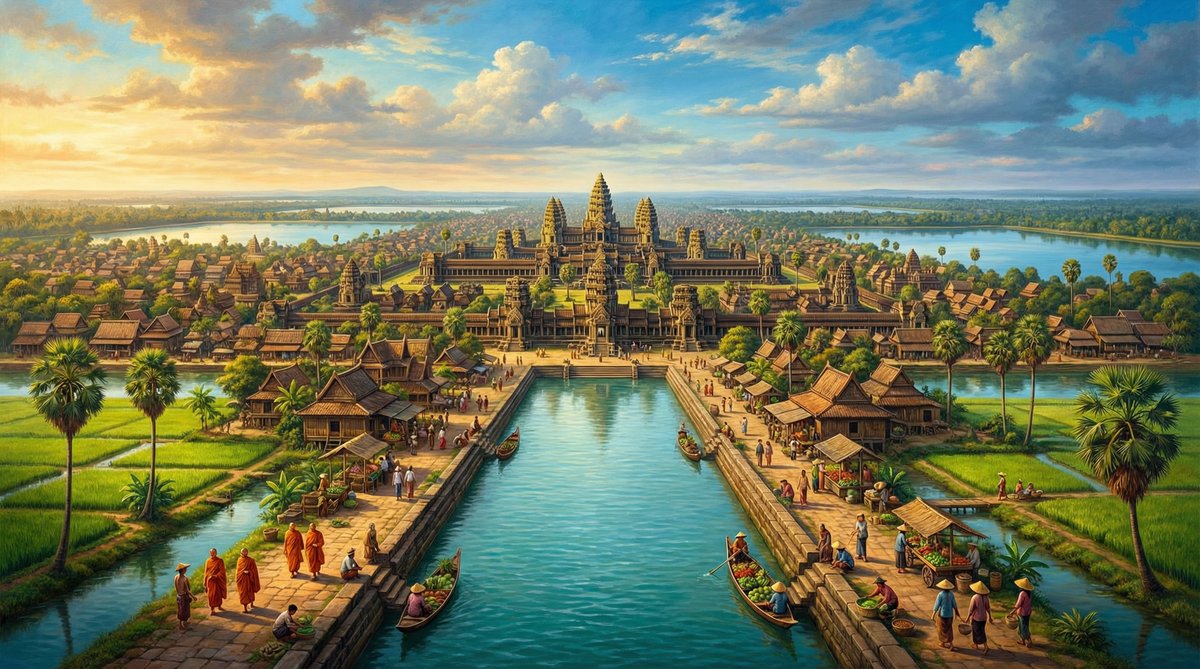
In the heart of the Cambodian jungle, the Khmer Empire built a civilization that, at its peak in the 12th century, was the largest and most advanced on Earth. The source of its power was not gold or armies, but water. The Khmer were masters of hydrology. They constructed a vast and intricate network of canals, reservoirs, and moats that stretched for hundreds of square miles. This was not merely an irrigation system; it was the circulatory system of the empire.
This “hydraulic city” allowed the Khmer to harvest rice three or even four times a year, generating immense agricultural surpluses that fueled their expansion. It was a system of breathtaking complexity, a testament to the ingenuity and ambition of a people who had learned to bend nature to their will. The water, and their control of it, was not just a source of wealth; it was a reflection of their cosmology, a physical manifestation of the divine order, with the king as the “god-king” at its center.
The Breaking of the System
For centuries, the system worked. The empire flourished, building the magnificent temples of Angkor Wat and Angkor Thom, monuments that still defy the imagination. But the climate, which had been relatively stable for centuries, began to change. In the mid-14th century, the region was struck by a series of prolonged and severe droughts. The great reservoirs began to dry up, the canals ran low, and the agricultural engine of the empire began to sputter.
The Khmer engineers, no doubt the most brilliant of their time, did what any skilled technocrat would do: they adapted. They modified the system, building new channels and dikes to conserve what little water remained. But they were fighting a losing battle. The droughts were followed by a period of intense and violent monsoons, far more powerful than anything the system had been designed to handle.
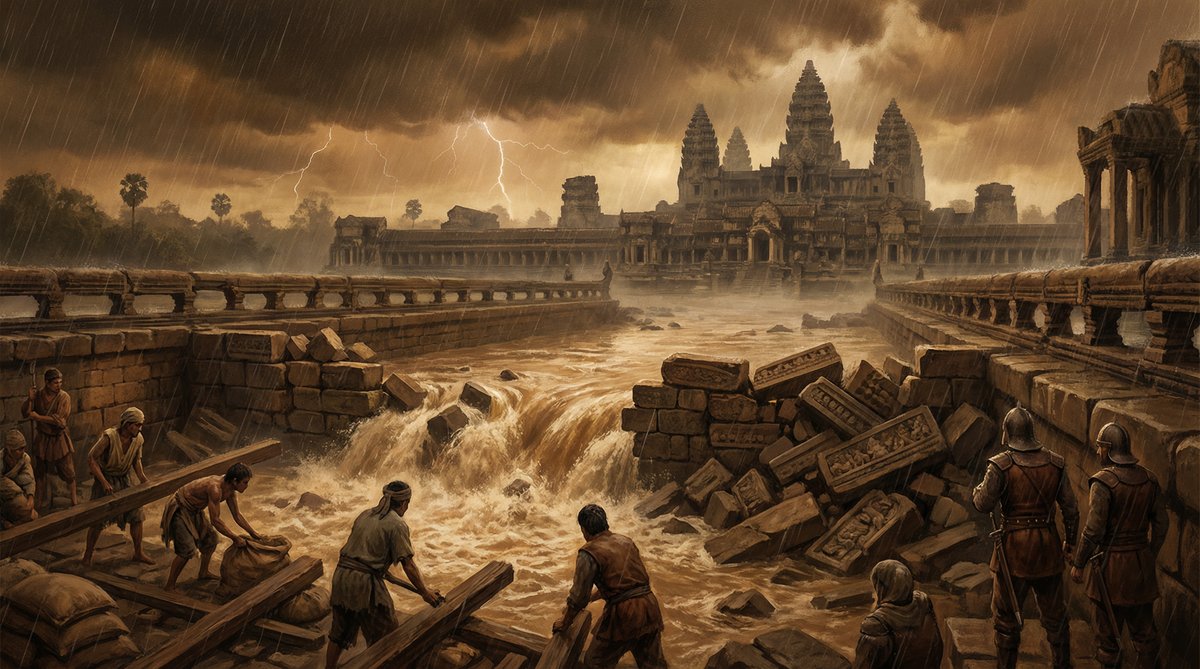
The deluge was catastrophic. The canals, baked and cracked by years of drought, were suddenly overwhelmed by torrents of water. The system, designed to distribute water, now became a conduit for its destructive power. The floodwaters, carrying tons of eroded soil, choked the canals and breached the dikes. The damage was widespread and irreparable. The hydraulic city, the very foundation of Khmer civilization, had broken.
The collapse was not instantaneous. There was a period of desperation, of frantic attempts to patch a system that was fundamentally broken. Archaeologists have found evidence of this in the very stones of Angkor: temple blocks, intricately carved with images of gods and kings, were ripped from their sacred walls and used to build crude bridges and dams. It was the act of a people who knew their world was ending.
The final blow came in 1431, when the neighboring Siamese kingdom of Ayutthaya, sensing the weakness of the once-mighty empire, invaded and sacked the city of Angkor. But the Siamese were not conquerors; they were scavengers, picking over the bones of a civilization that had already died.
The Illusion of Control
The Khmer Empire did not fall because it was technologically backward. It fell because it was too advanced. Its very sophistication was its undoing. The hydraulic system, so perfectly attuned to a stable climate, was catastrophically brittle in the face of change. The Khmer had built a gilded cage, and when the climate changed, they found themselves trapped inside.
We, too, live in a gilded cage. Our systems of government, of finance, of logistics, are miracles of complexity. We have come to believe that they are infallible, that they can withstand any shock. The shutdown of the Department of Homeland Security is a stark reminder that they cannot. Our political system, like the Khmer’s hydraulic system, was designed for a different era, a different set of conditions. It was not designed for the kind of existential, zero-sum polarization that now defines our political life.
The lesson of Angkor is that complexity is not the same as resilience. It is that the systems we depend on for our survival can become the instruments of our destruction. It is that the illusion of control is the most dangerous illusion of all.
Build Your Own Ark
When the machinery of the state grinds to a halt, who will protect you? When the complex supply chains that feed our cities are disrupted, who will provide for your family? The answer is the same as it has always been: you.
Self-reliance is not a hobby; it is a moral imperative. It is the recognition that the systems we have built are not eternal, and that we have a responsibility to prepare for their failure. It is the understanding that true security comes not from the state, but from our own skills, our own resources, and our own communities.
This is the time to build your own ark. It is the time to learn the skills that our ancestors took for granted: how to grow your own food, how to purify your own water, how to defend your own home. It is the time to build the local networks of trust and cooperation that will be the foundation of a new and more resilient society.
For those ready to take that first, most critical step, the 4ft Farm Blueprint offers a practical, proven path to food independence. It is a step-by-step guide to creating a high-yield, low-maintenance food system in your own backyard, a small but powerful declaration of independence from a system that is failing before our very eyes.
Your journey to true sovereignty doesn’t end there. Explore these essential resources:
- SurvivalStronghold.com — For comprehensive guides on every aspect of modern preparedness.
- SelfRelianceReport.com — For daily news and analysis that cuts through the mainstream noise.
- HomesteaderDepot.com — For the tools and supplies you need to build a productive homestead.
- SevenHolistics.com — For a self-reliant approach to health and wellness.
The lesson of Angkor is not a counsel of despair. It is a call to action. The Khmer were destroyed because they could not adapt. We can, and we must. The time to start is now.