
A special report from Shamus Gerry III
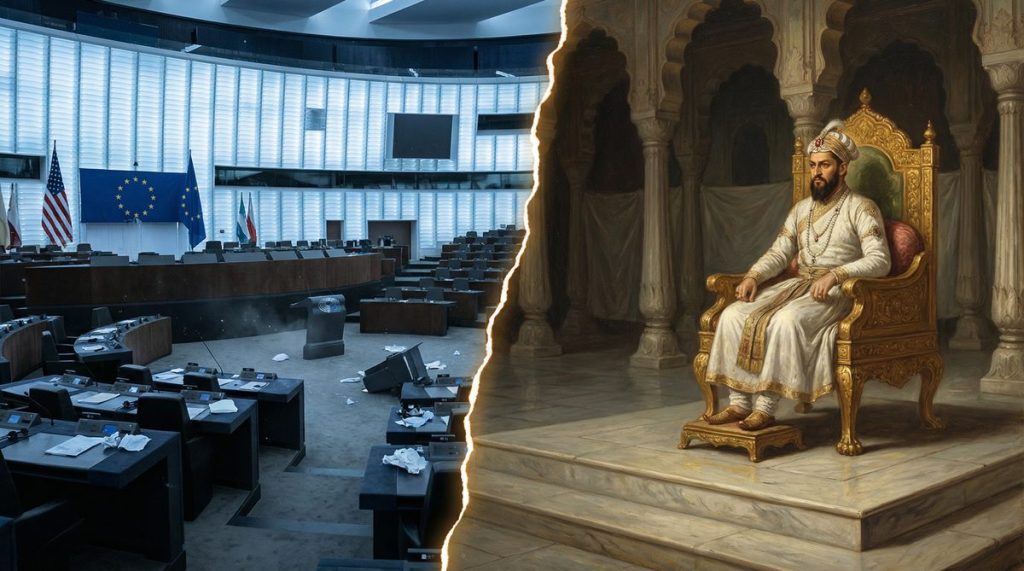
In the gilded halls of Munich, a chilling prophecy unfolded. As American officials spoke, the very foundations of the post-war world trembled. For eighty years, a network of alliances, painstakingly built on shared values and mutual defense, had kept the world from the brink. Now, that network is being systematically dismantled — not by an external enemy, but by its own architect.
At the 2026 Munich Security Conference, the world watched as the United States, the self-proclaimed leader of the free world, openly questioned its commitment to its oldest friends. Secretary of State Marco Rubio, while paying lip service to the transatlantic alliance, delivered a message of cold conditionality. The partnership, he implied, was contingent on Europe’s adherence to a new, American-defined “western civilization.”
European leaders were aghast. “Some lines have been crossed that cannot be uncrossed anymore,” declared European Commission President Ursula von der Leyen. A European diplomat, speaking anonymously, likened the American approach to that of a “psychologically abusive partner.” The message was clear: the America that had once stood as a bulwark against tyranny was now a source of instability and fear.
This spectacle of self-sabotage — of a superpower actively alienating the very allies that amplify its strength — feels like a terrifyingly new phenomenon. But history, as always, offers a grim precedent. Four centuries ago, on the plains of India, another great empire, the Mughal dynasty, embarked on a similar path of self-destruction, trading loyalty for ideological purity and, in doing so, sealing its own doom.
The Architect of Alliances: Akbar the Great and the Forging of an Empire
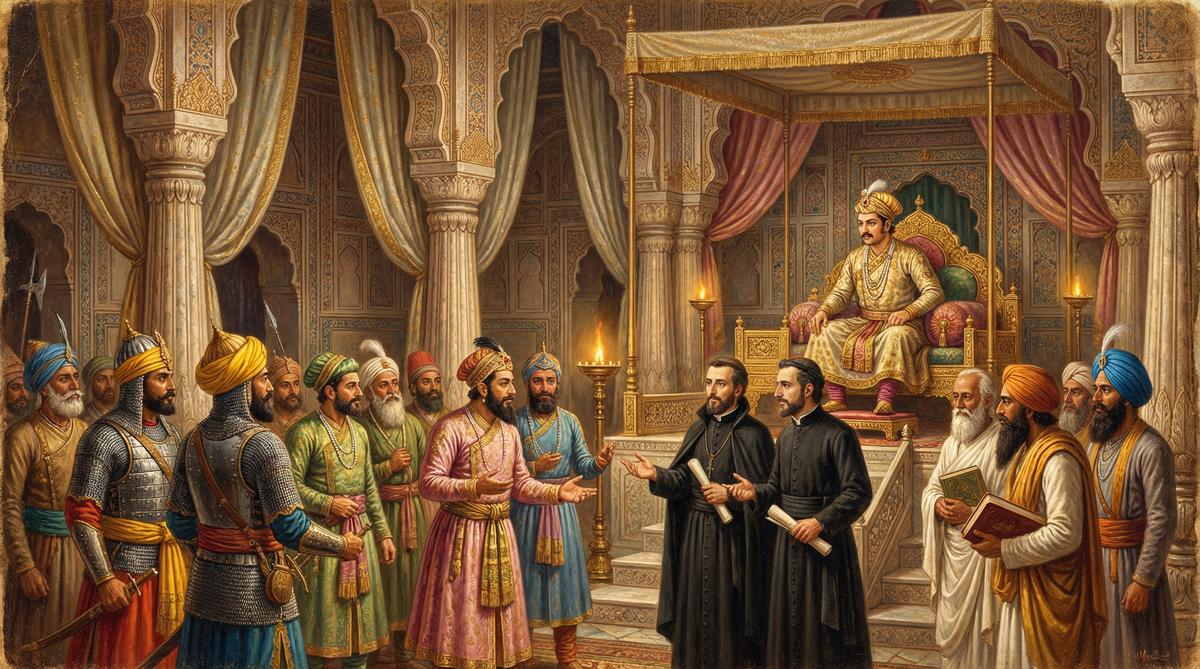
To understand the tragedy of the Mughal collapse, one must first appreciate the genius of its construction. In the mid-16th century, Emperor Akbar, a contemporary of Queen Elizabeth I, inherited a precarious kingdom. He transformed it into a continental superpower not through brute force alone, but through a revolutionary policy of inclusion and alliance.
Akbar understood that an empire as vast and diverse as India could not be ruled by fear. He recognized the martial prowess and fierce independence of the Rajput kingdoms, the Hindu warrior clans of Rajasthan. Instead of seeking to crush them, he sought to make them partners. He abolished the jizya, a discriminatory tax on non-Muslims, and welcomed Rajput princes into the highest echelons of his government and military. He even married into their families, most notably Jodha Bai, a Rajput princess who became one of his most influential wives.
This was not mere tokenism. It was a strategic masterstroke. The Rajputs, once the Mughals’ most formidable adversaries, became the staunchest pillars of the empire. Their loyalty was fierce, their military skill legendary. They guarded the frontiers, administered vast territories, and bled for the Mughal throne. The result was a century of unparalleled peace, prosperity, and cultural efflorescence. The empire, built on a foundation of mutual respect and shared power, was stronger than any force on the subcontinent.
The Zealot on the Throne: Aurangzeb and the Unraveling of Trust
Then came Aurangzeb. A man of spartan habits and fervent Islamic piety, he ascended the throne in 1658 after a bloody war of succession against his own brothers. Where his great-grandfather Akbar saw strength in diversity, Aurangzeb saw only heresy. He was a man possessed by a rigid, puritanical vision, and he was determined to impose it on his empire — regardless of the cost.
The policies that had made the empire strong were systematically dismantled. The jizya was reimposed. Hindu temples were destroyed. The vibrant, syncretic culture of the court was replaced by a sterile orthodoxy. The message to the Rajputs and other Hindu subjects was unmistakable: you are no longer partners, but second-class citizens in a state defined by one ideology alone.
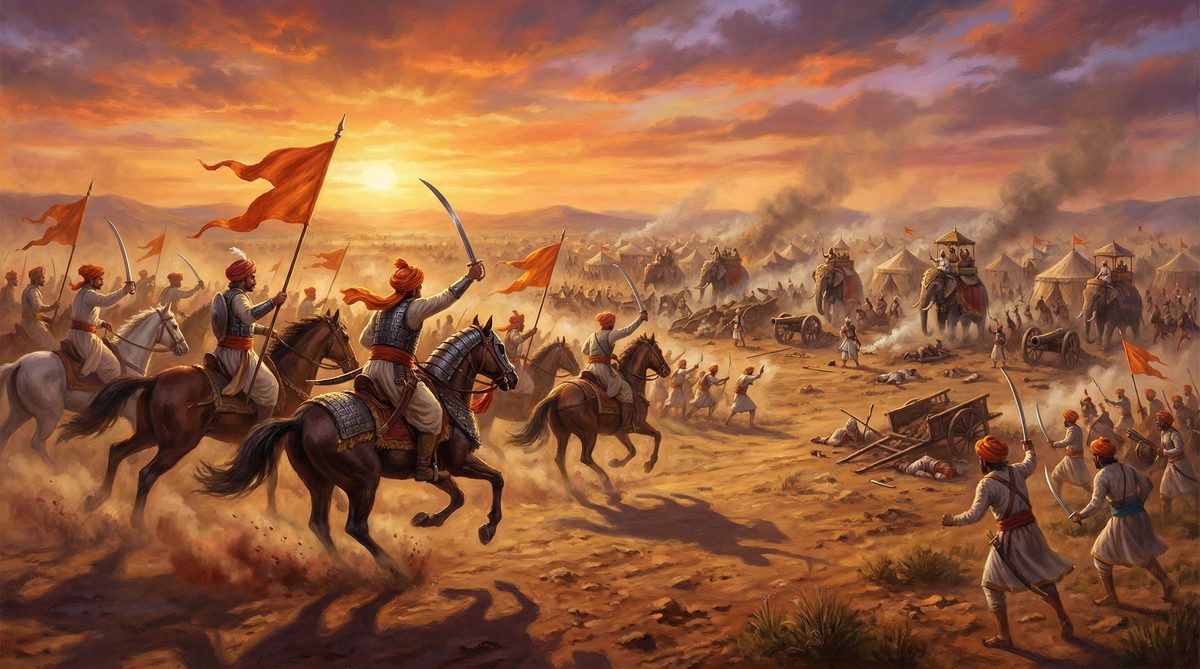
The trust that had been built over a century was shattered overnight. The Rajputs, who had once been the bedrock of Mughal power, rose in rebellion. The Marathas, a Hindu warrior people from the Deccan plateau, began a relentless guerrilla war that would bleed the empire dry. The Sikhs, a religious community in the Punjab, took up arms after their guru was executed by Aurangzeb’s order.
For the last 26 years of his reign, Aurangzeb was a man at war with his own people. He marched his massive armies from one end of the subcontinent to the other, crushing one rebellion only for another to spring up in its place. The empire, once a beacon of stability, became a cauldron of endless conflict. The treasury was drained, the administration collapsed, and the land was ravaged by famine and war. Aurangzeb had won his battles, but he had lost his empire.
The Lesson: An Empire Dies from Within
The parallel between Aurangzeb’s Mughal Empire and the United States today is as undeniable as it is terrifying. A superpower, at the zenith of its power, turns inward, consumed by ideological fervor. It alienates its most steadfast allies — not because of any strategic disagreement, but because they do not conform to a new, rigid orthodoxy.
Consider the evidence. At the Munich Security Conference, U.S. Undersecretary of Defence Elbridge Colby declared that “Europe was no longer a US priority.” He stated that the U.S. would be “reducing its capabilities in Europe, becoming a more limited and focused presence.” This is the modern equivalent of Aurangzeb reimposing the jizya — a deliberate signal to loyal allies that their partnership is no longer valued.
Just as Aurangzeb’s betrayal of the Rajputs created a power vacuum that was eventually filled by the British East India Company, America’s abandonment of its allies is creating a dangerous void on the world stage. The alliances that have maintained global stability for generations are fraying. The institutions that have prevented another world war are being hollowed out from within.
When Aurangzeb died in 1707, he left behind a fractured and bankrupt empire, ripe for the picking. He had mistaken ideological purity for strength, and in doing so, had engineered his own downfall. The tragedy is that he could not see that the empire’s greatest strength lay not in its uniformity, but in its diversity; not in its power to command, but in its ability to build consensus.
The Action: The End of Empire and the Dawn of Self-Reliance
We are witnessing the end of the American empire. Not an end brought about by foreign invasion or economic collapse, but by a slow, deliberate process of self-immolation. The betrayal of our allies is not a sign of strength, but of a terminal weakness — the act of a nation that has lost faith in its own founding values.
For those of us who have lived our entire lives under the umbrella of American power, this is a terrifying prospect. But it is also a moment of profound clarity. We can no longer depend on the institutions and alliances that have defined the post-war world. The time for complacency is over. The time for self-reliance is now.
This is not a call to despair, but a call to action. It is a call to build resilient communities, to acquire practical skills, and to create the systems that will allow us to weather the coming storm. True security does not come from the pronouncements of politicians or the promises of distant allies — it comes from our own ability to provide for ourselves and our families.
If you are ready to take the first step on the path to self-reliance, I urge you to consider the 4ft Farm Blueprint. This is not just a guide to gardening; it is a comprehensive system for producing your own food, securing your own water, and taking control of your own destiny. In a world where empires crumble and alliances shatter, the only thing you can truly rely on is yourself.
For more information on how to prepare for the uncertain future, explore these resources:
- Survival Stronghold — Tactical preparedness for an uncertain world
- Self-Reliance Report — Practical skills for independent living
- Homesteader Depot — Tools and knowledge for the modern homesteader
- Seven Holistics — Natural health solutions for your family
History has given us a clear warning. The question is whether we will heed it. The empire of broken trust is crumbling. It is time to build something new in its place.