

A special report from Shamus Gerry III
In the sterile quiet of a university conference room, a group of senior military and government officials played a game. The game was called “American Civil War,” and the scenario was chillingly plausible: a rogue president, a defiant state governor, and a violent clash between federal agents and the state’s own National Guard. The simulation, run by the Center for Ethics and the Rule of Law, ended in what the participants called “green-on-green” violence—American soldiers firing on American soldiers. It was a theoretical exercise. Until it wasn’t.
In Minnesota, the simulation has bled into reality. A standoff between the state government and federal ICE agents has escalated into violence, death, and a constitutional crisis. A governor has put his National Guard on standby. The President has threatened to invoke the Insurrection Act, readying the 11th Airborne Division to deploy on American soil. The scenario the experts war-gamed is unfolding, not as a hypothetical, but as a headline. It feels like a uniquely American nightmare, a 21st-century crisis born of our specific political divisions. But it is not.
Two hundred years ago, under the vast skies of Southern Africa, a similar and far more brutal drama played out. It was a period of cataclysmic violence, forced migrations, and state collapse known as the Mfecane—the “Crushing.” It was a time when new, aggressive forms of military power and political organization tore the old world apart. The story of the Mfecane, and the rise of the Zulu Kingdom under Shaka, is a stark and brutal warning of what happens when internal conflicts spin out of control, and a state turns its weapons upon its own people.
The Spark in the Grasslands: The Rise of Shaka and the Zulu Machine
For centuries, the societies of southeastern Africa had lived in a relatively stable, if not always peaceful, balance. Dozens of small-scale Nguni-speaking chiefdoms practiced agriculture and cattle herding, with conflicts that were typically limited and ritualized. But by the late 18th and early 19th centuries, pressures were mounting. Population growth, prolonged droughts, and competition for resources, particularly the lucrative ivory and slave trade routes to the coast, began to destabilize the region.
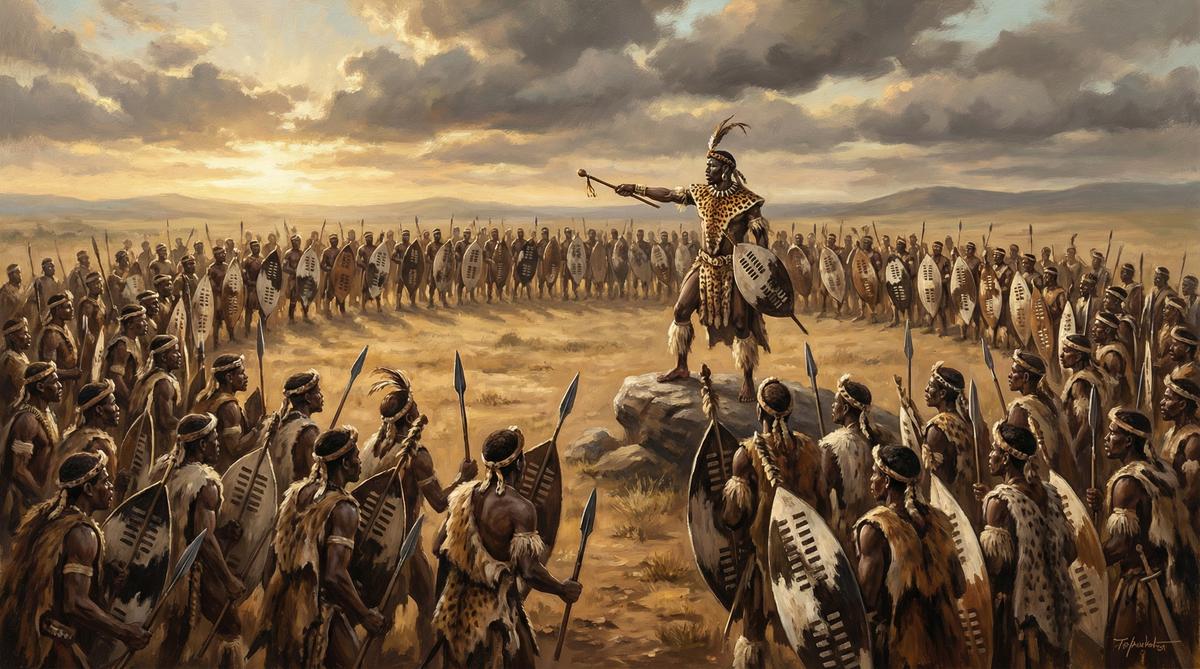
Into this volatile environment stepped a man who would become a legend: Shaka, an illegitimate son of a minor Zulu chief. Exiled and humiliated, Shaka found refuge with the powerful Mthethwa paramountcy under the chief Dingiswayo. It was here that he honed his revolutionary military and political ideas. Shaka was not just a warrior; he was a systems builder. He took the existing age-grade regiments (amabutho) and transformed them from a form of social organization into a standing army, a professional and disciplined fighting force.
He re-armed his warriors, replacing the long, throwing spear with a short, broad-bladed stabbing spear, the iklwa, forcing soldiers to close with the enemy in brutal, close-quarters combat. He developed the famous “buffalo horns” formation (impondo zankomo), a tactic that allowed his forces to encircle and annihilate their enemies. Discipline was absolute, and failure was met with death. Shaka’s Zulu were not just an army; they were a machine, ruthlessly efficient and utterly loyal to him.
When Dingiswayo was killed by a rival, Shaka seized his moment. He returned to the Zulu, took control, and unleashed his new military machine on the surrounding chiefdoms. The old ways of limited warfare were over. Shaka’s wars were wars of total conquest. Defeated clans were not just subjugated; they were either completely destroyed or forcibly assimilated into the growing Zulu state. Their young men were incorporated into the Zulu amabutho, their women and cattle taken, their identity erased. This was the engine of the Mfecane.
The Crushing: A Cascade of Violence
The rise of the Zulu Kingdom did not happen in a vacuum. It sent a shockwave across the entire subcontinent. The Mfecane was a domino effect of terror. Chiefdoms fleeing from the Zulu advance crashed into their neighbors, creating a cascade of violence and displacement that spread for a thousand miles. Entire peoples were uprooted, becoming militarized refugees who adopted the Zulus’ own brutal tactics to survive.
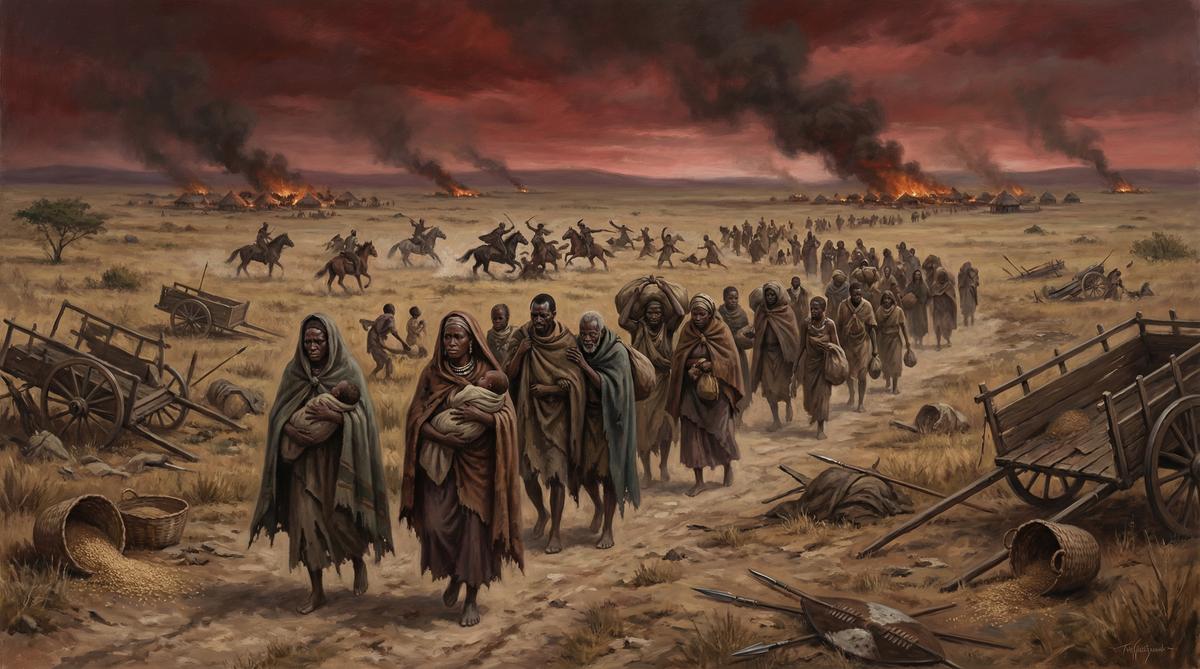
Groups like the Ngwane and the Hlubi were driven from their lands, becoming predators in their own right. Soshangane, a former general of a rival chiefdom, fled north to what is now Mozambique and carved out the Gaza Empire. Mzilikazi, one of Shaka’s own lieutenants, broke away after a dispute and led his Ndebele people on a devastating migration, eventually establishing a kingdom in modern-day Zimbabwe. They cut a bloody swath across the highveld, leaving a trail of destruction and depopulated lands.
This was a civil war on a continental scale. It was not a conflict between distinct nations, but a war of all against all, where today’s victim was tomorrow’s aggressor. The social fabric of the region was shredded. Famine became rampant as fields were abandoned and cattle seized. Cannibalism, once a taboo, became a desperate means of survival in the ravaged landscapes. It is estimated that between 1 and 2 million people died during the Mfecane. It was a period of almost unimaginable suffering, a “time of troubles” that fundamentally reshaped the political and demographic map of Southern Africa.
The Lesson: When the Center Cannot Hold, Savagery Follows
The Mfecane holds a terrifyingly relevant lesson for a polarized America. The clash in Minnesota between federal agents and state authorities is a symptom of a deeper sickness: the breakdown of a shared national identity and the erosion of the institutions that mediate conflict. Like the Nguni chiefdoms before the rise of Shaka, we have taken our internal stability for granted. We assume that our disagreements will remain within the bounds of political debate and legal challenges. The Mfecane shows that when those bounds are broken, the consequences are catastrophic.
Shaka’s revolution was to replace negotiation and ritual with total war. He demonstrated that a ruthless, disciplined minority could impose its will on a fractured majority. The current crisis in America reveals a similar dynamic. A president, claiming “absolute immunity,” uses federal agents as a personal paramilitary force, ignoring judicial rulings and daring state authorities to respond. This is a direct challenge to the very idea of a federal system, a move to replace the rule of law with the rule of force.
The result, as in Southern Africa, is a cascade of conflict. When the governor of a state feels compelled to place his National Guard on standby to protect his citizens from the federal government, the system is already broken. We are witnessing the first tremors of a potential green-on-green conflict, a scenario where American soldiers are ordered to fire on other American soldiers. This is the Mfecane in modern dress. It is the logical endpoint of a political culture that has abandoned compromise in favor of a zero-sum struggle for power.
The Action: Surviving the American Mfecane
We are not in 19th-century Africa. But the patterns of history are clear. When a state turns on itself, when its institutions of conflict resolution fail, the result is chaos. The events in Minnesota are not an isolated incident; they are a warning. The time to prepare for a future of increasing instability is now.
This is not a counsel of despair. It is a call for radical self-reliance. The systems we have depended on are showing their fragility. We must build our own.
1. Forge Your Own “Amabutho”: In the chaos of the Mfecane, the only safety was in the strength of the group. It’s time to build your own mutual assistance group (MAG). Don’t wait for the crisis. Start now. Identify neighbors you can trust, pool resources, and make a plan. The Self-Reliance Report has a definitive guide on how to start.
2. Secure Your Own Sustenance: The Mfecane was a time of widespread famine. When supply chains break, the grocery store shelves will be empty in hours. You must have your own food source. The 4ft Farm Blueprint is the single best system for producing a massive amount of food in a tiny space. It is your ultimate insurance policy against hunger.
3. Master Practical Skills: In a crisis, academic knowledge is useless. Practical skills are everything. Can you purify water? Start a fire? Treat a wound? Homesteader Depot is a treasure trove of practical knowledge for a self-reliant life. Start learning now.
4. Understand the Threat: The greatest danger is not knowing what’s coming. Stay informed about the real threats to our stability. Survival Stronghold provides no-nonsense analysis of the risks we face and the steps you can take to mitigate them.
5. Invest in Your Health: A broken system cannot keep you healthy. You must take control of your own well-being. Seven Holistics offers a wealth of knowledge on natural health and healing, helping you become independent of a fragile and overburdened healthcare system.
The Crushing is not just a historical event. It is a recurring pattern of human behavior. The warning from the past is clear. The time to act is now. Do not wait to be swept away by the tide. Build your own fortress of self-reliance. It is the only thing that will endure the coming storm.