A special report from Shamus Gerry III
A constitutional order is not a piece of paper. It is a gentleman’s agreement. It survives only as long as all parties, especially the most powerful, agree to abide by the rules, even when they lose. When a leader decides the rules no longer apply to them, the agreement is broken.
And the system begins to die.
This is the precipice on which America now stands.
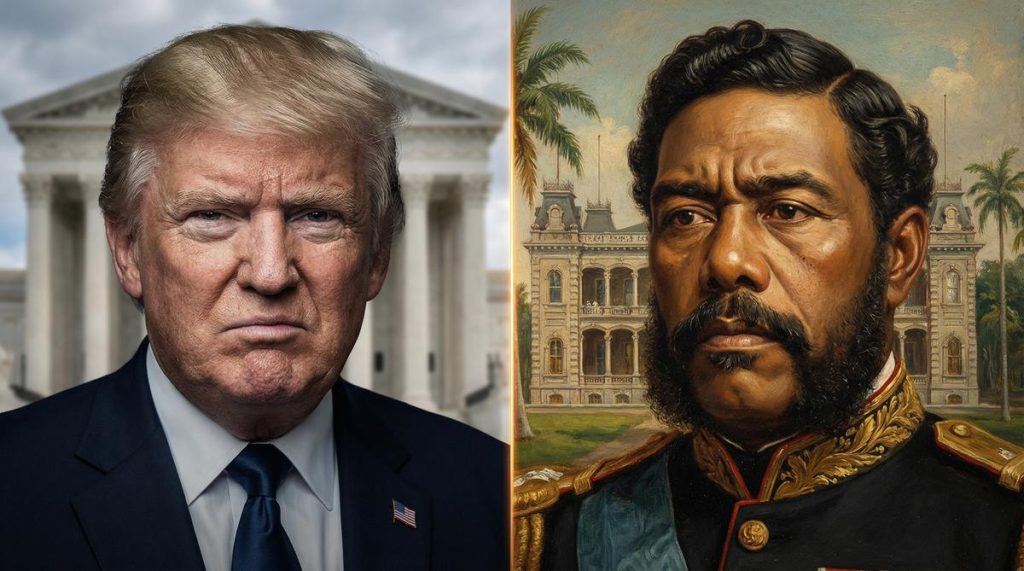
Yesterday, the Supreme Court of the United States, in a landmark 6-3 decision, struck down President Trump’s global tariffs, declaring he had unconstitutionally usurped the power of Congress. The ruling was a clear rebuke, a reassertion of the separation of powers that underpins the entire American experiment.
The President’s response was not one of sober reflection. It was a roar of defiance.
He called the justices—including his own appointees who voted against him—”fools” and “lap dogs.” He declared himself “ashamed” of the institution. Then, within hours, he announced he would simply use a different, obscure law—Section 122—to impose a new 10% global tariff anyway.
He was told “no” by the highest court in the land, and his answer was to find another way to do what he wanted.
It feels like a moment of unprecedented crisis, a singular challenge to the rule of law.
It is not.
One hundred and forty years ago, on the other side of the world, another head of state was told “no.” His name was King Kalākaua of Hawaii. And the story of how he was stripped of his power, how he tried to resist, and how his kingdom was ultimately consumed by the forces he could no longer control, is a terrifyingly precise blueprint for the constitutional death spiral America is now entering.
The Sugar Barons and the Gilded Cage
In the 1880s, the Hawaiian Kingdom was a sovereign nation, but its economy was a colony. A small group of wealthy American and European sugar planters, known as the “missionary boys,” controlled the vast majority of the islands’ wealth. They dominated the legislature and the economy, but they did not control the King.
King Kalākaua, the “Merrie Monarch,” was a proud nationalist. He believed in a Hawaii for Hawaiians. He spent lavishly on projects to bolster Hawaiian culture and national identity, including the construction of the magnificent ‘Iolani Palace.
To the foreign business elite, this was wasteful spending and, more dangerously, a threat to their control.
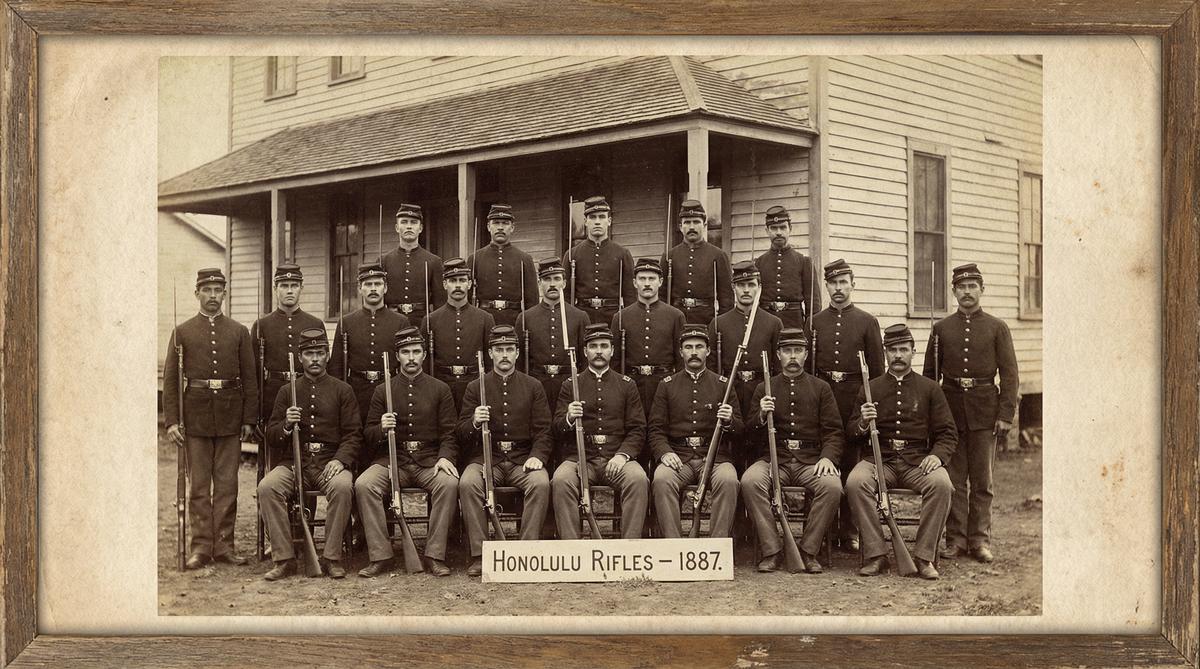
In 1887, this cabal of businessmen formed a secret society: the Hawaiian League. Their goal was simple — to end the monarchy and annex Hawaii to the United States. Their military arm was a militia of 1,500 men, the Honolulu Rifles.
They saw the King not as their sovereign, but as an obstacle.
An obstacle that needed to be removed.
The Day the Guns Entered the Palace
On July 6, 1887, the Hawaiian League made its move. Backed by the armed Honolulu Rifles, they presented King Kalākaua with a new constitution, one they had drafted themselves in secret over less than a week. It was a document designed to do one thing: strip the King of all meaningful power.
It would become known as the Bayonet Constitution.
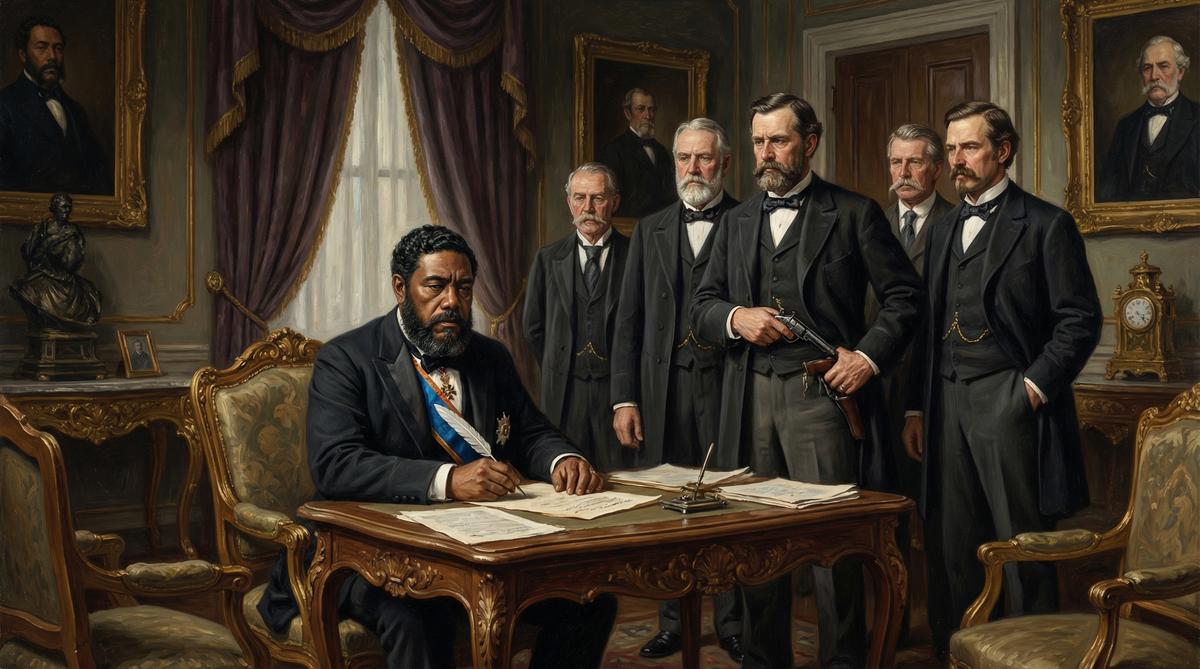
The new constitution was a legal coup. It gave the legislature, controlled by the foreign elite, the power to override the King’s veto. It made the King’s cabinet answerable only to the legislature, not to the monarch. Most critically, it changed the voting rights.
It allowed any wealthy American or European resident to vote, while disenfranchising the vast majority of native Hawaiians through steep property and income requirements. To vote for the upper house, a citizen needed an annual income of $600 or property worth $3,000 — the equivalent of roughly $21,500 and $107,500 today.
This excluded an estimated two-thirds of the native Hawaiian population.
King Kalākaua was given a choice: sign, or be deposed. With guns at his back and no loyal forces to call upon, he signed. The gentleman’s agreement was broken. The King had been told “no,” not by a court, but by the raw force of his own subjects.
The Lesson: Defiance is the Final Act
The parallel to today is not in the details, but in the terrifyingly simple human drama. A leader, believing in his own authority, is checked by another power center.
What happens next determines the fate of the nation.
King Kalākaua did not simply accept his fate. He spent the rest of his reign trying to find ways around the Bayonet Constitution, seeking to restore the power he had lost. His sister, Queen Liliʻuokalani, who succeeded him after his death in 1891, went further.
In January 1893, she proposed a new constitution to restore the monarchy’s power. 6,500 of 9,500 registered voters signed petitions supporting her.
The Hawaiian League’s response was immediate and final.
They overthrew her. They abolished the monarchy. They established a republic with Sanford B. Dole—the man who had called the original meeting to order—as its president.
Within six years of the Bayonet Constitution, the Hawaiian Kingdom was gone. Annexed by the United States. Erased from the map of sovereign nations.
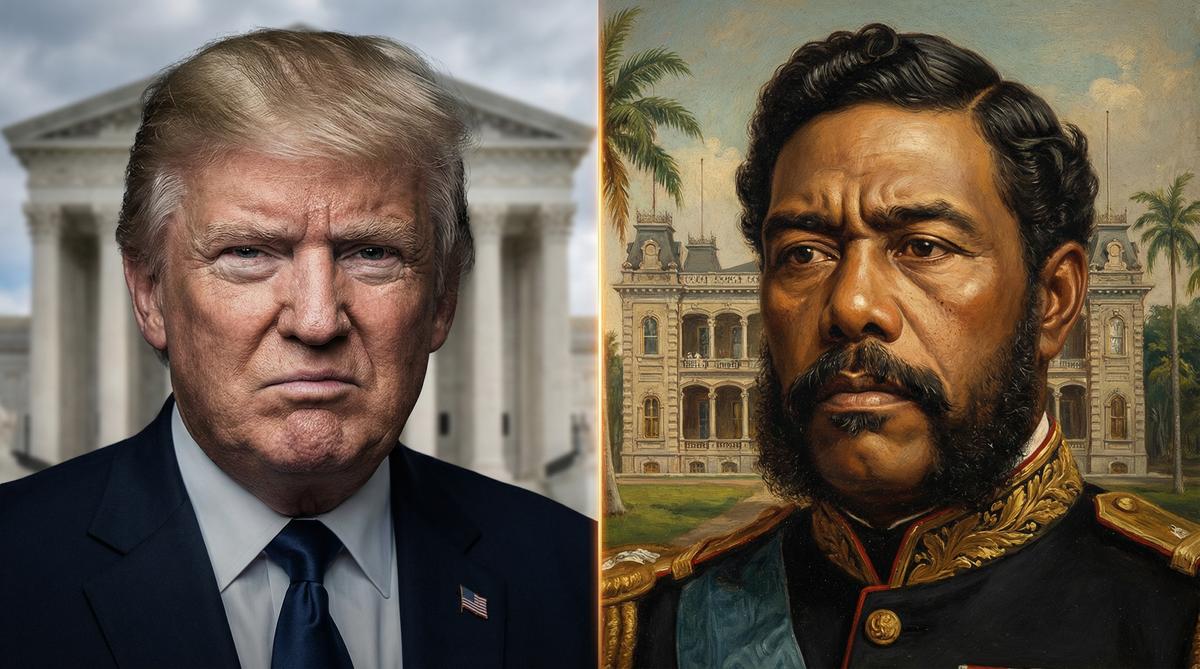
The lesson is clear: when a leader defies the constitutional limits placed upon them, the crisis does not de-escalate. It accelerates.
The other institutions of the state do not simply yield; they push back harder. The conflict becomes existential. The system fractures.
President Trump, by lashing out at the Supreme Court and immediately invoking a new law to bypass their ruling, is following the same path as Hawaii’s doomed monarchs. He is refusing to accept the “no.” He is treating the rule of law not as a sacred boundary, but as a temporary obstacle to be circumvented.
He is forcing a confrontation between the executive and the judiciary that the system may not be able to withstand.
The question is no longer about tariffs. It is about whether the American system can survive a leader who refuses to be bound by it.
The Action: Build Your Own Kingdom
When the very foundations of the state are cracking, when the leaders of the nation are at war with its own institutions, who can you rely on?
The answer is not in Washington. The answer is not in the courts.
The answer is in the mirror.
True sovereignty is not granted by a government; it is built with your own two hands. It is the security of knowing you can provide for your family, no matter what happens in the halls of power.
The chaos in Washington is a blaring siren, a final warning that the time to depend on these fragile systems is over.
That is why we created the 4ft Farm Blueprint. It is not just a guide to growing food. It is a declaration of independence. It is a step-by-step plan for building your own small, resilient kingdom in a world of failing empires. It is the practical knowledge you need to insulate yourself and your family from the constitutional crisis that is now unfolding.
To understand the full scope of the challenges we face and the solutions available, explore our network of resources:
- HomesteaderDepot.com: Tools and knowledge for the self-reliant life.
- SelfRelianceReport.com: In-depth analysis of the threats to our freedom.
- SurvivalStronghold.com: Strategies for protecting your family in a crisis.
- SevenHolistics.com: Health independence from a broken medical system.
The story of Hawaii is a tragedy. It does not have to be ours.
But that choice is up to you.