A 2,000-year-old warning about what happens when rulers target the intellectuals
The Modern Mystery
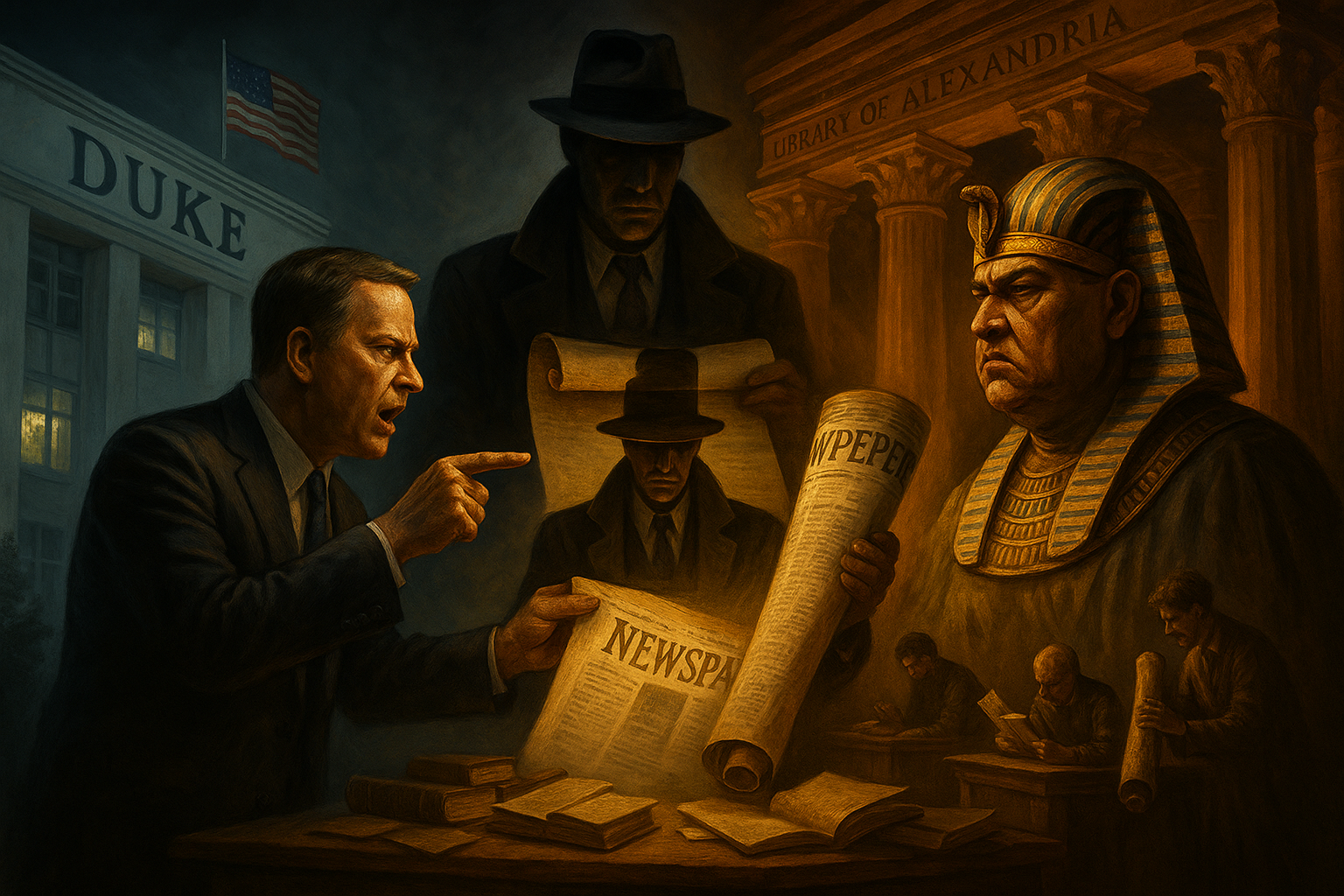
Something strange is happening in the marble halls of American academia, and it has the eerie familiarity of a story told before—exactly 2,169 years ago, to be precise.
The headlines read like a bureaucratic thriller: the White House has frozen $108 million in federal funds to Duke University over allegations of racial discrimination. But this isn’t just about Duke. It’s part of a broader campaign targeting what the administration calls “bastions of antisemitism and ideological indoctrination” across America’s elite universities. The pattern is unmistakable—prestigious institutions finding themselves in the crosshairs, their federal lifelines threatened, their scholars and administrators walking on eggshells.
At first glance, it looks like modern politics as usual. But dig deeper, and you’ll find something unsettling: this exact scenario has played out before, in a time when the Mediterranean world’s greatest center of learning faced a ruler who saw intellectuals not as assets, but as threats. The parallels are so precise they seem almost scripted, as if history is running the same program with different actors.
What happened when the ancient world’s most powerful leader decided that scholars were the enemy? What drove a ruler to systematically dismantle the very intellectual infrastructure that made his empire great? And most importantly, what can a 2,000-year-old political crisis teach us about the forces at work in America today?
The answers lie in the dusty archives of Ptolemaic Egypt, in the story of a king whose paranoia about intellectuals would echo through the centuries. His name was Ptolemy VIII Physcon—”Pot-belly” to his enemies—and his war against the scholars of Alexandria offers a chilling preview of what happens when political power collides with academic freedom.
#
The Time Portal
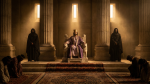
Picture Alexandria in 145 BC: the greatest city in the world, where the lighthouse of Pharos cast its beam across waters thick with merchant ships from India, Arabia, and the far reaches of the known world. The air hummed with a dozen languages as scholars debated in the Museum’s colonnaded halls, their voices mixing with the scratch of reed pens on papyrus and the soft footfalls of slaves carrying scrolls between the Library’s countless shelves.
This was the intellectual capital of the ancient world, home to minds that measured the Earth’s circumference, dissected human bodies, and preserved the works of Homer for posterity. Aristarchus of Samothrace, the greatest literary critic of his age, spent his days unraveling the mysteries of ancient Greek poetry. Apollodorus of Athens chronicled the rise and fall of civilizations with mathematical precision. Foreign scholars flocked here from across the Mediterranean, drawn by royal patronage and the promise of unlimited access to humanity’s accumulated knowledge.
But in the summer of 145 BC, everything changed.
Ptolemy VIII Euergetes II—known to his subjects by the less flattering nickname “Physcon” or “Pot-belly”—had just seized control of Egypt after his brother’s death in Syria. At 37 years old, he was a man shaped by decades of civil war, exile, and bitter family feuds. His face, preserved on coins, shows the heavy features that earned him his cruel nickname, but his eyes reveal something more dangerous: the calculating gaze of a ruler who trusted no one.
Physcon had spent years watching from the sidelines as Alexandria’s intellectuals flourished under his brother’s patronage. He’d seen how these foreign scholars commanded respect, how their words carried weight in the royal court, how they formed networks that transcended political boundaries. To a paranoid ruler fresh from victory, they looked less like assets and more like threats—independent minds with international connections, loyal to ideas rather than kings.
The new pharaoh’s solution was as brutal as it was systematic. If the intellectuals wouldn’t serve his vision of Egypt, they wouldn’t serve at all.
What happened next would send shockwaves across the ancient world and mark the beginning of the end for Alexandria’s golden age of learning.
#
The Parallel Revelation
The massacre began at dawn. Ptolemy VIII’s soldiers moved through Alexandria’s intellectual quarter with lists of names—prominent scholars, foreign intellectuals, anyone whose loyalty might be questioned. Aristarchus of Samothrace, the man who had spent decades preserving Homer’s poetry for future generations, was among the first to die. Apollodorus of Athens, whose chronological works had become the standard reference for ancient history, fell alongside him.
But the killing was just the beginning. Those scholars who escaped the initial purge faced a choice that would echo through the centuries: flee or submit. Most chose exile, abandoning their life’s work to seek refuge in Athens, Rhodes, and other Greek cities. The great brain drain had begun.
Sound familiar? Fast-forward 2,169 years, and the pattern repeats with stunning precision.
Today’s weapon isn’t the sword—it’s the federal funding freeze. The White House’s $108 million suspension to Duke University sends the same message Ptolemy VIII’s soldiers delivered in Alexandria: conform or face consequences. The accusations are different—”antisemitism” and “ideological indoctrination” instead of disloyalty to the crown—but the underlying psychology is identical. Both rulers saw prestigious intellectual institutions as threats to their political control.
The parallels run deeper than mere tactics. Both Ptolemy VIII and today’s administration target specifically the elite institutions—not the local schools or community colleges, but the prestigious centers that command international respect. Alexandria was the Harvard of the ancient world; Duke, Harvard, and their peers occupy the same cultural position today. Both rulers understand that controlling these institutions means controlling the narrative of intellectual legitimacy.
Even more striking is the selective nature of the persecution. Ptolemy VIII didn’t target all scholars—just the foreign ones, the independent thinkers, those whose loyalty seemed questionable. Today’s pressure focuses on universities that have taken positions on controversial issues, that house scholars whose research challenges certain political narratives. In both cases, the message is clear: intellectual independence is acceptable only within carefully defined boundaries.
The human psychology driving both crises is remarkably consistent. Ptolemy VIII, despite his persecution of scholars, was himself an intellectual—he wrote 24 books of commentary and considered himself a patron of learning. Similarly, today’s political leaders often claim to value education while simultaneously undermining educational institutions. This isn’t hypocrisy; it’s something more complex—the desire to control rather than destroy intellectual life.
The results, too, follow the same pattern. Just as Alexandria’s scholars fled to Athens and Rhodes, today’s academics are already beginning their own exodus. International students are choosing universities in other countries. Prominent researchers are accepting positions abroad. The brain drain that began in Ptolemaic Egypt is starting again in America, and for exactly the same reasons: when political power views intellectual independence as a threat, the intellectuals don’t stick around to find out what happens next.
History doesn’t repeat, Mark Twain supposedly said, but it rhymes. In this case, it’s rhyming with the precision of a Homeric epic.
#
The Pattern Recognition
Why does this pattern repeat across millennia? Why do rulers, separated by two thousand years and vastly different political systems, reach for the same playbook when dealing with intellectual institutions?
The answer lies in the fundamental tension between political power and independent thought. Intellectuals, by their very nature, are dangerous to authoritarian impulses. They ask inconvenient questions, preserve inconvenient truths, and maintain networks that transcend political boundaries. Most threatening of all, they command a form of authority that doesn’t derive from political appointment—the authority of expertise, of careful reasoning, of accumulated knowledge.
Ptolemy VIII understood this instinctively. The scholars of Alexandria weren’t just studying Homer and mathematics; they were preserving and transmitting a culture that predated his dynasty and would likely outlast it. Their loyalty was to truth, to their disciplines, to their international community of peers—not to him. In a world where political legitimacy depended on personal loyalty, this made them inherently subversive.
The same dynamic drives today’s tensions. Universities aren’t just educational institutions; they’re repositories of cultural memory, centers of critical thinking, and training grounds for future leaders. They operate according to principles—academic freedom, peer review, evidence-based reasoning—that can conflict with political expedience. When scholars conclude that certain policies are harmful, or when their research challenges preferred narratives, they become obstacles to political control.
This explains why the pattern is so consistent across cultures and centuries. It’s not about ideology—Ptolemy VIII wasn’t a conservative or liberal in any modern sense. It’s about the eternal conflict between those who seek to control information and those whose job it is to discover and preserve it. The weapons change—swords become funding freezes—but the underlying dynamic remains the same.
The tragedy is that both sides usually lose. Rulers who attack intellectual institutions may gain short-term political victories, but they ultimately weaken the very foundations of their civilization’s greatness. And intellectuals, for all their expertise, often underestimate how quickly political winds can shift and how vulnerable their seemingly secure positions really are.
#
The Ancient Warning
The aftermath of Ptolemy VIII’s scholar purges offers a sobering preview of what happens when political paranoia triumphs over intellectual freedom.
Alexandria never recovered. The city that had been the undisputed center of Mediterranean learning became just another provincial capital. The scholars who fled to Athens and Rhodes took their knowledge with them, but they also took something more precious: the institutional memory of how great scholarship actually works. The networks of collaboration, the traditions of rigorous inquiry, the accumulated wisdom of generations—all of it scattered to the winds.
Ptolemy VIII ruled for another 29 years after his first massacre, and he never stopped looking over his shoulder. In 126 BC, after a civil war with his sister, he carried out another purge of Alexandrian intellectuals. Each wave of persecution made him more isolated, more dependent on a shrinking circle of loyalists, more vulnerable to the very threats he thought he was preventing.
The king who had feared that intellectuals would undermine his power discovered that destroying them had made him weaker, not stronger. Without the scholars who had made Alexandria great, Egypt became increasingly irrelevant in a world where knowledge was power. The Ptolemaic dynasty limped on for another century, but it was already a shadow of its former self.
The warning is clear: civilizations that turn on their own intellectual institutions don’t just lose their scholars—they lose their future. The brain drain that began in Alexandria 2,000 years ago is starting again today. The only question is whether we’re wise enough to learn from Ptolemy VIII’s mistake before it’s too late.
#
Five Things You Can Do This Week to Prepare for History Repeating Itself
If the Ptolemy VIII parallel teaches us anything, it’s that intellectual crises can escalate quickly and have lasting consequences. Here are five practical steps you can take to prepare yourself and your family for potential disruptions to educational and intellectual institutions:
1. Diversify Your Information Sources
Don’t rely solely on institutions that might be vulnerable to political pressure. Build a personal library of books, subscribe to international publications, and cultivate relationships with thinkers across different platforms and countries. If domestic institutions become compromised, you’ll need alternative sources of reliable information.
2. Invest in Portable Skills and Knowledge
Focus on developing skills and acquiring knowledge that can’t be easily taken away or controlled. Learn languages, master practical skills, and build expertise that remains valuable regardless of political changes. The scholars who fled Alexandria survived because their knowledge was portable.
3. Build International Networks
Cultivate relationships beyond your immediate political environment. Professional associations, online communities, and international collaborations can provide alternatives if domestic institutions become unreliable. The ancient scholars who had connections in Athens and Rhodes had somewhere to go when Alexandria became dangerous.
4. Support Independent Educational Initiatives
Contribute to libraries, independent schools, online educational platforms, and other institutions that operate outside the traditional funding structures. These alternatives become crucial when mainstream institutions face political pressure.
5. Document and Preserve Important Information
Create personal archives of important documents, research, and cultural materials. History shows that periods of political upheaval often involve the loss or destruction of valuable information. What you preserve today might be invaluable tomorrow.
The scholars of Alexandria thought their institution was too important, too established, too valuable to be seriously threatened. They learned otherwise. The time to prepare for intellectual disruption is before it happens, not after.
This article is part of the AmericanDownfall.com series exploring how ancient history illuminates modern political patterns. For more historical parallels that shed light on contemporary events, visit our archive of time-traveling political analysis.