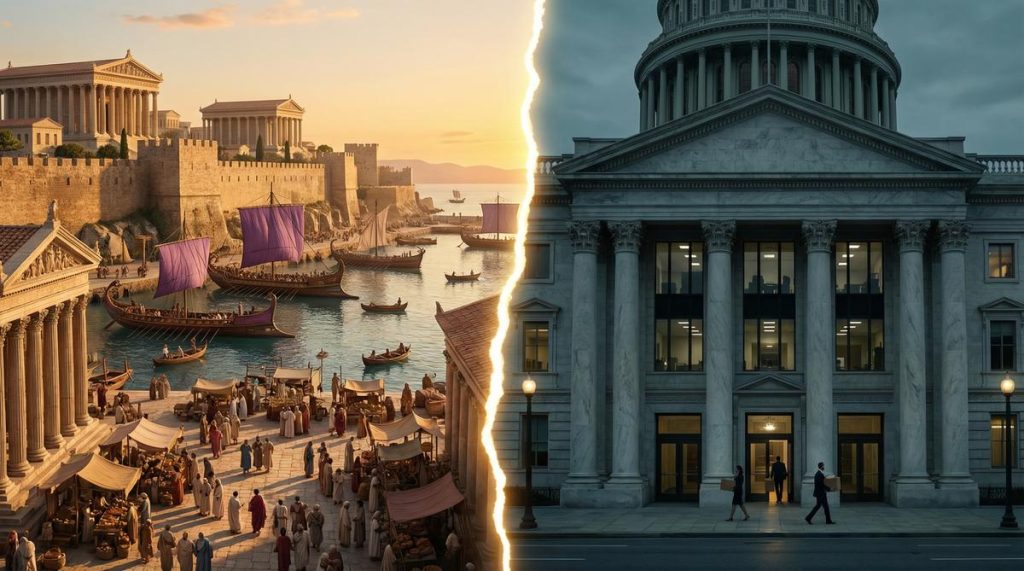
The news cycle is a blur of tariffs and trade wars. But the real story isn’t about what’s being built up at the border.
It’s about what’s being quietly dismantled at the heart of the American empire.
A staggering 12% of the entire U.S. federal workforce has been eliminated in just over a year.
That’s 386,826 jobs. Gone. The Treasury Department — the agency that manages the nation’s finances — has been gutted by 24%. Health and Human Services, the department responsible for public health, also cut by 24%. In the nation’s capital, 56,000 jobs have vanished, creating the worst regional job loss in the United States.
This is not a budget cut.
This is a systematic dismantling of the institutional machinery that runs a global superpower.
And it has happened before.
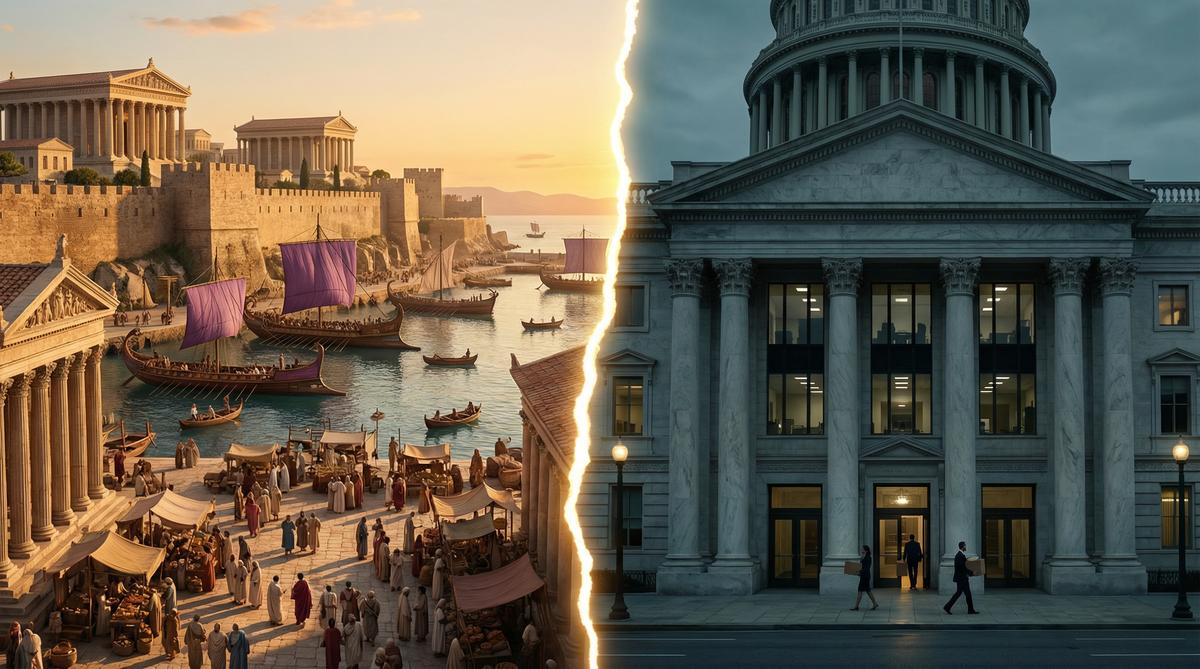
To understand what this means, we must look back 2,200 years to the shores of North Africa, to the glittering city of Carthage.
The Empire That Had to Be Destroyed
Carthage was the envy of the ancient world. A merchant empire whose trade routes were the arteries of the Mediterranean. Its wealth was legendary, its navy was peerless, and its government was a sophisticated republic that hummed with ruthless efficiency.
But Carthage had a rival. A brutish, land-based power that looked at Carthage’s wealth with envious eyes: Rome.
For over a century, the two superpowers clashed in a series of conflicts known as the Punic Wars. After the second war, a defeated Carthage was stripped of its military, its overseas territories, and forced to pay a crippling war indemnity to Rome.
Rome believed it had neutered its rival forever.
They were wrong.
Within a few short decades, Carthage — without a military — had become so commercially powerful through trade alone that it was once again one of the wealthiest cities in the Mediterranean. Its economic recovery was so stunning, so complete, that it terrified the Roman Senate.
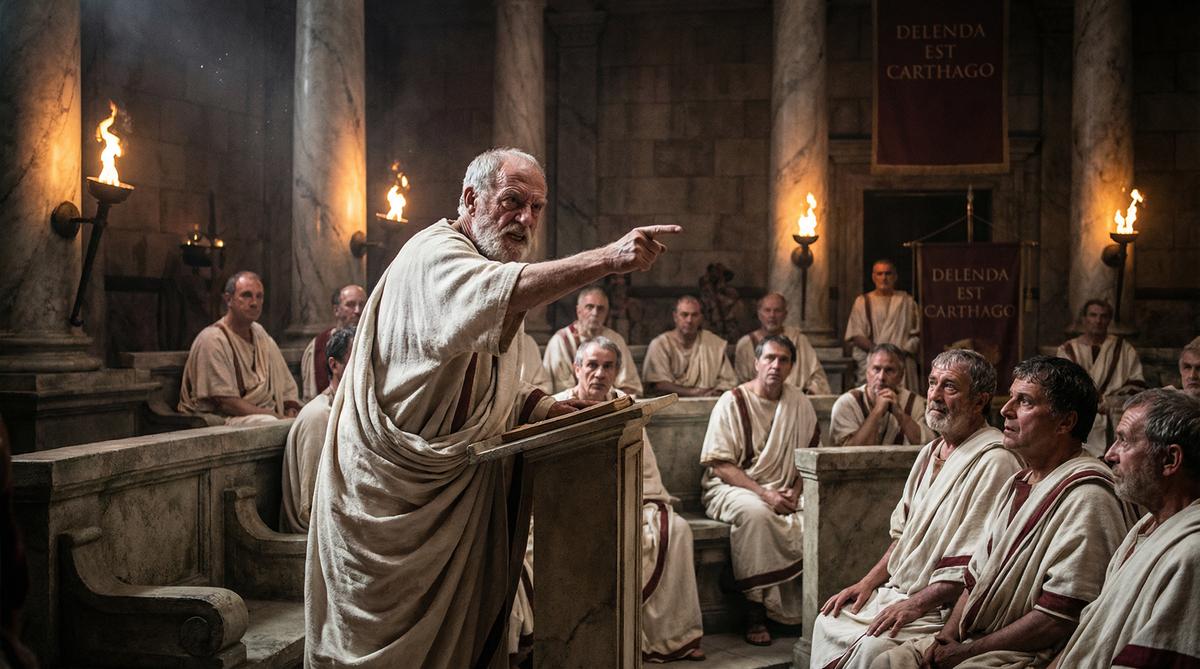
One Roman senator, Cato the Elder, became obsessed. He saw that Carthage’s real power wasn’t in its armies, but in its institutions — its trade networks, its merchant class, its genius for organization. He ended every speech, no matter the topic, with the same chilling phrase:
“Carthago delenda est.”
“Carthage must be destroyed.”
In 146 B.C., Rome finally got its wish. After a brutal three-year siege, the city was annihilated. Its buildings were torn down, its fields were sown with salt, and its people were sold into slavery. Rome didn’t just defeat Carthage; it erased it from the face of the earth.
The Lesson of the Salted Fields
Why? Why would Rome, the undisputed superpower of the age, be so threatened by a demilitarized trading city?
Because Rome understood a terrifying truth: the most dangerous rival is not the one with the biggest army, but the one with the best institutions.
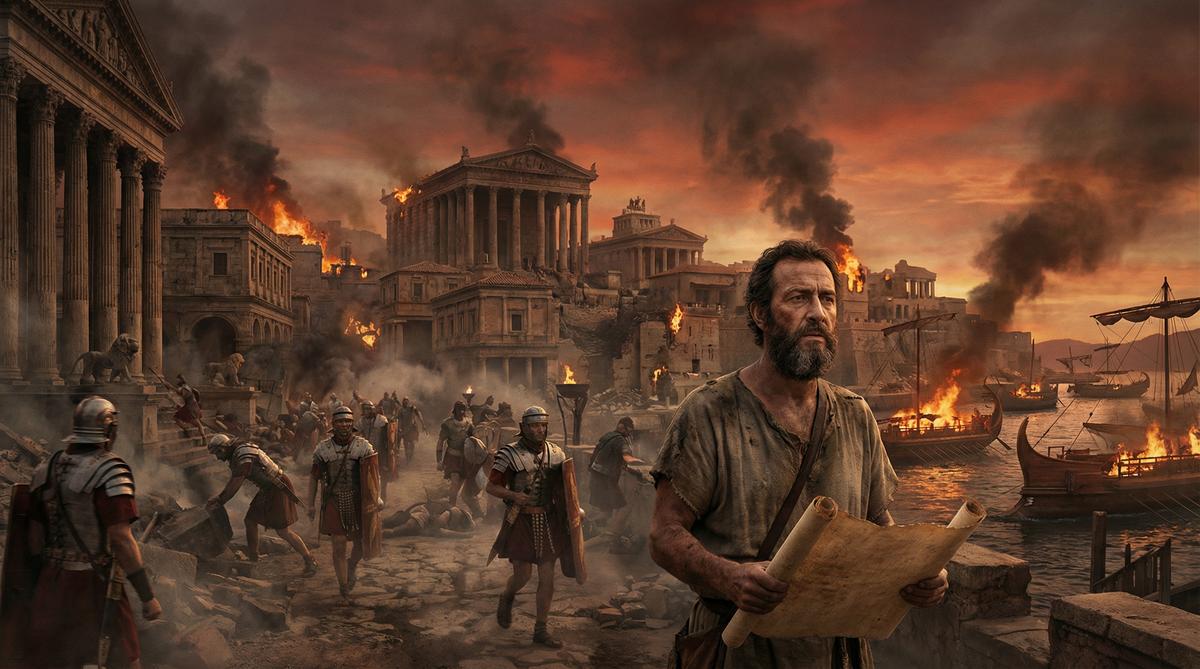
Carthage’s economic miracle was a testament to the power of its system. Even without a military, its ability to organize, trade, and create wealth was a fundamental threat to Rome’s dominance. Rome couldn’t compete with Carthage’s institutions, so it had to destroy them.
This is the ghost in our own machine.
The quiet dismantling of the American federal government is not a cost-saving measure. It is a deliberate attack on the very institutions that built and sustained the American empire for over two centuries.
When you fire 386,826 people who know how the system works — the scientists, the engineers, the diplomats, the regulators, the experts — you are not just cutting fat.
You are salting the fields of your own empire.
You are creating a vacuum.
The DMV region ended 2025 with around 56,000 fewer jobs than it had a year prior, with about 54,000 of these jobs (96%) stemming directly from federal layoffs. Total employment in the region declined by nearly 1.7% — the largest drop among all major metropolitan areas in the United States. — Brookings Institution, March 5, 2026
And unlike Carthage, which was destroyed by an external enemy, America is salting its own fields.
From the inside.
The Turn: The Path to Resilience
It is easy to look at this hollowing out of our own government and feel a sense of despair. To see the echoes of Cato’s destructive obsession in our own headlines.
But history teaches another, more powerful lesson.
When the great, centralized systems fail, they create a vacuum. And into that vacuum rushes the opportunity for something new.
The survivors of Carthage’s destruction weren’t the ones who clung to the dying system. They were the ones who scattered across the Mediterranean, who built new trade routes, new communities, and new ways of life. The Carthaginian merchant class — the very thing Rome feared — didn’t disappear. It adapted.
This is not a call to hide from the world. It is a call to build a better one, starting in your own backyard.
The dismantling of the old system, however chaotic, is also an opportunity. It is a chance to reclaim our own sovereignty, to build resilient communities, and to create systems that serve us — not the other way around.

The Action: The Blueprint for Hope
Building a resilient future starts with a single, powerful step: taking control of your own food supply.
The 4ft Farm Blueprint is not just about survival; it’s about sovereignty. It’s the first chapter in your family’s story of independence — a story where you are the builder, not the victim. Even in a 4-foot space, you can begin to build the kind of institutional resilience that empires envy.
As the old systems falter, the ability to provide for yourself and your community becomes the ultimate currency. Learn how to build your own food-producing ecosystem and declare your independence from the fragile supply chains of a dismantled empire.
To further your journey toward self-reliance, explore the resources our sister sites offer:
- Homesteader Depot — Your source for the tools and knowledge to build a productive homestead. The Carthaginian merchants who controlled their own resources were the ones who survived.
- Self Reliance Report — In-depth guides for becoming truly self-sufficient. Self-reliance is the one institution that can never be dismantled by a government decree.
- Survival Stronghold — The best gear and strategies for when the system fails completely. When the government salts its own fields, you’d better have your own stockpile.
- Freedom Health Daily — Take control of your health. With 24% of HHS gone, a resilient life requires a resilient body — and you can’t outsource that to a gutted agency.
- The Ready Report — Premium insights for those who want to be two steps ahead of the crisis. The Carthaginian elite saw the writing on the wall. This is where you go to read it first.