The U.S. national debt just breached $39 trillion.
To service that debt, the Treasury is now paying over $1.2 trillion a year in interest alone. That is more than we spend on national defense. It is more than we spend on Medicare.
We are borrowing money just to pay the interest on the money we already borrowed.
At the same time, the U.S. is burning between $1 billion and $2 billion every single day to fund the ongoing conflict in Iran. Oil prices have surged past $106 a barrel, driving up the cost of everything from groceries to gasoline.
To offset the bleeding, the government has slashed over 260,000 federal jobs, gutting scientific and administrative expertise built over decades.
We are watching a superpower try to cut its way out of a structural collapse.
The assumption in Washington is that the United States is simply too big, too wealthy, and too central to the global economy to fail. They believe our immense wealth will insulate us from the consequences of our endless spending.
But history proves otherwise.
The most terrifying parallel to America’s current crisis isn’t found in Rome or London. It is found in the sprawling plains of ancient North Africa, during the final days of the Ptolemaic Kingdom of Egypt.
The Empire That Borrowed to Survive
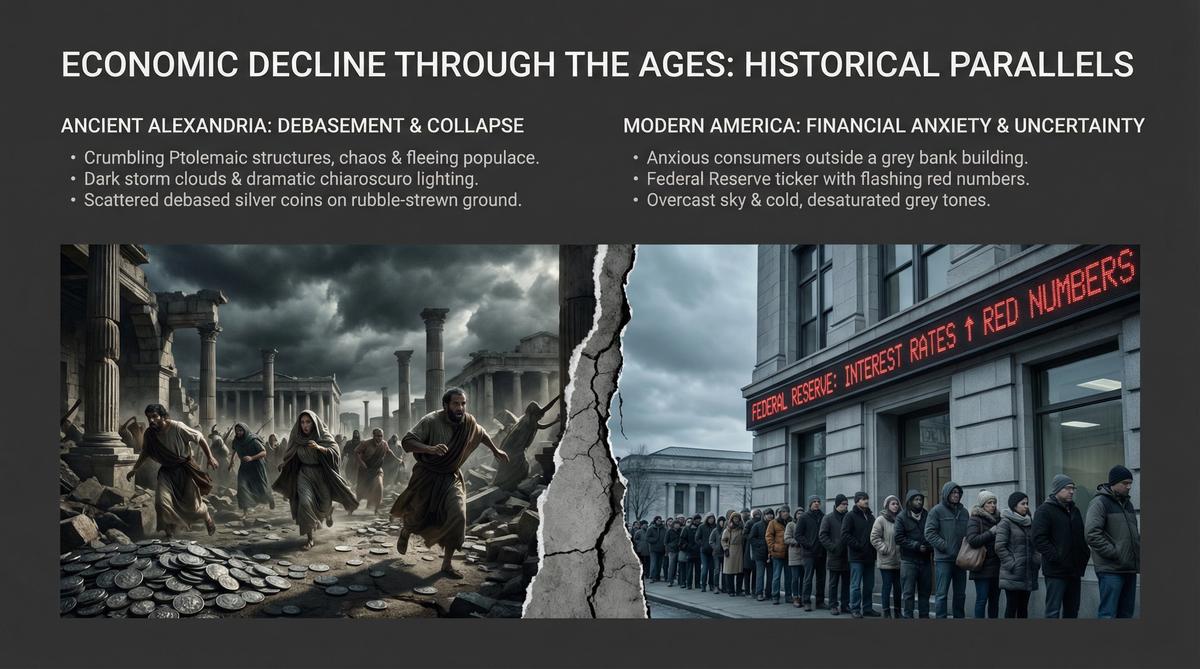
In the centuries following Alexander the Great, the Ptolemaic Kingdom of Egypt was the undisputed economic engine of the Mediterranean.
Stretching across modern-day Egypt and the Levant, the Ptolemies ruled over a vast, wealthy population. They controlled the most lucrative trade routes on earth, exporting grain, papyrus, and gold to every corner of the known world.
At its peak, the Ptolemaic Empire was the wealthiest civilization on earth.
They built the Library of Alexandria and the Pharos Lighthouse. Their capital city was a marvel of architectural brilliance, funded by a treasury that seemed bottomless.
They believed their wealth made them invincible.
But under the rule of the later Ptolemies, the empire made a fatal miscalculation. Instead of consolidating their wealth and investing in their infrastructure, they embarked on a massive, endless cycle of debt and currency debasement.
To finance their lavish lifestyles and continuous foreign wars, rulers like Ptolemy XII began borrowing heavily from Roman creditors. When the debts became too large to service, they did what every failing empire does.
They destroyed their own money.
The Debasement Spiral
When you can no longer afford to pay your debts, you have two choices: default, or print more money. The Ptolemies chose the latter.
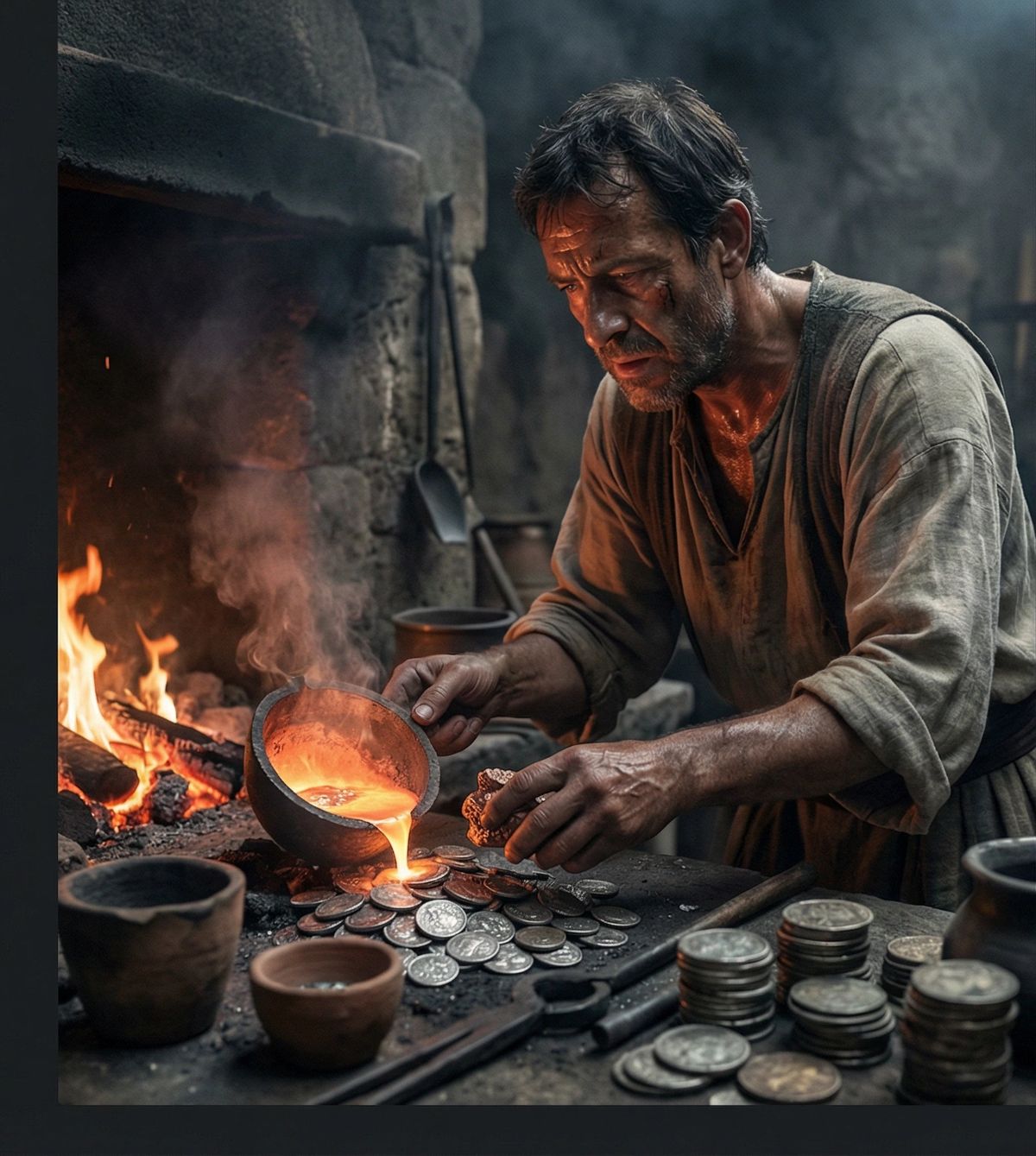
Ptolemy XII engineered a massive devaluation of the silver currency. He melted down the silver drachmae and mixed it with cheap copper. When he was done, the coin’s silver content stood at a mere 33 percent.
It was a hidden tax on the wealth of every citizen in the empire.
His daughter, Cleopatra VII, inherited this financial nightmare. But instead of fixing it, she accelerated the collapse. She cut the silver in Egypt’s currency by another 50 percent to fund her military campaigns and political alliances with Rome.
The result was catastrophic. Annual price inflation soared. The cost of basic goods skyrocketed. The savings of the middle class were wiped out overnight.
The government responded by imposing comprehensive wage and price controls.
They created an army of inspectors to enforce the new rules. When farmers, disgusted by the economic oppression, abandoned their fields, the state forced the remaining workers to cover the production quotas. The pressure applied extended to cruelty and torture.
The system squeezed the working class from every direction.
The Ptolemaic Kingdom didn’t fall because it was conquered by a superior military force. It fell because its economy collapsed from within. By the time Octavian’s Roman legions arrived in 30 B.C., Egypt was already a hollowed-out shell, crippled by debt and hyperinflation.
The Modern “Debasement”
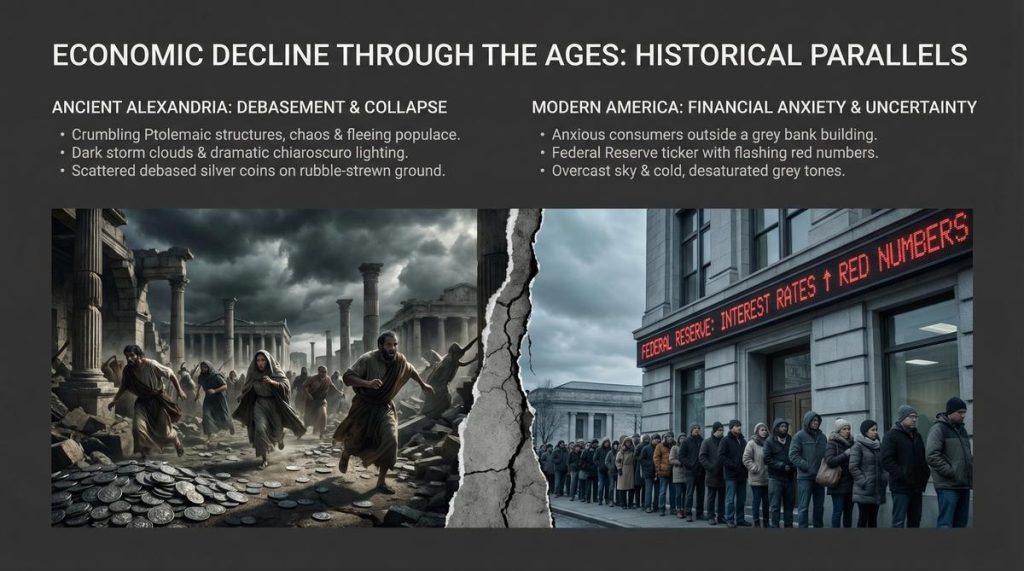
America is currently playing the role of the late Ptolemaic Empire.
We control the global reserve currency. We control the financial chokepoints through SWIFT and sanctions. And we assume the world has no choice but to accept our terms and our debt.
But the math is finally catching up with us.
While Washington fights over Supreme Court rulings and political theater, the financial foundation of the country is cracking. Traders in the futures market have just shifted the probability that the Federal Reserve will raise interest rates by the end of 2026 to over 50%.
The era of cheap money is over. The era of the debt spiral has begun.
Just as Ptolemy XII debased the silver drachmae to pay his Roman creditors, the Federal Reserve has debased the U.S. dollar to fund our $39 trillion national debt. The dollar has sunk roughly 8% in 2025, the most since 2017.
And just as the Egyptian farmers were squeezed by soaring prices and government mandates, the American consumer is being crushed by the highest inflation in a generation.
The Strait of Hormuz conflict has driven gasoline prices to their fastest rise in three decades. The cost of basic necessities continues to climb. Consumer sentiment has plunged, with the short-run economic outlook dropping 14% in a single month.
We are borrowing from the future to pay for the present.
Goldman Sachs has raised its recession probability to 30%. Moody’s puts it at 49%. The economic indicators are all pointing toward a significant contraction.
Yet, instead of reducing the burden on the American people, the government is doubling down on the policies that caused the problem in the first place. They are printing more money, fighting more wars, and pretending the bill will never come due.
The Path to Resilience
It is easy to look at the fragility of these global systems and feel a sense of despair. To see yourself as a pawn in a game of empires, trapped in a cycle of debt and inflation that you cannot control.
But history teaches another, more powerful lesson.
When the great, centralized systems fail, they create a vacuum. And into that vacuum rushes the opportunity for something new. The survivors of the Ptolemaic collapse weren’t the ones who simply hid or waited for the government to save them.
They were the ones who rebuilt. They focused on their local communities, strengthened their own skills, and created resilient networks of trade and mutual support.
This is not a call to hide from the world. It is a call to build a better one, starting in your own backyard.
The end of the American debt super-cycle will be painful for those who rely entirely on the system. But for those who take action now, it is an opportunity to reclaim your independence.

The Blueprint for Hope
Building a resilient future starts with a single, powerful step: taking control of your own resources.
You cannot control the Federal Reserve. You cannot stop the national debt from reaching $40 trillion. But you can control what happens inside your own property lines.
The 4ft Farm Blueprint is not just about survival; it’s about sovereignty. It’s the first chapter in your family’s story of independence, a story where you are the builder, not the victim.
By learning to produce your own food, secure your own water, and build your own local networks, you insulate yourself from the chaos of the centralized economy. You step out of the debasement spiral and into a system of true, tangible wealth.
The time to prepare is not when the crisis is upon us, but before it arrives.
- For daily intelligence on navigating the health impacts of economic stress, read the Freedom Health Daily.
- To learn the hard skills of off-grid independence, explore the Homesteader Depot.
- For advanced tactical strategies on protecting your assets during a currency collapse, join The Ready Report.
- To track the historical cycles that predict these exact events, follow The Pattern Ledgers.
The empire may be falling, but your family doesn’t have to fall with it. Start building today.