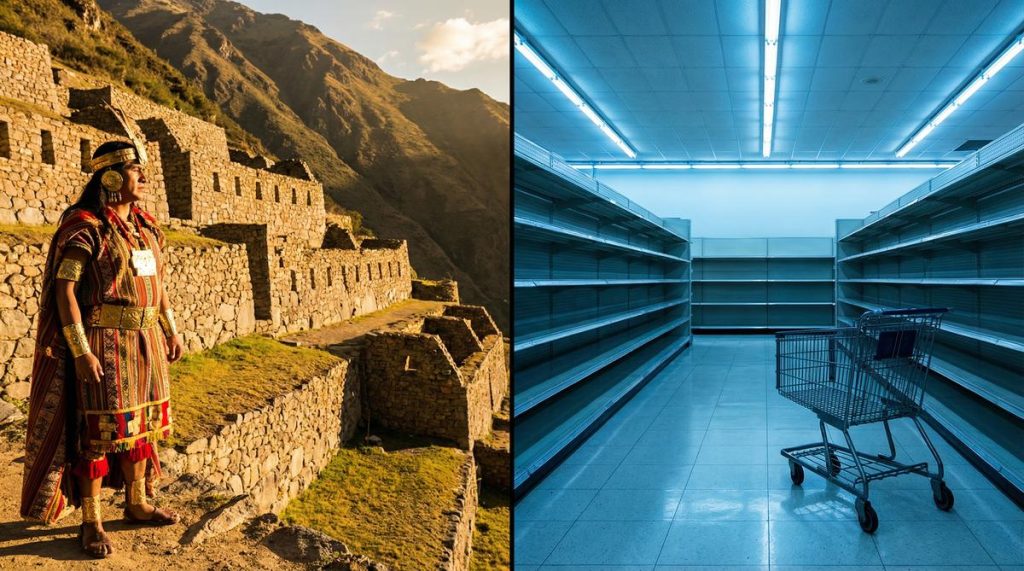
The U.S. economy is currently operating on a razor’s edge of centralized fragility.
While the media fixates on political theater, the underlying math of our supply chain is flashing red. The U.S. dollar has plunged to a three-year low, shedding more than 12% of its value from recent peaks. Goldman Sachs has raised its U.S. recession probability to 30%. Moody’s Analytics puts the odds even higher, at 48.6%.
The illusion of endless abundance is cracking.
The administration’s 145% tariffs on Chinese imports have created a massive chokepoint in global trade. American manufacturers are scrambling. Shipping lanes are being rerouted. And the just-in-time supply chain that stocks your grocery store is operating on a margin of error measured in days, not weeks.
We have built an economy that requires absolute perfection to function.
When a system relies on just-in-time delivery, centralized distribution hubs, and a weaponized reserve currency, it only takes one external shock to bring it down. We are watching the real-time stress testing of the American supply chain.
And history tells us exactly how this ends.
The Empire Without Money
Five hundred years ago, the Inca Empire built the most sophisticated logistical network the ancient world had ever seen.
Stretching over 2,500 miles along the spine of the Andes, Tawantinsuyu — the Inca state — controlled millions of subjects without ever inventing a currency. Instead, they relied on a centralized command economy powered by the mit’a: a mandatory labor tax where every citizen worked for the state, and the state provided for every citizen.
It was the world’s first perfectly planned economy.
The crown jewel of this system was the qullqa network. The Inca constructed thousands of massive stone storehouses across their empire, filled with enough freeze-dried potatoes, maize, and textiles to feed their population for years. Archaeologists have found over 2,500 qullqas in the Mantaro Valley alone.
“Inca officials received two-thirds of a farmer’s crops — over 20 varieties of corn and 240 varieties of potatoes — and stored them in a network of storehouses that stretched the length of the empire.” — Economy of the Inca Empire
They tracked every grain of corn and every pair of sandals using quipus — complex knotted cords that served as ancient databases. The system was a marvel of engineering and central planning.
It was also a single point of failure waiting to be exploited.
The 72-Hour Collapse
Because the Inca economy was entirely top-down, it required the central authority to function.
When Francisco Pizarro and his small band of Spanish conquistadors arrived in 1532, they didn’t need to defeat the entire Inca army. They only needed to capture the emperor, Atahualpa, at Cajamarca. With 168 soldiers, they brought down an empire of 12 million people.
By cutting off the head, the entire body died instantly.
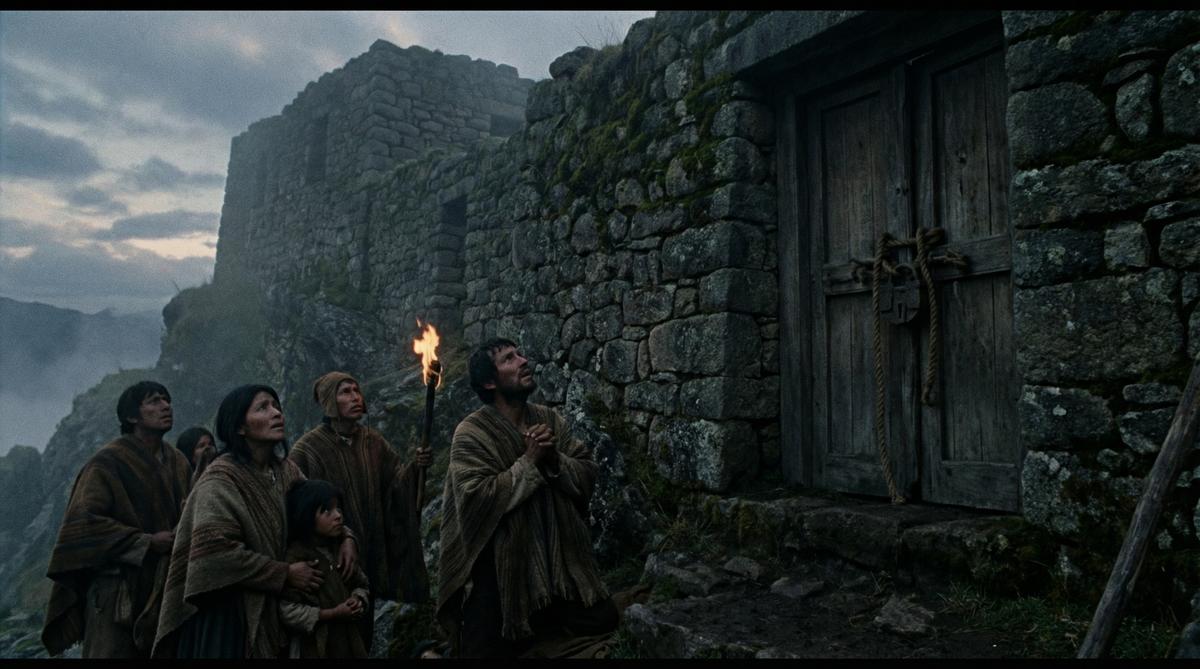
Without the central authority to issue orders via the quipu network, the massive qullqa storehouses sat locked and useless. The mit’a labor system froze. The redistribution of food halted. Communities that had depended entirely on the state for their survival found themselves with no backup plan.
The most perfectly planned economy in the Americas starved while surrounded by its own stockpiles.
The Inca had also spent years fighting a brutal civil war between Atahualpa and his brother Huáscar, weakening their internal resilience before the Spanish ever arrived. They had centralized all power, leaving local communities completely dependent on the state for survival. When the state vanished, the people had nothing.
The Spanish didn’t conquer the Inca through sheer military might. They simply exploited the extreme fragility of a hyper-centralized system.
The Modern Chokepoint
Today, America is running the exact same centralized playbook — just with digital quipus and global shipping lanes.
We do not have local resilience. We rely on a handful of massive ports, a fragile trucking network, and a centralized banking system to deliver our daily bread. The average American grocery store carries only three days of inventory. When the supply chain hiccups, the shelves empty before the problem is even reported on the news.
We are entirely dependent on the modern qullqa.
When tariffs disrupt the flow of goods, or when the dollar loses its purchasing power, the central nodes of our economy begin to seize up. The recent 145% tariff shock on Chinese imports is a stress test on a system already buckling under $39 trillion in national debt and $1.2 trillion in annual interest payments.
We are watching the early stages of a systemic bottleneck. The rising recession odds and the plunging dollar are the modern equivalents of the Spanish arriving on the coast — external shocks hitting a weakened, internally divided empire.
You cannot rely on the state’s storehouses when the system breaks.
Building Your Own Qullqa

The fatal flaw of the Inca was outsourcing their survival to a central authority. The survivors of the coming economic contraction will be those who decentralize their own lives before the crisis arrives.
You must build your own localized resilience now — not when the shelves are empty.
True sovereignty starts in your own backyard.
The 4 Foot Farm Blueprint is your first step toward real independence — teaching you how to generate your own food supply regardless of what happens at the grocery store or in Washington. Even a small raised-bed garden is a hedge against the supply chain.
Pair that with the practical, off-grid strategies found at Homesteader Depot and the daily preparedness intelligence from The Ready Report. You must become your own supply chain.
Protecting your physical health is just as critical when medical supply lines falter. Resources like Freedom Health Daily and Freedom Health Alerts provide the alternative health strategies you need, while Seven Holistics offers natural solutions when pharmacies run dry.
Do not wait for the central system to fail before you act.
For deep-dive analysis on how to protect your wealth from the plunging dollar and the coming economic contraction, follow The Pattern Ledgers and Self Reliance Report. And to understand the broader geopolitical shifts threatening our way of life, stay anchored with Survival Stronghold.
The Inca built the greatest centralized economy the ancient world had ever seen. They had storehouses full of food, a road network that spanned continents, and a bureaucracy that tracked every resource in the empire.
And they starved while surrounded by their own abundance, because they forgot how to feed themselves.
Don’t make the same mistake.