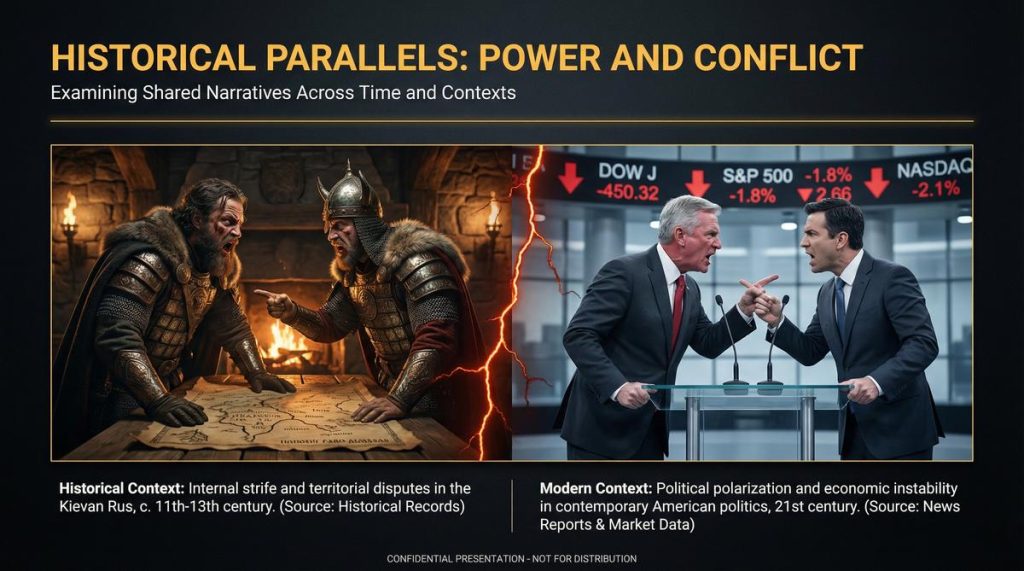
The American political machine is tearing itself apart at the exact moment the country can least afford it.
This week, the federal government sued three states over regulatory control, while a coalition of state attorneys general sued the federal government over election laws. The United States is no longer functioning as a unified entity. It is operating as a collection of rival factions fighting for control of a shrinking pie.
And the timing could not be worse.
While Washington is paralyzed by internal lawsuits and a $39 trillion debt crisis, the external world is moving fast. The S&P 500 just recorded its worst first quarter since 2020. The U.S.-Iran war is burning $1 billion a day. And the OECD is warning that inflation could spike to 4.2% this year.
We are watching a superpower fracture from within while external threats multiply.
It feels unprecedented. But it is not.
The Empire That Chose Division Over Survival
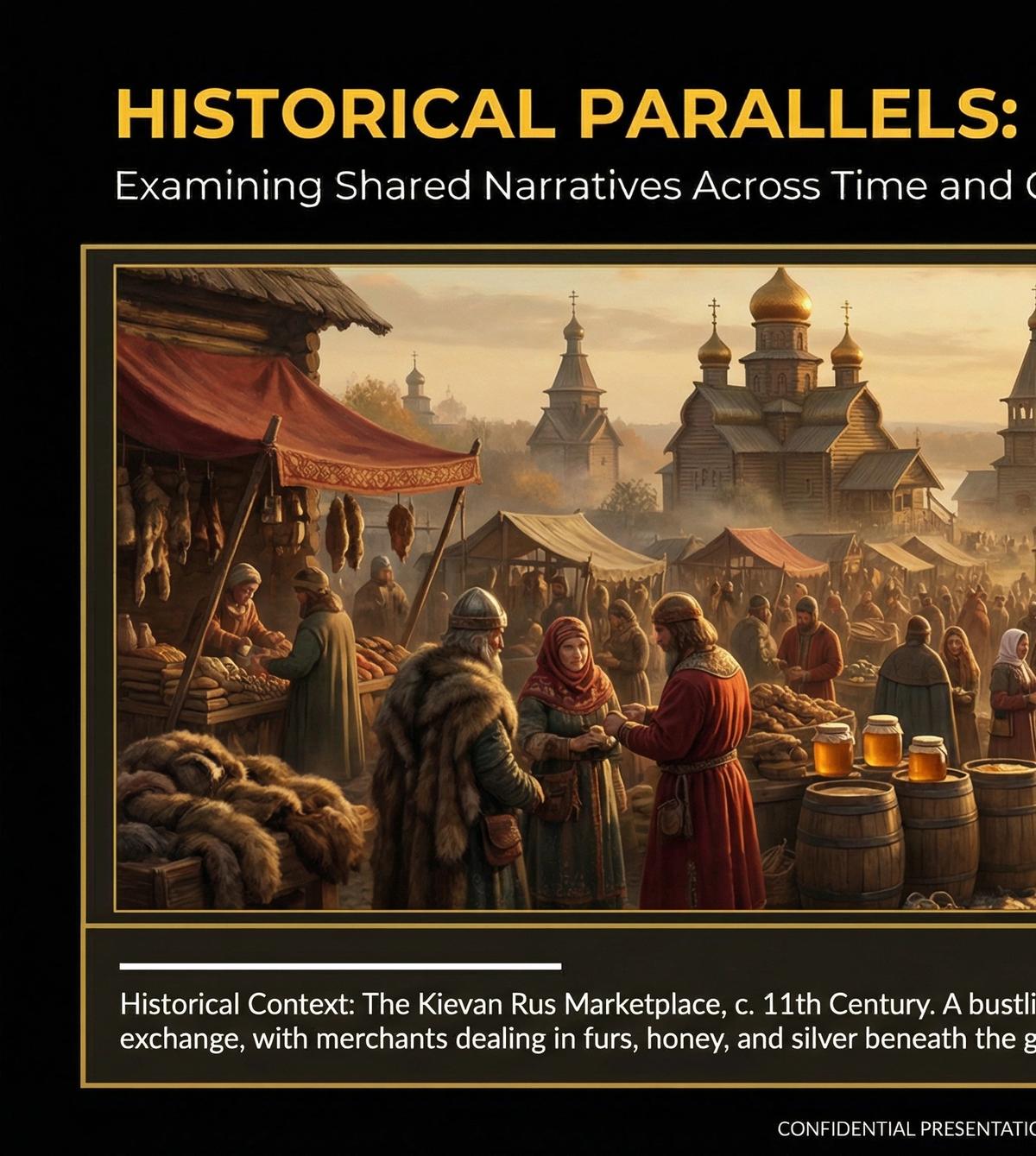
In the 11th century, Kievan Rus was the undisputed superpower of Eastern Europe.
Stretching from the Baltic Sea to the Black Sea, it controlled the most lucrative trade routes in the known world. Under the rule of Yaroslav the Wise, the capital city of Kiev was richer and more advanced than London or Paris. It was an economic juggernaut built on unity and trade.
But when Yaroslav died in 1054, he left behind a fatal flaw in the system.
Instead of passing power to a single strong successor, he divided the empire among his five sons. He instituted the “Rota System”—a complex ladder of succession where power moved laterally from brother to brother, rather than father to son.
It was a recipe for endless civil war.
Almost immediately, the brothers turned on each other.
The unified empire fractured into 13 independent principalities. Instead of defending their borders or expanding their trade networks, the princes spent all their energy, wealth, and military power fighting their own blood relatives for control of the capital.
By 1097, the situation was so dire that the princes held the Council of Liubech to stop the bleeding. They agreed to a new rule: “Let each hold his patrimony.”
They thought they were creating peace. In reality, they were formalizing their own destruction.
The principalities became permanently divided. The local elites—the boyars—gained immense power, preferring weak, squabbling princes over a strong central authority. The economy stagnated as internal borders and tariffs choked off trade.
And then, the Mongols arrived.
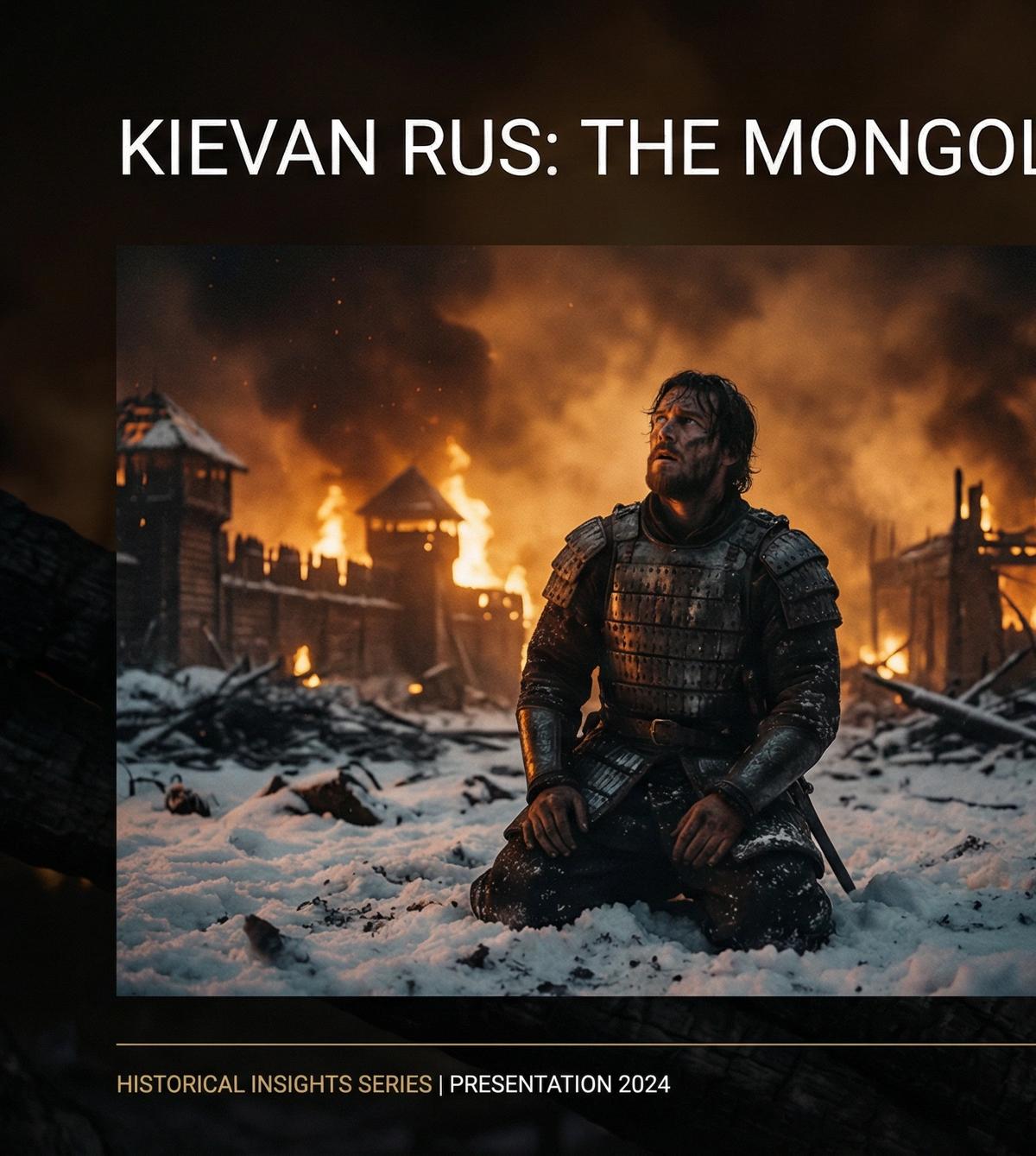
In 1237, Batu Khan’s armies swept across the steppes. If Kievan Rus had been united, they might have stood a chance. But the princes were too busy fighting each other to mount a coordinated defense. They fell one by one.
In 1240, the Mongols reached Kiev. The city that was once the jewel of Eastern Europe was burned to the ground. Out of 50,000 inhabitants, only 2,000 survived.
The Modern Rota System
America is currently operating under its own version of the Rota System.
Our two-party political machine guarantees gridlock. The constant shifting of power between rival factions ensures that long-term problems—like a $39 trillion national debt or a collapsing industrial base—are never solved. They are simply weaponized for the next election cycle.
We are fighting over the throne while the treasury burns.
Just like the princes of Kievan Rus, our modern political elites are so focused on defeating their domestic rivals that they are blind to the external threats. While states sue the federal government and politicians argue over budget cuts, the BRICS nations are actively dismantling the dollar’s reserve status.
The “Mongols” of the 21st century aren’t riding horses across the steppe. They are economic forces: stagflation, de-dollarization, and the collapse of global supply chains.
And just like Kievan Rus, a divided America cannot mount a coordinated defense against them.
The Path to Resilience
It is easy to look at this political paralysis and feel a sense of despair. To feel like a passenger on a sinking ship.
But history teaches another, more powerful lesson. The fall of Kiev was not the end of the Rus people. The survivors were not the ones who stayed in the burning capital, hoping the princes would finally unite.
The survivors were the ones who built local resilience.
While Kiev burned, the northern city of Novgorod thrived. They ignored the dynastic squabbles of the south and built a resilient, independent merchant republic. They focused on local trade, local defense, and local sovereignty.
When the centralized system fails, it creates a vacuum. And into that vacuum rushes the opportunity for something new. This is not a call to hide from the world. It is a call to build a better one, starting in your own backyard.
The Blueprint for Hope

You cannot fix the political gridlock in Washington. You cannot stop the national debt from growing. But you can absolutely control your own exposure to the fallout.
Building a resilient future starts with a single, powerful step: taking control of your own supply chains. When the federal system fractures, local sovereignty is your only defense.
The 4ft Farm Blueprint is not just about growing food; it is about sovereignty. It is the first chapter in your family’s story of independence, a story where you are the builder, not the victim. By producing your own calories, you insulate yourself from the inflation and supply chain shocks caused by political dysfunction.
Do not wait for the princes to stop fighting. Start building your own resilient principality today.
More Resources for the Sovereign Builder:
- Survival Stronghold: Secure your perimeter and resources before the centralized system fractures further.
- Homesteader Depot: The tools and skills you need to build a life independent of the federal grid.
- Seven Holistics: Protect your physical and mental health from the stress of a divided nation.
- The Ready Report: Advanced strategies for navigating the economic fallout of political paralysis.