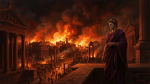
The Modern Mystery
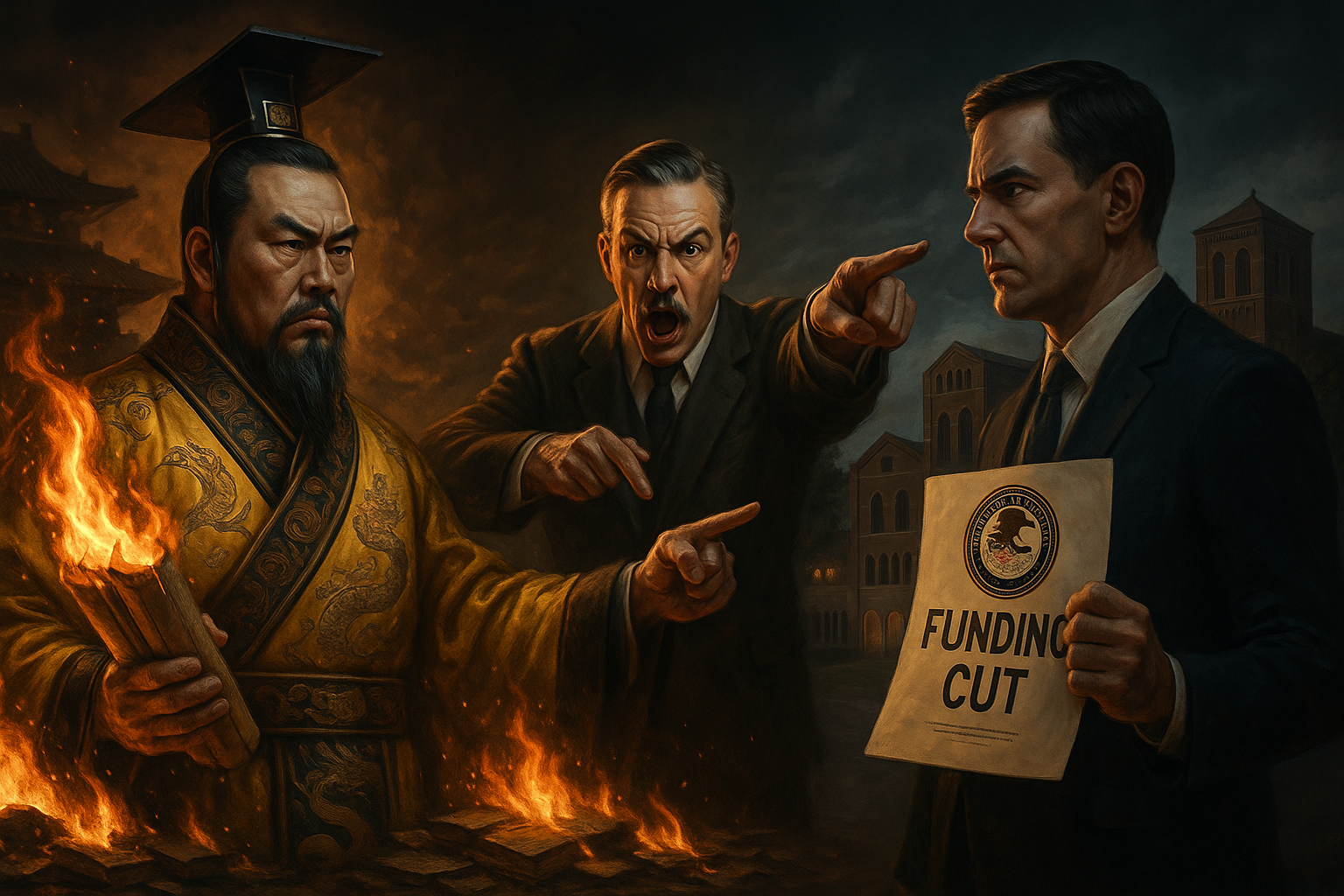
The Department of Justice just weaponized federal research funding in a way that would make ancient tyrants proud. UCLA—one of America’s most prestigious public universities—lost over $300 million in federal grants last week after the DOJ accused them of being “deliberately indifferent” to antisemitism on campus. The message was crystal clear: comply with our demands, or watch your research empire crumble.
This isn’t subtle bureaucratic pressure. This is financial warfare against intellectual institutions. The DOJ gave UCLA officials exactly one week to contact them about a “voluntary resolution agreement”—or face a federal lawsuit by September 2nd. Multiple federal agencies simultaneously cut off grants, creating a coordinated assault on the university’s funding lifeline. Cancer research, diabetes studies, heart disease programs—all frozen until UCLA submits to political demands.
But here’s what makes this moment historically terrifying: we’ve seen this exact playbook before. Not in some dystopian novel, but in real history. 2,200 years ago, another newly unified empire decided that controlling universities and scholars was essential to maintaining power. The methods were different, but the psychology was identical. And what happened next should make every American pay attention.
The First Emperor of China didn’t just cut funding from intellectual institutions. He buried 460 scholars alive and burned their books to ash. The parallels between ancient China and modern America aren’t just striking—they’re a warning written in blood and fire about what happens when governments decide that controlling knowledge is more important than preserving it.
The Time Portal
Xianyang, Capital of the Qin Empire, 213 BC
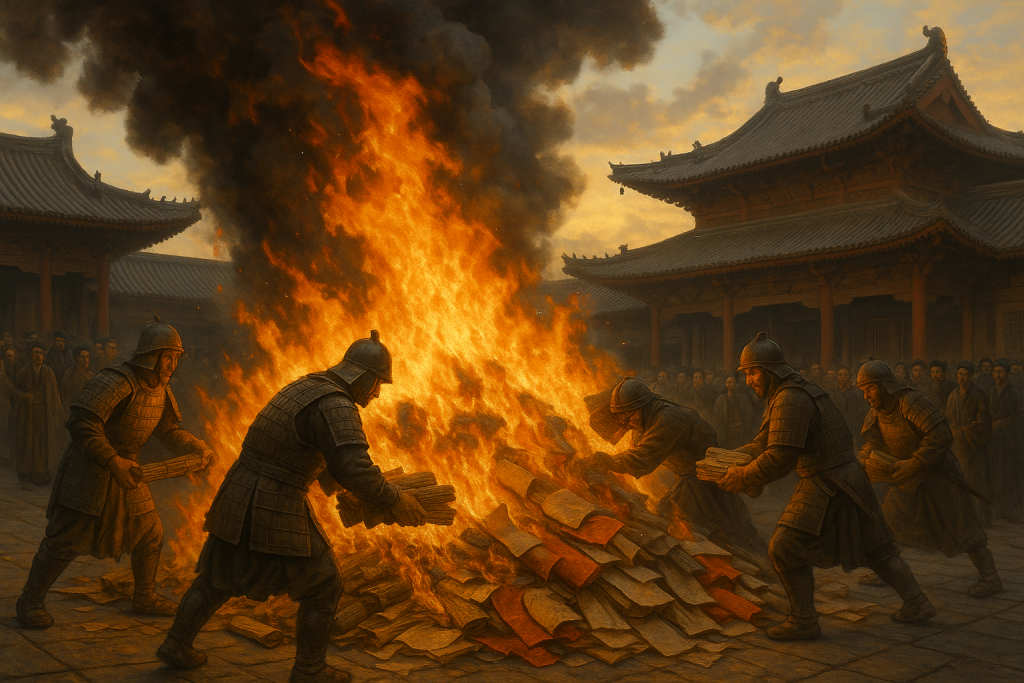
The smell of burning bamboo and silk filled the autumn air as Emperor Qin Shi Huang watched thousands of scrolls turn to ash in the palace courtyard. The First Emperor of China—the man who had just unified seven warring kingdoms into a single empire—stood motionless as his soldiers fed centuries of philosophical wisdom into the flames. The crackling of burning texts mixed with the distant sound of scholars weeping in their cells.
Li Si, the emperor’s chief minister, approached with a satisfied expression. “Your Majesty, the purification proceeds as planned. We have identified 460 scholars in the capital who refuse to abandon their Confucian teachings. They continue to venerate the old ways and spread dangerous ideas about benevolent governance.”
The emperor’s eyes never left the flames. At 39 years old, Qin Shi Huang had already accomplished what no ruler in Chinese history had managed: complete unification of the known world under a single government. He had standardized currency, writing systems, and measurements across his vast empire. He was building the Great Wall to keep out northern barbarians. But there was one enemy he couldn’t defeat with armies: ideas.
“The scholars claim that ancient kings ruled through virtue and moral example,” Li Si continued, his voice dripping with contempt. “They say our Legalist philosophy—rule through strict laws and harsh punishments—goes against the natural order. They’re teaching students that government should serve the people, not the other way around.”
The emperor finally turned from the flames. His face, weathered by decades of warfare and political intrigue, showed no emotion. “And what do you recommend, Minister Li?”
“Complete elimination, Your Majesty. We cannot allow competing philosophies to undermine the unity you have created. The Hundred Schools of Thought must become one school—ours. Any scholar who refuses to abandon the old teachings must be removed permanently.”
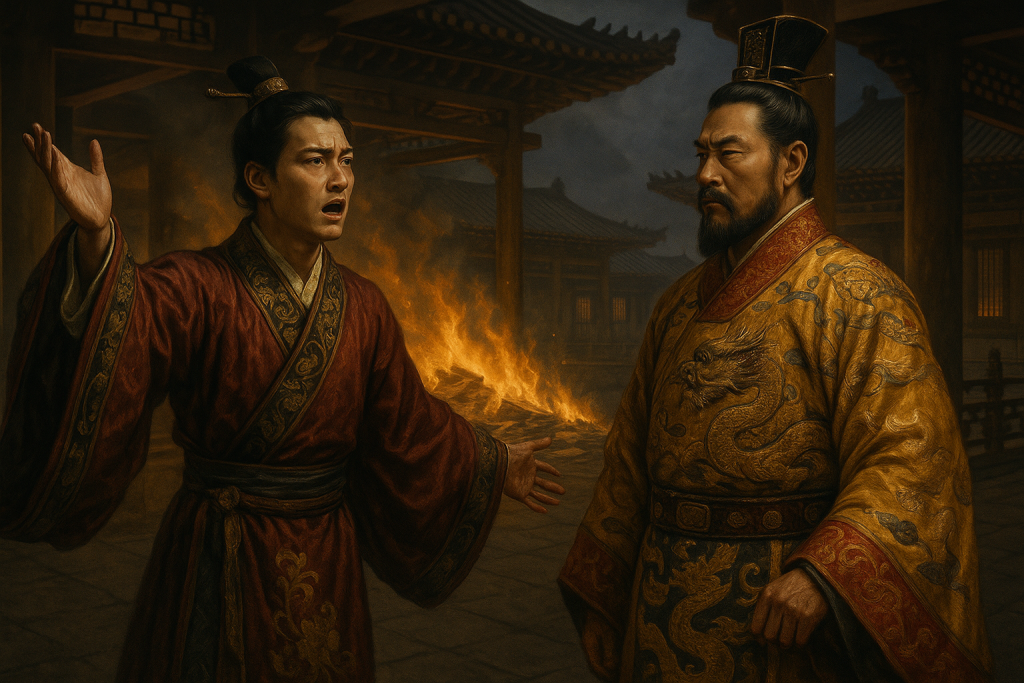
In the distance, Crown Prince Fusu watched the book burning with growing horror. At 25, the emperor’s eldest son had been raised on Confucian classics before his father’s rise to power. He understood what was being destroyed: not just books, but the accumulated wisdom of centuries. The works of Confucius, Mencius, and dozens of other philosophers who had spent their lives trying to understand how humans could live together in harmony.
The prince approached his father with careful steps. “Father, the empire has just achieved peace after centuries of war. The people are still adjusting to unification. If we punish scholars so severely, it may cause unrest throughout the realm.”
Qin Shi Huang’s eyes flashed with anger. “You think like them, my son. You believe in their weakness. But I have seen what happens when rulers allow competing ideas to flourish—chaos, division, endless war. There will be one truth in this empire: mine.”
The next morning, 460 scholars were marched to a massive pit outside Xianyang. They had been given one final chance to renounce their teachings and embrace Legalism. All refused. As dirt was shoveled over their heads, the emperor’s message echoed across the empire: challenge the official ideology, and face extinction.
The Parallel Revelation
The psychological DNA connecting Qin Shi Huang’s scholar massacre to the DOJ’s UCLA funding cuts is identical: both represent governments using their ultimate weapon—the power to destroy livelihoods—to force intellectual compliance. The methods have evolved from burial pits to budget cuts, but the core strategy remains unchanged: make the cost of dissent so catastrophic that institutions surrender their independence rather than face annihilation.
Consider the precision of both attacks. Qin Shi Huang didn’t randomly persecute scholars—he specifically targeted those who “venerated Confucius and took him as a role model,” according to ancient records. The DOJ didn’t randomly cut university funding—they specifically targeted UCLA over antisemitism claims while leaving other universities untouched. Both rulers identified institutions spreading ideas they considered dangerous to their authority, then used overwhelming force to crush resistance.
The financial warfare aspect is particularly chilling. Qin Shi Huang preserved two copies of each banned book in imperial libraries—maintaining government control over knowledge while denying it to everyone else. The DOJ’s approach mirrors this perfectly: they’re not destroying UCLA’s research capabilities permanently, just transferring control. The university can have its funding back the moment it agrees to implement the government’s ideological demands.
Both emperors understood that direct violence against scholars creates martyrs, but economic strangulation creates compliance. Qin Shi Huang’s live burials were designed as public warnings—”the event was announced to all under heaven to warn followers,” according to historical records. The DOJ’s UCLA funding cuts serve the same function: a public demonstration that even America’s most prestigious universities aren’t immune to federal retaliation.
The speed of both crackdowns reveals identical authoritarian instincts. Qin Shi Huang gave scholars no time to organize resistance—the book burning and executions happened within months of his decision. The DOJ gave UCLA exactly one week to respond to their demands before facing a federal lawsuit. Both timelines were designed to prevent institutional resistance and force immediate capitulation.
Most disturbing is how both governments framed their attacks as necessary protection. Qin Shi Huang claimed he was protecting imperial unity from dangerous philosophical divisions. The DOJ claims it’s protecting Jewish students from campus antisemitism. Both justifications contain elements of legitimate concern, but both were weaponized to justify unprecedented government control over intellectual institutions.
The resistance patterns are equally revealing. Crown Prince Fusu warned his father that persecuting scholars would “cause unrest in the empire”—and was immediately exiled to the frontier for his dissent. UCLA Chancellor Julio Frenk called the funding cuts “a cruel manipulation” of legitimate antisemitism concerns—and now faces the choice between defending academic freedom or preserving his university’s financial survival.
The Pattern Recognition
This pattern repeats across millennia because it exploits a fundamental vulnerability in human psychology: the gap between our ideals and our survival instincts. Every generation believes it’s too civilized, too educated, too democratic to fall for ancient authoritarian tactics. But when governments threaten the economic foundations of intellectual institutions, the same psychological pressures that worked 2,200 years ago still work today.
The pattern always begins with a legitimate grievance. Qin Shi Huang genuinely faced the challenge of unifying seven different kingdoms with competing philosophical traditions. The DOJ genuinely faces concerns about antisemitism on college campuses. But authoritarian minds see these legitimate challenges as opportunities to establish unprecedented control over intellectual discourse.
The escalation follows predictable steps: identify institutions spreading “dangerous” ideas, frame the crackdown as protecting vulnerable groups, use economic pressure to force compliance, and publicize the punishment to warn others. The specific justifications change—philosophical unity, national security, protecting minorities—but the underlying psychology remains constant.
What makes this pattern so persistent is that it works. Qin Shi Huang successfully eliminated competing philosophical schools for over a decade. His Legalist ideology became the only acceptable form of political thought throughout the Chinese empire. The DOJ’s UCLA strategy has already prompted other universities to preemptively modify their policies to avoid similar retaliation.
The human cost of this pattern is always the same: the destruction of intellectual diversity in favor of ideological conformity. When governments gain the power to financially destroy institutions that displease them, the natural result is self-censorship, intellectual timidity, and the gradual erosion of independent thought.
But history also reveals the ultimate futility of this approach. Qin Shi Huang’s dynasty collapsed just four years after the scholar massacres, partly because his brutal suppression of dissent had eliminated the very intellectual traditions that might have helped him govern more effectively. The ideas he tried to destroy—Confucian concepts of benevolent governance and moral leadership—became the foundation of Chinese political philosophy for the next 2,000 years.
The Ancient Warning
The Qin Dynasty’s rapid collapse after the scholar massacres offers a stark warning about the long-term consequences of government attacks on intellectual institutions. Within four years of burying 460 scholars alive, Qin Shi Huang was dead and his empire was fragmenting into civil war. The very unity he had tried to preserve through intellectual suppression was destroyed by the resentment his brutality had created.
The emperor’s own son, Crown Prince Fusu—the one who had warned against persecuting scholars—was forced to commit suicide by court officials who feared his more moderate approach to governance. The intellectual traditions Qin Shi Huang had tried to eliminate became the rallying cry for rebels who overthrew his dynasty. The Confucian scholars he had buried became martyrs whose ideas inspired centuries of resistance to authoritarian rule.
History’s judgment was swift and merciless. The Han Dynasty that replaced the Qin explicitly rejected Legalist philosophy and restored Confucian teachings to prominence. The books Qin Shi Huang had burned were painstakingly reconstructed from memory by surviving scholars. The intellectual diversity he had tried to destroy became the foundation of Chinese civilization’s greatest achievements.
The pattern holds across cultures and centuries: governments that attack intellectual institutions may achieve short-term compliance, but they ultimately weaken the very foundations of their own power. Universities and scholars don’t just produce research—they produce the critical thinking skills that societies need to solve complex problems. When governments prioritize ideological conformity over intellectual freedom, they trade long-term stability for short-term control.
For modern America, the warning is clear: the DOJ’s financial warfare against UCLA represents the same authoritarian instinct that led Qin Shi Huang to bury scholars alive. The methods are more sophisticated, but the psychology is identical. And if history is any guide, the long-term consequences of government attacks on intellectual institutions will be just as destructive to American democracy as they were to the Chinese empire 2,200 years ago.
5 Things You Can Do This Week
The parallels between ancient China and modern America aren’t just historical curiosities—they’re actionable warnings about protecting intellectual freedom in your own life and community. Here’s how to prepare for and resist government attacks on independent thought:
1. Diversify Your Information Sources Beyond Government-Dependent Institutions
Don’t rely solely on universities and mainstream media for your understanding of current events. Build a personal library of books, subscribe to independent newsletters, and cultivate relationships with thinkers who aren’t dependent on federal funding. The Self Reliance Report offers practical strategies for creating information independence that can’t be cut off by government pressure.
2. Support Local and Independent Educational Initiatives
When federal funding becomes a weapon against intellectual freedom, local alternatives become essential. Homeschooling cooperatives, community discussion groups, and independent learning circles can preserve intellectual diversity when universities are forced into compliance. Homesteader Depot provides resources for creating educational alternatives that operate outside government control.
3. Develop Financial Independence from Government-Dependent Systems
The DOJ’s power over UCLA comes from the university’s dependence on federal funding. Build your own financial resilience through emergency savings, alternative income streams, and investments that can’t be frozen by government agencies. Freedom Health Daily offers strategies for protecting your economic independence during political upheavals.
4. Create Physical and Digital Archives of Important Information
Qin Shi Huang’s book burning succeeded because most knowledge existed in single copies that could be destroyed. Modern digital censorship works the same way—information disappears when platforms decide to remove it. Download and print important documents, books, and research papers. Survival Stronghold provides guides for creating personal archives that survive both digital and physical threats.
5. Build Community Networks That Can Function Independently
The scholars who survived Qin Shi Huang’s persecution did so by maintaining underground networks that preserved knowledge and supported each other. Build relationships with like-minded people in your community who share your commitment to intellectual freedom. Seven Holistics offers practical advice for creating support networks that can withstand political pressure and economic disruption.
The lesson from ancient China is clear: when governments attack intellectual institutions, individual preparation and community resilience become the last lines of defense for preserving independent thought. The time to build these defenses is now, before the next round of funding cuts forces even more institutions into compliance.
—
Ready to take control of your food security while the government controls everything else? The 4ft Farm Blueprint shows you how to grow a year’s worth of food in just 4 square feet, creating true independence from supply chains that can be disrupted by political upheaval. When emperors control the universities, smart people control their own food supply.