The clock is ticking on the most dangerous, yet invisible, crisis in America.
Today, the Highway Trust Fund—the financial lifeblood of America’s roads, bridges, and transit systems—is bleeding out.
It is projected to be completely exhausted by 2028.
If that happens, federal highway and transportation funding will face an immediate 46% cut.
Project freezes. Payment delays. Massive tax hikes on local residents just to keep the asphalt from crumbling beneath their tires.
Meanwhile, the U.S. Environmental Protection Agency admits that the nation’s drinking water systems need a staggering $625 billion just to replace toxic lead pipes and failing treatment plants.
Right now, water lost to faulty, aging pipe infrastructure is costing U.S. utilities $6.4 billion annually.
That is 2 trillion gallons of treated drinking water vanishing into the dirt every single year.
We are watching a superpower rot from the inside out.
The American taxpayer is being squeezed to fund a $1.5 trillion defense budget and a $1 billion-a-day war in the Middle East, while the very foundation of the country collapses.
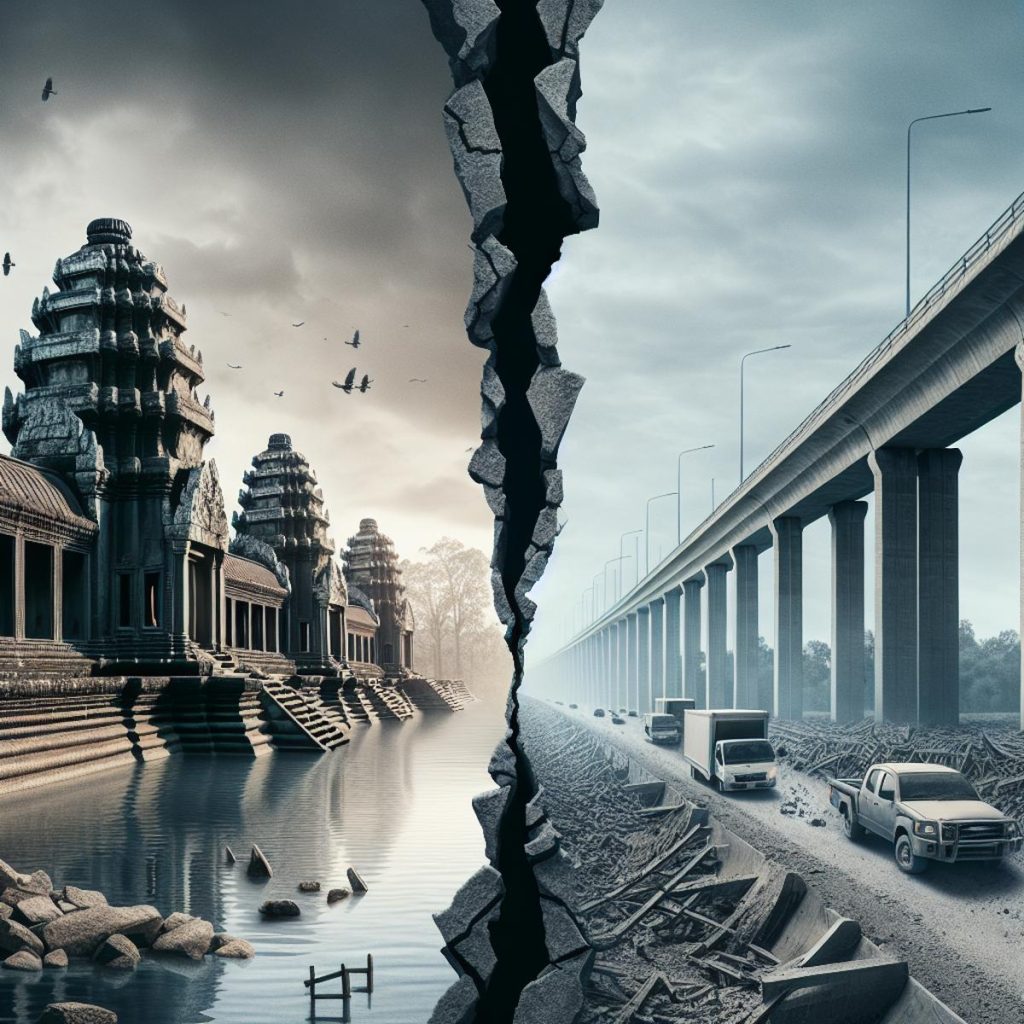
It feels like a modern disaster. But it is an ancient pattern.
The Empire That Drowned in Its Own Success

In the 12th century, the Khmer Empire was the undisputed master of Southeast Asia.
Operating from their capital at Angkor in modern-day Cambodia, the Khmer built a civilization that had no equal on Earth.
At its peak, Angkor was the largest city in the pre-industrial world, home to nearly one million people.
But their true power wasn’t just military might or the breathtaking stone temples of Angkor Wat.
Their power was water.
The Khmer built a “hydraulic city”—a staggering, complex network of canals, reservoirs (barays), embankments, and bypasses designed to capture monsoon rains, control flooding, and irrigate massive rice crops.
This infrastructure was the economic engine of the empire.
It allowed them to produce multiple rice harvests a year, feeding a massive population and funding their monumental architecture and military campaigns.
But complexity breeds fragility.
The Math of Collapse
For centuries, the system worked. The Khmer engineers continually expanded and modified the network.
But by the mid-1300s, the climate began to shift.
A prolonged, severe drought gripped the region. The massive reservoirs dried up. The agricultural engine sputtered.
Then, the pendulum swung violently in the other direction.
Years of unusually intense monsoon rains battered the weakened, poorly maintained infrastructure.
The system could not hold.
The massive flow of water overwhelmed the canals. Embankments eroded. Critical links in the water distribution network were systematically severed.
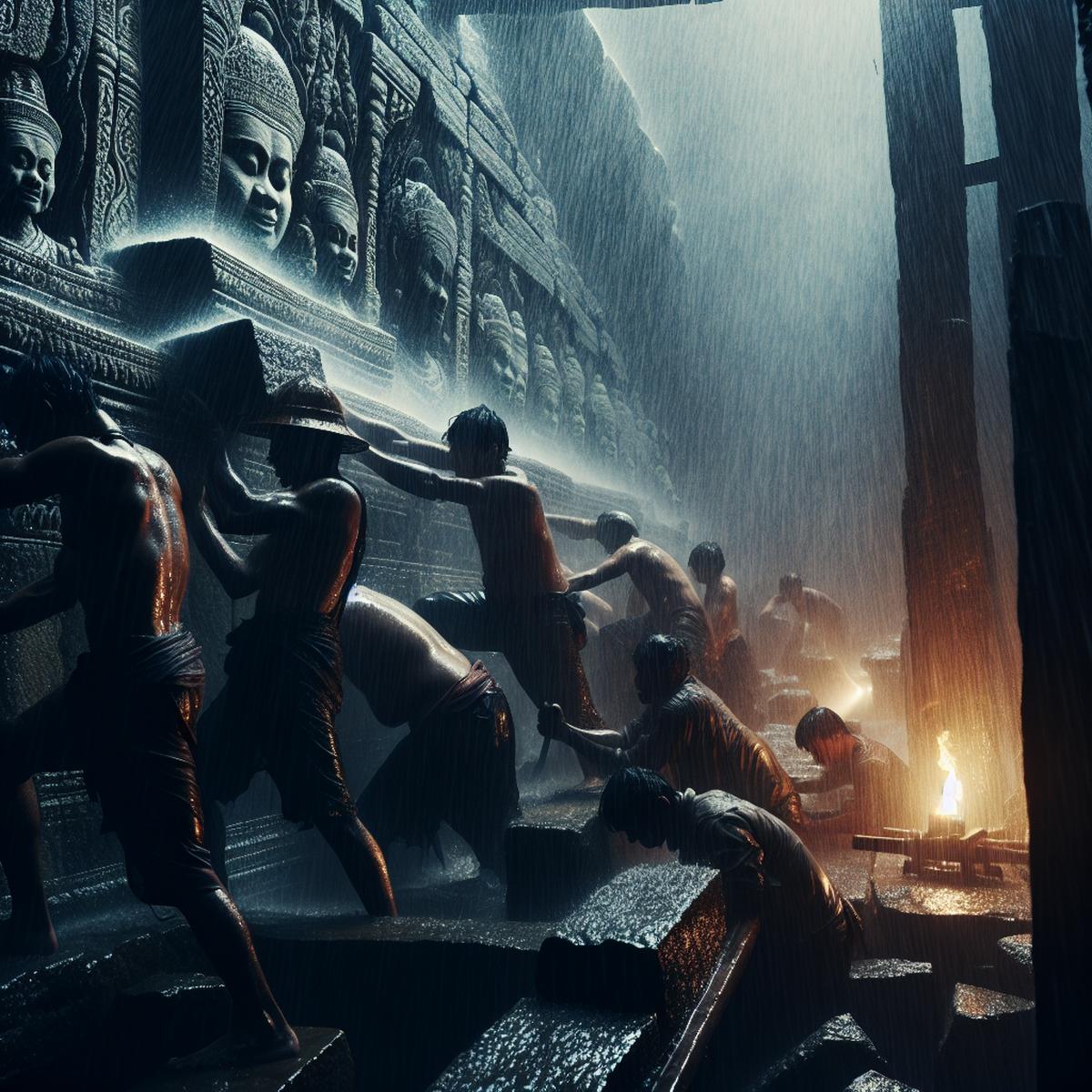
The Khmer had built a system so massive and complex that when it began to fail, they simply lacked the resources and manpower to repair it.
They were forced to cannibalize their own monuments.
Archaeologists have found bridges in Angkor Thom built from recycled, intricately carved sandstone blocks torn from temples—a desperate, ultimately futile attempt to control the floodwaters.
When an empire starts tearing down its own temples to patch its plumbing, the end is near.
By 1431, the weakened, starving city was sacked by the Siamese army. The jungle reclaimed the greatest hydraulic engineering marvel of the ancient world.
The American “Water Bankruptcy”
The parallels to modern America are terrifying.
The United States built the greatest infrastructure network of the 20th century: the Interstate Highway System, the Hoover Dam, the sprawling municipal water grids.
But like the Khmer, we have stopped maintaining the foundation.
The U.N. recently warned that the world has entered a new era of “water bankruptcy.”
In the American West, states are locked in a bitter, zero-sum battle over the dwindling Colorado River.
In older Eastern and Midwestern cities, century-old pipes are bursting.
Just recently, a massive sewer pipe collapse dumped hundreds of millions of gallons of raw human waste into the Potomac River, just miles from the Lincoln Memorial.
The empire is leaking.
And just like the Khmer, our leaders are distracted.
While Washington debates canceling $15 billion from bipartisan infrastructure laws to fund overseas wars, the physical reality of America is degrading.
When the Highway Trust Fund runs dry in 2028, the illusion of endless American prosperity will hit a massive, literal pothole.
The Sovereign Solution
The collapse of Angkor teaches us a brutal economic truth:
You cannot rely on a centralized, overextended system to provide your most basic needs.
When the Khmer hydraulic network failed, the people who survived were the ones who didn’t wait for the god-king to fix the canals.
They adapted. They moved. They localized.
As the American infrastructure grid faces its own “water bankruptcy” and funding cliffs, the intended loser is the dependent consumer.
You must build your own resilience.
The time to secure your own clean water supply, independent energy, and local food sources is before the municipal pipes run dry and the highway funds evaporate.
True wealth is not what a bankrupt government promises to fix tomorrow.
True wealth is the sovereign infrastructure you build today.
Action Plan: Build Your Local Infrastructure

The federal government cannot fix a $1.1 trillion infrastructure deficit while fighting global wars. You must secure your own perimeter.
1. Secure Your Water Supply: Do not rely on century-old municipal pipes. Invest in high-quality, gravity-fed water filtration systems and rainwater catchment. Read the complete guide at SurvivalStronghold.com.
2. Build Local Food Resilience: When the highways degrade, the grocery store supply chains will fracture. Start building your own sovereign food supply today. Get the step-by-step system at 4footfarmblueprint.com.
3. Protect Your Health: Crumbling infrastructure means increased exposure to heavy metals (like lead) and waterborne pathogens. Learn how to detoxify and protect your family’s health at SevenHolistics.com.
4. Master Essential Skills: The survivors of Angkor were the ones who knew how to build and repair without the empire’s help. Equip yourself with the tools and knowledge for total self-reliance at HomesteaderDepot.com.
5. Understand the Timeline: The Highway Trust Fund exhaustion in 2028 is a hard mathematical deadline. Prepare your finances and household economy now. Get the latest intelligence at SelfRelianceReport.com.