The most powerful financial weapon in American history is quietly bleeding out.
For fifty years, the U.S. dollar has been the undisputed king of global trade. It was the currency that priced the world’s oil, backed the world’s central banks, and funded the American way of life.
But the king is losing his crown.
According to the latest data from the International Monetary Fund, the U.S. dollar’s share of global foreign exchange reserves has plummeted to 56.8%—the lowest level in 31 years.
At its peak in 2001, the dollar held a commanding 73% share. Today, that dominance is eroding at an accelerating pace.
The catalyst? The quiet death of the petrodollar.
Two years ago, Saudi Arabia allowed its 50-year agreement to price oil exclusively in U.S. dollars to expire. Now, with war raging in Iran and the Strait of Hormuz choked off, the unthinkable is happening: oil is being traded in Chinese yuan.
Meanwhile, the BRICS nations have been aggressively hoarding physical gold. They now control over 6,000 tonnes—a staggering 17.4% of global central bank reserves.
They are building a lifeboat to escape the sinking dollar.
The American taxpayer is left holding the bag. With a $39 trillion national debt, $1 trillion in annual interest payments, and a $1 billion-a-day war in the Middle East, the Federal Reserve has only one play left: print more money.
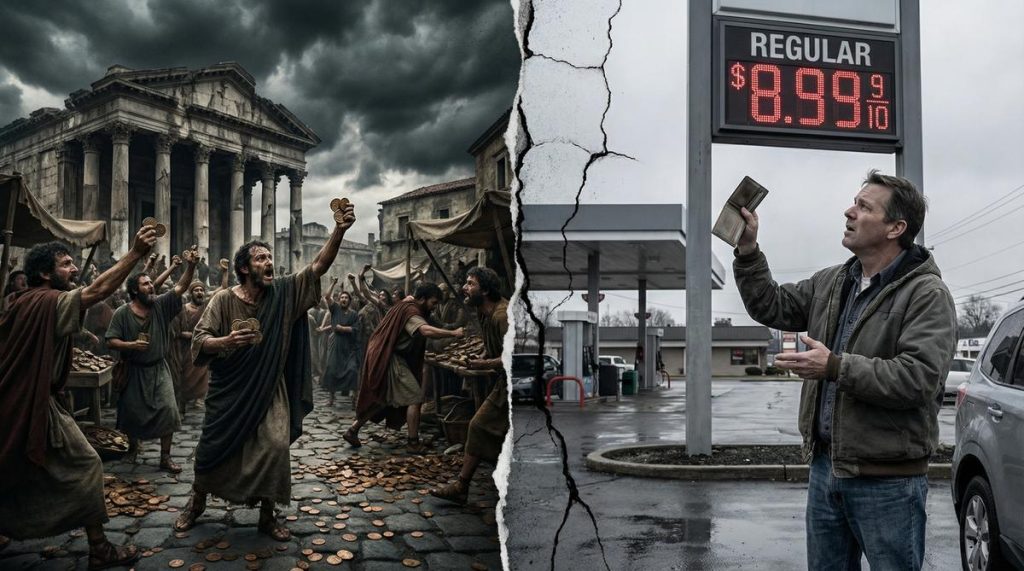
It feels like an unprecedented modern crisis. But it is an ancient pattern.
The Empire That Melted Its Own Wealth
In the first century AD, the Roman Empire was the undisputed master of the Mediterranean.
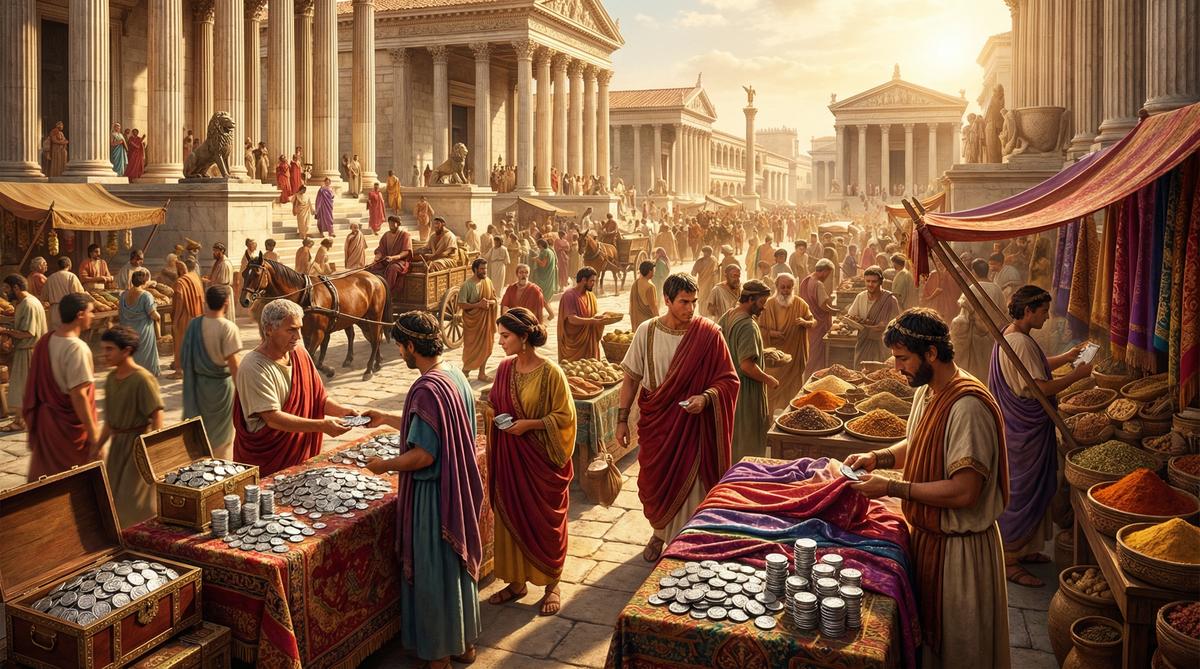
Their power was not just built on the swords of the legions. It was built on the denarius—a silver coin that served as the reserve currency of the ancient world.
During the reign of Augustus, the denarius was a masterpiece of hard money. It was struck from nearly pure silver, holding its value across continents and generations.
Because the denarius was trusted everywhere, Rome could buy whatever it wanted. Spices from India, silk from China, grain from Egypt—all flowed into the capital in exchange for Roman silver.
But the empire’s appetite outgrew its treasury.
The Math of Collapse
As Rome expanded, the costs of maintaining the empire skyrocketed.
They had to fund massive border wars against Germanic tribes and the Persian Empire. They had to pay for extravagant public works, free grain doles, and an ever-expanding bureaucracy.
When the treasury ran low, the emperors did not cut spending. They did what desperate governments always do.
They debased the currency.
Roman officials began melting down the pure silver denarii and mixing in cheaper metals like copper and bronze. They would then mint new coins with the same face value, but a fraction of the actual silver.
By the time of Marcus Aurelius, the denarius was only 75% silver.
A few decades later, Emperor Caracalla needed to raise soldier pay by 50% to maintain his grip on power. He introduced a new coin, the antoninianus, which was worth twice as much as a denarius but contained only 1.5 times the silver.
The debasement accelerated into a death spiral.
By 265 AD, under Emperor Gallienus, the Roman “silver” coin contained a pathetic 0.5% silver.
It was nothing more than a bronze core with a thin, shiny coating. As soon as the coin circulated, the silver wash rubbed off, revealing the cheap bronze underneath.
The illusion of wealth was shattered.
The result was catastrophic hyperinflation. Prices across the Roman Empire skyrocketed by 1,000%. The middle class was wiped out. Trade ground to a halt, and citizens reverted to a barter economy just to survive.
The Roman monetary system collapsed, dragging the western half of the empire down with it.
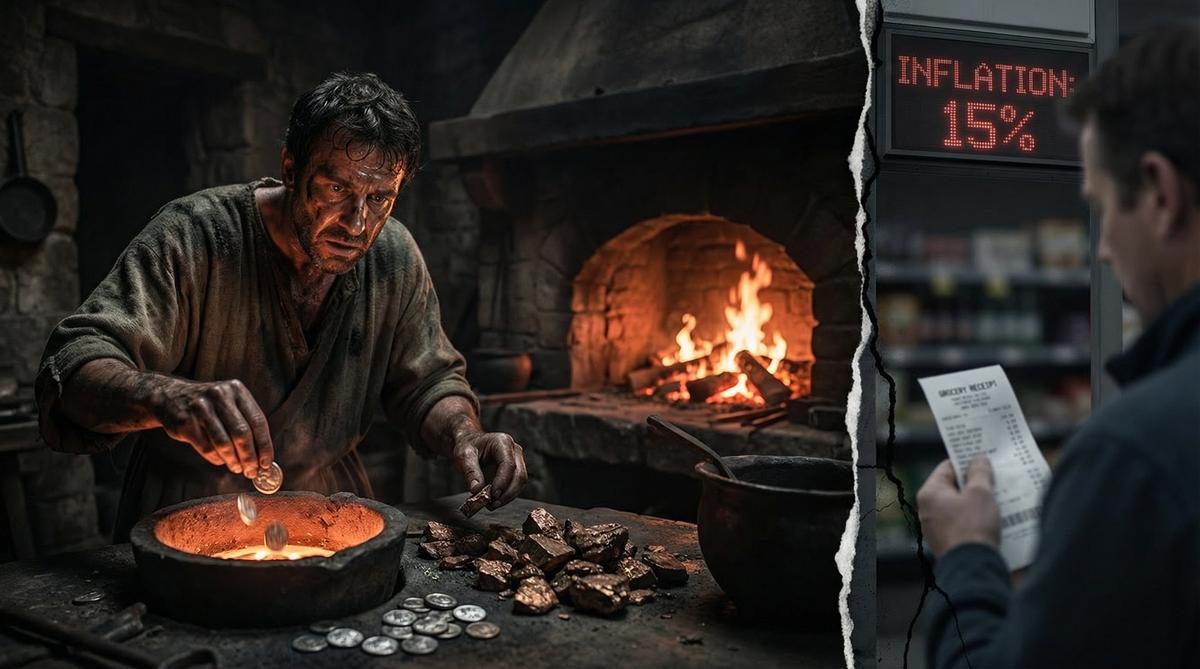
The Bronze Core of the American Dollar
The parallel to modern America is chillingly exact.
For decades, the “silver coating” of the U.S. dollar was the petrodollar system. Because the world needed dollars to buy oil, the U.S. government could print endless amounts of currency to fund its wars, its welfare state, and its $39 trillion debt.
But just like the Roman denarius, the intrinsic value of the dollar has been hollowed out.
The inflation of the past four years was the first warning sign. The tariff shocks and the $1 trillion annual interest payments are the second.
Now, with Saudi Arabia pivoting to China and the BRICS nations hoarding gold, the silver coating is rubbing off.
The world is seeing the bronze core underneath.
When a reserve currency loses its global monopoly, the printed money comes flooding back home. The result is a massive, unavoidable spike in domestic inflation and a crushing loss of purchasing power for the average citizen.
The Path to Sovereign Wealth
But this is not a story of inevitable doom. It is a story of predictable patterns—and the opportunity to step outside of them.
During the Third Century Crisis, the Romans who survived the hyperinflation were not the ones holding onto the emperor’s bronze coins.
They were the ones who held real, tangible assets.
They were the families who owned productive land. They were the craftsmen who possessed irreplaceable skills. They were the local communities that built resilient, decentralized trade networks outside the reach of the collapsing imperial state.
They stopped relying on the empire, and started relying on themselves.
The decline of the dollar’s reserve status is a mathematical certainty. But your family’s financial ruin is not.
You have the agency to build a sovereign store of value right now, before the global financial system fully resets.

The Blueprint for Independence
The intended loser in a currency collapse is the dependent consumer. The winner is the sovereign producer.
The time to trade depreciating fiat currency for tangible, life-sustaining assets is today.
Start by securing your family’s most critical vulnerabilities. A failing currency means failing supply chains. Build a robust, independent food supply with the 4ft Farm Blueprint, ensuring you can produce high-yield nutrition regardless of grocery store prices.
Next, protect your physical health. When inflation strikes, medicine and medical supplies are often the first to become scarce or unaffordable. Establish a sovereign medical reserve and learn the protocols of self-reliant care with Survival Stronghold.
Finally, invest in the ultimate hard asset: the skills to build, repair, and maintain your own infrastructure. Equip yourself with the knowledge and tools from Homesteader Depot to create a homestead that thrives outside the fragile municipal grid.
The empire’s coins are turning to bronze. It is time to build something real.