
Three days ago, the International Monetary Fund warned that the global economy is slowing again under the pressure of war, debt, and weakening confidence. Its April outlook now projects just 3.1% global growth in 2026, while also warning that public debt is already high and institutional credibility is eroding.[1][2]
That sounds like a problem for finance ministers and bond traders.
It is not.
It is a problem for families who still assume that a rich country can stay stable just because the shelves are stocked, the markets are open, and the flags are still flying.
An empire can look solid long after its room for error is gone.
The Real Warning Is Not Collapse. It Is Surrender.
Most people imagine national decline as a dramatic final scene. A bank panic. A default. Empty stores. Soldiers in the street.
But history usually works a different way. The first loss is often invisible. A government does not lose power when the television tells you it has lost power. It loses power when it can no longer make hard decisions without begging, borrowing, or handing over control.
That is the warning buried inside the IMF’s language.
The fund is not saying America is finished. It is saying the same thing serious institutions say right before a system becomes dangerous: growth is slowing, inflation pressure is back, debt is high, and the policy margin is thin.[1][2]
In plain English, that means the machine can still run.
But it has less cushion than it looks like it does.
The Empire That Borrowed to Stay Impressive
In the mid-19th century, the Ottoman Empire still looked like a major power. It had armies, ministries, diplomats, ports, and prestige.
It also had a growing problem underneath the costume.
It kept borrowing to preserve the appearance of strength.
After the Crimean War, the Ottoman state began taking on large foreign loans. Between 1854 and 1874, it entered into fifteen major borrowing agreements with European creditors.[3][4]
The official reasons sounded responsible enough. Reform the bureaucracy. Centralize revenues. Modernize the army. Keep the empire functional in a more competitive world.[3][4]
Those are exactly the kinds of explanations tired systems always give themselves.
We only need more time. More financing. More flexibility. More management.
But debt does not just buy time. It also changes who owns the future.
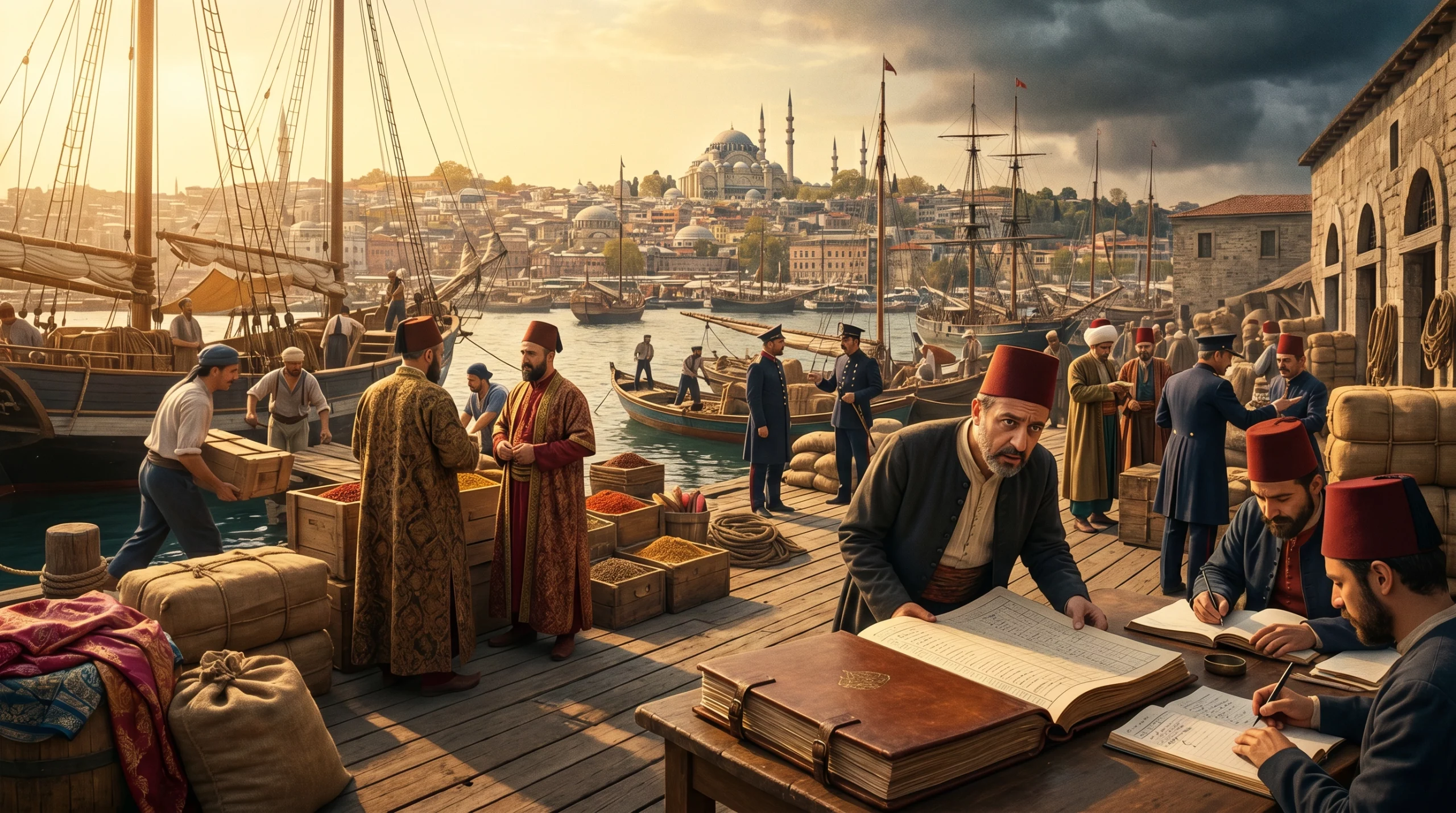
By 1875, according to a widely cited historical account, two-thirds of Ottoman state revenue was going to debt repayments.[4]
Think about what that means.
Before the empire formally fell, before its flag disappeared, before the public could fully understand the danger, an enormous share of the state’s energy was already being swallowed by yesterday’s promises.
The empire still looked imperial.
But its fiscal sovereignty was already bleeding out.
Then the Outside Shock Arrived
This is the part modern people always underestimate. Weak systems do not need one giant fatal blow. They just need a shock to arrive at the wrong time.
For the Ottomans, that shock was not singular. It came in layers.
There was the global financial crisis that began in 1873. There were poor harvests. There was palace intrigue. There was military pressure. There was the old habit of solving structural weakness with fresh borrowing.[3]
That combination is what made the empire truly vulnerable.
The Ottoman government partially suspended payments in October 1875 and fully defaulted in 1876.[3] What followed was not immediate disappearance. It was something quieter and, in many ways, more humiliating.
The empire kept existing.
But it existed with less control over itself.
That is an important distinction.
Systems rarely move straight from prestige to ruin.
They pass through a long middle stage where symbols of power remain intact while the substance of power gets traded away piece by piece. The bureaucracy still speaks in confident tones. The leadership still insists the reforms are temporary. The public still assumes tomorrow will resemble yesterday.
Meanwhile, the balance sheet grows teeth.
When Creditors Start Touching the Tax Base
In 1881, the empire accepted the creation of the Ottoman Public Debt Administration. That body was established to collect specific revenues and direct them to creditors.[3][4]
This is the part of the story every American should sit with for a minute.
The Ottoman problem was no longer just that it owed money.
The deeper problem was that the empire had drifted into a position where outsiders could lawfully stand between the state and its own tax stream. One scholarly summary notes that the new arrangement controlled revenues equal to roughly one-quarter of state revenue.[3] Another account says that by 1914, around one-third of Ottoman state revenue was being collected under that creditor-centered structure.[4]
That is what loss of sovereignty looks like in spreadsheet form.
No dramatic soundtrack. No cinematic final battle. Just a ruling system that can no longer fully command the cash flow that keeps it alive.
It still has ceremonies.
It still has speeches.
It still has uniforms.
But the future is being managed elsewhere.

America’s Version Would Not Look the Same
The United States is not the Ottoman Empire. The reserve currency, the domestic market, and the country’s institutional depth make the comparison imperfect.
Good. Historical parallels should be used carefully.
But the mechanism of decline is close enough to matter.
The IMF now says the world is entering another period of slower growth, higher inflation pressure, and tighter margins.[1] It also says fiscal space is much thinner than before because debt is already elevated and policymakers have less room to absorb the next shock cleanly.[2]
That is the modern parallel.
America may not wake up one morning and discover a foreign debt board collecting tax stamps and salt levies. That is not how a 21st-century superpower loses flexibility.
It loses flexibility through different channels.
One of them is interest expense. Another is political exhaustion. Another is the slow conversion of every budget into a triage exercise, where leaders can no longer ask what is wise because they are trapped asking what can still be financed.
That is how strategic states start behaving tactically.
Higher interest costs. Larger rollover pressure. More politically impossible budgets. More dependence on market confidence. More public promises funded with less real slack.
In that kind of system, every outside shock matters more than it should. Energy shocks matter more. Trade shocks matter more. War shocks matter more. Supply disruptions matter more.
Not because the country is weak in the cartoon sense.
Because the margin is thin.
The Richest Systems Often Misread Their Own Danger
One of the most dangerous habits in a late system is confusing scale with resilience. People see a giant military budget, a deep bond market, a famous currency, and an enormous federal apparatus, and they assume that means safety.
Sometimes it means the opposite.
Sometimes scale is what hides fragility.
The Ottomans had ministries. They had revenue. They had international relationships. They had administrators who could explain every borrowing round as a rational bridge to stability.
Modern America has its own version of that story. Analysts can always produce another model, another refinancing pathway, another explanation for why the next year will be manageable if growth surprises to the upside or markets remain calm or the next conflict stays contained.
Sometimes those explanations are even true for a while.
That is why late fragility is so easy to miss.
And still the borrowing kept tightening the trap.
The same logic applies now. A debt-heavy system can continue functioning for years. It can even continue looking strong. But once too much of its energy goes toward servicing the past, the future starts getting crowded out.
That is when roads are delayed, maintenance is deferred, social trust falls, political theater gets louder, and every new emergency requires still more borrowing.
The flag stays up. The freedom to act gets smaller.
What Late-Stage Debt Really Steals
People often talk about debt as if it were just a large number on a government website. That is too abstract.
Late-stage debt steals options.
It steals the option to respond calmly to a crisis. It steals the option to repair infrastructure before failure. It steals the option to fund social peace without more borrowing. It steals the option to absorb a commodity shock without passing the pain downstream to households.
That is why debt-heavy systems become so brittle. They are not weak because they are poor. They are weak because too much of tomorrow has already been spent keeping yesterday intact.
That is how a rich system starts behaving like a desperate one.
The Turn: The Path to Resilience
It is easy to read a story like this and feel discouraged. That reaction is understandable.
But it misses the most important lesson.
Households are not empires.
You do not need a balanced federal budget to start reclaiming your own resilience. You do not need Washington to rediscover fiscal sanity before you begin building local strength. You do not need global stability before you make your family less exposed to fragile systems.
History does not only teach us how societies decay. It also teaches us where durable strength actually lives.
It lives in productive households.
It lives in the people who reduce forced dependence before the official emergency arrives. It lives in the boring, deeply unglamorous work of building margin: pantry depth, garden capacity, repair skill, useful tools, lower fixed costs, and relationships with people who still know how to do real things in the physical world.
It lives in families that lower dependence before dependence becomes expensive.
It lives in neighbors who can trade, store, repair, grow, and adapt without waiting for distant institutions to save them.
The answer to late-system fragility is not panic. It is production.
That means more food close to home. More practical skill. More redundancy. More useful friendships. More ability to absorb price shocks without losing your footing.
When a central machine has less room for error, the people who fare best are usually the ones who already started building outside its bottlenecks.

The Action: Build Before the Margin Disappears
If you want one practical response to a debt-heavy, shock-prone age, start with the most basic form of sovereignty there is: food you can produce yourself.
Not because tomatoes solve sovereign debt. They do not.
But because every ounce of useful production you move closer to home makes your life less exposed to fragile systems you do not control. It gives you margin when prices jump, quality falls, or policy gets stupid.
That is why the 4ft Farm Blueprint matters. It is not a bunker fantasy. It is a builder’s tool. It shows ordinary families how to turn small spaces into reliable food production systems, so they can own a little more of tomorrow instead of renting all of it from unstable institutions.
You do not need to control an empire to control a raised bed.
And that is the point.
For readers who want to keep building, not just worrying, there are other useful lanes in the portfolio too. Self Reliance Report focuses on practical independence under system stress. Survival Stronghold sharpens the household preparedness side. Homesteader Depot helps turn tools and skills into durable capability. Seven Holistics covers the health side of resilience when inflation and stress start hitting the body.
The empire-level question is whether the center can keep pretending.
Your question is simpler.
What can you build now, while the machine still looks normal?
That is where the future starts.
Sources
[1] International Monetary Fund, World Economic Outlook, April 2026: Global Economy in the Shadow of War, April 14, 2026.
[2] International Monetary Fund, Press Briefing Transcript: World Economic Outlook, Spring Meetings 2026, April 14, 2026.
[3] Daniel A. Stolz, “Impossible to Provide an Accurate Estimate: The Interested Calculation of the Ottoman Public Debt, 1875–1881,” The British Journal for the History of Science.
[4] Ilias Luursema, “In Debt: How the Ottoman Empire Became Beholden to European Capital,” TheCollector, January 18, 2023.