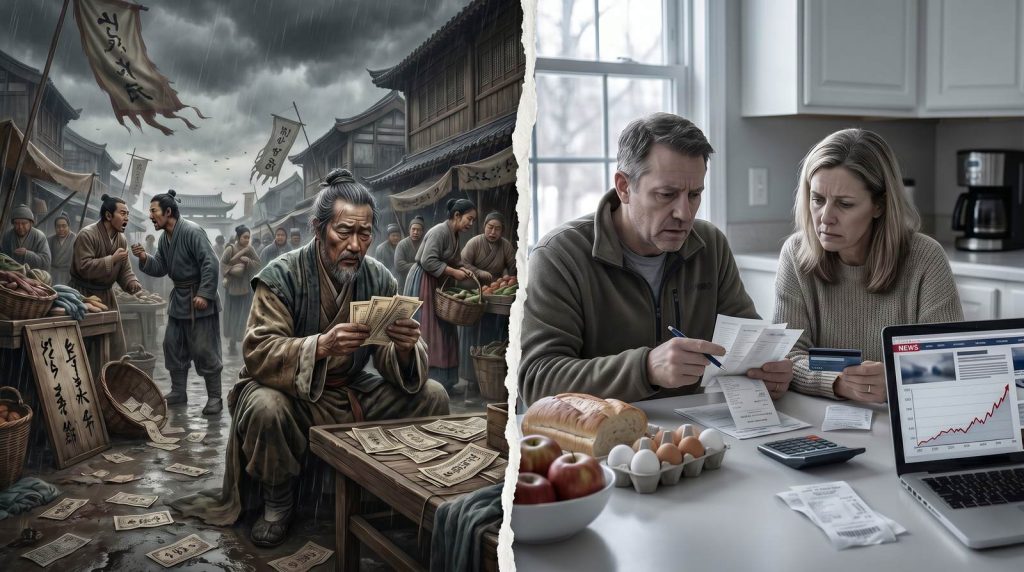
At first, it feels like a bad month.
The Federal Reserve now says America is dealing with one transitory shock after another. Gasoline prices have risen by more than one-third since the Iran conflict began, the energy portion of CPI jumped 10.8% in a single month, and consumer confidence just hit its lowest reading on record according to the University of Michigan survey cited by Governor Christopher Waller.[1]
The IMF is delivering the same message from a wider angle. Global growth has been downgraded to 3.1%, energy prices are expected to be up 19% in the reference scenario, and public debt is already so high that fiscal space is “much thinner than before.”[2]
Most people hear those warnings and think one word: inflation.
But that is too small.
The deeper problem begins when ordinary people stop trusting the price system itself. When every month brings a new explanation, every shock is called temporary, and every household budget gets harder to recognize, the public starts to feel something more dangerous than sticker shock.
It starts to feel like the numbers are lying.

The Warning Is Not Just Inflation. It Is Distrust.
The Fed’s message matters because it is not coming from a cable-news panic merchant. It is coming from a sitting governor who warned that a sequence of supposedly temporary shocks can keep inflation elevated long enough to change how businesses and households behave.[1]
That is the point where a price spike stops being just an economic inconvenience. It becomes a social event.
“The standard ‘look through’ can become problematic if businesses and households start to believe inflation is persistently high…” — Governor Christopher J. Waller, April 17, 2026 [1]
Once that happens, families do not simply complain. They change their timing, their trust, and their habits.
They stock up early. They delay repairs. They hoard cash or burn cash. They accept worse substitutes. They stop believing official reassurances because the grocery bill is speaking louder than the podium.
That is when a modern system begins to lose credibility at the household level.
And history has seen this movie before.
When the Yuan Note Still Felt Like Money
In the 13th century, the Mongol-led Yuan dynasty ruled one of the most formidable empires on earth. It governed vast territory, controlled trade routes, fielded armies, and used one of history’s most ambitious monetary tools: state-issued paper money.[3]
For a long stretch, that system worked better than many modern people realize. New research shows that Yuan paper money was initially constrained by convertibility and other monetary discipline, which helped keep the price level relatively stable for decades.[3]
That stability is the important part.
The system did not begin in obvious chaos. It began with public usefulness, state prestige, and enough discipline to make the paper believable.
That is how trust-based systems always begin. Not with madness, but with convenience.
People accepted the notes because the empire still looked strong. Trade still moved. Administration still functioned. The paper still seemed connected to something real.
Then the shocks started to stack.
Then the State Solved Every Shock the Same Way
According to recent economic history research, late Yuan inflation was closely tied to military pressure and civil war, which created fiscal demands that encouraged over-issuance of paper money.[3] The issue was not that one bad harvest or one emergency ruined everything by itself.
The issue was that repeated pressure taught the state the same reflex over and over again.
Print more. Cover the gap. Buy time.
That reflex is seductive because it works just long enough to feel rational. It keeps the machinery moving a little longer. It softens the immediate pain. It lets the center pretend the problem is manageable.
But every time leaders solve a real-world shortage with more monetary claims, they widen the gap between paper promises and physical reality.
By the end of the Yuan period, paper money was reported to be close to worthless, and some towns and cities were falling back into barter.[3]
That is the moment to remember.
Collapse did not arrive merely because prices went up. Collapse arrived because the public no longer trusted the measuring stick.
Money stopped feeling like stored work. It started feeling like political narration.
The Day People Stop Believing the Measure
A society can survive hardship longer than elites assume. People can adapt to scarcity, improvise through disruption, and endure long stretches of uncertainty.
What they cannot endure forever is a system in which the official numbers and lived reality drift too far apart.
When that gap widens, the damage spreads fast. Merchants change behavior. Workers demand more. Households lose patience. Trust drains not only from money, but from the institutions standing behind it.
That is why price instability is so corrosive.
It does not only make life expensive. It makes coordination harder.
The Yuan court did not wake up one day and decide to destroy monetary trust. It drifted there through accumulated pressures, emergency responses, and the illusion that one more issuance round would bridge one more problem.[3]
That is what makes the parallel uncomfortable. Modern America is not handing out medieval paper notes in a palace market. But it is living through a chain of shocks in which higher energy costs, tariff pass-through, weaker confidence, and shrinking policy room all collide at once.[1] [2]
Every empire thinks its sophistication will protect it from old laws.
It never does.
America’s Version Would Not Look the Same
It would look more polished. More digital. More statistically defended.
It would come with charts, talking points, and very serious people explaining why the latest jump is contained, why the next quarter is cleaner, and why households should focus on the long term.
And some of that would even be partly true.
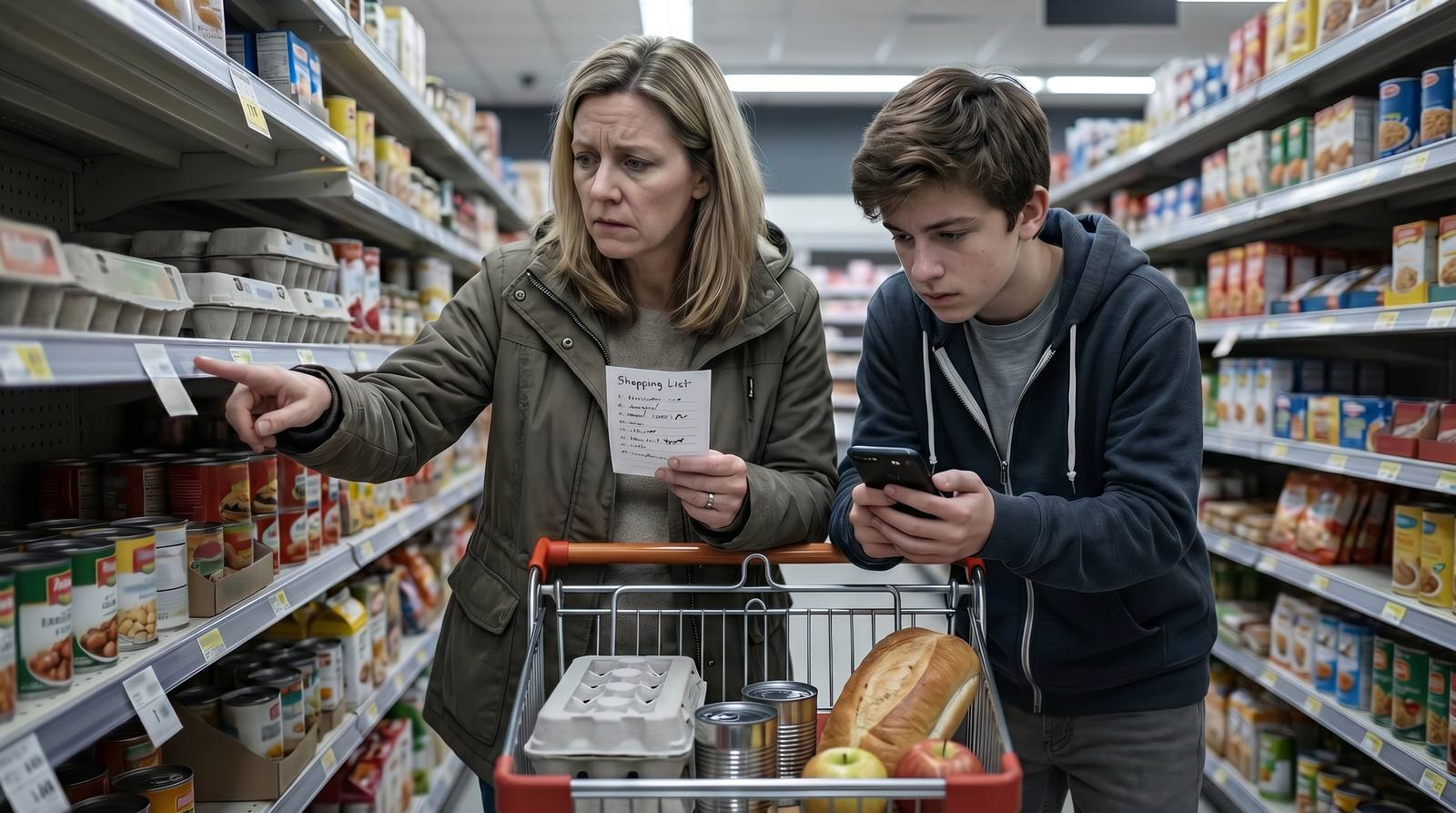
But the household experience is what matters. If gasoline jumps, food inputs rise, borrowing stays expensive, and each “temporary” shock lands before the last one has cleared, families start making decisions based on loss of trust, not just loss of income.[1] [2]
That is how a price system starts lying to ordinary people.
Not because every statistic is false. Because the official story no longer matches the lived sequence of concessions.
You drive less. You postpone the dentist. You downgrade groceries. You stop assuming next month will be easier. You feel rich countries are supposed to be sturdier than this.
That emotional break matters more than economists like to admit.
The IMF’s warning about thin fiscal space should be read through that lens. It means the people in charge have less room to cushion the next hit cleanly.[2]
The Fed’s warning about repeated shocks should be read the same way. It means even “temporary” pressures can become politically and psychologically durable if they keep arriving back-to-back.[1]
That is where credibility starts to leak.
The Richest Systems Often Misread Their Own Danger
The wealthy layers of a society are often the last to feel the full force of a distorted price system. They have buffers. They have optionality. They can absorb a season of waste and call it inconvenience.
Middle-class and working households cannot do that forever.
They feel the lie first. They feel it in grocery substitutions, insurance premiums, fuel costs, and the quiet humiliation of discovering that old routines no longer fit new math.
That is why elite calm can be such a bad indicator.
A society does not have to look poor to be losing stability. It only has to keep forcing ordinary people to renegotiate reality faster than institutions can restore trust.
That was true in late Yuan China. It is true now in every modern economy trying to convince the public that one more shock will be the last shock.
But it does not have to end there.
What Late-Stage Price Stress Really Steals
Most people think inflation steals purchasing power. It does.
But late-stage price stress steals planning power, which is worse.
A family can survive a lean season if the rules stay stable. What crushes morale is the feeling that every budget assumption expires faster than your paycheck arrives.
That is why repeated price shocks reshape behavior so deeply. They make long-term thinking feel naive. They train households to become short-term, defensive, and exhausted.
The Yuan collapse showed the same pattern in older form. Once the public stopped trusting the note, commerce itself became more cumbersome, because every exchange required more doubt, more negotiation, and more friction.[3]
Modern Americans are not haggling over paper notes in a caravan market. But they are increasingly forced to ask the same underlying question: What will this dollar really buy me by the time I need it?
That question changes everything.
It changes how people save. It changes how they shop. It changes how much risk they can tolerate. It even changes whether they still believe tomorrow will reward discipline.
When a society reaches that point, the real emergency is not only economic. It is moral and civic.
A country where ordinary prudence stops working is a country inviting distrust, anger, and political manipulation.
The Turn: The Path to Resilience
It is easy to read a pattern like this and feel cornered. If the cost structure is unstable, if institutions are stretched, and if the public story keeps lagging behind lived reality, then despair can feel like the most honest response.
But it is not.
History teaches a better lesson than helplessness. When large systems become less reliable, the people who do best are rarely the ones who stare at the macro chart all day. They are the ones who start rebuilding margin, skills, and local trust before the pressure becomes a full-blown crisis.
That is the hopeful side of this pattern. You do not need to control the Fed, the IMF, or the shipping lanes to reduce your exposure to a lying price system.
You need to control more of the things that touch your home every week.
Food is one of them. So are health basics, practical skills, neighborhood relationships, and information sources that still respect reality.
Resilience begins when your household stops outsourcing every essential to fragile systems.
That is not fear-based living. It is sovereignty.

The Action: Build Before Prices Rewrite Your Life
If you want one concrete move that turns anxiety into leverage, start with food. The 4ft Farm Blueprint is not just a gardening guide. It is a practical way to build recurring savings, food security, and family confidence in a world where the official price story keeps changing.
If you want to deepen that foundation, read Homesteader Depot for hands-on self-reliance systems and Survival Stronghold for practical preparedness that begins before the shelves look empty.
If your goal is stronger analysis and calmer decision-making, spend time with Self Reliance Report and The Ready Report. Both help readers think beyond headlines and build durable personal strategy instead of reacting emotionally to every new shock.
And if rising prices are colliding with health stress in your own home, Seven Holistics offers a more grounded view of wellness and recovery than the usual panic-driven media cycle.
You do not need the whole system to tell the truth before you begin building a better one.
That is the real historical lesson.
The public usually realizes too late that the measuring stick has changed. You still have time to respond while the stores are open, the lights are on, and one square foot of soil can still become a form of independence.
Small acts of ownership matter most when large systems are becoming less trustworthy.
Build now, while the numbers still look normal.