
Something extraordinary happened in the concrete corridors of New York City public housing this week that would have made a 950-year-old Chinese bureaucrat nod in grim recognition. While residents of NYCHA developments were celebrating their new “free internet” connections—part of Mayor Eric Adams’ flagship Big Apple Connect program—they had no idea they were actually volunteering to become subjects in the latest chapter of America’s expanding surveillance state.
The revelation broke like a digital thunderclap: Adams’ administration has been quietly using the very broadband infrastructure meant to bridge the digital divide as a highway for police surveillance. Through network connections established under the three-year-old Big Apple Connect program, the NYPD is now linking cameras at New York City Housing Authority developments directly to their central digital surveillance system—without asking residents, without public disclosure, and without the traditional bureaucratic friction that might slow such an expansion.
By the end of this year, twenty NYCHA developments will have their camera feeds flowing directly into the NYPD’s Domain Awareness System, that controversial counterterrorism platform that fuses expansive data on New Yorkers’ movements, digital footprints, and biographical information into a centralized repository. The system can harness this data for facial recognition analysis and predictive policing algorithms that use pattern recognition to decide where and how to allocate police resources. One development was already connected last Wednesday. Nineteen more are set to follow.
The genius—if we can call it that—lies in the deception’s elegant simplicity. What resident would question free internet access? What community advocate would oppose bridging the digital divide? The program was presented as pure public benefit, a lifeline for families struggling with remote work and online education. Instead, it became the infrastructure for a surveillance expansion that would make the architects of the Patriot Act weep with envy.
But here’s what should make every American’s blood run cold: this exact playbook was perfected nearly a millennium ago by a Chinese emperor whose “community improvement program” became the template for authoritarian surveillance that echoes through history to this very day.

The Time Portal
Picture this: It’s 1069 CE, and the morning mist clings to the curved rooftops of Kaifeng, capital of the Northern Song Dynasty. In the halls of the imperial palace, a brilliant and controversial minister named Wang Anshi is about to present Emperor Shenzong with a revolutionary idea that will reshape Chinese society for the next thousand years.
Wang Anshi was the kind of reformer who made enemies simply by existing. Tall, gaunt, with the intense eyes of a man who saw solutions where others saw only problems, he had already earned the nickname “The Stubborn Premier” for his relentless pursuit of governmental efficiency. His colleagues whispered that he changed his clothes so infrequently that lice had taken up permanent residence in his robes—a detail that somehow makes his obsession with social control even more unsettling.
On this particular morning, Wang Anshi unfurled a silk scroll before the young emperor and began to describe what he called the “Baojia System”—a community-based program that would, he promised, solve multiple problems at once. Crime was rising in the provinces. Tax collection was inefficient. The government was spending too much on mercenaries to maintain order. But what if, Wang Anshi suggested, they could turn the people themselves into the solution?
The system was elegantly simple, almost beautiful in its logic. Every ten families would form a “jia”—a tithing, a neighborhood watch, a mutual aid society. Ten jia would form a “bao,” creating a network of one hundred families under unified leadership. Each group would have a rotating placard, a wooden tablet that would pass from household to household, marking who was responsible for leadership that month.
“Imagine, Your Majesty,” Wang Anshi said, his voice carrying the fervor of a man who believed he was saving civilization, “a system where the people police themselves, where neighbors watch neighbors, where crime becomes impossible because everyone is accountable to everyone else.”
Emperor Shenzong, barely twenty-one and eager to prove himself as a reformer, was captivated. Here was a program that promised to strengthen communities while extending imperial control into every village, every neighborhood, every household in the empire. It would be presented as community empowerment—local self-defense, mutual aid, civic responsibility. The people would embrace it because it would make them safer, more prosperous, more connected to their neighbors.
What could possibly go wrong?

The wooden placards began appearing in villages across the Song Empire like a rash of bureaucratic efficiency. Families gathered in courtyards to swear oaths of mutual responsibility. Neighborhood leaders emerged, some reluctant, others eager for the small taste of authority the system provided. The Baojia System was born, and with it, a surveillance network that would make the NSA’s wildest dreams seem quaint by comparison.
But Wang Anshi had made one crucial miscalculation. He assumed that a system designed to serve the people would remain in service to the people. He never imagined that future rulers would discover the Baojia System’s true potential—not as a tool of community empowerment, but as the perfect infrastructure for authoritarian control.
The Parallel Revelation
The parallels between Wang Anshi’s Baojia System and Eric Adams’ surveillance expansion are so precise they seem almost supernatural—as if the same playbook has been passed down through the centuries, translated from ancient Chinese into modern bureaucratese.
Both systems began with the same seductive promise: community improvement disguised as government innovation. Wang Anshi sold the Baojia System as neighborhood empowerment, local self-defense, and mutual aid. Eric Adams sells his surveillance expansion as public safety enhancement, community protection, and technological progress. Both leaders positioned themselves as reformers solving multiple problems with one elegant solution.
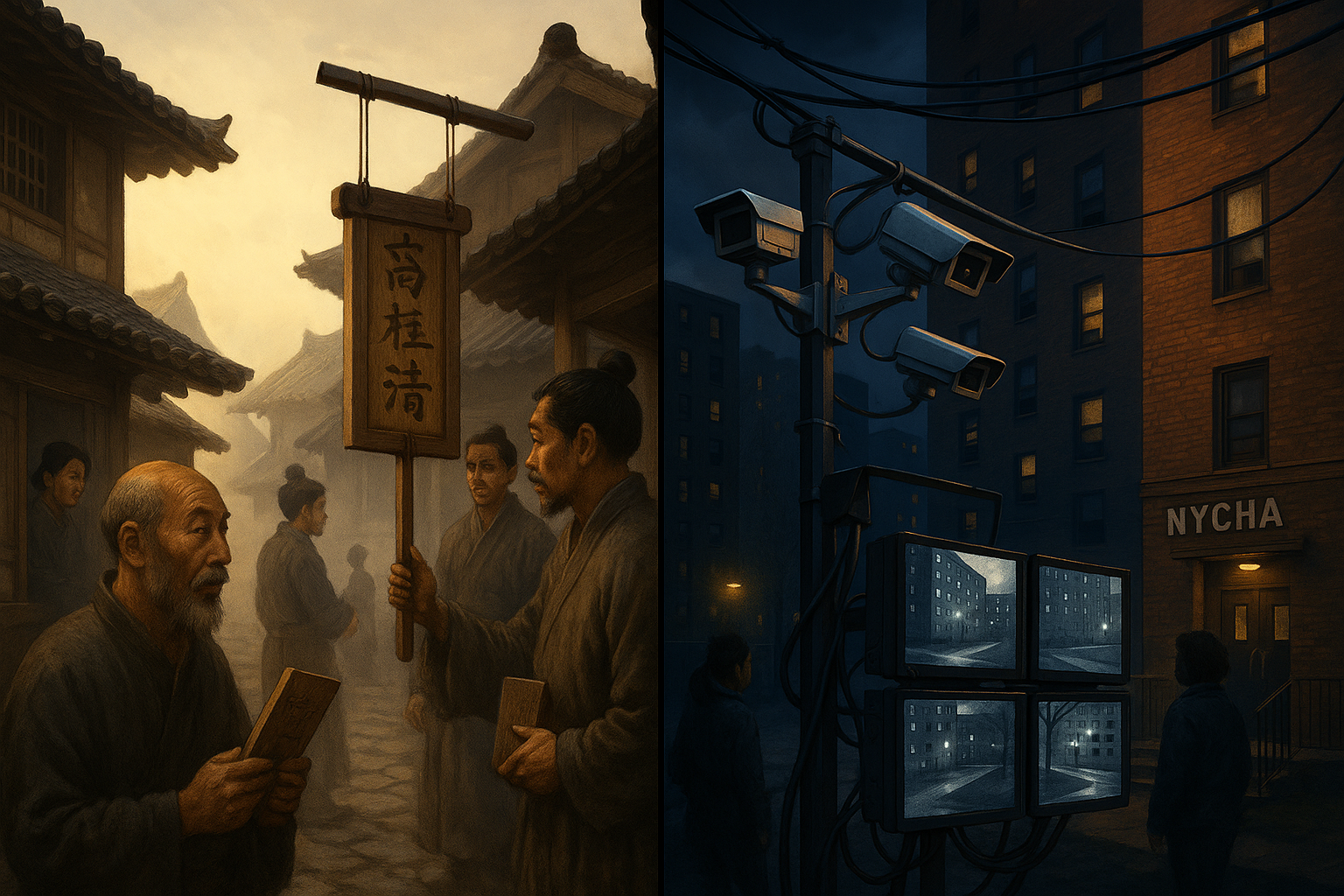
The deception tactics are virtually identical. Wang Anshi’s wooden placards rotated through households, creating the illusion of shared leadership while actually establishing a surveillance network where every family monitored every other family. Adams’ broadband connections flow through public housing developments, creating the illusion of digital equity while actually establishing a surveillance network where every camera monitors every resident.
Both systems targeted the most vulnerable populations first. The Baojia System began in rural villages and poor urban neighborhoods—places where people had little political power to resist and much to gain from promised improvements. Adams’ surveillance expansion targets public housing residents—people who depend on government services and have limited ability to opt out of programs presented as benefits.
The bureaucratic camouflage is eerily similar. Wang Anshi embedded surveillance within community organization, making it seem like civic participation rather than government monitoring. Adams embeds surveillance within digital infrastructure, making it seem like technological progress rather than police expansion. Both systems operate through existing community structures, making resistance seem like opposition to community improvement itself.
Perhaps most chillingly, both systems bypass traditional oversight mechanisms. The Baojia System allowed imperial authorities to monitor citizens without deploying official government agents—the people monitored themselves. Adams’ system allows the NYPD to access surveillance footage without asking NYCHA for permission—the infrastructure monitors itself.
The psychological manipulation is identical across the centuries. Wang Anshi understood that people would accept surveillance if it was presented as empowerment, if they believed they were participating in their own protection rather than submitting to government monitoring. Adams understands that residents will accept surveillance if it’s presented as a benefit, if they believe they’re receiving digital equity rather than surrendering privacy.
This isn’t coincidence. This is the eternal playbook of authoritarian expansion: present surveillance as service, embed monitoring within benefits, target the vulnerable first, bypass traditional oversight, and always, always claim that resistance to surveillance is opposition to community improvement itself.
The Pattern Recognition
Why does this exact pattern repeat across nearly a thousand years of human history? Why do leaders separated by continents and centuries independently discover the same surveillance strategies? The answer lies in the uncomfortable truth about human nature: we haven’t evolved as much as we’d like to believe.
The fundamental psychology that made Wang Anshi’s deception possible in 1069 CE is identical to the psychology that makes Adams’ deception possible in 2025. Humans are social creatures who crave security, community, and the approval of authority figures. We want to believe that our leaders are working in our best interests. We want to trust that programs presented as benefits actually benefit us. We want to assume that surveillance systems designed to protect us won’t be used against us.
This psychological vulnerability creates what we might call the “Surveillance Paradox”: the very human traits that make communities strong—trust, cooperation, mutual aid—are the same traits that make communities vulnerable to surveillance expansion. Leaders like Wang Anshi and Eric Adams don’t succeed despite human goodness; they succeed because of it.
The pattern repeats because the incentive structure never changes. Political leaders face eternal pressures: maintain order, collect revenue, demonstrate effectiveness, expand control. The most successful leaders are those who find ways to increase government power while making citizens feel empowered. Surveillance systems disguised as community benefits solve this problem perfectly—they expand state capacity while generating public gratitude.
The Ancient Warning
History has already written the ending to Eric Adams’ surveillance story, and it’s not pretty. The Baojia System that Wang Anshi created as community empowerment became, over the centuries, one of the most oppressive surveillance networks in human history—a cautionary tale written in the suffering of millions.
Initially, the system worked exactly as Wang Anshi promised. Communities became more organized, crime decreased in some areas, and tax collection improved. The wooden placards rotated peacefully through households, and neighbors genuinely looked out for each other. For a brief, shining moment, it seemed like surveillance and community benefit could coexist.
But power, once created, seeks its own expansion. By the Ming Dynasty, the Baojia System had evolved from community self-defense into government control mechanism. The rotating placards became tools of political monitoring. Neighbors were required to report not just crimes, but political dissent, religious activities, and social behavior that deviated from imperial norms. The system that began as mutual aid became mutual surveillance.
The most chilling chapter came in the 20th century, when Japanese occupiers in Manchukuo discovered the Baojia System’s true potential. They implemented what they called the “Tonarigumi” system, using the existing surveillance infrastructure to monitor and control Chinese citizens under occupation. The Japanese added a “lianzuo” punishment system—crimes committed by one family resulted in punishment for all ten families in their group.
The system that Wang Anshi created to strengthen communities became the infrastructure for foreign occupation and authoritarian control. The wooden placards that once rotated peacefully through households became the foundation for a surveillance state that would make Orwell’s Big Brother seem amateurish by comparison.
The ancient warning is clear: surveillance systems disguised as community benefits will eventually become tools of community oppression. The only question is how long the transformation takes, and whether we’ll recognize it happening before it’s too late to stop.
5 Things Readers Can Do This Week
The Baojia System’s thousand-year evolution from community benefit to authoritarian nightmare didn’t happen overnight—and neither will the transformation of Adams’ surveillance expansion. But history shows us that the time to act is now, before surveillance systems become so embedded in our daily lives that resistance becomes impossible. Here are five concrete steps you can take this week to protect yourself and your family from the surveillance state that’s being built around us:
1. Create Communication Networks That Bypass Digital Surveillance
The most important lesson from the Baojia System is that surveillance states depend on controlling information flow. Start building analog communication networks with your neighbors, family, and trusted friends. Learn basic radio operation, establish regular in-person meeting schedules, and create physical message systems that don’t depend on digital infrastructure. The Self Reliance Report offers detailed guides on setting up neighborhood communication networks that can function during emergencies or when digital systems are compromised.
2. Develop Food and Water Independence
Surveillance systems gain power by controlling access to essential resources. The more dependent you are on government services and corporate supply chains, the more vulnerable you become to surveillance expansion. Start this week by implementing a 4ft Farm Blueprint system that can produce fresh food in minimal space, even in urban environments. Homesteader Depot provides comprehensive resources for developing food and water independence that can sustain your family even when traditional systems fail or become tools of control.
3. Build Physical and Digital Security Skills
The Baojia System succeeded because people didn’t know how to protect themselves from surveillance. Don’t make the same mistake. This week, learn basic digital security practices: use encrypted messaging apps, employ VPN services, and understand how to minimize your digital footprint. Survival Stronghold offers training in situational awareness, personal defense, and home security that can protect you from both criminal threats and government overreach.
4. Strengthen Your Health Independence
One of the most effective tools of social control is medical dependency. The Baojia System eventually controlled people by controlling access to resources they needed to survive. Build your health independence by learning natural healing methods, maintaining physical fitness, and reducing dependence on pharmaceutical interventions. Freedom Health Daily provides evidence-based information on natural health practices that can keep you and your family healthy without relying on systems that may be compromised by surveillance or political pressure.
5. Develop Mental and Spiritual Resilience
The most insidious aspect of surveillance systems like the Baojia is how they change people psychologically, making them compliant, fearful, and dependent on authority for guidance. Counter this by developing mental and spiritual practices that strengthen your independence and resilience. Seven Holistics offers comprehensive approaches to mental, emotional, and spiritual health that can help you maintain clarity and courage even under pressure.
The key insight from Wang Anshi’s failed experiment is that surveillance systems succeed when people feel isolated, dependent, and powerless. They fail when people are connected, self-reliant, and confident in their ability to take care of themselves and their communities. The choice between freedom and surveillance isn’t made in voting booths or legislative chambers—it’s made in the daily decisions we make about how to live, how to connect with others, and how much of our independence we’re willing to trade for the illusion of security.
History is watching. The question is: will we learn from Wang Anshi’s mistake, or will we repeat it?