By Shamus Gerry III
The Modern Mystery
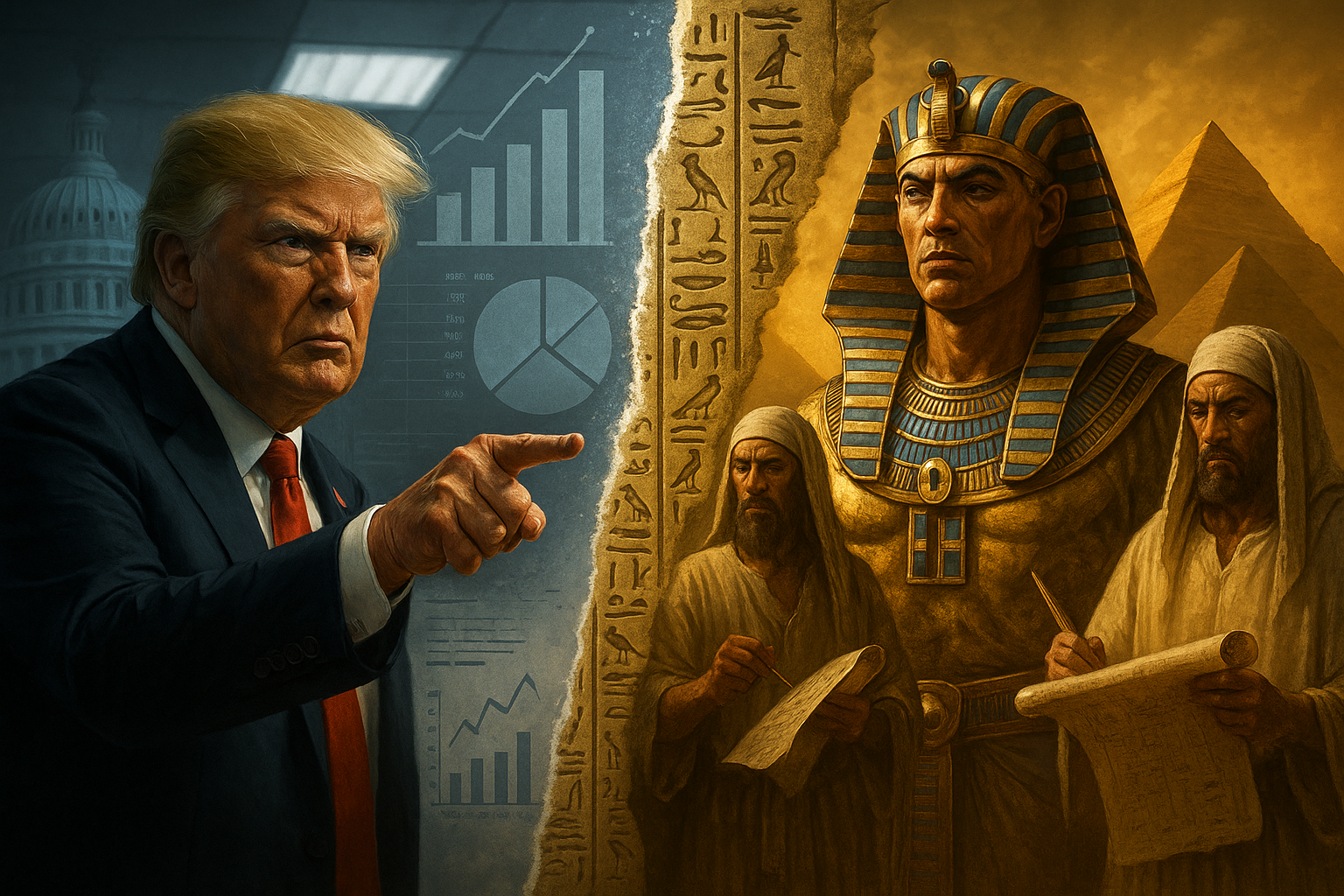
Something extraordinary happened in the marble corridors of Washington this week that would have made a 4,000-year-old Egyptian scribe nod in grim recognition. While Americans were debating the latest political theater, President Trump quietly executed what may be the most consequential power grab of his presidency—one that strikes at the very heart of how we understand economic reality itself.
The firing of Bureau of Labor Statistics Commissioner Erica Groshen wasn’t just another bureaucratic reshuffling. It was a surgical strike against the independence of America’s most trusted economic data. For nearly a century, the BLS has operated as the nation’s statistical conscience, producing the employment numbers, inflation data, and economic indicators that guide everything from Federal Reserve decisions to your retirement planning. These aren’t just numbers on a spreadsheet—they’re the mathematical foundation of American economic policy.
But here’s where the story gets fascinating, and more than a little unsettling. Trump’s move represents something far more ancient and dangerous than partisan politics. It’s the age-old struggle between rulers who want to control the narrative and the keepers of inconvenient truths. When a leader starts treating statisticians like enemies of the state, history shows us exactly where that path leads.
The parallels to ancient power struggles are so precise they’re almost eerie. Throughout history, the moment rulers begin controlling the flow of economic information is the moment their empires begin their descent into chaos. The numbers don’t lie—but when rulers start firing the people who count them, the numbers stop mattering altogether.
What Trump may not realize is that he’s just triggered a sequence of events that played out with devastating consequences along the banks of the Nile over four millennia ago, when another absolute ruler decided that controlling economic data was more important than preserving the integrity of his kingdom.
The Time Portal

Picture this: It’s 2000 BCE, and the morning sun casts long shadows across the limestone steps of the pharaoh’s administrative complex in Memphis. The air is thick with the scent of papyrus ink and the quiet scratch of reed pens against parchment. In a dozen chambers throughout the palace, Egypt’s most powerful men aren’t generals or priests—they’re scribes.
These aren’t the humble record-keepers you might imagine. In ancient Egypt, scribes were the ultimate power brokers, the gatekeepers of truth itself. Only one to five percent of the population could read and write, making literacy more exclusive than membership in today’s most elite clubs. A scribe’s reed pen was mightier than any sword because it controlled something far more valuable than military might: information.
Meet Amenemheb, chief scribe of the royal treasury. Every morning, he unfurls papyrus scrolls containing the economic lifeblood of the kingdom—tax receipts from the fertile Delta, grain inventories from Upper Egypt, tribute records from Nubia. His calloused fingers trace hieroglyphic columns that represent the wealth of nations. The pharaoh may wear the double crown, but Amenemheb holds the real power: he knows exactly how much gold flows into the royal coffers, how many bushels of wheat fill the state granaries, and which regional governors are skimming from their tax collections.
The system is breathtakingly sophisticated. Ancient Egyptian bureaucracy makes modern government look like amateur hour. They’ve invented double-entry bookkeeping, created elaborate checks and balances, and developed a statistical apparatus so advanced that it won’t be matched again for millennia. Every transaction is recorded, every bushel counted, every tax payment meticulously documented on papyrus that will survive longer than most civilizations.
But here’s the thing about information: it’s only as powerful as the person who controls it. And in the halls of the pharaoh’s palace, a dangerous game is about to begin—one that will determine whether Egypt remains the world’s greatest superpower or crumbles into the dust of history. The pharaoh is growing suspicious of his scribes, and the scribes are growing tired of serving a ruler who doesn’t appreciate the delicate balance between power and truth.
ADVERTISEMENT: When governments start manipulating economic data, smart families start growing their own food. The 4ft Farm Blueprint shows you how to create a sustainable food source in just 4 square feet—perfect for apartments, small yards, or anywhere you need reliable nutrition when supply chains fail. Don’t wait for the next crisis to hit. Start building your food independence today.
The Parallel Revelation
The parallels between Trump’s BLS purge and ancient Egypt’s bureaucratic crisis are so precise they’re almost supernatural. Both scenarios feature the same fundamental conflict: an absolute ruler versus the keepers of inconvenient economic truths.
In ancient Egypt, the pharaoh’s power rested on a carefully constructed myth of divine infallibility. The kingdom’s prosperity was supposedly a direct reflection of the pharaoh’s favor with the gods. But the scribes knew better. Their papyrus scrolls told a different story—one of regional tax rebellions, declining agricultural yields, and growing economic inequality. When the numbers contradicted the narrative, something had to give.
Sound familiar? Trump’s relationship with economic data has always been complicated. When unemployment numbers looked good under Obama, he called them “fake.” When they improved under his watch, they suddenly became “real” again. The BLS commissioner’s independence represented the same threat to Trump that Amenemheb’s honest accounting posed to the pharaoh: the possibility that objective reality might contradict the official story.
The psychology is identical across four millennia. Both leaders faced the same impossible choice: accept uncomfortable truths or eliminate the truth-tellers. Both chose the latter, and both triggered the same predictable sequence of events.
The Pattern Recognition
Here’s where the historical parallel becomes genuinely chilling. In ancient Egypt, the pharaoh’s decision to purge his statistical apparatus didn’t happen in isolation. It was part of a broader pattern of authoritarian overreach that historians now recognize as the beginning of the Middle Kingdom’s collapse.
The sequence was always the same: first, the ruler would grow suspicious of independent information sources. Then came the purges—not just of scribes, but of regional governors, military commanders, and anyone else who might possess inconvenient knowledge. Finally, with no reliable feedback mechanisms left, the ruler would make increasingly catastrophic decisions based on increasingly fictional information.
Trump’s BLS purge fits this pattern with terrifying precision. It’s not just about employment statistics—it’s about the systematic dismantling of institutional independence. When you fire the people who count the unemployed, you’re not just attacking data; you’re attacking the very concept of objective reality.
The ancient Egyptians learned this lesson the hard way. By the time the pharaoh realized that his scribes had been telling the truth about the kingdom’s economic problems, it was too late. The administrative apparatus had been so thoroughly compromised that accurate information was no longer available. The kingdom stumbled blindly from crisis to crisis, each decision based on increasingly unreliable data, until the entire system collapsed.
The Ancient Warning

The final chapter of Egypt’s Middle Kingdom offers a sobering preview of what happens when rulers successfully eliminate independent sources of economic truth. By 1650 BCE, the pharaoh’s court had become an echo chamber of wishful thinking and manufactured statistics. The real numbers—crop failures, tax rebellions, military defeats—were simply too dangerous to report.
The result was predictable: a kingdom that had dominated the ancient world for over a millennium suddenly found itself unable to respond to basic challenges. When the Hyksos invaded from the north, Egypt’s leaders were caught completely off guard. Their own statistics had told them the kingdom was stronger than ever.
The parallels to modern America are impossible to ignore. When you systematically undermine the institutions that produce reliable economic data, you don’t eliminate economic problems—you just eliminate your ability to see them coming. The BLS doesn’t create unemployment; it measures it. Fire the measurers, and the unemployment doesn’t disappear—it just becomes invisible until it’s too late to address.
This is the ancient warning that echoes across four millennia: rulers who control information may feel more powerful in the short term, but they inevitably become less capable of actual governance. The pharaohs who purged their scribes didn’t strengthen their kingdoms—they blinded themselves to the very threats that would ultimately destroy them.
ADVERTISEMENT: When economic systems collapse, energy independence becomes survival. Discover the lost generator technology that’s been suppressed for decades. This simple device can power your entire home for pennies, giving you the energy security you need when the grid fails and government statistics become meaningless.
5 Things Readers Can Do This Week
The historical parallel between Trump’s data purge and ancient Egypt’s bureaucratic collapse isn’t just an academic curiosity—it’s a warning about what happens when statistical integrity becomes a casualty of political ambition. Here are five concrete steps you can take to protect yourself and your family from the consequences of unreliable economic information:
1. Diversify Your Information Sources
Don’t rely solely on government statistics for economic planning. Create your own financial independence strategy using multiple data sources, including private sector reports, international comparisons, and local economic indicators. When official numbers become unreliable, independent analysis becomes essential.
2. Build Economic Resilience
The ancient Egyptians who survived their kingdom’s collapse were those who had prepared for uncertainty. Start building your own economic resilience through emergency savings, debt reduction, and skill diversification. Visit Survival Stronghold for practical guides on financial preparedness and self-reliance strategies.
3. Invest in Tangible Assets
When statistical integrity becomes questionable, tangible assets become more valuable. Consider investments in real estate, precious metals, or other physical assets that maintain value regardless of what official statistics claim about the economy.
4. Develop Local Networks
Ancient Egyptian communities that maintained strong local networks were better able to weather the kingdom’s collapse. Build relationships with neighbors, local businesses, and community organizations. Local knowledge often proves more reliable than distant bureaucratic reports.
5. Stay Historically Informed
Understanding historical patterns helps you recognize contemporary dangers. The more you know about how past civilizations handled similar challenges, the better equipped you’ll be to navigate current uncertainties. History doesn’t repeat, but it often rhymes—and right now, it’s rhyming with some very troubling ancient precedents.
The lesson from ancient Egypt is clear: when rulers start firing the people who count things, it’s time to start counting on yourself. The pharaohs who ignored this warning lost their kingdoms. We still have time to learn from their mistakes.