

At first, this looks like another ugly procedural fight.
Voting-rights groups say the Department of Justice is trying to gather voter data from across the country and turn it into the raw material for a national surveillance-and-purge system. The administration says it is enforcing election law and helping states identify ineligible voters.1
That sounds technical.
But the real question is not technical at all.
The real question is what happens when political belonging starts getting treated like a record-management problem. What happens when the state begins acting as if the difference between citizen and suspect can be settled by one big list.
The Modern Mystery
On Tuesday, Common Cause and individual voters sued to block the DOJ from collecting confidential voter information on a national scale.1 Votebeat reports that 12 states have already voluntarily shared full voter rolls, while the DOJ has sued 30 states and Washington, D.C. for refusing to hand over unredacted lists.2
That should make you stop.
Because voter rolls are not just clerical files. They are the machinery that decides who counts when power is handed out.
According to the lawsuit and reporting on it, the plaintiffs argue that DOJ is building a national voter list, consolidating sensitive personal data, and laying the groundwork for removals that could wrongly strip eligible Americans from the rolls.1
If that sounds alarmist, remember how most dangerous political changes begin.
They do not begin with jackboots.
They begin with forms, categories, matching logic, data requests, and official language about maintenance.
First the list expands. Then the discretion expands with it.

The Time Portal
To see the deeper pattern, you have to leave modern court filings and walk into medieval Venice.
For a long time, Venice looked like one of the most dynamic republics in the world. Trade made it rich. Merchant families pushed back against arbitrary executive power. Institutions opened up enough to help the city grow.4
Then the republic changed direction.
In 1297, Venice carried out the Serrata del Maggior Consiglio—the closing of the Great Council. Membership in the state’s ruling assembly became hereditary rather than broadly contestable. Then, in 1315, the regime created the Golden Book to keep a registry of who qualified to belong.3
That registry was not a side note.
It was the mechanism.
History Walks Venice summarizes the shift plainly: after the council was closed in 1297, Venice created the Golden Book in 1315 to register all potential members, and only those from selected families could enter the political body that functioned as the republic’s electorate.3
A list decided who was in.
A list decided who was out.
And because the list looked administrative, the power grab could present itself as orderly.
That is how republics get narrowed without always looking dramatic in the moment.
When a Republic Becomes a Registry
This is the part modern people tend to miss.
Venice did not announce that it was abandoning republican legitimacy altogether. It kept the language of public life. It kept procedures. It kept councils, votes, and ceremony.
What changed was access.
Political participation moved behind a gate that could be managed, inherited, and defended. The republic still had institutions. But the institutions now served a narrower class whose names were protected inside an official book.3
The Quarterly Journal of Economics describes the larger result as a shift away from political openness, economic competition, and social mobility and toward political closure, extreme inequality, and social stratification after 1297.4
That is the warning inside the present fight.
When the state gains greater power over the master list of participation, the public debate usually fixates on whether the list is accurate. Accuracy matters.
But accuracy is not the only issue.
The deeper issue is who controls the gate, who gets to define error, and how much recourse ordinary people have once their standing becomes a data problem.
Every master list creates a master class of list-managers.
The Dangerous Part Is the Direction of Travel
America is not medieval Venice.
The Constitution is different. Federalism is different. Elections are different. The parallel is not about copying the past detail for detail.
It is about the direction of travel.
In Venice, political narrowing became easier once belonging could be formalized, recorded, and defended by an official registry. In the current American dispute, civil-liberties groups are warning that a national voter database would do something similar in principle: shift more practical power over political belonging toward centralized actors who can surveil, match, flag, and pressure removals at scale.1
That does not automatically mean every database becomes tyranny.
It does mean the burden of proof should run in the opposite direction from where power usually wants it to run.
The public should not have to prove why the state deserves a national participation ledger. The state should have to prove why it needs one, why the old limits are insufficient, and why the inevitable errors will not fall hardest on ordinary people with the least time, money, and legal support to fight back.
Because that is always how these systems bite.
Not at the podium.
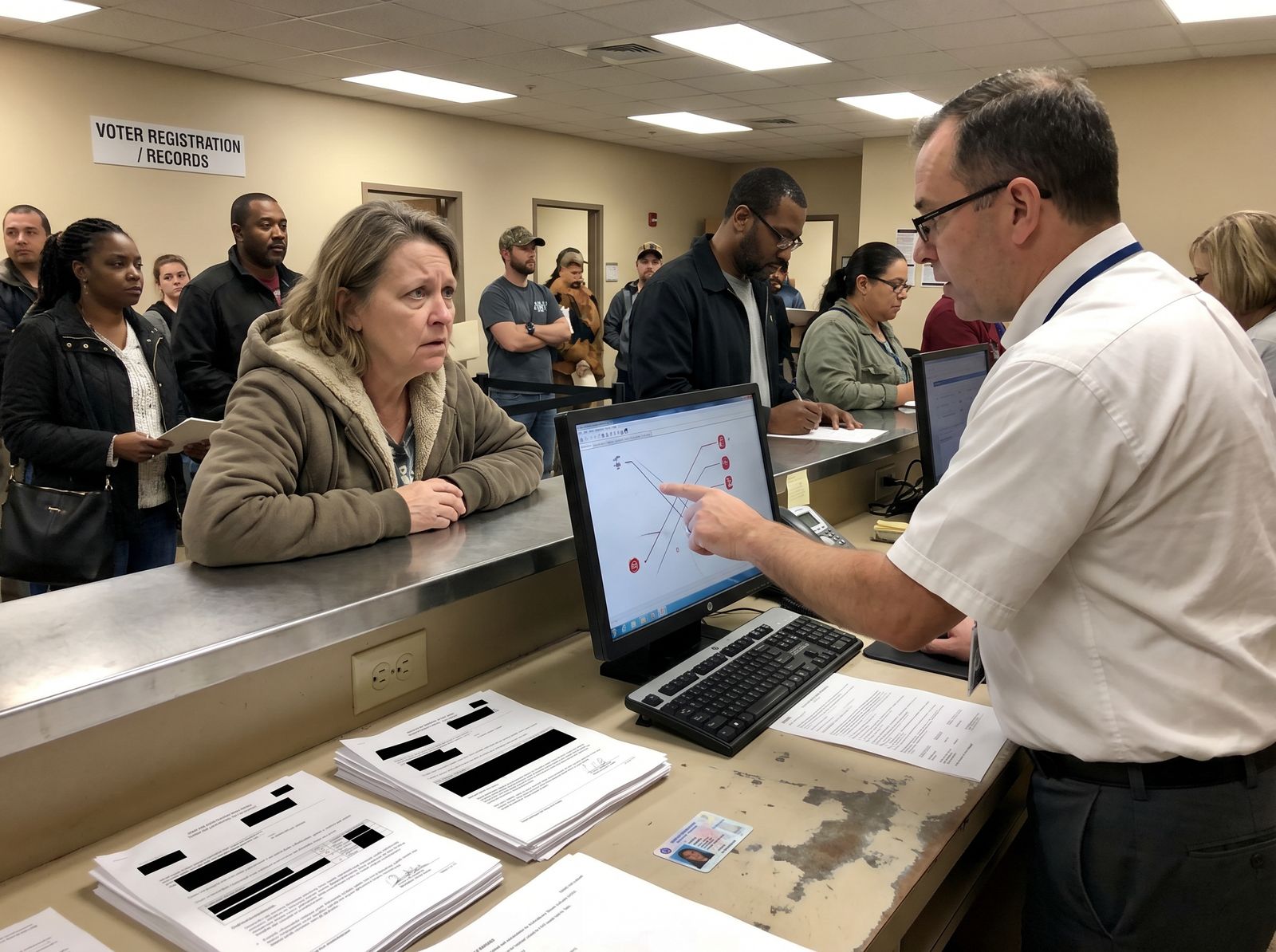
At the county desk. At the provisional ballot table. In the letter that never arrived. In the record mismatch no one fixes before Election Day.
Why Lists Change Human Behavior
The most corrosive political effect of a system like this is not only wrongful removal.
It is behavioral intimidation.
When citizens believe that participation is being watched, consolidated, scored, or second-guessed by distant authorities, some of them start stepping back on their own. They do not all need to be purged to be chilled.
A list can become a message.
It tells the public that participation is conditional. It tells them that an error in the machinery may become their burden to solve. It tells them that politics is less a right than a status subject to ongoing administrative verification.
Venice learned that political narrowing does not require the whole population to be rounded up or openly crushed. It only requires a structure that gradually teaches people where the gate is and who controls it.
Once enough people internalize that lesson, the system becomes self-reinforcing.
The book does not merely record the regime. It trains the public to live inside it.
The Ancient Warning Inside the Data Fight
The easiest mistake is to treat this as a temporary legal skirmish.
Maybe the courts will block the DOJ’s effort. Maybe the scope will be reduced. Maybe the database never fully materializes. All of that matters.
But the broader warning would remain.
A governing class under pressure almost always wants cleaner ledgers, faster identification, tighter categorization, and more direct leverage over the mechanics of belonging. It wants politics to become more machine-readable, because machine-readable politics is easier to manage.
Venice did not become weaker the instant it created a registry.
In some ways, it became more orderly.
That is what made the shift so dangerous.
The system could still function while becoming more closed. It could still look competent while becoming less free. It could still call itself a republic while shrinking the circle of those who truly mattered.
That is the American danger too.
Not sudden dictatorship.
Orderly exclusion.
The Turn: Build Power Below the List
If institutions become more brittle and more suspicious, the household answer is not despair.
It is productive sovereignty.
Start by reducing the number of ways a stressed system can corner your family. Build food capacity. Lower dependence on long supply chains. Strengthen your local relationships. Keep better records than the institutions do. Make sure your household can absorb bureaucratic friction without instantly breaking.
That is why the smartest response to political narrowing is not just outrage.
It is capability.
If you want one practical place to begin, the 4ft Farm Blueprint helps families convert small spaces into real food output and real household margin. That matters more than most people realize, because freedom gets harder to defend when every disruption turns into immediate dependency.
If you want a sharper lens on how these systems evolve, read The Pattern Ledgers for the pattern language, Self Reliance Report for capability-minded resilience, and The Ready Report for higher-level strategic pressure points.
The point is simple.
When the political machine starts showing unusual interest in the master list, do not become more dependent on the machine.
Build margin outside it.
The families that endure late-system pressure are rarely the ones who trusted the ledger longest.
The Final Pattern
A republic does not die only when the streets are full of soldiers.
Sometimes it dies a little each time political belonging is pulled farther away from the citizen and placed deeper inside a controlled administrative file.
That is why this fight matters.
It is not just about one lawsuit.
It is about whether America keeps the presumption that political rights belong to citizens first and databases second, or whether the country drifts toward a future where the database increasingly tells the citizen what he is allowed to be.
Venice has already shown how that story goes.
It begins with a registry.
It ends with a republic that still knows how to count votes, but no longer remembers how to belong to itself.
References
- ACLU, “Voting Rights Groups Sue DOJ to Block National Voter Surveil-and-Purge Database”
- Votebeat, “Voting rights groups sue Trump administration to stop collection of voter data”
- History Walks Venice, “The Maggior Consiglio”
- Diego Puga and Daniel Trefler, International Trade and Institutional Change: Medieval Venice’s Response to Globalization, The Quarterly Journal of Economics