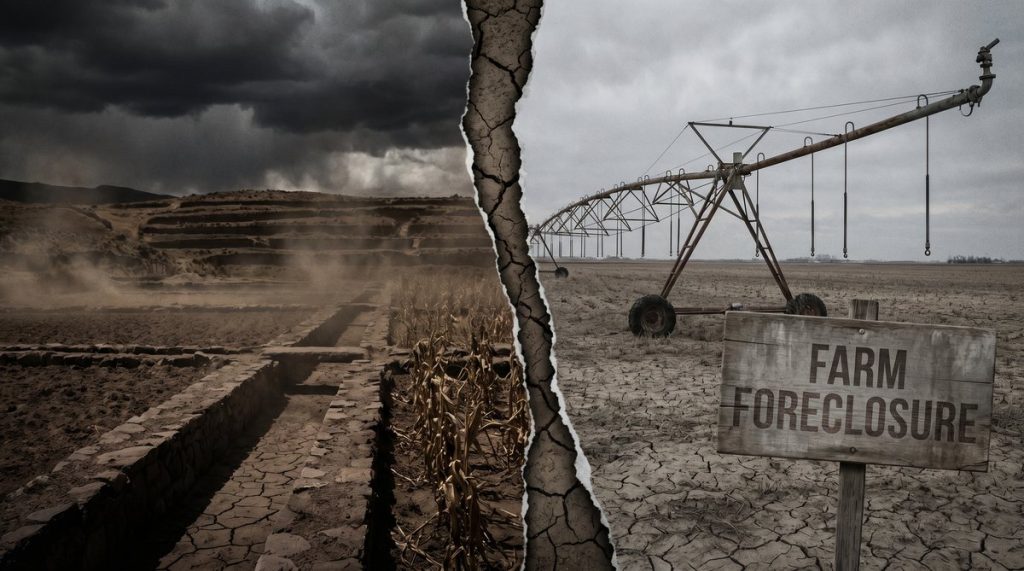
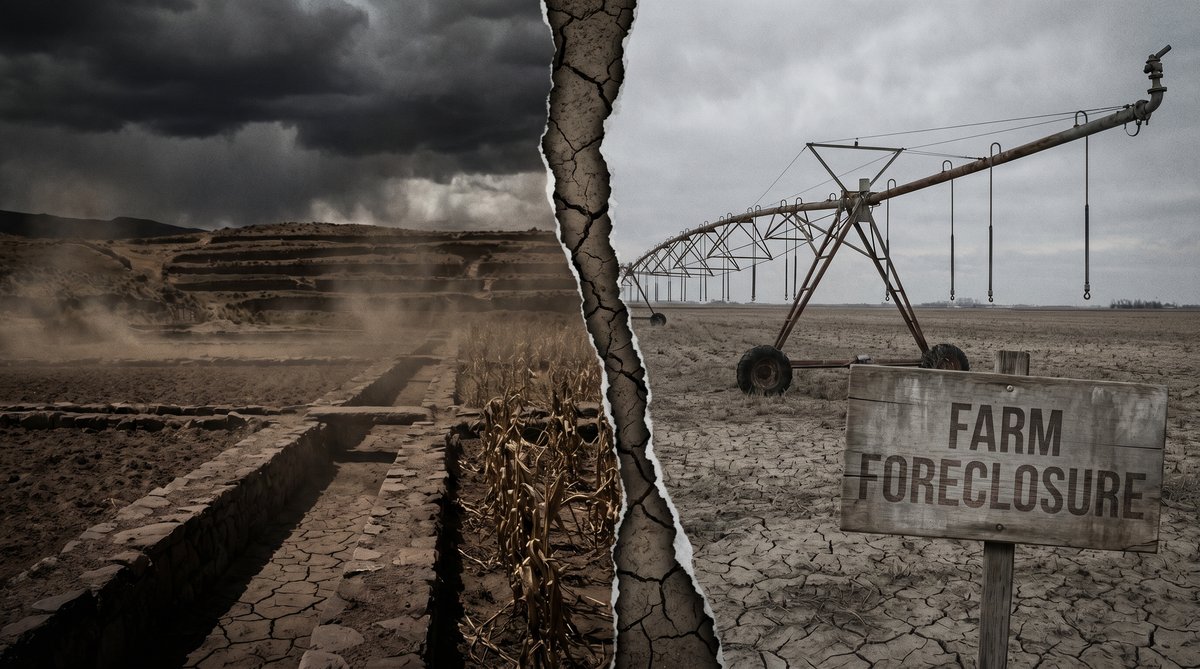
Right now, 61% of the continental United States is under moderate to exceptional drought conditions.
It is only April.
The USDA has already revised its food price forecast upward, projecting a 3.6% increase in 2026.
In the Central Plains and the Cotton Belt, the soil is turning to dust before the summer heat even arrives.
Nearly 70% of all U.S. winter wheat production is currently sitting in drought-stricken land.
We are watching the foundation of our food system crack in real-time.
And while politicians argue over tariffs and energy prices, the United Nations has quietly declared a state of “global water bankruptcy.”
They estimate $58 trillion in economic value is now at risk.
But this is not the first time a massive, highly engineered civilization has faced a sudden, catastrophic failure of its water and food systems.
The Empire of the High Andes
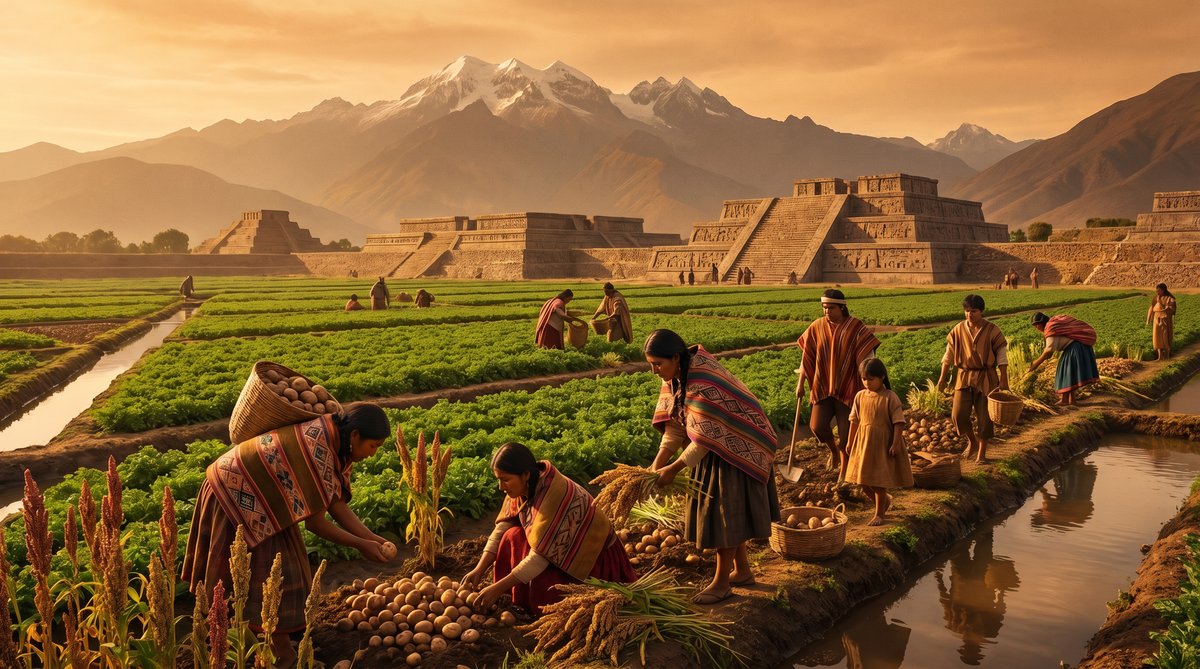
High in the Bolivian Altiplano, over 12,000 feet above sea level, sits the ruins of Tiwanaku.
For 600 years, this was one of the most powerful and prosperous empires in the pre-Columbian Americas.
They didn’t just survive in this harsh, high-altitude environment—they thrived.
Their secret was a marvel of ancient engineering: a vast system of raised-bed agriculture covering over 47,000 acres.
They literally reshaped the earth to feed their people.
By digging massive canals and piling the earth into elevated planting beds, they created a micro-climate.
The water in the canals absorbed the sun’s heat during the day and released it at night, protecting the crops from the freezing Andean temperatures.
This system was so efficient it could produce 20 metric tons of potatoes per hectare.
It allowed the Tiwanaku Empire to support a massive population and project power across the region.
They built monumental stone temples, diverted rivers, and created a society that seemed invincible.
Until the climate turned against them.
When the System Fails
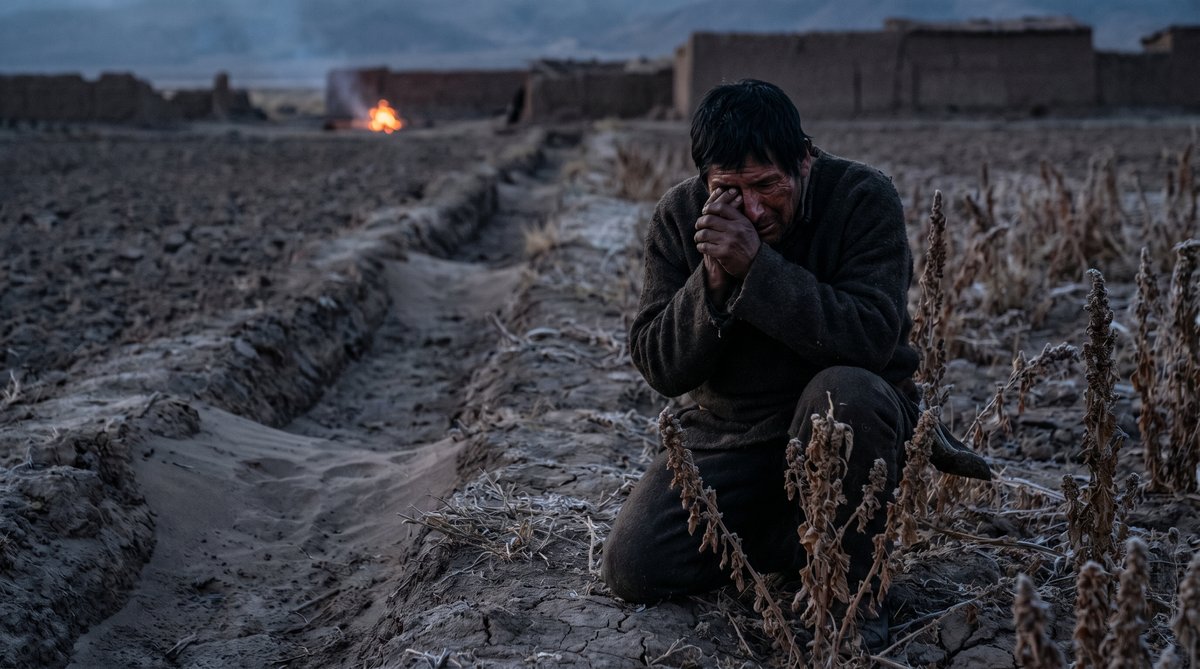
Around 1000 AD, the rain stopped.
Ice core data from the Quelccaya Ice Cap reveals a severe, prolonged drought that gripped the region.
The brilliant raised-bed system, which had fed the empire for centuries, suddenly became its greatest vulnerability.
Without consistent rainfall to fill the canals, the thermal protection vanished.
The crops froze. The yields collapsed.
The system that built the empire was the exact thing that destroyed it.
Because the Tiwanaku had centralized their food production around this single, highly engineered method, they had no backup plan.
When the raised beds failed, the food surplus vanished.
Without food, the political and religious authority of the elites crumbled.
Within a few generations, the great city of Tiwanaku was abandoned, its monumental temples left to the wind and dust.
The Illusion of Control
The Tiwanaku believed their engineering had conquered nature.
Today, we believe our global supply chains, industrial fertilizers, and massive irrigation projects have done the same.
But the math is catching up to us.
The American food system is highly centralized and deeply dependent on predictable weather patterns and cheap inputs.
But right now, 70% of farmers say they cannot afford the fertilizer they need for this season.
Fuel prices are surging due to geopolitical conflict in the Middle East.
And the water that sustains the massive agricultural output of the West and Midwest is simply disappearing.
We are running the same fragile playbook as the Tiwanaku.
When a highly complex, centralized system experiences a shock to its core inputs—like water or fertilizer—the collapse isn’t gradual.
It is sudden, and it is devastating.
Building Your Own Micro-Climate

The lesson of Tiwanaku is not that drought is inevitable.
The lesson is that centralized dependence is a death sentence during a crisis.
When the empire’s massive agricultural machine failed, the people who survived were the ones who could produce food locally, outside the fragile system.
You cannot control the global water bankruptcy.
But you can control the resilience of your own household.
You don’t need 47,000 acres of raised beds to protect your family.
You need a decentralized, independent system that doesn’t rely on industrial fertilizer, cheap diesel, or perfect weather.
You need the ability to produce calories on your own terms.
Because when the centralized system cracks, the only food you can count on is the food you grow yourself.
The rain may stop, but your family doesn’t have to starve.
If you want to learn how to build a drought-resistant, high-yield food system in your own backyard—one that thrives even when the industrial supply chain fails—you need to see this.