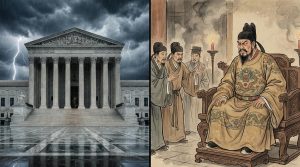
The U.S. economy just officially shrank for the first time since 2022.
But the reason why is the real warning.
According to the Bureau of Economic Analysis advance estimate released today, U.S. GDP contracted by 0.3% in the first quarter of 2026.
The primary driver wasn’t a banking collapse or a sudden drop in consumer demand.
It was a massive surge in imports as businesses rushed to front-run incoming tariff increases.
We are watching a superpower deliberately strangle its own economic engine in the name of protectionism.
As the government attempts to wall off the American economy from global trade, the immediate result is a contraction that gives corporations the perfect cover to accelerate layoffs.
We have seen this exact playbook before.
And it ended with the collapse of the most advanced economy on earth.
The Empire That Locked Its Own Doors
In the 14th century, Ming Dynasty China was the undisputed economic and technological center of the world.
They possessed the largest navy, the most advanced manufacturing, and a massive, self-sufficient agricultural base.
Under the Yongle Emperor, Admiral Zheng He led fleets of massive treasure ships across the Indian Ocean, projecting Chinese power and establishing lucrative trade networks.
Then, they decided they didn’t need the rest of the world.
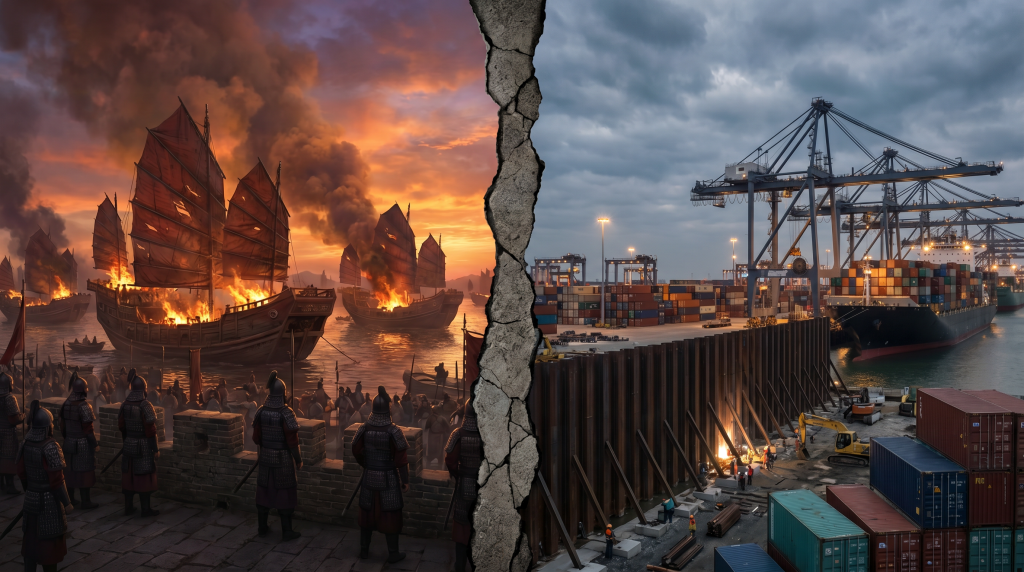
Fearing foreign influence, piracy, and the perceived corruption of international commerce, the Ming court enacted the Haijin—the sea ban.
They made it a capital offense to build a ship with more than two masts.
They destroyed their own naval records. They let their massive fleets rot in the harbors.
They believed that by closing their borders and relying entirely on domestic production, they would protect the empire from external shocks.
They were catastrophically wrong.
The Cost of Isolation
The Haijin didn’t protect the Ming economy; it suffocated it.
By cutting off legitimate maritime trade, the government destroyed the livelihoods of millions of coastal citizens.
The policy that was supposed to stop piracy actually created it.
Desperate merchants, cut off from legal commerce, turned to smuggling and armed rebellion. The “Japanese pirates” that plagued the coast were actually mostly displaced Chinese citizens trying to survive.
The isolationist policy strained local resources and decimated tax revenues.
Without the influx of foreign silver and trade goods, the domestic economy stagnated.
The math of isolation is unforgiving.
When a highly advanced, complex economy suddenly cuts itself off from global networks, the internal pressure builds until the system cracks.
The Ming Dynasty spent vast fortunes defending its borders and building the Great Wall, while simultaneously starving its own economic engine.
By the time they finally lifted the ban in 1567, the damage was done. The technological and economic supremacy they once held had slipped away, setting the stage for their eventual collapse in 1644.
The Modern Sea Ban
Today, the United States is enacting its own version of the Haijin.
We are not burning our ships, but we are erecting massive tariff walls that serve the exact same purpose.
The Q1 2026 GDP contraction is the first tremor of a self-inflicted economic earthquake.
When you artificially restrict trade, you don’t just punish foreign competitors—you punish your own citizens.
The businesses that rushed to import goods before the tariffs hit are now passing those costs directly to the consumer.
Inflation is the hidden tax of protectionism.
And just like the Ming Dynasty, we are discovering that isolationism doesn’t create security; it creates fragility.
When the government tries to control every aspect of commerce, the black markets thrive, the middle class suffers, and the elites consolidate power.
We are watching the exact same mathematical trap close around the United States.
5 Things You Can Do This Week
When empires try to wall themselves off from the world, the economic burden always falls on the citizens. Here is how you can prepare your household for the realities of a contracting, protectionist economy:
1. Build a Tangible Asset Base
When tariffs drive up the cost of everyday goods, paper money loses its value rapidly. Move a portion of your wealth into tangible assets—precious metals, land, or productive equipment—that hold their value regardless of government trade policies.
2. Secure Your Food Production
The Ming Dynasty’s isolation led to devastating famines when internal systems failed. Protect yourself from food inflation by starting a garden, supporting local farmers, or investing in long-term food storage. Food sovereignty is the ultimate hedge against imperial decline. Learn how to build a drought-resistant, high-yield food system in your own backyard with the 4-Foot Farm Blueprint.
3. Develop Local Trade Networks
When the Haijin cut off legal trade, the people who survived were those who built strong local networks. Connect with your neighbors, local producers, and community members. The less you rely on complex, globalized systems, the safer you are. Find resources for local self-reliance at Self Reliance Report.
4. Invest in Practical Skills
As the economy contracts and imports become prohibitively expensive, the ability to repair, maintain, and build things yourself becomes invaluable. Learn practical skills that make you indispensable to your community. Get started with modern homesteading techniques at Homesteader Depot.
5. Reduce Your Personal Debt Exposure
When the economy shrinks, companies cut workers. Do not let a sudden job loss or economic downturn become your personal bankruptcy. Eliminate variable-rate debt and consolidate what you owe to protect your family’s financial future. Discover more financial preparedness strategies at Survival Stronghold.