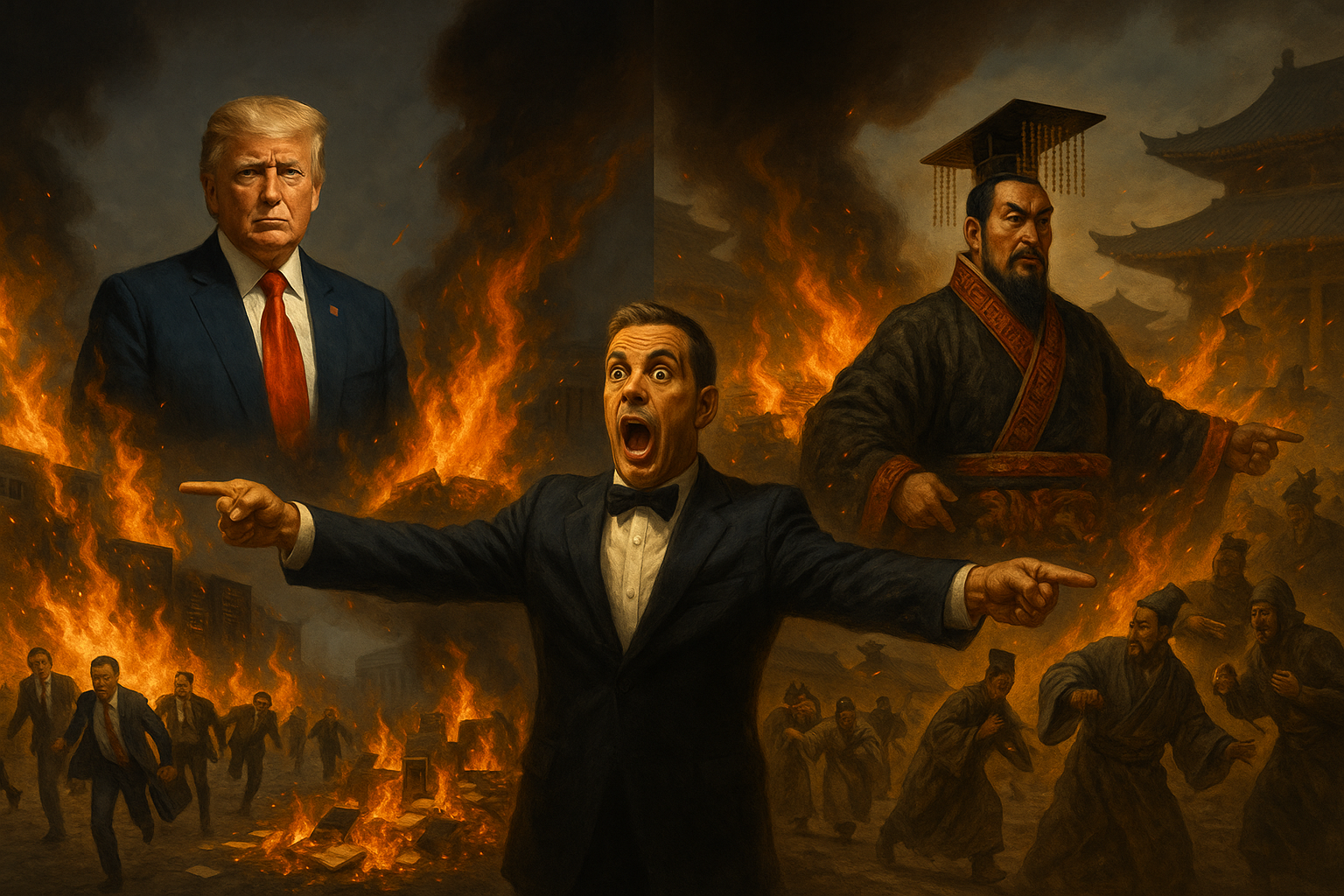
Trump’s War on Knowledge… and the Emperor Who Burned a Civilization
By Shamus Gerry III
#
The Modern Mystery
Something deeply unsettling is happening in the quiet, fluorescent-lit corridors of American power. It’s not a scandal you’ll see debated on cable news, nor a controversy that will ignite a Twitter firestorm. But for those who understand the fragile foundations of a stable society, it’s an alarm bell ringing in the dead of night.
In the last 24 hours, the Trump administration has effectively taken a sledgehammer to the nation’s education research infrastructure. We’re not talking about a simple budget cut; this is a systematic dismantling of the very institutions that provide evidence-based policymaking. The Institute of Education Sciences (IES), the primary federal agency for education research, has been gutted, losing nearly 90% of its workforce. The National Center for Education Statistics (NCES), the backbone of our national education data, has been reduced to a skeleton crew. Hundreds of millions of dollars in research grants have been vaporized, and major longitudinal studies tracking everything from early childhood development to student aid have been frozen.
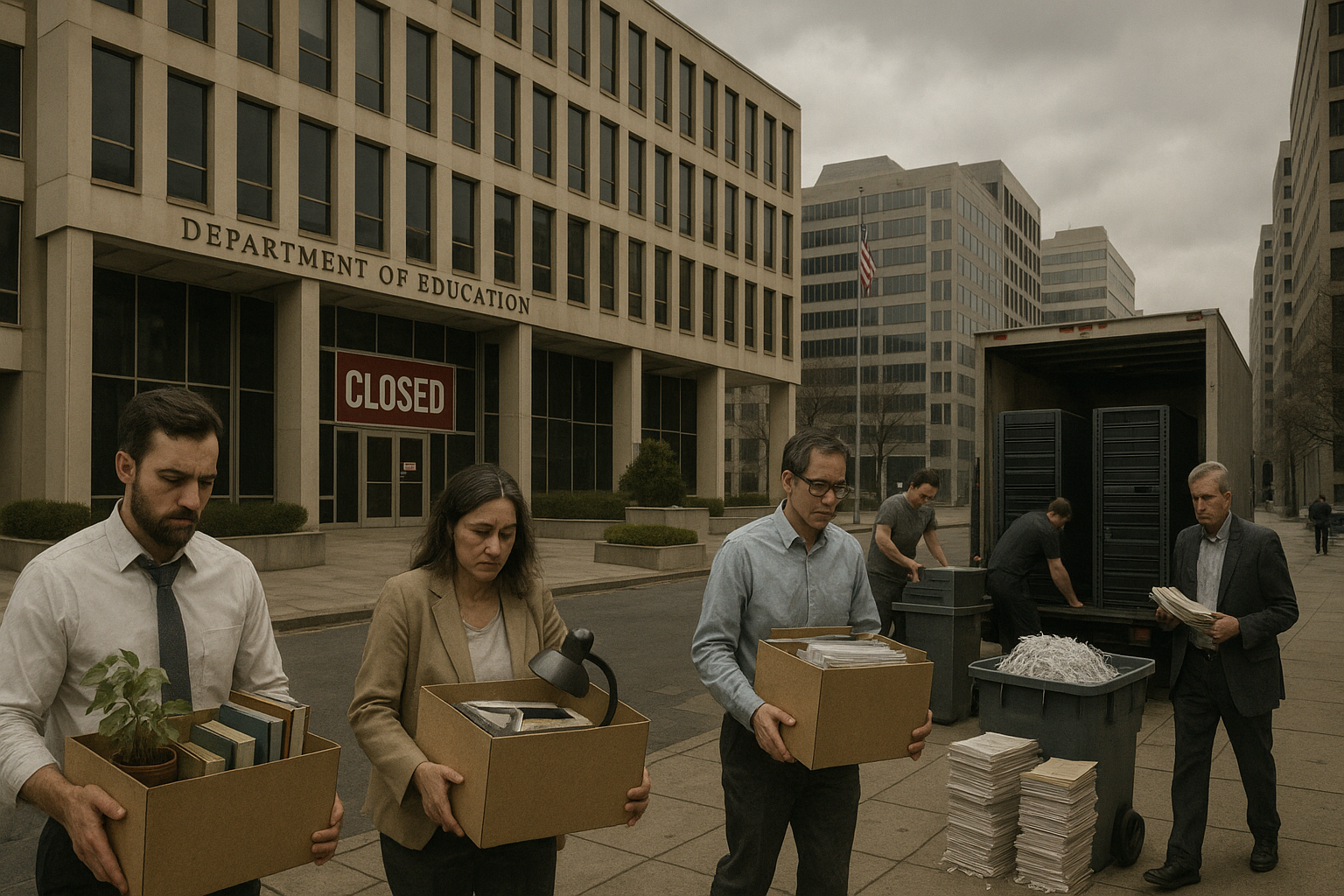
This isn’t just about defunding a few government programs. This is about blinding the nation. It’s a deliberate act of institutional destruction that leaves policymakers, educators, and the public flying blind. Without this research, how do we know what works in our schools? How do we address learning loss from the pandemic? How do we ensure our children are prepared for the future? We don’t. We’re left with ideology, guesswork, and the whims of those in power.
As researchers pack their boxes and universities pause PhD admissions, a chilling question hangs in the air: why would a modern, 21st-century government actively choose to destroy its own capacity for knowledge? To find the answer, we must journey back over 2,200 years to a time when another powerful leader decided that the only way to secure his rule was to burn an entire civilization’s worth of knowledge.
#
The Time Portal
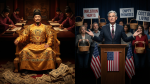
Imagine the year is 213 BC. The air in Xianyang, the capital of the newly unified Chinese empire, is thick with the smoke of burning bamboo scrolls and silk manuscripts. Emperor Qin Shi Huang, the first emperor of a unified China, stands on a high platform, his face a mask of cold resolve. Below him, a scene of cultural apocalypse unfolds.
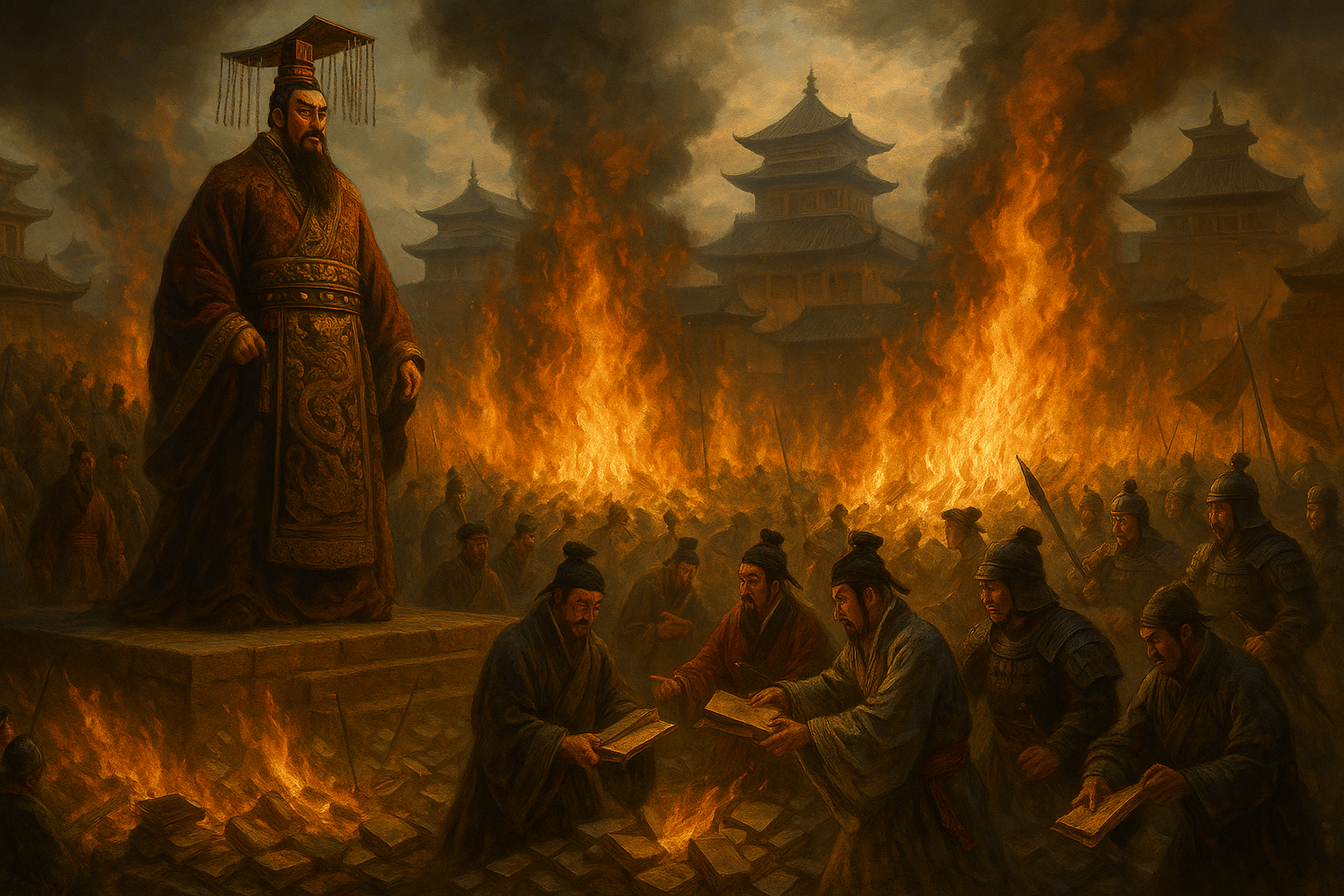
For centuries, China had been a vibrant tapestry of competing ideas, a place where a “Hundred Schools of Thought” blossomed. Confucian scholars debated ethics and governance, Daoists contemplated the nature of the cosmos, and Legalists argued for a society based on strict laws and absolute power. This intellectual ferment, this constant questioning and debate, was the engine of Chinese civilization.
But Qin Shi Huang, a man of brutal efficiency and paranoid ambition, saw this intellectual diversity not as a strength, but as a threat. He had conquered the warring states, unified the currency, and standardized the writing system. Now, he would unify the mind of his people.
His chancellor, Li Si, a man whose name would become synonymous with intellectual suppression, stood before the emperor and delivered his chilling proposal: “I, your servant, propose that all historians’ records other than those of Qin be burned. Except the academics whose duty includes possessing books, if anyone under heaven has copies of the _Shi Jing_ [Classic of Poetry], the _Shujing_ [Classic of History], or the writings of the hundred schools of philosophy, they shall deliver them to the governor or the commandant for burning. Anyone who dares to discuss the _Shi Jing_ or the _Classic of History_ shall be publicly executed. Anyone who uses history to criticize the present shall have his family executed.”
The emperor agreed. The order was given. And so, the great burning began. For thirty days, the fires raged. Centuries of poetry, history, and philosophy—the accumulated wisdom of a civilization—turned to ash. Only books on medicine, divination, agriculture, and forestry were spared. It was a lobotomy performed on an entire culture.
#
The Parallel Revelation
Now, let’s return to 2025. The fires are not literal, but the effect is the same. When the Trump administration guts the IES and the NCES, it is, in essence, burning the books of our time. It is destroying the data, the research, the evidence—the very tools we use to understand our world and make informed decisions.
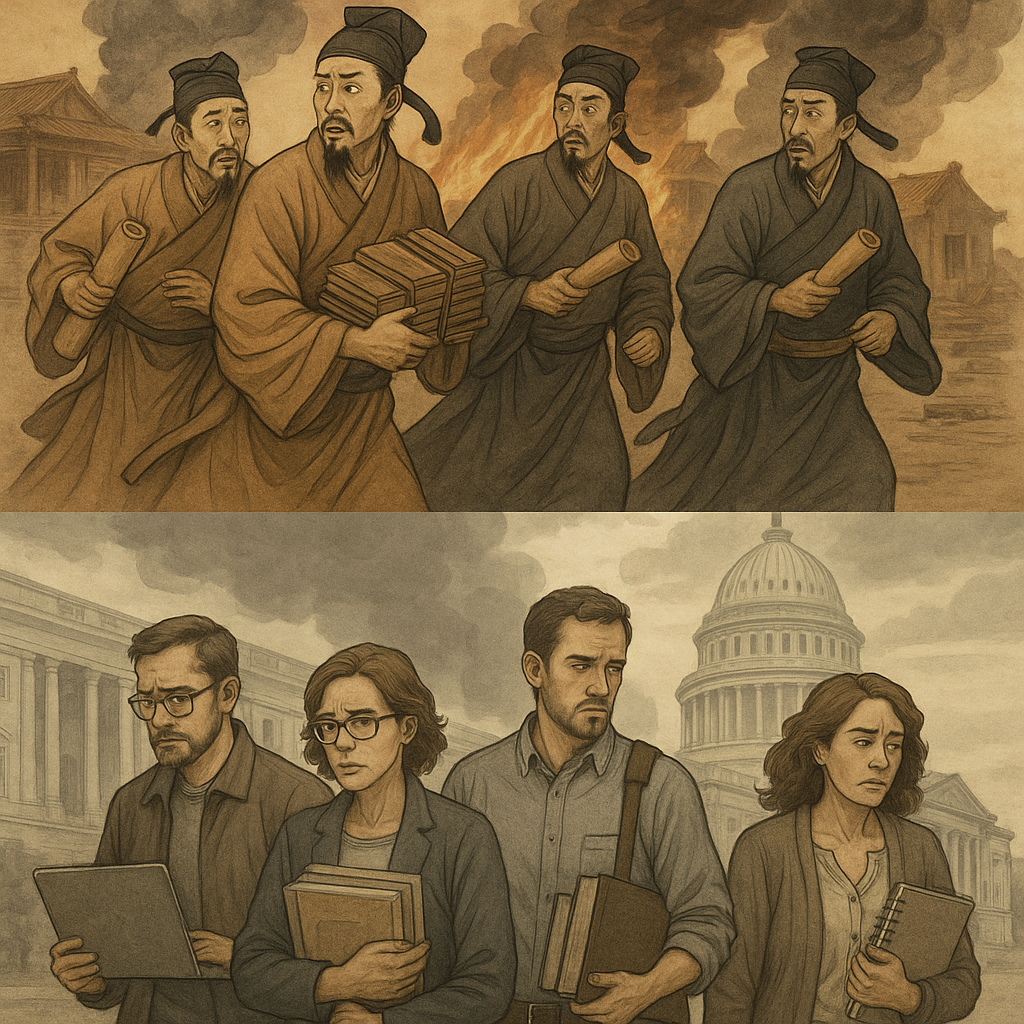
Just as Qin Shi Huang feared that the scholars of his day would use history to criticize his rule, the modern assault on research infrastructure is driven by a similar fear: the fear of inconvenient truths. What if the data shows that a particular policy is failing? What if the research reveals that a certain ideology is harmful? The easiest way to avoid these uncomfortable questions is to destroy the institutions that ask them.
This is not a partisan issue. It is a pattern that has repeated itself throughout history. When leaders seek to consolidate power, they often begin by attacking the sources of independent knowledge. They defund the universities, they silence the researchers, they discredit the experts. They create a world where the only truth is the truth they dictate.
And just as in ancient China, the consequences are devastating. The scholars of the Qin Dynasty were not just individuals; they were the living repositories of their culture’s knowledge. When they were silenced, that knowledge was lost. Today, the researchers and academics who are being driven from their fields are not just losing their jobs; they are taking with them years of expertise, of institutional memory, of a deep understanding of the complex challenges we face.
#
The Pattern Recognition
Why does this pattern repeat? Because at its core, it is a struggle between two fundamentally different visions of society. One vision believes in the power of knowledge, of evidence, of open debate. It believes that the best way to solve our problems is to understand them, to study them, to learn from our mistakes. The other vision believes in the power of authority, of ideology, of unquestioning obedience. It believes that the best way to solve our problems is to impose a single, rigid worldview on everyone.
This is the choice that every civilization faces, in every era. Do we embrace the messy, complicated, often uncomfortable process of seeking the truth? Or do we retreat into the false certainty of dogma?
Qin Shi Huang chose dogma. And for a brief, brutal moment, it seemed to work. He built the Great Wall, he created a unified empire, he imposed his will on millions. But his dynasty, the dynasty he believed would last for ten thousand generations, collapsed just a few years after his death. It was a house built on a foundation of lies, and it could not stand.
#
The Ancient Warning
And that is the ultimate warning from the ancient world. The destruction of knowledge is not a sign of strength; it is a sign of weakness. It is the act of a regime that is so afraid of the truth that it must resort to burning the books and silencing the scholars.
When a government actively chooses to make itself blind, it is only a matter of time before it leads its people off a cliff. The challenges we face today—from climate change to economic inequality to global pandemics—are complex and multifaceted. They cannot be solved with slogans or soundbites. They require deep thinking, careful research, and a willingness to confront uncomfortable truths.
By dismantling our education research infrastructure, we are not just hobbling ourselves in the present; we are stealing from the future. We are ensuring that the next generation of leaders will have less knowledge, less evidence, and fewer tools to solve the problems they will inherit.
#
5 Things You Can Do This Week
History is not a spectator sport. It is a living, breathing force that shapes our world every day. Here are five things you can do this week to push back against the modern-day book burners and defend the importance of knowledge and evidence-based policy:
1. **Support Independent Journalism:** In an era of rampant misinformation, supporting credible, independent news sources is more important than ever. Subscribe to a local newspaper, donate to a non-profit news organization, or simply share well-researched articles with your friends and family. Check out [Self-Reliance Report](https://selfreliancereport.com) for news and analysis that you won’t find in the mainstream media.
2. **Get Involved in Your Local School Board:** The fight for evidence-based education often begins at the local level. Attend your local school board meetings, advocate for policies that are backed by research, and support candidates who value the expertise of educators. Learn more about how you can make a difference at [Survival Stronghold](https://survivalstronghold.com).
3. **Learn a New Skill:** In a world where knowledge is under attack, the most radical thing you can do is to learn something new. Take an online course, read a book on a topic you know nothing about, or start a new hobby. The more you learn, the more you will value the importance of knowledge. [Homesteader Depot](https://homesteaderdepot.com) has a wealth of resources for learning practical, hands-on skills.
4. **Contact Your Elected Officials:** Let your representatives know that you value evidence-based policymaking and that you oppose the dismantling of our research infrastructure. Call them, write to them, or visit them in person. Your voice matters. Find out how to contact your representatives at [Freedom Health Daily](https://freedomhealthdaily.com).
5. **Talk to Your Friends and Family:** Many people are not aware of the threat to our research infrastructure. Have conversations with your friends and family about why this issue is so important. Share this article with them. The more people who understand what is at stake, the more likely we are to win this fight. For more information on how to have productive conversations about difficult topics, check out [Seven Holistics](https://sevenholistics.com).
**Sponsor:** Ready to build your own resilient food source? The [4ft Farm Blueprint](https://4ftfarmblueprint.com/) shows you how to build a high-yield, low-maintenance garden in just 4 square feet. Click here to learn more.
**Sponsor:** Worried about the future? [My Patriot Supply](https://mypatriotsupply.com) has everything you need to prepare for any emergency. From long-term food storage to survival gear, they have you covered. Click here to see their latest deals.
**Sources:**
1. [Trump administration dismantles education research infrastructure in Washington, ending decades of evidence-based policy – Times of India](https://timesofindia.indiatimes.com/education/news/trump-administration-dismantles-education-research-infrastructure-in-washington-ending-decades-of-evidence-based-policy/articleshow/123463628.cms)
2. [Burning of books and burying of scholars – Wikipedia](https://en.wikipedia.org/wiki/Burning_of_books_and_burying_of_scholars)
3. [Qin Shi Huang: The ruthless emperor who burned books – BBC News](https://www.bbc.com/news/magazine-19922863)
4. [The First Emperor of China Destroys Most Records of the Past Along with the Scholars Who Study Them](https://www.historyofinformation.com/detail.php?id=2491)
**Disclaimer:** The Brain2 Project x Oyolokorai Family Copyright 2025. This article contains affiliate links. The author, Shamus Gerry III, is an alias.
alias.
\n**Portfolio:**\n* [Survival Stronghold](https://survivalstronghold.com)\n* [Self-Reliance Report](https://selfreliancereport.com)\n* [Homesteader Depot](https://homesteaderdepot.com)\n* [Freedom Health Daily](https://freedomhealthdaily.com)\n* [Seven Holistics](https://sevenholistics.com)