Is Your Mailman a Spy? The 1,300-Year-Old Warning We’re Ignoring
#
The Modern Mystery
In thousands of American communities, a new set of eyes is watching. They’re silent, tireless, and they never blink. They belong to Flock Safety, a company whose AI-powered cameras are reading millions of license plates a day, creating a vast, searchable map of our movements. The promise? To stop crime. The reality? A creeping unease that we’re outsourcing our civil liberties to a private company, creating a surveillance network of unprecedented scale and power. [1]
Recently, under pressure from civil rights groups like the ACLU, Flock announced it was pausing its work with federal agencies. The concern? That this technology, capable of tracking vehicles across states and identifying cars traveling together, was becoming a tool of mass surveillance, sweeping up innocent citizens in a digital dragnet. “Outsourcing broad data collection to a private vendor undermines democratic accountability,” warned one ACLU analyst. [1]
It feels like a uniquely modern dilemma, a clash between 21st-century technology and timeless American values. But what if I told you this isn’t new? What if the same system, with the same promises and the same perils, was perfected over 1,300 years ago, not with cameras and AI, but with horses, scrolls, and the friendly face of your local mailman?
#
The Time Portal
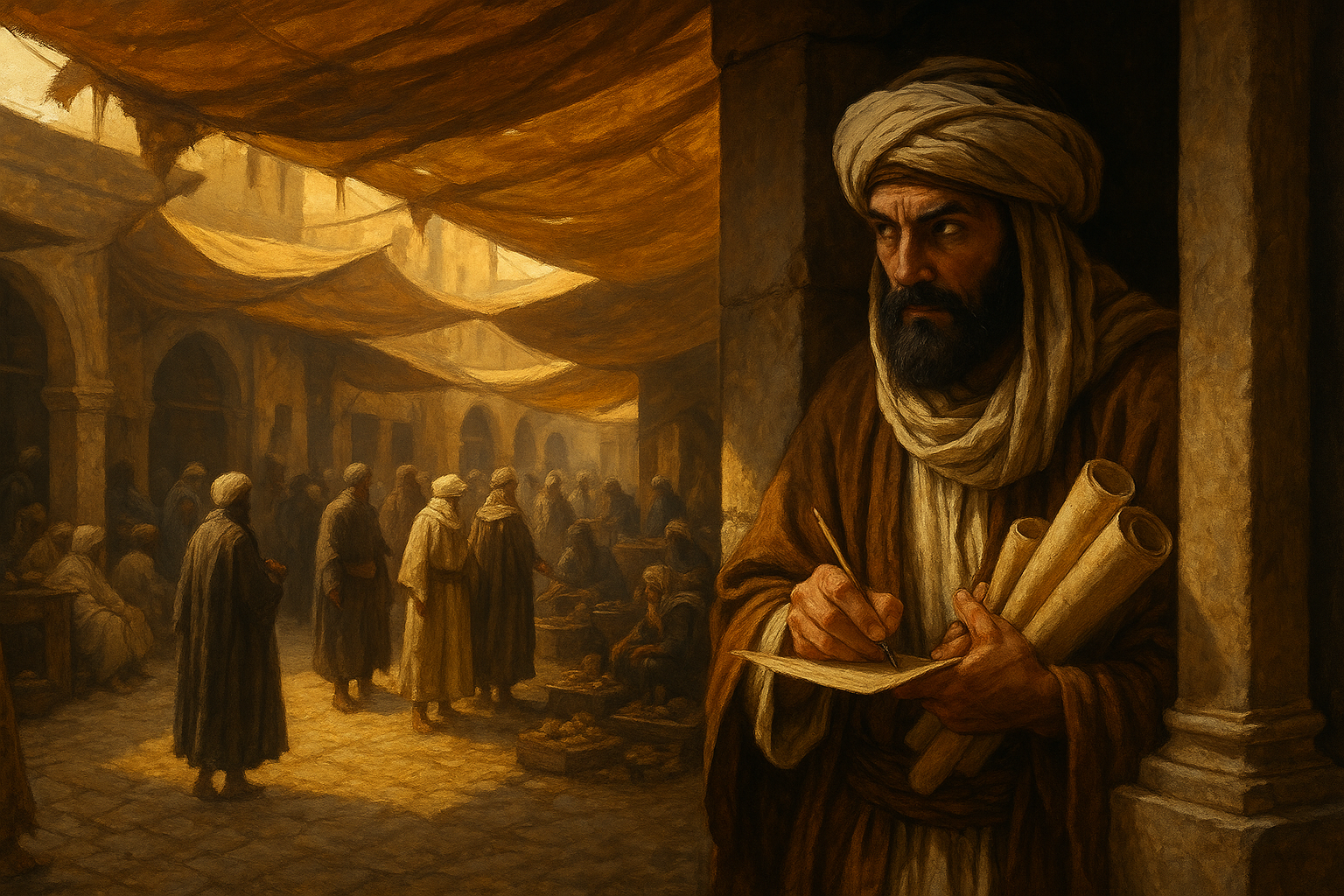
Let’s travel back to the 8th century, to the heart of the booming Abbasid Caliphate. Imagine the sprawling, vibrant city of Baghdad, a global center of science, culture, and commerce. Camels laden with silk and spices jostle with scholars and merchants in crowded souks. The air is thick with the scent of exotic perfumes and the murmur of a hundred different languages. It’s a world away from our own, yet in one crucial respect, it’s eerily familiar.
Meet Ahmed, a postal carrier for the Caliph’s official mail service, the *Barid*. To his neighbors, he’s a reliable, if unremarkable, figure. He delivers official decrees, carries messages between governors, and ensures the smooth flow of information across a vast empire. He’s a vital part of the infrastructure that holds the Caliphate together. But Ahmed has another title, a secret one: he is also the *sahib al-khabar*—the “carrier of secrets.” [2]
As he makes his rounds, Ahmed isn’t just delivering mail. He’s listening. He’s observing. He notes the whispers of dissent in the marketplace, the grumblings of a disgruntled official, the unusual comings and goings at a wealthy merchant’s home. He reports on the price of grain, the mood of the populace, and any signs of unrest. Every piece of information, no matter how trivial, is meticulously recorded and sent back to his superior, the Postmaster General in Baghdad—who also happens to be the Caliph’s chief intelligence officer. [3]
#
The Parallel Revelation
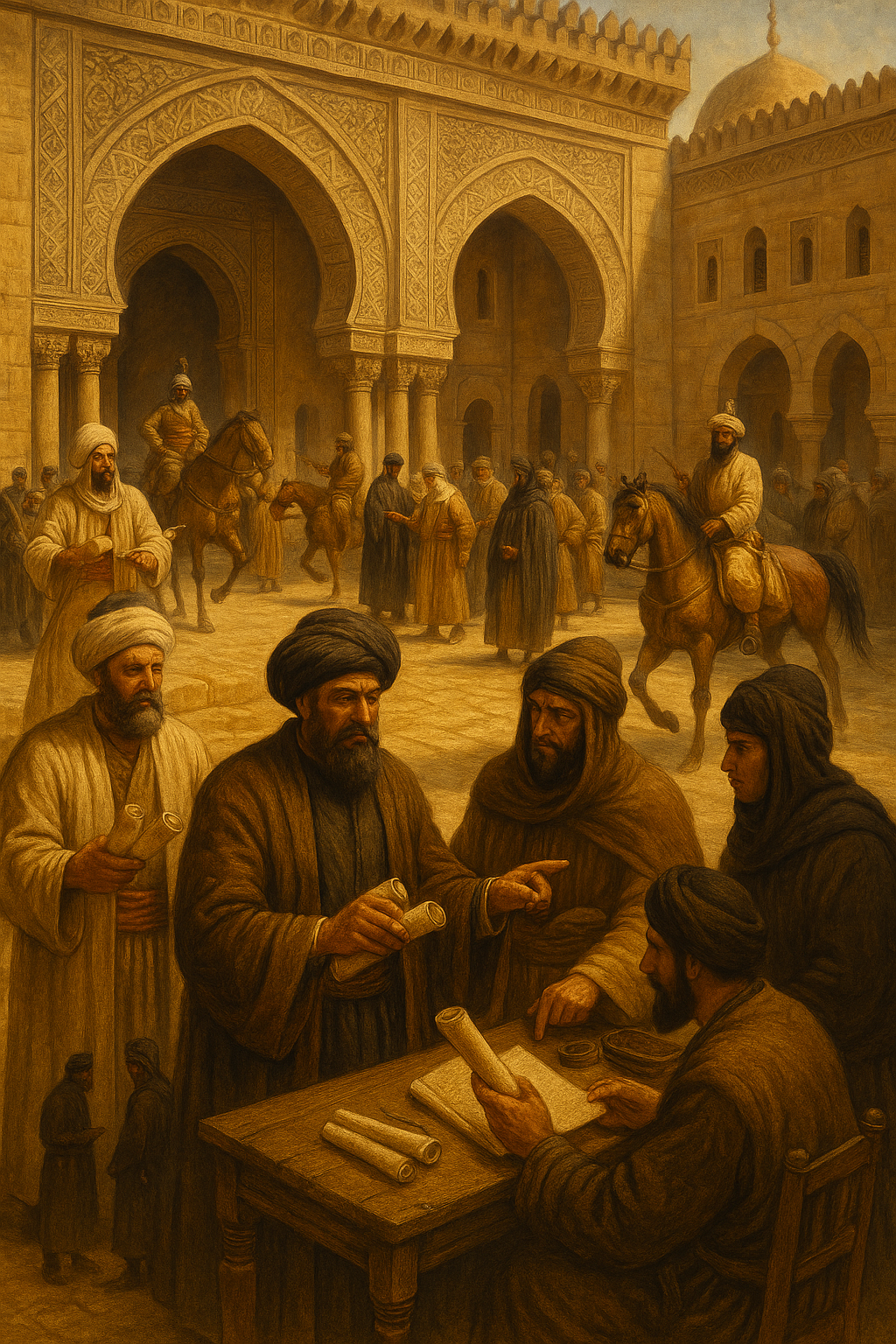
Ahmed, the 8th-century mailman, and the modern Flock Safety camera are two sides of the same coin. The *Barid* system, one of the first priorities of the early Islamic empires, was a masterpiece of dual-use infrastructure. On the surface, it was a postal service. But its true purpose was intelligence. The entire postal establishment was, as one historian puts it, “subordinated to an espionage system.” [3]
Just like Flock Safety’s network, the *Barid* was a vast, interconnected system that could track movements and gather information across the empire. The postmasters in each province weren’t just sorting mail; they were supervising a network of spies and informants, reporting directly to the Caliph. They were the central nodes in a massive data collection apparatus, monitoring not just potential enemies, but every aspect of public and private life.
And just like today, this system was built on a network of “private contractors.” The mailmen, the merchants, the singing-girls in the palace—all were potential informants, feeding information into the central system. The state had effectively outsourced its surveillance to the very fabric of society. The paranoia became so intense that in some cities, people would simply turn away any unfamiliar face, assuming they were a spy. [2]
#
The Pattern Recognition

Why does this pattern repeat? Why would a 21st-century American suburb and an 8th-century Islamic metropolis arrive at the same solution for social control? The answer lies in a timeless human impulse: the desire for security and order, and the willingness to trade freedom for it.
The Abbasid Caliphs, ruling a vast and diverse empire, were constantly on guard against rebellion and dissent. The *Barid* was their solution—a way to feel the pulse of the empire, to anticipate threats before they materialized. It was a tool of control, born of fear. Today, we are told that AI-powered surveillance is the key to stopping crime, to making our communities safer. It’s the same promise, wrapped in a different technological package.
Human nature hasn’t changed. We are still drawn to the allure of a system that promises to see everything, to know everything, to stop bad things from happening. We are still willing to accept the presence of a watchful eye, as long as we believe it is looking at someone else. But as the Abbasids discovered, once you build the infrastructure of surveillance, it has a life of its own. It grows, it expands, and eventually, it turns its gaze on everyone.
#
The Ancient Warning
The *Barid* system was incredibly effective. It helped the Abbasid Caliphs maintain control for centuries. But it came at a cost. The constant surveillance created a climate of fear and suspicion. It stifled dissent and innovation. And ultimately, it couldn’t prevent the empire’s eventual decline. The very system designed to preserve the Caliphate may have contributed to its brittleness, creating a society where trust was a scarce commodity.
The warning from 1,300 years ago is clear: when you build a system that can watch everyone, you create a system that can control everyone. The line between security and oppression is perilously thin. And a society that outsources its vigilance to a network of spies—whether human or artificial—risks losing the very freedoms it seeks to protect.
#
5 Things You Can Do This Week
History is not just a story; it’s a roadmap. The patterns of the past can help us navigate the challenges of the present. Here are five things you can do this week to better prepare for a future where surveillance is becoming ever more pervasive:
1. **Secure Your Digital Life:** Learn how to protect your online privacy. Start with this guide on how to stay anonymous online from [Self-Reliance Report](https://selfreliancereport.com/stay-anonymous-online/).
2. **Build Local Networks:** Get to know your neighbors. Strong communities are the best defense against overreaching authority. Find tips on building community at [Homesteader Depot](https://homesteaderdepot.com/building-community/).
3. **Support Independent Journalism:** Stay informed about the latest developments in surveillance technology and civil liberties. Support independent media outlets that hold power accountable.
4. **Learn a New Skill:** In a world of increasing uncertainty, practical skills are invaluable. Consider learning how to grow your own food with the [4ft Farm Blueprint](https://4ftfarmblueprint.com/).
5. **Take Control of Your Health:** A healthy body and mind are your greatest assets. Explore natural health solutions at [Seven Holistics](https://sevenholistics.com/) and [Freedom Health Daily](https://freedomhealthdaily.com/).
—
**Sponsored by:**
* **The 4ft Farm Blueprint:** Learn how to grow a year’s worth of food on just a 4×8 plot of land. [Click here to learn more!](https://4ftfarmblueprint.com/)
* **Patriot Power Greens:** Boost your energy and vitality with this delicious green drink. [Get yours today!](https://www.patriotpowergreens.com/v2/pggooglesearch?gl=us&WickedSource=Google&WickedID=Cj0KCQjw_qrbBRDtARIsACnbpoC-3n7xZ7Y4n9yQ4x9yQ4x9yQ4x9yQ4x9yQ4x9yQ4x9yQ4&WickedCategory=Search&WickedPlacement=&WickedAd=393325277930&WickedKeyword=patriot%20power%20greens&gclid=Cj0KCQjw_qrbBRDtARIsACnbpoC-3n7xZ7Y4n9yQ4x9yQ4x9yQ4x9yQ4x9yQ4x9yQ4)
—
**Author: Shamus Gerry III**
**References:**
[1] “Flock Safety pauses work with federal agencies amid privacy concerns.” WAPT News, August 27, 2025. [https://www.wapt.com/article/flock-safety-pauses-work-with-federal-agencies-amid-privacy-concerns/65916428](https://www.wapt.com/article/flock-safety-pauses-work-with-federal-agencies-amid-privacy-concerns/65916428)
[2] Stevenson, Cait. “The Mailman Was a Spy: Espionage in the Medieval Islamic World.” Medievalists.net, February 2025. [https://www.medievalists.net/2025/02/espionage-medieval-islamic-world/](https://www.medievalists.net/2025/02/espionage-medieval-islamic-world/)
[3] Dvornik, F. “Origins of Intelligence Services.” [http://www.promacedonia.org/en/fdois/fdois_4.htm](http://www.promacedonia.org/en/fdois/fdois_4.htm)
[4] “Barid System: Research paper.” Scribd. [https://www.scribd.com/document/856578238/Barid-System-Research-paper](https://www.scribd.com/document/856578238/Barid-System-Research-paper)