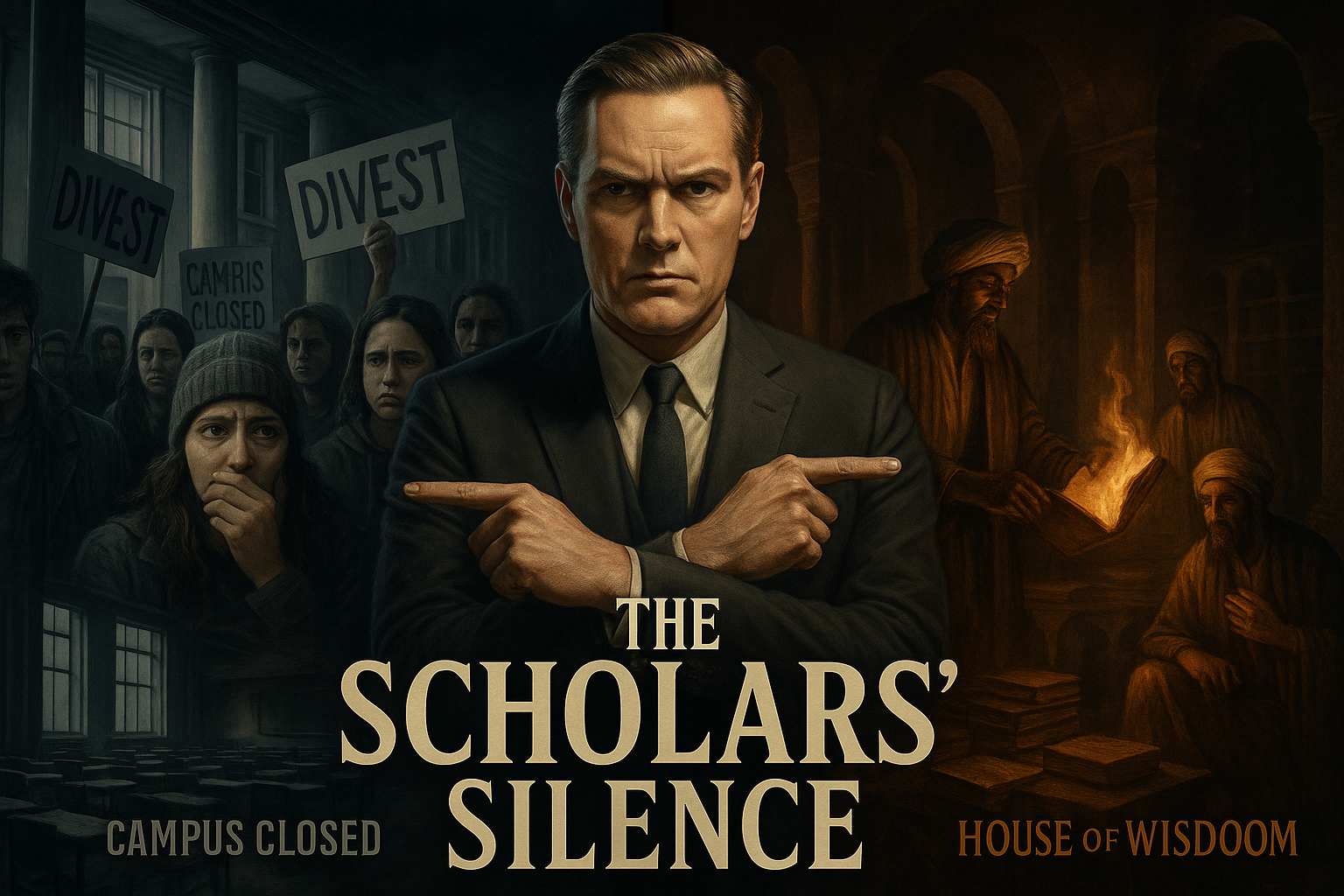
The Scholars’ Silence: How America’s Campus Crisis Mirrors the 900-Year-Old Catastrophe That Ended the Islamic Golden Age
By Shamus Gerry III
—
##
The Modern Mystery
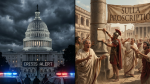
In the last 24 hours, a chilling report from the Foundation for Individual Rights and Expression (FIRE) landed like a bombshell, giving American colleges a failing grade on free speech. A staggering 166 out of 257 universities surveyed now have a speech climate rated as “hostile” [1]. It’s a story that’s been simmering for months, a slow-motion crisis of intellectual conformity.
But now, the data is undeniable: a staggering number of students and faculty feel they can no longer speak their minds. Politically appointed trustees are overriding faculty decisions. Federal pressure campaigns are shaping what can and cannot be said in the classroom.
Even more disturbing, for the first time ever, a majority of students now support using violence to shut down speakers they disagree with.
How did this happen? How did the very institutions designed to foster open inquiry and debate become places of fear and silence? How did the American university, once a beacon of intellectual freedom, become a place where scholars are silenced and students are afraid to speak?
This isn’t just a political squabble.
It’s a full-blown institutional crisis. And it has happened before. To understand what’s happening to America today, we have to travel back 900 years, to a time and place that seems a world away, but whose story holds a terrifyingly relevant warning for our own time.
##
The Time Portal
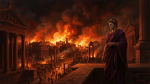
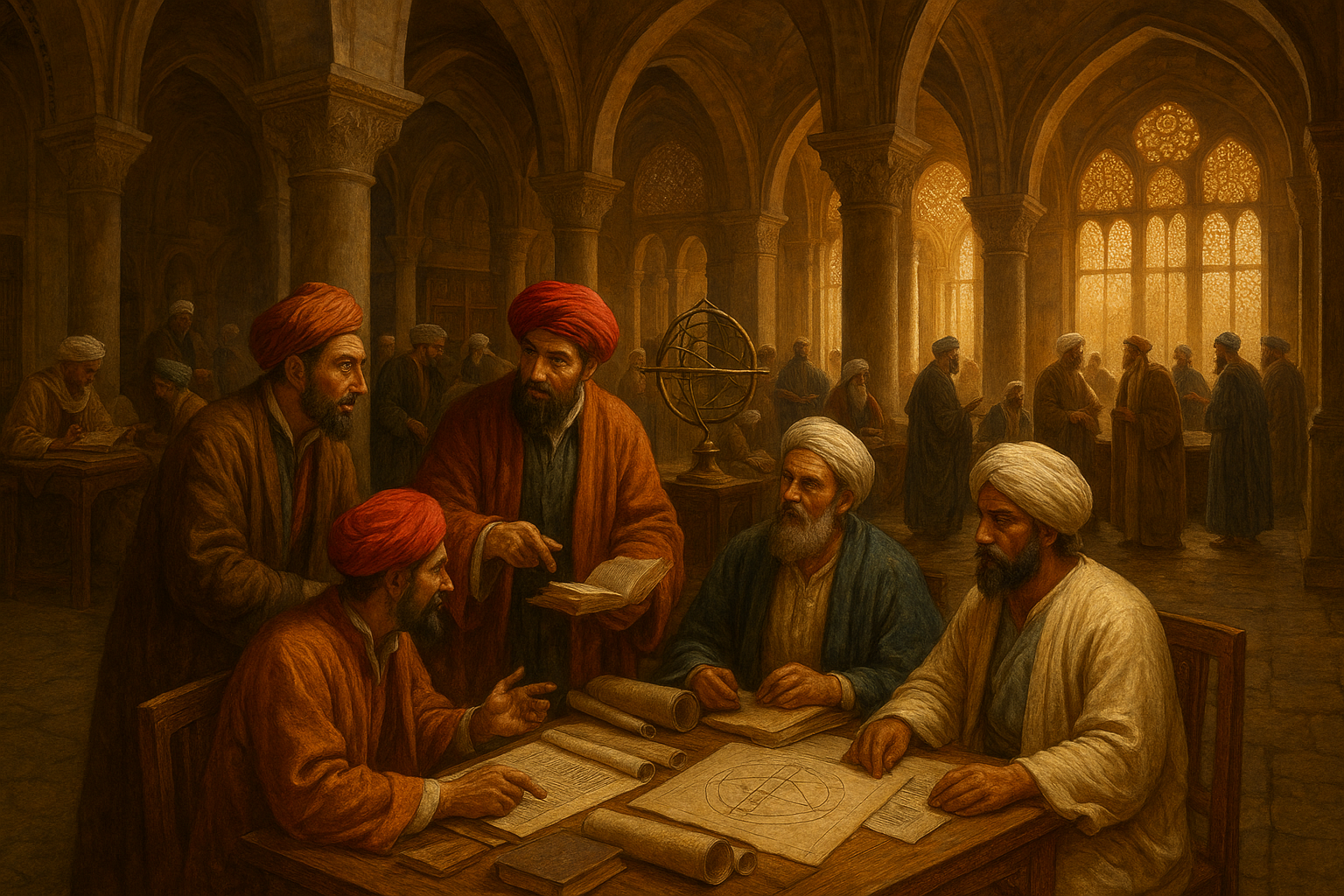
Imagine Baghdad in the year 1020. This is not the war-torn city of modern headlines. This is the heart of the Islamic Golden Age, the intellectual capital of the world.
At its center is the House of Wisdom, a magnificent library and academy that dwarfs any institution of learning in Europe. Here, scholars from every corner of the known world—Arabs, Persians, Greeks, Indians, Christians, Jews, and Muslims—gather to translate, debate, and discover.
The air hums with intellectual energy.
In one corner, a group of mathematicians discusses the new concept of algebra. In another, astronomers refine their models of the cosmos.
Physicians debate the latest medical theories, and philosophers argue the nature of reality itself. This is a place where knowledge is treasured above all else, where no idea is too dangerous to be considered.
But a shadow is beginning to fall. Walking through these vibrant halls is a man named Abu Hamid al-Ghazali.
He is a brilliant scholar, one of the most respected minds of his time. But as he listens to the freewheeling debates, he is not filled with wonder, but with dread.
He sees not the pursuit of knowledge, but the erosion of faith. He believes that the uncritical embrace of Greek philosophy is leading Muslims astray, and he is determined to stop it.
##
The Parallel Revelation
The crisis that would end the Islamic Golden Age didn’t begin with al-Ghazali. It started two centuries earlier, with a Caliph named al-Mamun. In a move that eerily mirrors the institutional pressure we see today, al-Mamun imposed an inquisition to enforce a state-approved version of Islam known as Mu’tazilism, a rationalist school of thought heavily influenced by Greek philosophy.
Scholars who refused to profess their allegiance were flogged, imprisoned, or even beheaded.
The backlash was swift and severe. Within a few decades, Mu’tazilism was declared a heresy, and adherence to it became a punishable offense. By the year 885, it was a crime to even copy books of philosophy.
The
intellectual openness of the early Abbasid period was replaced by a rigid orthodoxy.
It was in this climate that al-Ghazali wrote his masterpiece, “The Incoherence of the Philosophers.” In this brilliant but devastating work, he argued that reason was incompatible with faith, and that the pursuit of philosophy led to doubt and unbelief. The book was a sensation, and its impact was profound. It gave intellectual cover to the forces of religious dogmatism and provided a justification for the suppression of free thought.
Scholars began to self-censor, avoiding controversial topics for fear of being branded as heretics.
The vibrant intellectual culture of the House of Wisdom withered. The spirit of inquiry was replaced by a stultifying conformity.
The parallels to our own time are impossible to ignore. The institutional pressure, the ideological conformity, the use of violence to silence dissent—it’s all happening again, right before our eyes.
##
The Pattern Recognition
Why does this pattern repeat itself? Why do societies, at the peak of their intellectual power, so often turn against the very forces that made them great? The answer, it seems, lies deep in human nature.
We are tribal creatures, and we are often more comfortable with conformity than with conflict. We are drawn to the certainty of dogma and frightened by the ambiguity of open-ended inquiry.
When a society is faced with a crisis, whether it be political, economic, or religious, the temptation to circle the wagons and silence dissenting voices can be overwhelming.
This is what happened in the Islamic world in the 11th and 12th centuries, and it is what is happening in America today. The pressure to conform to a particular ideology, whether it comes from the government, from powerful activist groups, or from within the university itself, is creating a climate of fear that is toxic to intellectual life.
##
The Ancient Warning
The story of the Islamic Golden Age does not have a happy ending. The intellectual vibrancy of the House of Wisdom was never recovered. The scientific and philosophical achievements of the early Abbasid period were largely forgotten in the Muslim world, only to be rediscovered centuries later by European scholars.
The civilization that gave the world algebra, algorithm, and the astrolabe turned its back on science and reason.
The destruction of the House of Wisdom by the Mongols in 1258 was merely the final nail in the coffin. The real destruction had taken place centuries earlier, in the hearts and minds of the scholars who were too afraid to speak the truth.
The warning for us is clear: intellectual freedom is a fragile thing. Once it is lost, it may never be regained.
—
##
5 Things You Can Do This Week
History is not a spectator sport. The story of the Islamic Golden Age is a cautionary tale, but it is also a call to action. Here are five things you can do this week to help ensure that our own society does not suffer the same fate:
1.
**Support Free Speech Organizations:** Groups like FIRE are on the front lines of the battle to defend intellectual freedom. Consider making a donation to support their work.
2. **Engage with Opposing Viewpoints:** Seek out and respectfully engage with people who hold different opinions than you do.
The health of our society depends on our ability to have civil conversations, even about difficult topics.
3. **Build Your Emergency Preparedness:** Social instability often follows periods of intellectual and cultural decay. Visit SurvivalStronghold.com to learn how to prepare yourself and your family for whatever the future may hold.
4.
**Develop Self-Reliance Skills:** In uncertain times, the ability to provide for yourself and your family is invaluable. Check out HomesteaderDepot.com for resources on everything from gardening to animal husbandry.
5.
**Strengthen Your Community:** Strong families and strong communities are the bedrock of a healthy society. Make an effort to connect with your neighbors and build local networks of mutual support.
—
##
Sponsored Content
**Ready to take the first step towards self-reliance?**
In a world of uncertainty, the ability to grow your own food is more than just a hobby—it’s a superpower. With the **4ft Farm Blueprint**, you can learn how to create a highly productive, low-maintenance food garden in a space as small as 4×4 feet.
Don’t wait for the crisis to hit. Click here to learn more and get your copy of the 4ft Farm Blueprint today: https://4ftfarmblueprint.com/
—
##
References
[1] Foundation for Individual Rights and Expression. (2025, September 9). *2026 College Free Speech Rankings: America’s colleges get an ‘F’ for poor free speech climate*. Retrieved from https://www.thefire.org/news/2026-college-free-speech-rankings-americas-colleges-get-f-poor-free-speech-climate
[2] Ofek, H. (2011). Why the Arabic World Turned Away from Science. *The New Atlantis*, (30), 3–23. Retrieved from https://www.thenewatlantis.com/publications/why-the-arabic-world-turned-away-from-science
—
*This article is part of the Brain2 Project x Oyolokorai (https://oyolokorai.com) Family. Copyright 2025. The author, Shamus Gerry III, is an alias. This site contains affiliate links; we may earn a commission on purchases.*