

The Modern Mystery
It’s Friday in America. For 1.4 million federal workers, it’s payday. Except it’s not. The direct deposit never arrived. The mortgage is due. The fridge is getting empty. The kids need shoes. All because a thousand miles away, in the marble halls of Washington D.C., the gears of government have ground to a halt.
This isn’t just a news headline. It’s a quiet, creeping crisis unfolding in homes across the country. Essential workers—the ones who keep our skies safe, our borders secure, and our nation running—are being forced to work for free. The rest are sent home, their livelihoods held hostage by political gridlock. We’re told it’s a temporary problem, a partisan squabble over budgets and policies. But what if it’s something more? What if this is a symptom of a much deeper, older disease?
What if we’ve seen this all before, not in our lifetime, but in the fading echoes of a fallen empire? To understand the real danger of a government that can’t pay its people, we have to travel back in time, not just a few decades, but over a thousand years, to a city of fabulous wealth and fatal weakness: Constantinople.
The Time Portal
Imagine you are a soldier named Leo, a loyal legionary of the Byzantine Empire in the 9th century. You stand on the formidable Theodosian Walls, the greatest fortifications in the world, gazing out at the shimmering Sea of Marmara. You are a guardian of the richest city on earth, the “Queen of Cities,” the heart of a Christian empire that has endured for five hundred years.
But your stomach is empty. Your worn leather boots are splitting at the seams. Your wife and children are at home, praying for a miracle. The paymaster was supposed to come last spring. Then last fall. Now, you hear whispers in the barracks: the treasury is empty. The bureaucrats in the palace are fighting over scraps. You might see your salary in five years. If you’re lucky.
You watch as a new contingent of mercenaries arrives—blond, bearded Vikings from the north, the famed Varangian Guard. They are paid in gold, on time, every time. The Emperor trusts them more than his own people. Your loyalty, once ironclad, begins to rust. You are not just a soldier; you are a husband, a father. And your government has abandoned you.
The Parallel Revelation
For centuries, the Byzantine Empire was a marvel of administration and military might. Its professional civil service and standing army were the envy of the world. But by the 9th century, the cracks were showing. Political infighting, extravagant spending, and endless wars drained the treasury. The government began to do the unthinkable: it stopped paying its own people.
Just like today’s furloughed federal workers, Byzantine soldiers and civil servants were left in the lurch. Arabic sources from the period confirm that soldiers sometimes waited four to five years for their salaries. As the renowned historian Warren Treadgold notes in his work, “Byzantium and its Army,” the state’s inability to pay its soldiers became a chronic and fatal weakness.
The empire that once projected power across the Mediterranean could no longer afford to recruit its own citizens. It turned to expensive, unreliable foreign mercenaries. The very people sworn to protect the empire were demoralized, impoverished, and resentful. The social contract was broken. The foundation of the state was crumbling from within.
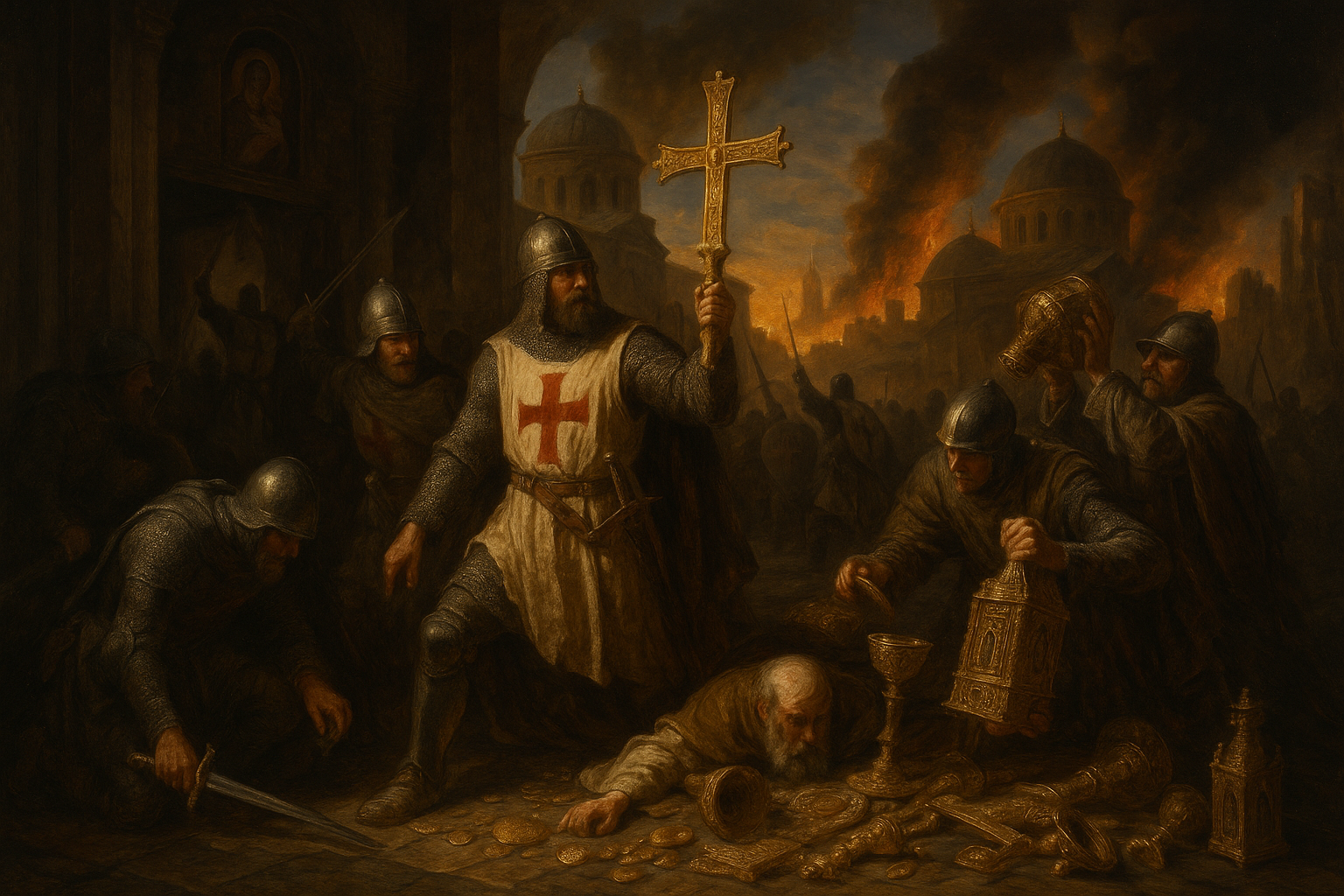
Fast forward to 1204. A fleet of crusaders, supposedly on their way to the Holy Land, diverts to Constantinople. They are owed money by a deposed emperor. When the new regime can’t pay, the crusaders, fellow Christians, decide to take their payment in plunder. They attack the city.
And the once-mighty walls, defended by a skeleton crew of unpaid, demoralized soldiers and a few thousand foreign mercenaries, fall in just three days. The sack that followed was one of the most brutal in history. For three days, the crusaders looted, raped, and murdered. Priceless ancient artworks were melted down for coin. Libraries were burned. Churches were desecrated. The city that had been the light of the world for a thousand years was extinguished in a storm of greed and violence.
The Pattern Recognition
Why does this pattern repeat? A government shutdown in 21st century America and the collapse of a medieval empire seem worlds apart. But the underlying human dynamics are identical. A government, any government, is built on a foundation of trust and mutual obligation. The people serve the state, and the state, in turn, protects and provides for its people.
When that obligation is broken—when the state fails to pay its soldiers, its administrators, its essential workers—that trust evaporates. Loyalty is replaced by resentment. Duty gives way to despair. The institution becomes hollow. It is a house eaten from the inside by termites, standing only by the grace of a gentle wind.
The politicians in Washington, like the bureaucrats in Constantinople, become so consumed with their internal power struggles that they forget whom they serve. They treat the machinery of government as a weapon in their political wars, and the people who run that machinery as acceptable collateral damage. They fail to see that they are not just shutting down a government; they are dismantling the very loyalty and faith that holds a nation together.
The Ancient Warning
After the 1204 sack, the Byzantine Empire never recovered. It was a ghost of its former self, a fractured collection of petty states. Though it recaptured its capital a half-century later, it was forever weakened, impoverished, and vulnerable. The final fall to the Ottoman Turks in 1453 was just the final, merciful blow to an empire that had died from within, centuries before.
The warning from 1204 is chillingly clear: when a government demonstrates that it cannot or will not protect its own people, it invites disaster. The internal paralysis, the political gridlock, the casual disregard for the well-being of its citizens—these are the signals that predators, both foreign and domestic, look for. They are the scent of blood in the water.
5 Things You Can Do This Week
History is not a spectator sport. The patterns of the past are a roadmap for the future, and a warning to prepare. Here are five things you can do this week to strengthen your own household against the echoes of history.
1. Build Your Own Stockpile. The Byzantines learned the hard way that you can’t eat imperial promises. Don’t rely on a fragile supply chain. Learn how to build a reliable, long-term food supply for your family. Start by reading this essential guide on SurvivalStronghold.com.
2. Declare Your Financial Independence. A government that can’t manage its own finances can’t be trusted with yours. It’s time to take control. Explore the path to true self-reliance and financial freedom with the insights from SelfRelianceReport.com.
3. Secure Your Homestead. Whether you live in a city apartment or a country farm, your home is your castle. Learn the essential skills to make it a fortress of self-sufficiency. The experts at HomesteaderDepot.com show you how.
4. Take Charge of Your Health. When institutions fail, you are your own first responder. Don’t outsource your well-being. Discover the secrets to natural, resilient health at FreedomHealthDaily.com.
5. Master the Basics of Self-Sufficiency. The 4ft Farm Blueprint is a revolutionary system for producing your own food, even in a small space. This isn’t just gardening; it’s a declaration of independence. Secure your family’s future and get your own 4ft Farm Blueprint here.
This article is sponsored by the 4ft Farm Blueprint. In an age of uncertainty, the most powerful act is to plant a seed. The 4ft Farm Blueprint is more than a guide; it’s a key to unlocking a life of true freedom and self-reliance. Don’t wait for history to repeat itself. Take control. Click here to learn more.


