

Outside the gleaming white walls of the White House, a nation holds its breath. The gears of the world’s most powerful government have ground to a halt. For the fourth week, a bitter political stalemate has left over a million federal workers without pay, air traffic controllers working on IOUs, and critical health subsidies for millions of Americans dangling over a cliff.
Yet inside, the scene is jarringly different. Under a crisp autumn sky, the President hosts a festive luncheon for his political allies in a newly renovated garden. The cheerful sounds of “YMCA” echo across the lawn as cheeseburgers are served and souvenir caps are handed out. “We have the hottest country anywhere in the world,” the President declares, a world away from the quiet desperation gripping the households of unpaid federal employees.
This disconnect—between a celebrating political class and a suffering populace—feels unnervingly new. But it’s not. History whispers a chilling warning, a story of a golden empire that rotted from the head down, where rulers played games while their nation burned. To understand the danger we face today, we must open a time portal to the 9th century, to a glittering city named Samarra, the heart of the mighty Abbasid Caliphate.
The Time Portal
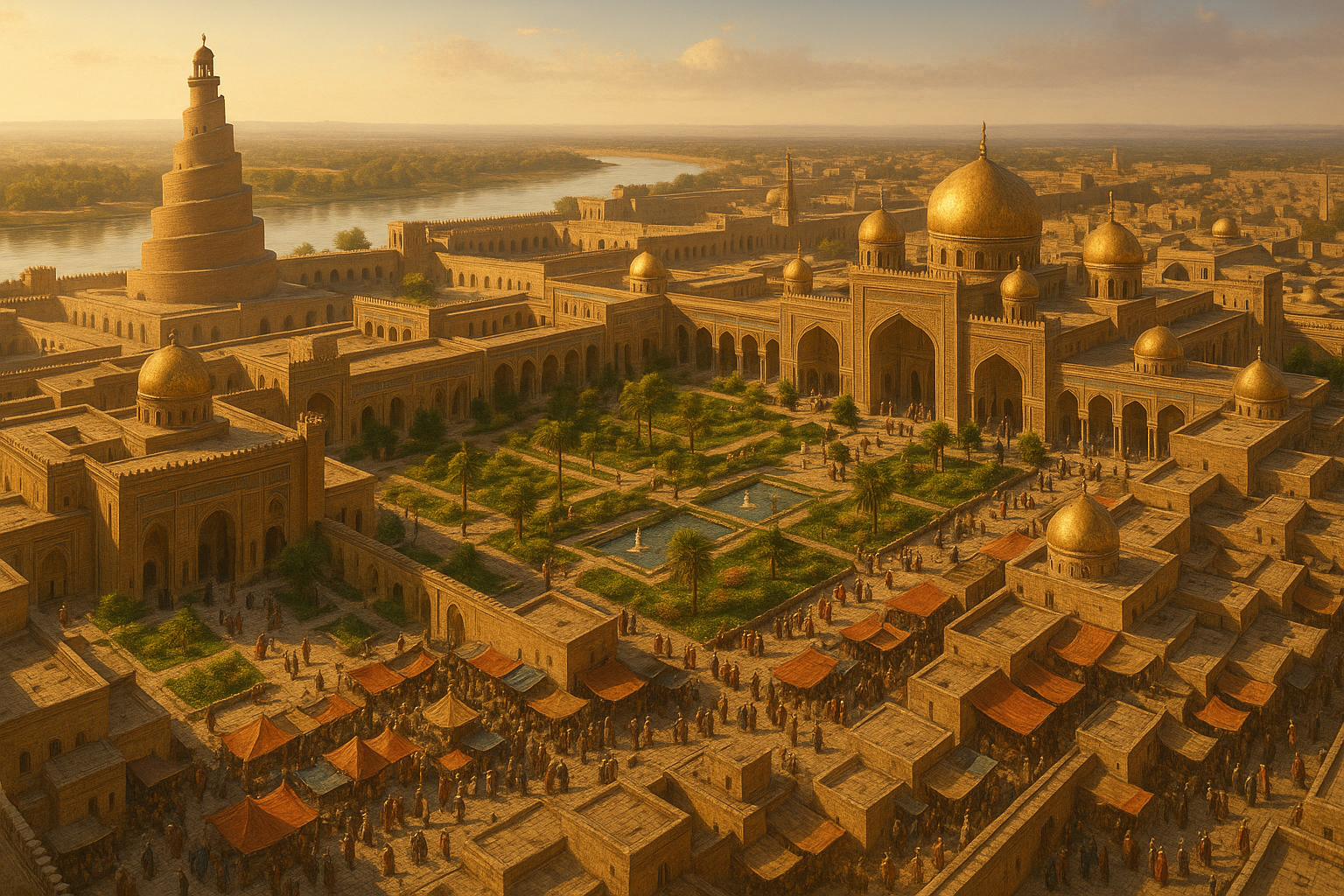
Imagine a city of unimaginable wealth, the epicenter of the Islamic Golden Age. Samarra in 861 CE was the Washington D.C., New York, and Silicon Valley of its day, all rolled into one. Its palaces were marvels of architecture, its libraries held the accumulated knowledge of the known world, and its markets overflowed with silks, spices, and gold from three continents.
The Caliph, al-Mutawakkil, was the most powerful man on Earth. But his power rested on a precarious foundation: an elite guard of Turkic slave-soldiers. These mercenaries were the empire’s muscle, ruthlessly effective but loyal only to coin. For years, the Caliph had showered them with riches, keeping them fat and happy. But the treasury was not infinite, and the whispers of delayed payments had begun to circulate through the barracks.
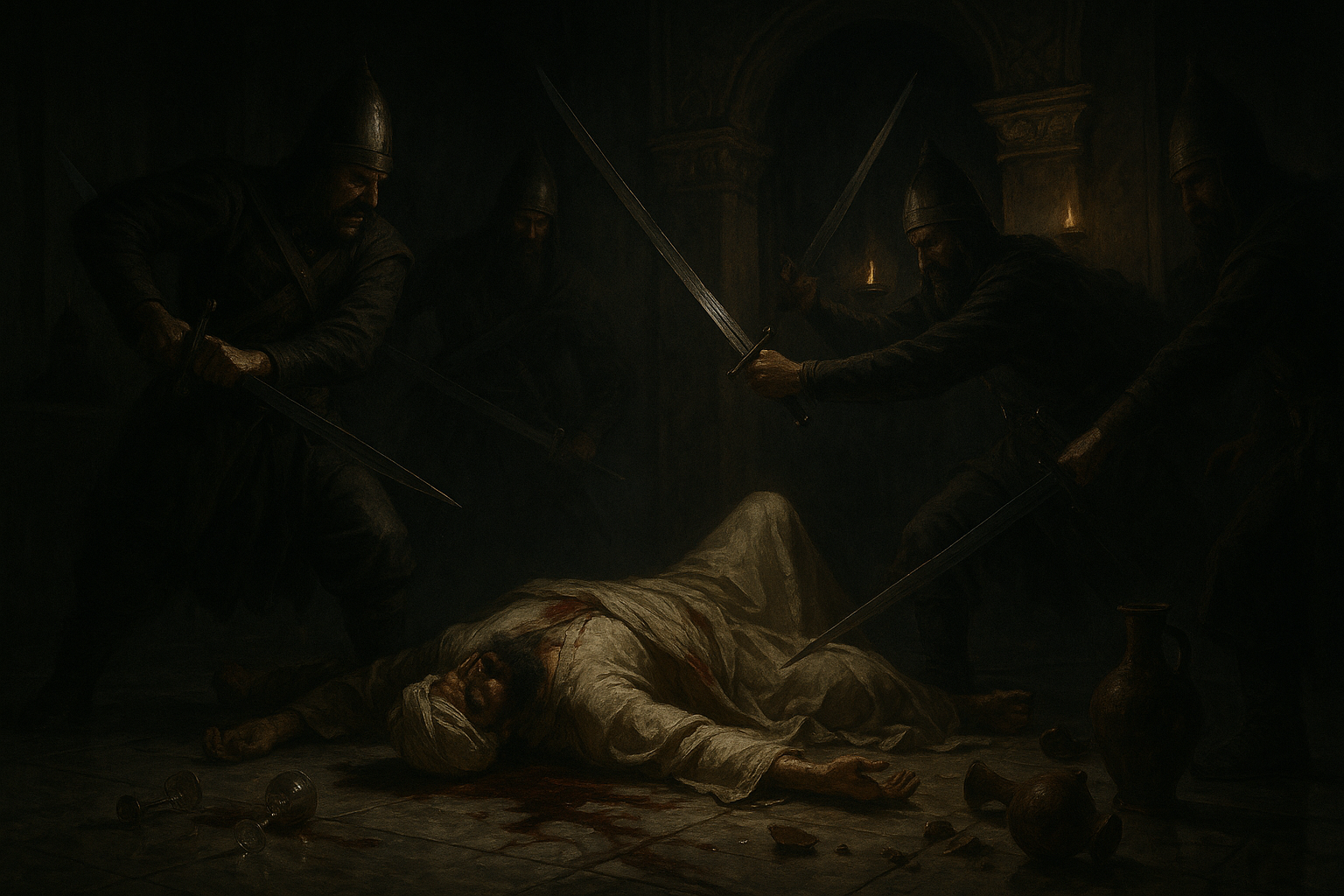
On the night of December 11, 861, those whispers became a roar. As the Caliph drank with a handful of companions, a group of Turkic officers, their faces grim, burst into the chamber. The wine glasses shattered. The music stopped. By morning, the Caliph was dead, and the nine most chaotic years in Islamic history—a period historians now call the “Anarchy at Samarra”—had begun.
The Parallel Revelation
The assassination kicked off a horrifying domino effect. The Turkic guards, now the Caliph-makers, installed al-Mutawakkil’s son on the throne. He lasted six months before dying under mysterious circumstances, likely poisoned by the same men who elevated him.
Next came his cousin, al-Musta’in. But the military factions couldn’t agree, and the empire plunged into a bloody civil war. The capital itself was besieged. Eventually, al-Musta’in was forced to abdicate. His replacement, his own cousin al-Mu’tazz, promised him a peaceful exile.
It was a lie. A short time later, an executioner brought al-Musta’in’s severed head to the new Caliph. The historian al-Tabari tells us what happened next. Al-Mu’tazz, who was in the middle of a chess game, glanced at the grisly trophy and said, “Lay it aside, till I have finished the game.”
Let that sink in. The government was bankrupt. The provinces were in open revolt. The army was a mutinous mob. And the leader of the empire, confronted with his cousin’s head, told the executioner to wait until he finished his chess match. He then calmly inspected the head and ordered the killer paid a reward of 500 pieces.
This was the “Anarchy at Samarra.” A government so paralyzed by infighting and financial collapse that it ceased to function. The Turkic troops, much like today’s essential federal workers, were forced to work without pay. Their anger and desperation fueled the chaos, leading to a revolving door of puppet Caliphs—four in nine years, all deposed or brutally murdered. The state was bankrupt, but the elites, insulated within their palace walls, continued their games of power and intrigue, utterly detached from the consequences.
The Pattern Recognition
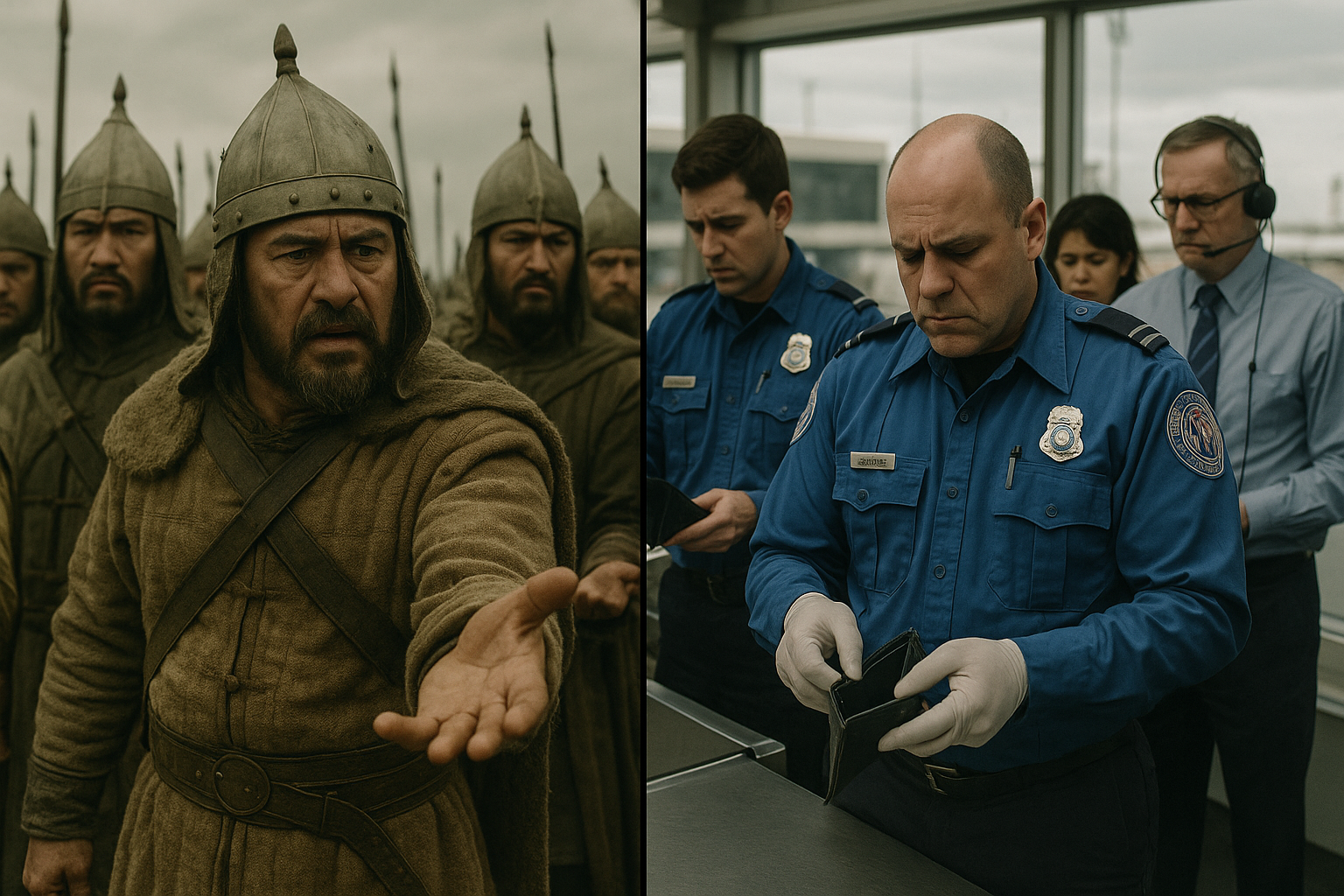
The parallels are impossible to ignore. A government shutdown triggered by intractable political division. A ruling class that appears indifferent to the suffering of its own people. Essential state employees—the very pillars of the system, from the TSA to the military—forced to work without knowing when their next paycheck will arrive.
In 9th-century Samarra, it was Turkic guards who went unpaid. Today, it’s air traffic controllers and FBI agents. In Samarra, it was feuding military factions who held the government hostage. Today, it’s warring political parties. And in Samarra, it was a Caliph playing chess, just as today we see a festive White House luncheon while the country drifts deeper into crisis.
This isn’t about political parties. It’s about a pattern of human behavior as old as civilization itself. When a nation’s leaders become so insulated, so obsessed with their own power plays and so disconnected from the reality of the people they govern, the foundations of the state begin to crack. They forget that the government is not a game of chess, and that the people are not disposable pawns.
The Ancient Warning
The Anarchy at Samarra finally ended in 870, but the Abbasid Caliphate never recovered. The nine-year crisis shattered the central government’s authority and prestige beyond repair. The financial collapse was permanent. Provinces, left to fend for themselves, broke away one by one.
What was once the world’s undisputed superpower became a hollow shell, a shadow of its former glory. The “Golden Age” was over. The crisis wasn’t temporary; it was terminal. It was a slow, nine-year-long heart attack from which the empire never got up.
Today, as our own government shutdown drags on, we are hearing the echoes of Samarra. We are told this is a temporary political squabble. But history warns us that these “temporary” crises, born of elite indifference and political paralysis, can inflict permanent wounds. They erode trust, they break institutions, and they can set a nation on a path to irreversible decline.
Sponsor: The Farm That Fits in Your Backyard
While politicians play games in Washington, a quiet revolution is happening in backyards across America. It’s a revolution of self-reliance, powered by the 4ft Farm Blueprint.
This isn’t just about gardening. It’s about food security. It’s about taking power back from a fragile system and putting it in your own hands. The 4ft Farm is a high-efficiency food production system that can provide fresh, organic produce for your family, using just a tiny corner of your yard. Don’t wait for the system to save you. Learn to save yourself. Click here to see how thousands are declaring their food independence.
5 Things You Can Do This Week
History’s lesson is clear: when the center cannot hold, you must become your own center. Here are five practical steps you can take this week to build your own resilience, inspired by the wisdom of those who survived past collapses.
1. Secure Your Food Supply. The chaos in Samarra began when the state could no longer pay its bills, disrupting everything. Your first line of defense is a full pantry. Read this guide on the foods that never expire and start building your personal stronghold. Read more at SurvivalStronghold.com
2. Take Control of Your Health. A government that can’t even stay open cannot be trusted with your family’s well-being. The expiring healthcare subsidies are a stark reminder that you are your own first responder. Explore natural, time-tested health solutions that don’t depend on Washington. Discover more at FreedomHealthDaily.com
3. Learn a Real-World Skill. When the Caliphate’s bureaucracy failed, people with practical skills—farmers, builders, healers—were the ones who endured. This week, commit to learning one tangible skill, from basic first aid to water purification. Get ideas at SelfRelianceReport.com
4. Build Your Local Network. The survivors of historical collapses were those who had strong communities. Get to know your neighbors. Organize a neighborhood watch or a tool-sharing program. A strong community is worth more than gold in a crisis. Learn about community building at HomesteaderDepot.com
5. Fortify Your Mind. Crises are mentally and spiritually draining. The ancient Stoics, much like the resilient scholars of the Islamic Golden Age, knew that mental fortitude was the ultimate survival tool. Practice mindfulness and study the wisdom of the ancients to build your inner citadel. Find holistic mind-body strategies at SevenHolistics.com
Sources:
[1] “Anarchy at Samarra.” Wikipedia. Accessed October 22, 2025. https://en.wikipedia.org/wiki/Anarchy_at_Samarra
[2] Kennedy, Hugh. The Prophet and the Age of the Caliphates: The Islamic Near East from the 6th to the 11th Century. Third edition. London and New York: Routledge, 2016.
[3] Al-Tabari, The History of al-Tabari, Volume 35: The Crisis of the Abbasid Caliphate. Translated by George Saliba. Albany, NY: State University of New York Press, 1985.
[4] Gordon, Matthew S. The Breaking of a Thousand Swords: A History of the Turkish Military of Samarra (A.H. 200-275/815-889 C.E.). Albany, NY: State University of New York Press, 2001.


