
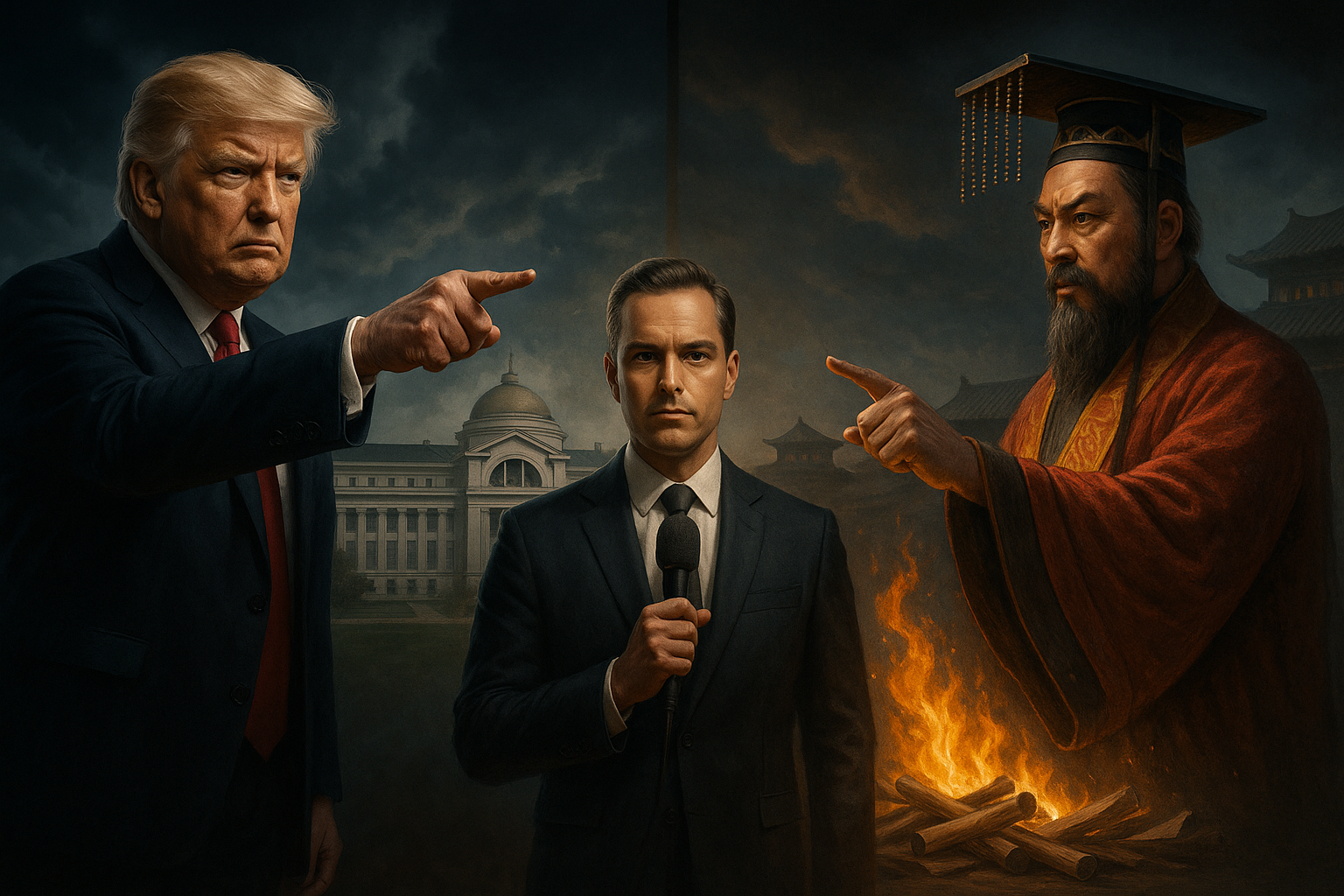
# The Emperor’s New History: Is Washington Repeating a 2,200-Year-Old Mistake?
**The Modern Mystery**
In the last 24 hours, a political firestorm has erupted, not with the usual rhetoric of cable news, but with a chilling display of federal power. In a move that sent shockwaves through the nation’s capital, the White House announced a dramatic escalation in its pressure campaign against some of America’s most revered cultural and educational institutions. The Smithsonian, the nation’s museum, was publicly branded “OUT OF CONTROL” by the President for its supposedly “divisive” and “race-centered” narratives, particularly its exhibits on the history of slavery. The message was clear: focus on the “Brightness” of American history, or face the consequences.
This wasn’t just a war of words. Across the country, universities are feeling the squeeze. A staggering $6 billion in federal research funding has been frozen at nine major universities, a move widely seen as a strong-arm tactic to force compliance with the administration’s preferred curriculum and research priorities. The message to academics is equally clear: toe the line, or your funding disappears. The very institutions designed to foster critical thinking and preserve our collective memory are now under direct threat, their independence hanging by a thread. This isn’t just a policy dispute; it’s a battle for control over America’s story. And as we watch this unfold, a haunting question emerges: have we seen this before? Is this a new chapter in American politics, or a chilling echo from a distant, authoritarian past?
**The Time Portal**
Let’s wind the clock back 2,200 years, to the dawn of the first Chinese empire. The year is 213 BC. The air in the imperial capital of Xianyang is thick with tension. The newly unified empire, forged in the crucible of the Warring States period, is still a fragile entity. Emperor Qin Shi Huang, a ruler of immense ambition and ruthless efficiency, sits on the Dragon Throne. He has conquered all his rivals, standardized weights, measures, and even the axle widths of carts. But one thing remains stubbornly untamed: the minds of his people.
To his side stands his most trusted advisor, the Chancellor Li Si. A man of sharp intellect and unwavering loyalty, Li Si understands the emperor’s deepest fear: that the past could be used to undermine the present. He steps forward, the silk of his robes rustling in the cavernous throne room. He presents a memorial to the emperor, a document that will change the course of Chinese history. “I, your servant,” he begins, his voice echoing in the silent hall, “propose that all historians’ records other than those of Qin’s be burned.”
He argues that scholars and intellectuals, armed with stories of past dynasties and virtuous rulers, are a threat to the new order. They “use history to criticize the present,” he warns, and their dissenting voices could unravel the fragile unity of the empire. The solution, he proposes, is as simple as it is brutal: a nationwide book burning. All historical records, all philosophical texts, all works of poetry that do not align with the official Qin narrative must be turned over to the authorities and consigned to the flames. The only exceptions are to be books on agriculture, medicine, and divination – practical manuals that pose no threat to the emperor’s absolute authority. The emperor listens, his face an unreadable mask. Then, he nods. The decree is issued. The fires are lit.
**The Parallel Revelation**
The parallels between Qin Shi Huang’s ancient decree and the current events in Washington are as striking as they are unsettling. The language may be different, but the underlying impulse is identical. When the White House declares the Smithsonian “OUT OF CONTROL” for its focus on slavery, it is echoing Li Si’s warning about scholars who “use history to criticize the present.” The demand for a focus on America’s “Brightness” is a modern-day version of the Qin dynasty’s attempt to create a single, state-sanctioned narrative, one that glorifies the ruling power and erases inconvenient truths.
The freezing of university research funds is a 21st-century equivalent of the Qin’s biblioclasm. It’s a powerful tool for enforcing ideological conformity, a way of saying to academics and researchers: “Your funding, your livelihood, depends on your willingness to align with our version of history.” Just as Qin Shi Huang sought to eliminate all schools of thought that challenged his Legalist philosophy, the current administration seems determined to silence any narrative that deviates from its preferred version of American history. The goal is the same: to control the past in order to control the present and the future. It’s a chilling reminder that the struggle for intellectual freedom is a timeless one, and that the temptation for those in power to rewrite history in their own image is a danger that transcends centuries and civilizations.
**The Pattern Recognition**
Why does this pattern repeat itself across millennia? Why do rulers, separated by thousands of years and vastly different cultures, resort to the same tactics of cultural control and historical revisionism? The answer lies in a fundamental aspect of human nature: the fear of losing control. For a ruler, whether an ancient emperor or a modern president, the most dangerous threat is not an invading army, but a questioning populace. A people who are aware of their own history, who have access to a wide range of ideas and perspectives, are a people who are difficult to control.
History, in its truest form, is a repository of alternatives. It shows us that things have not always been as they are now, and that they can be different in the future. It provides us with examples of both good and bad rulers, of both successful and failed policies. It is, in essence, a handbook for critical thinking. And for a ruler who demands unquestioning loyalty, critical thinking is the ultimate enemy. By burning the books, by silencing the scholars, by rewriting the historical narrative, a ruler can create the illusion that their own power is not only absolute, but also inevitable. They can transform history from a source of liberation into a tool of oppression.
**The Ancient Warning**
What happened to the dynasty that tried to erase history? The Qin dynasty, for all its power and ambition, was remarkably short-lived. It collapsed in 206 BC, just 14 years after it was founded. The very act of burning the books and burying the scholars, designed to secure the emperor’s rule, ultimately contributed to its downfall. The brutal suppression of intellectual dissent created a climate of fear and resentment. The destruction of historical records left the dynasty adrift, cut off from the wisdom and experience of the past. The Qin’s attempt to create a sterile, state-sanctioned history backfired. It created a cultural vacuum, a void that was soon filled by rebellion and civil war.
The lesson from 2,200 years ago is clear: a society that fears its own history is a society on the path to ruin. A government that tries to control the narrative by silencing dissenting voices and suppressing inconvenient truths is a government that is ultimately building its own prison. The burning of books is not a sign of strength, but of weakness. It is the desperate act of a regime that is terrified of its own people, and of the power of ideas. The echoes of the Qin dynasty’s collapse can be heard in the halls of Washington today, a stark warning of what happens when political power is used to wage war on history itself.
**5 Things Readers Can Do This Week**
History is not a spectator sport. It’s a living, breathing force that shapes our present and our future. Here are five things you can do this week to push back against the rewriting of history and to prepare for what may come next:
1. **Support Independent Media and Cultural Institutions:** Your local library, museums, and independent news sources are the front lines in the battle for historical truth. Consider a donation, a membership, or simply a visit. A thriving ecosystem of independent institutions is the best defense against a state-sanctioned narrative. For more on the importance of self-reliance, check out this article on [Self-Reliance Report](https://selfreliancereport.com/the-importance-of-self-reliance-in-todays-world/).
2. **Read a Banned Book:** The American Library Association keeps a list of the most frequently challenged books. Pick one up and read it. Engage with the ideas that some people want to suppress. Understanding why a book is considered “dangerous” is a powerful exercise in critical thinking. For more on protecting your freedoms, read this article on [Survival Stronghold](https://survivalstronghold.com/protecting-your-freedoms-a-guide-for-the-modern-patriot/).
3. **Talk to Your Family About Your Own History:** Every family has a story. Take some time this week to talk to your parents, grandparents, or other relatives about their own experiences. Preserve your own family’s history, the stories that the official narratives often leave out. For tips on how to start these conversations, check out this guide on [Homesteader Depot](https://homesteaderdepot.com/preserving-family-history-a-guide-for-the-modern-homesteader/).
4. **Learn a New Skill:** In times of uncertainty, practical skills are the ultimate form of self-reliance. Learn how to grow your own food, purify water, or perform basic first aid. These are skills that can’t be taken away from you, no matter who is in power. For a great place to start, check out the [4ft Farm Blueprint](https://4ftfarmblueprint.com/).
5. **Support Your Health and Well-being:** A healthy mind and body are your best assets in challenging times. Make sure you’re eating well, getting enough exercise, and taking care of your mental health. For some great tips on holistic health, check out this article on [Seven Holistics](https://sevenholistics.com/the-seven-pillars-of-holistic-health/).
—
**Sponsored Content**
*This article is brought to you by our sponsors. Please support them for helping us to bring you these important historical parallels.*
* **4ft Farm Blueprint:** Learn how to grow your own food in a 4×4 space. Perfect for urban and suburban preppers. [Click here to learn more](https://4ftfarmblueprint.com/).
* **My Patriot Supply:** Get your emergency food and survival gear from a trusted source. [Click here to visit My Patriot Supply](https://mypatriotsupply.com/?rfsn=7245215.1a6316).
* **Augusta Precious Metals:** Protect your retirement with a gold IRA. [Click here to get your free gold IRA guide](https://augustapreciousmetals.com/?irclickid=zp%3Axyy11MxyPT4hT3T29fX-zUkH29r3Z11t62I0&irpid=341021&irmpname=Gregory%20Coleman&utm_source=341021&utm_medium=affiliate&utm_campaign=ira-lead-gen-no-limits&utm_term=Gregory%20Coleman&utm_content=ira-lead-gen-no-limits).


