
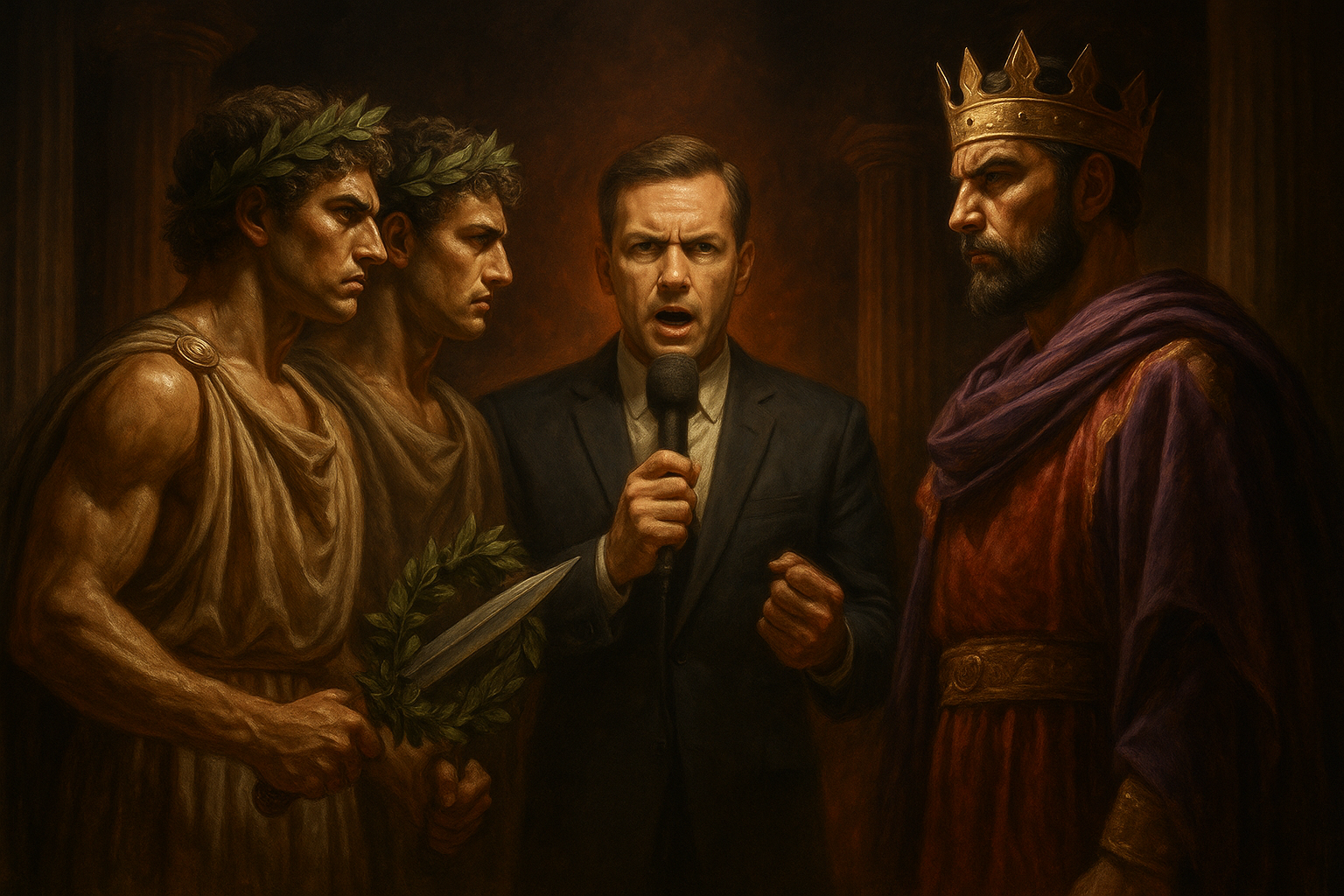
A roar is echoing across America.
It’s not the sound of celebration. It’s the defiant cry of millions. In the last 48 hours, over seven million Americans, in more than 2,600 cities and towns, have flooded the streets. Their message is simple, ancient, and deeply unsettling to those in power: “No Kings.”
This isn’t just another protest. It’s a coordinated, nationwide rejection of what millions see as a rising tide of authoritarianism. From the steps of the Lincoln Memorial to the sun-drenched boulevards of Los Angeles, the sentiment is the same. People are looking at the daily news—the security alerts, the political pressure, the ever-tightening grip of executive power—and they are seeing the shadow of a throne falling across the republic.
But this cry of “No Kings” is not new. It’s a ghost. A 2,500-year-old echo from a time when the world’s first democracy was still a fragile dream. To understand what’s happening in America today, we have to travel back to a single, bloody afternoon in ancient Athens, where two lovers with daggers hidden in flowers tried to kill a tyrant… and failed spectacularly.
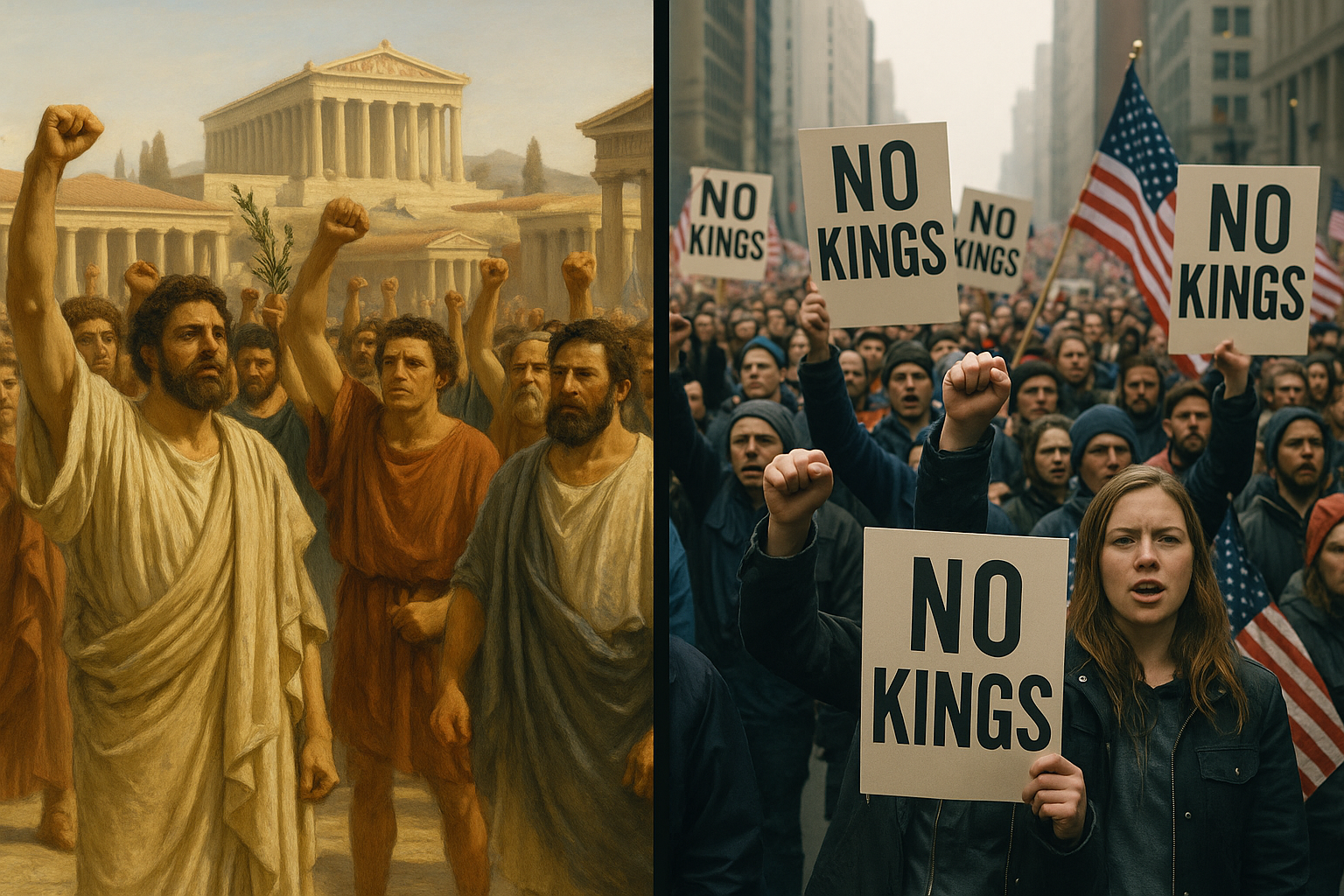
Their failure, and the myth that grew from it, holds a chillingly relevant warning for us today.
The Time Portal
Picture Athens, 514 BC. The city is simmering under the rule of the tyrant Hippias. He and his brother, Hipparchus, inherited their power from their father, Peisistratus. At first, their rule was mild. But power, as it always does, began to corrupt.
Hipparchus, the younger brother, was known for his predatory appetites. He set his sights on a handsome young man named Harmodius. But Harmodius was already in a relationship with an older man, Aristogeiton. They were lovers, a common and accepted bond in ancient Athens. Harmodius rejected the tyrant’s brother.
The rejection was a spark in a powder keg. Humiliated, Hipparchus retaliated not with violence, but with public shame. He invited Harmodius’s young sister to be a basket-bearer in the grand Panathenaic festival, a high honor. Then, as she prepared for the procession, he had her publicly dismissed, declaring she was not a virgin and therefore unworthy.
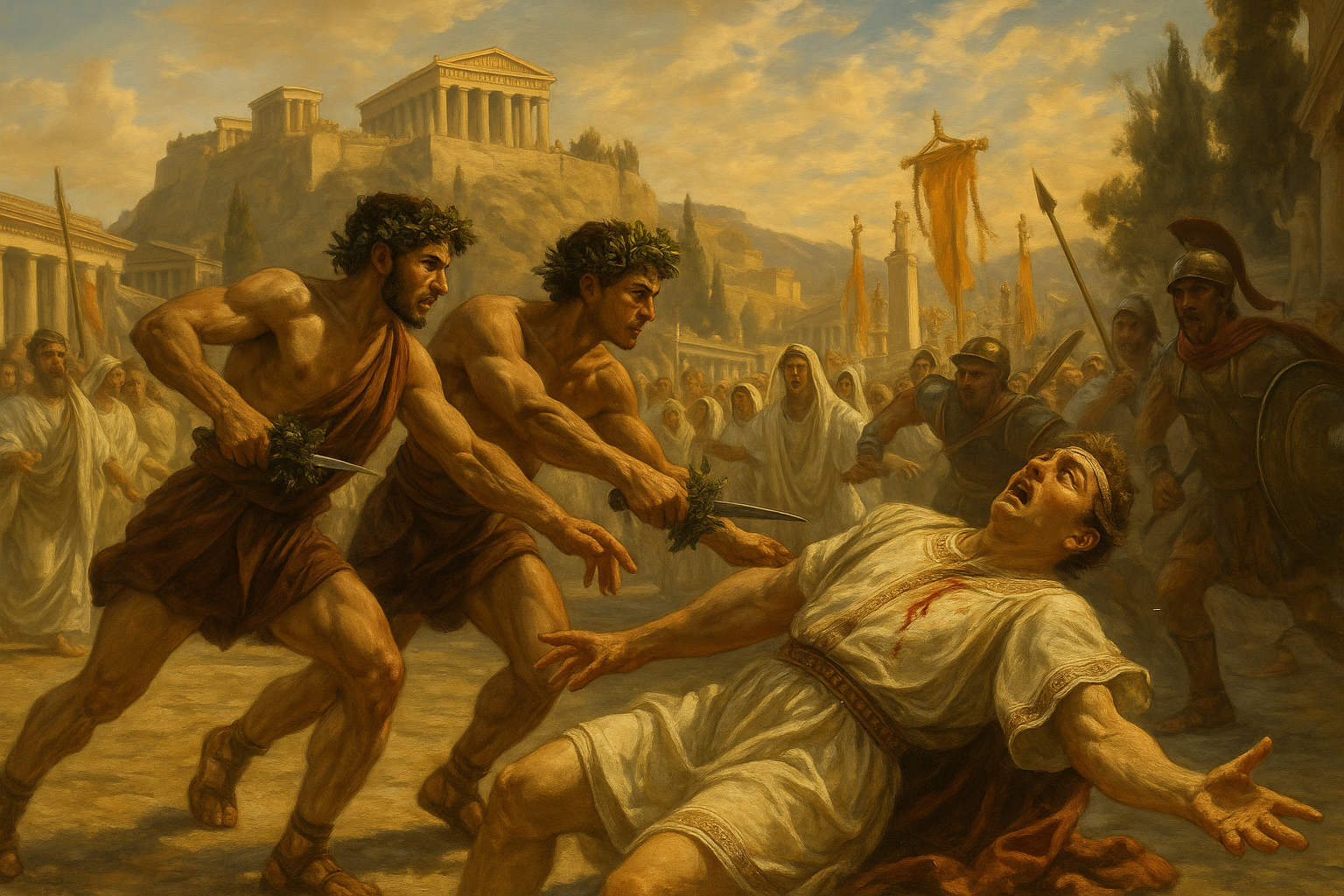
The insult was devastating. It was an attack on the honor of an entire family. For Harmodius and Aristogeiton, it was the final straw. A personal vendetta was about to become a political assassination. They hatched a plan: during the festival, when many citizens would be carrying ceremonial weapons, they would hide daggers in their myrtle wreaths, get close to the tyrants, and end their rule forever.
The Parallel Revelation
The day of the festival arrived. The air was thick with the scent of incense and roasting meat. As the procession formed at the foot of the Acropolis, Harmodius and Aristogeiton saw one of their co-conspirators speaking amicably with the main tyrant, Hippias.
Panic seized them. They thought they had been betrayed. Their carefully laid plans shattered. They acted on pure impulse.
They couldn’t get to Hippias, who was surrounded by his guards. But they saw his brother, Hipparchus, the source of their personal grievance. They lunged, their daggers flashing in the Athenian sun. Hipparchus fell, stabbed to death.
In the chaos, Harmodius was killed on the spot by the tyrant’s bodyguards. Aristogeiton was captured.
Think about this for a moment. The first “No Kings” protest was not a grand, philosophical movement. It was a messy, personal, and ultimately failed assassination attempt. They killed the wrong man. The tyrant, Hippias, survived.
And what happened next is the most crucial part of the story. Enraged and paranoid, Hippias unleashed a reign of terror for the next four years. He became the very monster the assassins had tried to stop.
This mirrors the unsettling reality of many modern protests. An act of defiance, born from a sense of injustice, can often lead to an immediate and harsher crackdown. The system, when threatened, doesn’t always yield. It often bites back, harder.
The Pattern Recognition
So why do we remember Harmodius and Aristogeiton as heroes? Why did the Athenians, after they finally did get rid of Hippias (with the help of the Spartan army, a fact they conveniently forgot), celebrate these two failed assassins as the saviors of democracy?
Because every society needs a founding myth.
The Athenians needed to believe that they had freed themselves. They couldn’t admit that their liberty was handed to them by their arch-rivals, the Spartans. So, they rewrote history. They transformed a personal vendetta into a noble act of political martyrdom.
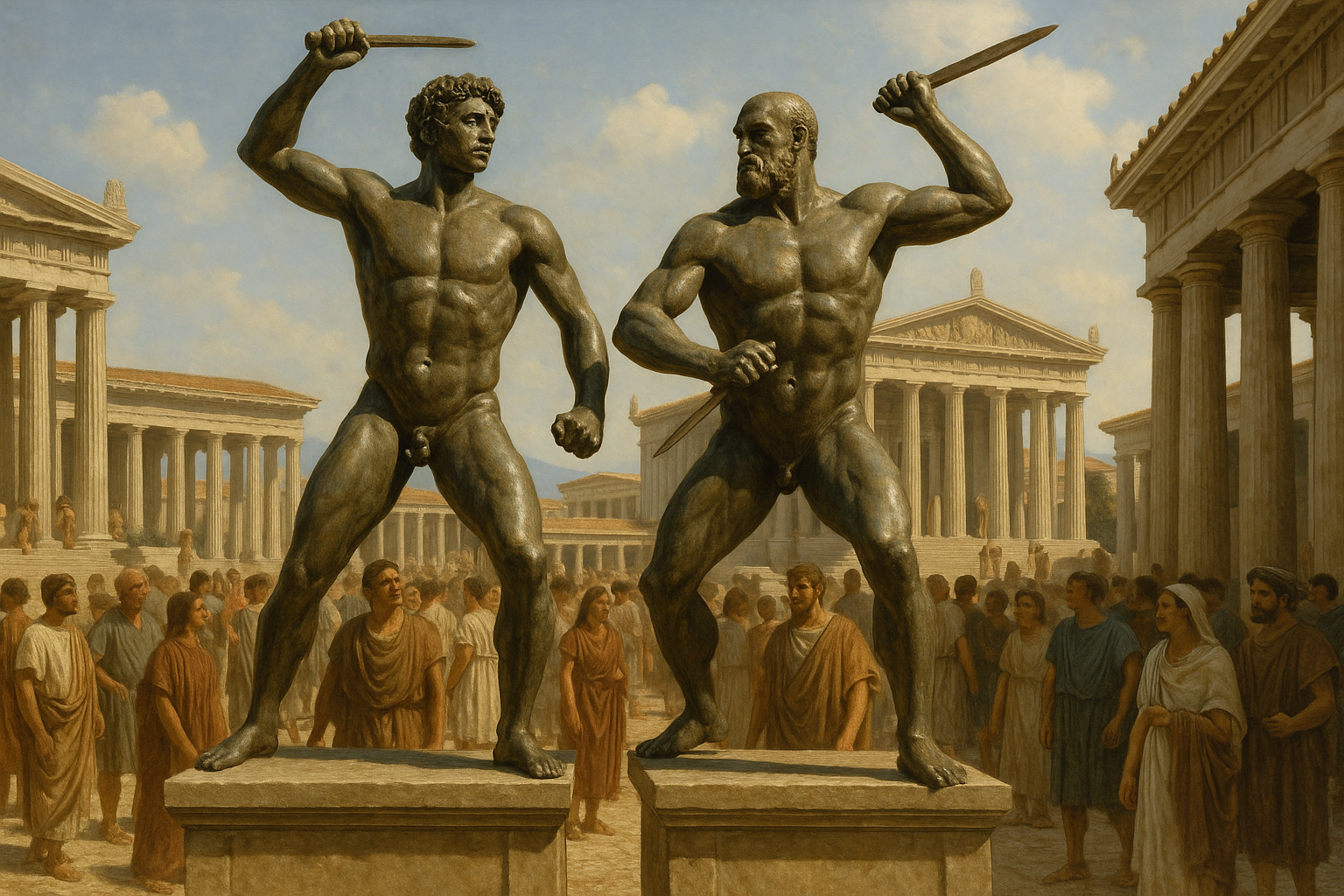
They erected statues of the “Tyrannicides,” Harmodius and Aristogeiton, in the heart of their city. These were the first statues of mortals ever placed in the Athenian Agora. They became a civic shrine.
They sang drinking songs, called skolia, in their honor at parties for centuries:
“I will wrap my sword in a crown of myrtle,
As Harmodius and Aristogeiton did
When they killed the tyrant
And made the Athenians equal under the law.”
The song is a lie. They didn’t kill “the” tyrant, and they didn’t make Athens “equal under the law.” But the myth was more powerful than the truth. The story of two lovers who dared to strike a blow against tyranny, even in failure, became the emotional bedrock of Athenian democracy. It was a constant reminder: we are a people who say “No Kings.”
This is the timeless pattern. When people feel their fundamental rights are being eroded, they don’t just protest the present; they reach into the past for symbols of defiance. The millions of Americans marching under the “No Kings” banner are not just reacting to the news of the last 24 hours. They are, consciously or not, tapping into a 2,500-year-old tradition of citizen resistance to unchecked power. They are singing a modern version of the Harmodius song.
The Ancient Warning
The story of the Tyrannicides is not just an inspiring tale of heroism. It’s a warning.
The immediate result of their act was not freedom, but a more brutal dictatorship. Their passion, their anger, their justified sense of grievance—it all led to more suffering in the short term. It was only years later, through a complicated series of political and military maneuvers, that democracy was born.
The warning is this: The road from crying “No Kings” to actually living in a secure republic is long, complicated, and often bloody. Symbolic acts are powerful. They can shape the soul of a nation. But they are not, by themselves, enough to secure liberty.
The Athenians built a myth around their failed assassins because they needed heroes. But they secured their democracy with something far less glamorous: institutions, laws, and the constant, difficult work of self-governance.
As we see the streets of America filled with righteous anger, we must ask ourselves: What comes next? Is this a fleeting moment of passion, or the beginning of a sustained effort to reinforce the institutions that protect us from tyranny?
History teaches us that the first is a beautiful, tragic song. The second is freedom.
Why This Matters to Your Family
History doesn’t just warn us; it prepares us. The same spirit of self-reliance that drove the Athenians to build their democracy is the same spirit we need to cultivate today. While the world outside feels uncertain, you have the power to create your own stronghold of security and abundance.
The 4ft Farm Blueprint is more than a gardening guide; it’s a declaration of independence. It teaches you how to turn a tiny 4×4 foot space into a perpetual source of fresh, healthy food for your family. This isn’t about becoming a farmer. It’s about becoming self-reliant. It’s about knowing that no matter what happens in the halls of power, you can provide for yourself.
In a world of uncertainty, the ultimate act of defiance is to build your own security.
Click Here to Learn How to Build Your Own 4ft Farm and Declare Your Independence
5 Things You Can Do This Week to Prepare for History Repeating Itself
The story of the Tyrannicides teaches us that true freedom is about more than just defiance; it’s about preparation and resilience. Here are five practical steps, inspired by the lessons of history, that you can take this week to strengthen your own household against the storms of our time.
1. Secure Your Food Supply, The Ancient Way. The Athenians understood that a city’s freedom depended on its grain supply. You can apply the same principle to your family. Don’t just stockpile cans; learn a skill. A fantastic starting point is understanding how our ancestors preserved food for long winters without refrigeration. Check out this article on How to Build a Root Cellar from our friends at Homesteader Depot. It’s a timeless skill for true self-reliance.
2. Build Your Personal Fortress of Health. A tyrant’s greatest weapon is a populace weakened by fear and sickness. The strength to resist comes from personal vitality. Ancient wisdom and modern science agree on the power of natural anti-inflammatories to keep your body resilient. Freedom Health Daily has an insightful piece on The Top 7 Natural Anti-Inflammatory Foods that can help you build a strong foundation of health.
3. Forge Your Own “Tyrannicide” Mindset. The Tyrannicides acted out of a fierce love for their own. The most powerful resistance to chaos is a strong, independent mind. This starts with taking control of what you can control. Self-Reliance Report offers a powerful guide on Developing a Resilient Mindset. It’s about building the mental fortitude to see through the noise and act with clarity.
4. Create Your Own “Isles of the Blest.” The drinking songs imagined Harmodius in a paradise. You can create your own small paradise of security. True wealth isn’t in a bank; it’s in your ability to provide. Survival Stronghold has a foundational article on The 10 Essentials for Long-Term Survival that goes beyond the basics and helps you think like a true survivor.
5. Master the Art of Natural Healing. When institutions fail, you become your own first responder. The ancient Greeks relied on herbs for their medicine. You can too. Seven Holistics provides a deep dive into one of the most powerful natural remedies on the planet. Read their report on The Ancient Golden Spice: Turmeric’s Healing Power to understand how to use this incredible plant to support your family’s well-being.


