Another day, another dollar lost. For millions of Americans, that’s the grim reality of the government shutdown grinding our nation to a halt.
Federal workers, the backbone of our country, are watching their savings evaporate. Our brave men and women in uniform stand guard across the world, their own families unsure if they’ll be paid. And now, the most vulnerable—children and the elderly—face the terrifying prospect of empty cupboards as SNAP benefits hang by a thread.
Our leaders, cloistered in their halls of power, trade insults and accusations. “It’s their fault!” one side screams. “They’re crazed lunatics!” the other retorts. While they bicker, the gears of our Republic are seizing up, one by one. The system is failing.
If this all feels terrifyingly new, it isn’t. What we are witnessing is not a modern crisis. It is an ancient echo, a ghost story whispering a dire warning to us from the marble ruins of a fallen empire.
Two thousand years ago, the Roman Republic, a global superpower that had stood for nearly five centuries, faced the exact same abyss.
The Historical Echo
Before the Caesars, before the emperors, Rome was a Republic, much like our own. It was governed by a Senate, a body of powerful men who, like our politicians today, became locked in a death spiral of partisan hatred and political gridlock.
Their crisis, like ours, wasn’t a single event, but a cancer that grew over years. It was a disease of broken norms, of leaders who chose power over principle, and of a system that had become so brittle it was destined to shatter.
At the heart of their final, fatal shutdown were three men whose actions serve as a chilling blueprint for our own time: a stubborn idealist, a populist reformer, and a feckless obstructionist. Their story is not just history; it is a prophecy.
A Republic’s Breaking Point: The Story of Cato, Caesar, and Bibulus
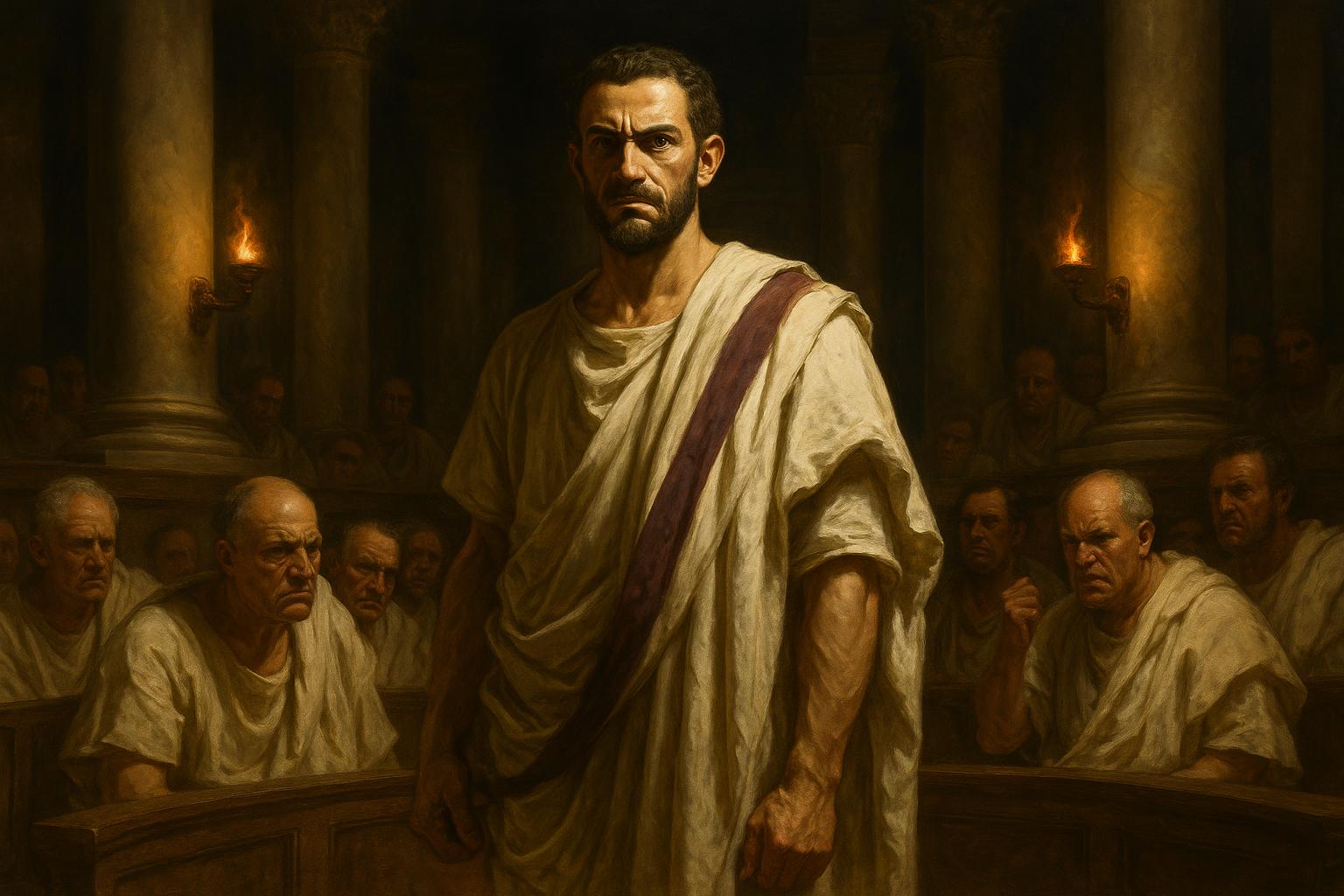
Meet Cato the Younger, an ultra-conservative Senator, a man of iron will and unbending principle. He saw himself as the last true Roman, the sole guardian of the Republic’s ancient virtues. To his allies, he was a hero. To history, he was a man with “the politics of a brick wall.”
In 60 BCE, the populist reformer Julius Caesar proposed a bill to give land to Rome’s decorated military veterans—a G.I. Bill for the ancient world. But Cato and his faction, the optimates, saw it as a power grab. They feared it would make Caesar too popular, a threat to their control. So Cato did something unprecedented. He launched a filibuster, speaking for hours on end, day after day, grinding the entire Roman Senate to a complete halt for months.
Sound familiar?
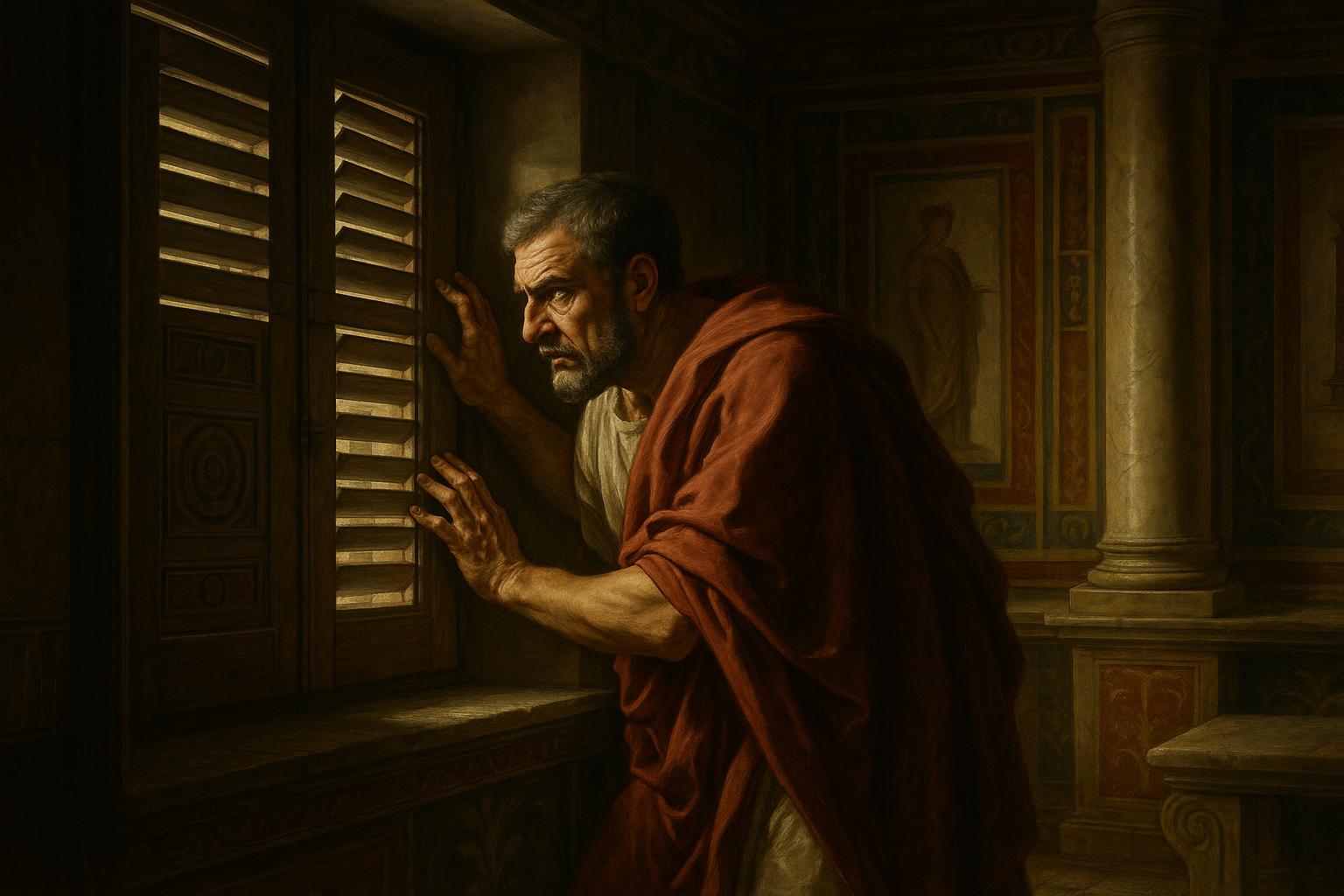
When Caesar was elected co-consul the following year, he was paired with Cato’s own son-in-law, Bibulus. Bibulus’s mission was simple: stop Caesar at all costs. When Cato’s filibuster failed, Bibulus took obstruction to a new, almost comical, level. He declared every remaining day of the year a religious holiday, making it legally impossible to hold a vote.
Then, when the people of Rome grew angry, Bibulus did the unthinkable. He barricaded himself inside his own home, refusing to perform his duties, effectively boycotting his own government for nearly a year. From his window, he issued a decree of pure spite: “You shall not have this law this year, not even if you all want it!”
One man’s ego held an entire Republic hostage. The government was paralyzed. The people were furious. And the stage was set for a final, catastrophic act.
The Ancient Warning
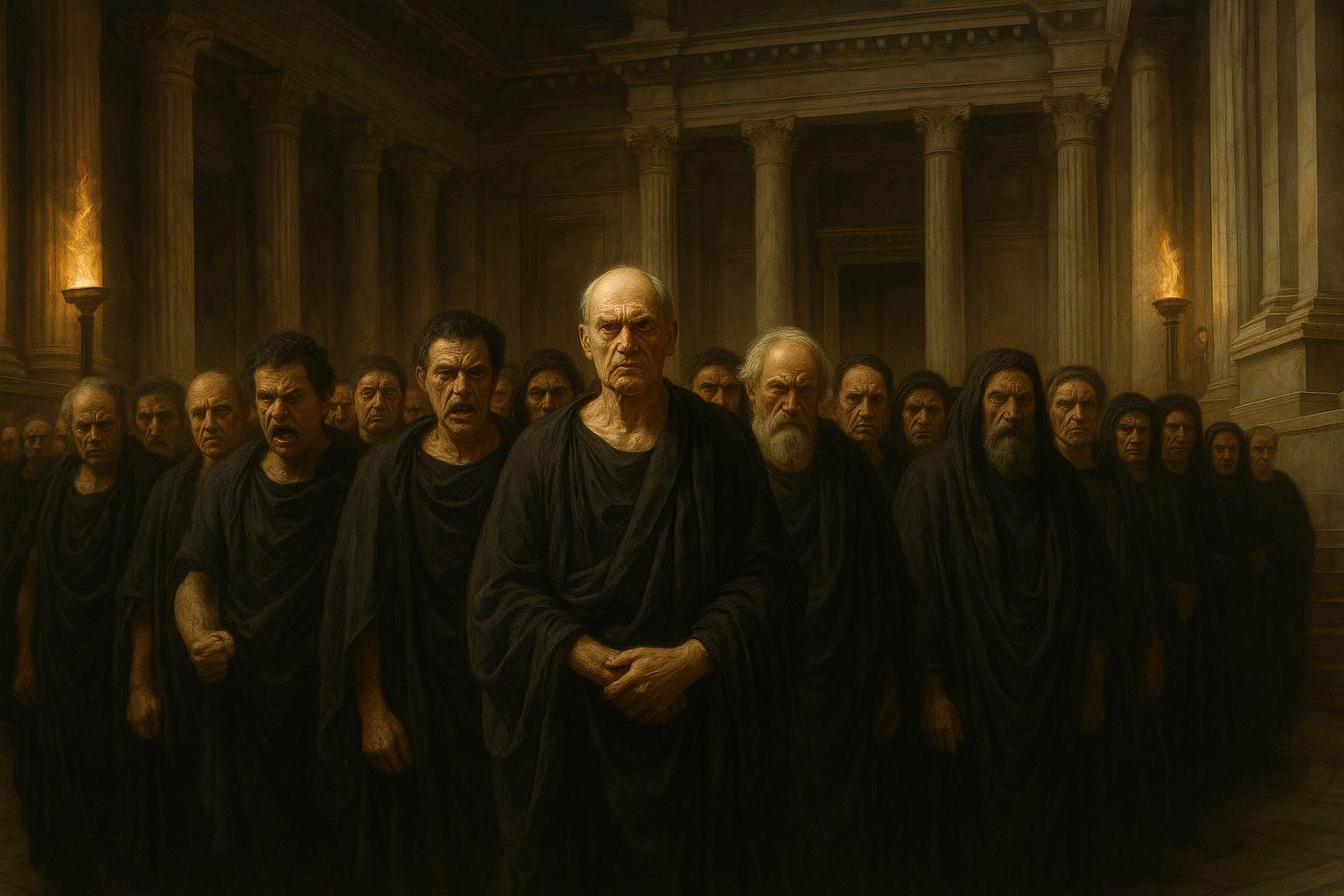
Three years later, the optimates escalated their war on governance. In protest of Caesar’s faction, they stormed the Senate, dressed in black mourning clothes as if the Republic were already dead. They shut down the chamber and, most terrifyingly, refused to schedule the next elections.
For the first time in its 500-year history, Rome faced a new year with no elected government at all. The system had completely broken. The norms that had held their society together for centuries were shattered in a matter of years. As one historian noted, political norms are “far easier to break than to build—and breaking them only takes the defection of one side.”
This “crisis politics” became the new normal. The people, disgusted with the squabbling and paralysis, began to cry out for a “strongman” to restore order. The political trust that is the lifeblood of any Republic had evaporated. Within 15 years, Caesar would cross the Rubicon, plunging Rome into a bloody civil war. Within a generation, the Republic was dead, replaced by the iron fist of an Emperor.
Cato thought he was saving the Republic. Instead, his righteous, unbending obstructionism helped destroy it.
While Washington Fails, You Can Thrive
As our own leaders walk us down the same ruinous path as Cato and Bibulus, it’s clear we can no longer depend on the system for our survival. The time for blind faith is over. The time for self-reliance is now.
While the politicians play their games, a quiet revolution is taking place in backyards across America. It’s a revolution of resilience, of independence, of taking back control from a broken system. It’s the 4ft Farm Blueprint.
Imagine a world where you don’t have to worry about empty grocery store shelves or the price of food skyrocketing because of political incompetence. Imagine harvesting fresh, organic food from a tiny, 4×8 foot plot of land in your own backyard. This isn’t a dream. It’s a proven system that can feed your family, slash your grocery bills, and give you the one thing our leaders can’t: food security.
Don’t wait for the system to save you. It won’t. Click here to discover how the 4ft Farm Blueprint can make you and your family self-sufficient today.
5 Things You Can Do This Week to Prepare for What’s Coming
The parallels are undeniable. The warning is clear. History is not just repeating itself; it is screaming at us. Here are five practical steps you can take this week to insulate yourself and your family from the coming storm.
1. Declare Your Food Independence. The Romans faced starvation when their political system failed. You don’t have to. Learn the foundational skills of producing your own food, even in a small space. Start by understanding the principles of sustainable agriculture. This guide from the Self-Reliance Report is an essential first step.
2. Build Your Financial Ark. A government shutdown is just one way the system can freeze your assets. Economic instability is the twin sister of political chaos. It’s time to learn how to protect your wealth outside of the traditional system. Survival Stronghold offers critical insights on surviving an economic collapse.
3. Master One Practical Skill. When the supply chains break, practical skills become more valuable than gold. Can you purify water? Can you mend clothes? Can you build a simple shelter? Choose one essential skill and master it. Homesteader Depot has a wealth of knowledge on practical, hands-on projects.
4. Secure Your Health. What happens when the healthcare system, already strained, is pushed to the breaking point by a national crisis? You become your own first responder. Learn about natural remedies and basic first aid. Freedom Health Daily provides a crucial look at what happens when the medical system collapses.
5. Fortify Your Mind. The greatest battle will be against fear and uncertainty. A crisis environment is designed to create panic. Learn to stay calm, think clearly, and lead your family with a steady hand. Ancient wisdom can be a powerful tool. Seven Holistics offers guidance on finding peace and resilience in turbulent times.
Our Founding Fathers, who wrote under Roman names like “Publius” and “Brutus,” studied Rome’s fall to avoid it. They gave us a Republic, if we can keep it. The choice is now ours. Will we succumb to the same political rot that destroyed Rome, or will we have the wisdom to save ourselves?