
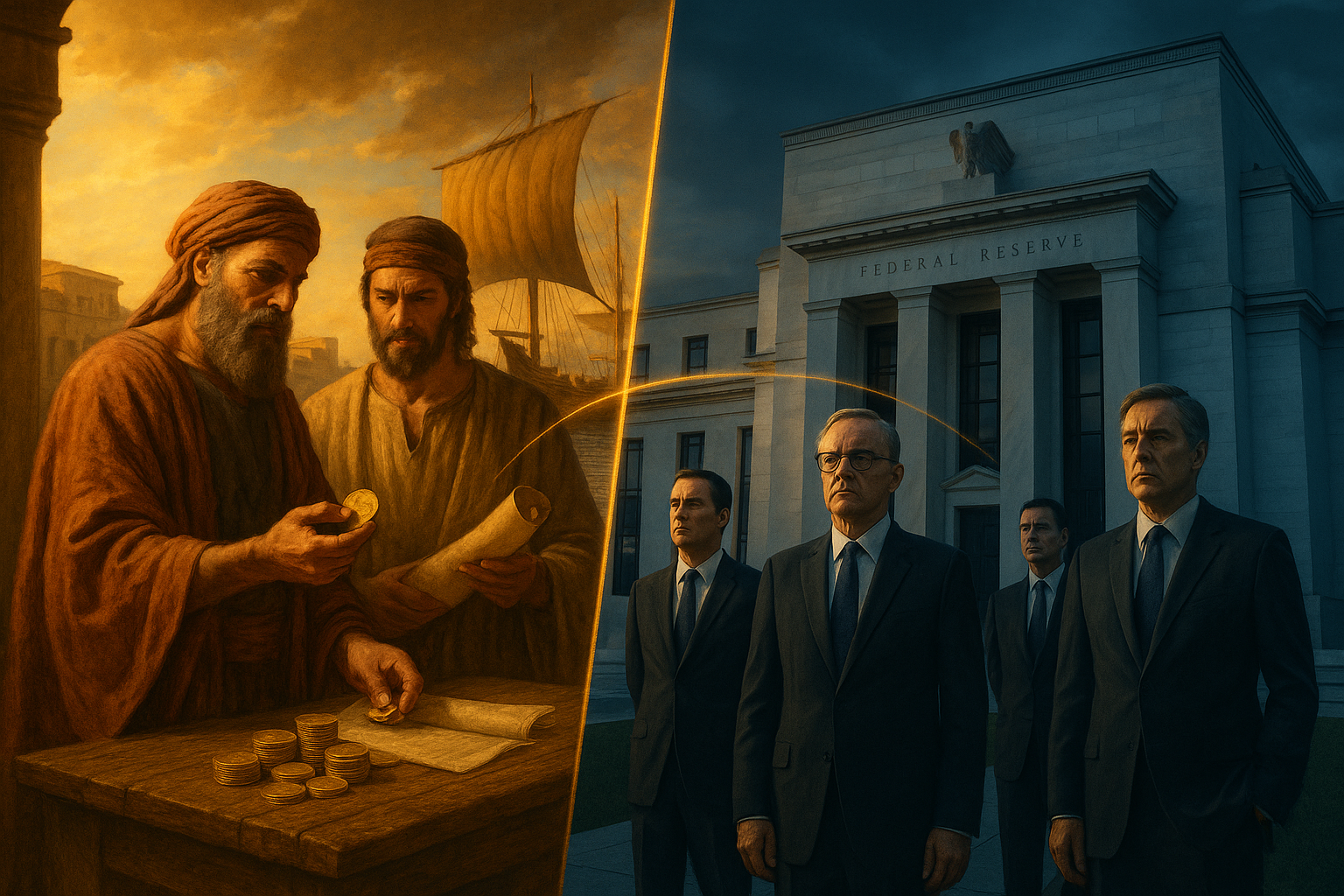
The Crisis Unfolding in Washington
In the marble halls of the Federal Reserve building in Washington D.C., a battle is raging that could determine the economic fate of America. It’s not a battle fought with weapons, but with words, threats, and unprecedented political pressure that experts warn could trigger the very economic catastrophe it claims to prevent.
The numbers tell a stark story. According to a comprehensive survey of leading economists, 82% believe that the current White House pressure campaign against Federal Reserve independence will lead to higher inflation and weaker economic growth. Former Fed officials project that inflation will remain above the central bank’s 2% target through at least 2027, with prices expected to finish 2025 at a troubling 3%.
But this isn’t just about numbers on a spreadsheet. This is about a fundamental question that has echoed through history: Who should control a nation’s money? Should it be independent experts focused on long-term stability, or political leaders driven by short-term electoral pressures?
The current crisis reached a boiling point when President Trump launched what economists describe as an “unprecedented” assault on Fed Chair Jerome Powell, calling him a “numbskull,” “fool,” and “moron” while demanding “sharply lower rates” and attempting to fire Fed Governor Lisa Cook. David Andolfatto, an economics professor at the University of Miami and former top economist at the Federal Reserve Bank of St. Louis, captured the gravity of the situation: “What’s unusual about this is the level of open disrespect and just childishness… this is just beyond the pale.”
Yet this crisis, as unprecedented as it seems, follows a pattern as old as civilization itself. To understand where this leads, we must travel back 2,800 years to the bustling ports of ancient Phoenicia, where the world’s first great banking empire faced the exact same challenge—and where the consequences of political interference in monetary policy played out with devastating clarity.
#
The Phoenician Miracle: Masters of the Ancient Economy
Picture the Mediterranean world in 800 BC. Most of the great civilizations lay in ruins. The Bronze Age Collapse of 1200 BC had shattered the Mycenaeans, toppled the mighty Hittite Empire, and sent waves of desperate refugees—the mysterious Sea Peoples—rampaging across the known world. Cities burned, trade routes collapsed, and the sophisticated economic systems that had flourished for centuries crumbled into dust.
But in the narrow coastal cities of what is now Lebanon, something remarkable was happening. The Phoenicians, rather than fighting the chaos, had found a way to profit from it. When the Sea Peoples arrived at their shores, the clever Phoenician merchants didn’t raise armies—they opened their purses. They paid off the marauding refugees, turning potential destroyers into trading partners.
This pragmatic approach to crisis management allowed the Phoenicians to do something extraordinary: while their contemporaries were destroyed, they minted new currency, prepared their fleets, and began building what would become the greatest trade network the Mediterranean had ever seen.
The secret to Phoenician success wasn’t just their ships or their purple dye. It was their revolutionary approach to finance. According to the Roman historian Pliny, “Phoenicians invented trade.” But they did more than that—they invented modern banking.
By the 8th century BC, Phoenician merchants had introduced something that would change the world forever: interest-bearing loans. This practice, inherited from the ancient Sumerians through the Babylonians, gave the Phoenicians a tool of immense power. They weren’t just traders; they were the world’s first international bankers.
The sophistication of their system was breathtaking. Phoenician banks could finance expeditions to distant lands, provide credit for massive construction projects, and even fund the armies of kings. Their financial networks stretched from the Atlantic coasts of Spain and Morocco to the Black Sea, creating what historian Michael Hudson describes as the world’s first truly global economy.
But perhaps most importantly, the Phoenicians understood something that modern economists are rediscovering: the critical importance of institutional independence. In Phoenician cities, power was shared between kings and what historians call “merchant oligarchies”—powerful families who had wrestled control of economic policy from traditional rulers.
As the ancient sources tell us, “His power, however, was limited by the powerful merchant families, who wielded great influence in public affairs. Associated with the king was a council of elders, drawn from the leading merchant families.” This wasn’t just a political arrangement—it was an economic necessity. The merchant families understood that their financial system required independence from short-term political pressures to function effectively.
For centuries, this system worked brilliantly. The Phoenicians maintained what historians call “economic hegemony in the Mediterranean for a millennium.” Their banks financed the rise of civilizations, their trade networks connected distant continents, and their financial innovations laid the groundwork for the economic systems we use today.
But then, something changed.
#
The King’s Dilemma: When Politics Meets Money
The crisis began, as these crises always do, with a king who believed he knew better than the bankers.
In the great Phoenician city of Ugarit, around 600 BC, a new ruler ascended to the throne. Like many political leaders throughout history, he looked at the immense wealth and power of the merchant bankers and saw not partners, but rivals. Why should these merchants control the kingdom’s financial destiny? Why should their concerns about “long-term stability” and “institutional independence” matter more than his immediate political needs?
The king’s frustration was understandable. The kingdom faced challenges—economic pressures, social unrest, demands from the people for immediate relief. The bankers, with their talk of “sustainable monetary policy” and “inflation targets,” seemed out of touch with the urgent needs of ordinary citizens. When the king demanded that the banks lower interest rates to stimulate the economy and fund his ambitious public works projects, the bankers resisted.
“We must think of the long term,” they argued. “Rapid monetary expansion will debase the currency and create instability.”
But the king had heard enough. He was the ruler, elected by the people, accountable to their immediate needs. These unelected bankers, with their arcane theories and their resistance to change, were standing in the way of progress.
Sound familiar?
The parallels to today’s Federal Reserve crisis are striking. Just as the ancient Phoenician king grew frustrated with banker resistance to his economic agenda, President Trump has launched an unprecedented campaign against Fed independence. The language is remarkably similar across the millennia.
Ancient sources record the king’s complaints: the bankers were “out of touch,” “resistant to necessary change,” and “more concerned with their theories than with the people’s welfare.” Compare this to President Trump’s characterization of Fed officials as “numbskulls” and “fools” who don’t understand the “real economy.”
The underlying tension is identical: political leaders, accountable to voters and facing immediate pressures, clash with financial institutions designed to operate independently and focus on long-term stability.
#
The Fatal Decision: When Kings Control Money
What happened next in ancient Phoenicia provides a chilling preview of what economists warn could happen in America today.
Frustrated by banker resistance, the Phoenician king made a fateful decision. Using his political authority, he began to override the merchant families’ financial policies. He forced the banks to lower interest rates dramatically, ordered them to fund his ambitious spending programs, and gradually brought the entire monetary system under direct political control.
The immediate results seemed to vindicate his approach. With cheap credit flowing freely, the economy boomed. Construction projects flourished, trade expanded, and the king’s popularity soared. Critics who had warned of dire consequences were dismissed as pessimists and fear-mongers.
But the ancient sources tell us what happened next—and it’s a story that should terrify anyone concerned about America’s economic future.
Within a generation, the Phoenician monetary system began to collapse. The currency, once the most trusted in the Mediterranean, started to lose value as political spending drove inflation higher. Trading partners, who had relied on Phoenician financial stability for centuries, began to lose confidence in their monetary system.
The great historian Herodotus recorded the consequences: “When the kings took control of the money, trade became uncertain. Contracts could not be trusted. The great merchant families, who had built their wealth over generations, saw their fortunes evaporate.”
The collapse wasn’t immediate—these things never are. It took decades for the full consequences to unfold. But once the process began, it proved irreversible. The Phoenician banking system, which had dominated the Mediterranean for a millennium, gradually lost its central role in the global economy.
Other powers—first the Greeks, then the Romans—stepped in to fill the void. The Phoenicians, who had once been the world’s financial superpower, found themselves relegated to the margins of history.
The pattern was clear: when political leaders gained control over monetary policy, short-term gains led to long-term catastrophe.
#
The Modern Echo: America’s Federal Reserve Under Siege
Fast-forward 2,800 years to Washington D.C., and the same drama is playing out with eerie precision.
Just as the ancient Phoenician king grew frustrated with banker independence, President Trump has launched what experts describe as an unprecedented assault on Federal Reserve autonomy. The parallels are so exact they seem almost scripted by history itself.
The economic context is strikingly similar. America faces significant challenges: inflation remains stubbornly above the Fed’s 2% target, hiring has slowed dramatically (with employers shedding 13,000 jobs in June and adding only 22,000 in August), and political pressure is mounting for immediate solutions.
Like the ancient Phoenician king, President Trump sees the Fed’s independence as an obstacle to necessary action. His demands are clear: lower interest rates immediately, regardless of inflation concerns, and subordinate monetary policy to political priorities.
The Fed’s resistance mirrors that of the ancient Phoenician bankers. Fed Chair Jerome Powell and his colleagues argue that monetary policy must remain independent to maintain long-term economic stability. They point to decades of research showing that central bank independence is crucial for controlling inflation and maintaining economic credibility.
But President Trump, like the ancient king, has grown impatient with such arguments. His attacks on Fed officials have escalated to a level that economists describe as “unprecedented” and “beyond the pale.” The personal nature of these attacks—calling Powell a “numbskull,” “fool,” and “moron”—echoes the ancient king’s dismissal of banker concerns as irrelevant and out-of-touch.
The institutional damage is already becoming apparent. Loretta Mester, a former president of the Federal Reserve Bank of Cleveland, warns that these attacks “threaten to undermine the Fed’s credibility with the public.” Ellen Meade, an economics professor at Duke University and former senior Fed economist, notes that the political pressure creates “unprecedented difficulty” for effective policy-making.
Perhaps most ominously, the survey data suggests that the ancient pattern is already beginning to repeat. The 82% of economists who warn that political pressure will lead to higher inflation and weaker growth are essentially predicting the same outcome that befell ancient Phoenicia: short-term political gains followed by long-term economic catastrophe.
#
The Deeper Pattern: Why This Always Ends Badly
The Phoenician example isn’t unique in history. The pattern of political interference in monetary policy leading to economic disaster has repeated itself across civilizations and centuries.
In ancient Rome, emperors who debased the currency to fund their spending programs triggered inflation that contributed to the empire’s eventual collapse. In Weimar Germany, political pressure on the central bank led to hyperinflation that destroyed the middle class and paved the way for extremism. In more recent times, countries from Argentina to Zimbabwe have seen their economies devastated when political leaders gained control over monetary policy.
The reason this pattern repeats is rooted in the fundamental difference between political and economic time horizons. Political leaders face election cycles measured in years and must respond to immediate public pressures. Economic systems, however, operate on much longer time scales, where the consequences of monetary decisions can take decades to fully unfold.
This temporal mismatch creates an inherent tension. What’s politically popular in the short term—easy money, low interest rates, rapid economic stimulus—often proves economically disastrous in the long term. Conversely, what’s economically necessary for long-term stability—sometimes higher interest rates, fiscal restraint, resistance to inflationary pressures—can be politically unpopular in the short term.
The genius of the Federal Reserve system, like the ancient Phoenician merchant councils, was to insulate monetary policy from these short-term political pressures. Fed officials serve long terms, are appointed rather than elected, and are specifically charged with thinking beyond the next election cycle.
This independence isn’t an accident or an oversight—it’s the entire point. As the empirical evidence shows, the evolution toward central bank independence has coincided with a long-term decline in inflation in advanced economies. Countries with independent central banks consistently outperform those where monetary policy is subject to political control.
But independence only works if it’s respected. When political leaders begin to override or intimidate central bank officials, the entire system starts to break down. Markets lose confidence, inflation expectations become unanchored, and the economy enters a dangerous spiral that can take decades to reverse.
#
The Warning Signs: How Collapse Begins
The ancient sources provide detailed accounts of how the Phoenician monetary collapse unfolded, and the parallels to current warning signs in America are deeply troubling.
The first stage was the erosion of institutional norms. Just as President Trump’s personal attacks on Fed officials represent an unprecedented breach of traditional boundaries, the ancient Phoenician king began by publicly questioning and undermining the authority of the merchant bankers.
The second stage was the gradual subordination of monetary policy to political priorities. In ancient Phoenicia, this meant forcing banks to fund the king’s spending programs regardless of economic consequences. In modern America, this would mean forcing the Fed to keep interest rates artificially low to boost short-term economic performance, regardless of inflation risks.
The third stage was the loss of market confidence. Ancient trading partners began to question the reliability of Phoenician currency and financial institutions. In today’s context, this would manifest as international investors losing faith in the dollar’s stability and the Fed’s credibility.
The fourth stage was the emergence of alternative financial centers. Just as Greek and Roman banking systems eventually displaced Phoenician dominance, other countries’ central banks could potentially challenge the dollar’s role as the global reserve currency.
The final stage was economic marginalization. The Phoenicians went from being the world’s financial superpower to a historical footnote. For America, this could mean the loss of the economic advantages that come with having the world’s reserve currency and most trusted financial institutions.
The terrifying aspect of this pattern is that each stage makes the next one more likely. Once institutional norms are broken, it becomes easier to break them further. Once market confidence is shaken, it becomes harder to restore. Once alternative systems emerge, they can quickly gain momentum.
The survey data suggesting that 82% of economists expect higher inflation and weaker growth from political pressure on the Fed represents the early stages of this process. These aren’t abstract academic concerns—they’re the warning signs that the ancient pattern is beginning to repeat.
#
The Stakes: What America Stands to Lose
To understand what’s at risk, consider what the Phoenicians lost when their monetary system collapsed.
For a millennium, Phoenician banks had been the backbone of Mediterranean commerce. Their currency was accepted from Spain to the Black Sea. Their financial innovations—letters of credit, interest-bearing loans, complex trading arrangements—had made possible the economic integration of the ancient world.
When political interference destroyed this system, the consequences rippled across continents. Trade routes that had operated for centuries became unreliable. Economic relationships built over generations dissolved. The sophisticated financial instruments that had enabled long-distance commerce became worthless.
The Phoenicians themselves went from being the world’s dominant economic power to a collection of declining city-states. Their influence, their wealth, and their central role in global affairs all evaporated within a few generations.
For modern America, the stakes are even higher. The United States doesn’t just have the world’s largest economy—it has the world’s reserve currency and most influential financial institutions. The Federal Reserve’s decisions affect not just American interest rates, but global capital flows, international trade, and the economic stability of nations around the world.
This privileged position brings enormous advantages. American companies can borrow more cheaply, American consumers can buy foreign goods at lower prices, and the American government can finance its operations more easily than any other nation in history.
But these advantages depend entirely on global confidence in American financial institutions. If that confidence erodes—if the Fed loses credibility, if the dollar becomes unreliable, if American monetary policy becomes unpredictable—the consequences would be catastrophic.
Other powers are already positioning themselves to fill any void. China has been working for years to internationalize its currency and reduce dependence on the dollar-based financial system. European leaders have spoken openly about the need for “monetary sovereignty” independent of American influence.
If America’s monetary system loses credibility due to political interference, these alternative systems could rapidly gain ground. The result would be the loss of what economists call “exorbitant privilege”—the unique advantages that come with controlling the world’s reserve currency.
The economic costs would be staggering. American borrowing costs would rise, inflation would become harder to control, and the government’s ability to finance its operations would be severely constrained. The standard of living that Americans have enjoyed for generations would come under severe pressure.
But the costs wouldn’t be purely economic. Just as the collapse of Phoenician financial dominance marked the end of their civilization’s golden age, the loss of American monetary leadership could signal the beginning of a broader decline in American global influence.
#
The Path Forward: Lessons from History
The ancient Phoenician example offers both a warning and a guide. The warning is clear: political interference in monetary policy leads to economic catastrophe. But the example also suggests what must be done to avoid this fate.
The key insight from Phoenician history is that monetary independence isn’t just an economic necessity—it’s a political choice. The merchant families who controlled Phoenician banking didn’t gain their independence by accident. They fought for it, defended it, and built institutional structures to protect it.
When that independence came under attack, they had a choice: resist or submit. History shows that submission led to disaster, while resistance—even when difficult—preserved economic stability.
For modern America, this means that defending Federal Reserve independence isn’t just the responsibility of Fed officials—it’s the responsibility of everyone who cares about long-term economic stability.
This defense must operate on multiple levels. Economically, it means supporting policies that strengthen rather than weaken institutional independence. Politically, it means electing leaders who understand the importance of monetary independence and will resist the temptation to interfere for short-term gain.
But perhaps most importantly, it means public education. The ancient Phoenician merchant families understood that their independence depended on public support for the principle of institutional autonomy. When that support eroded, their independence became vulnerable.
In modern America, polls suggest that many citizens don’t fully understand the role of the Federal Reserve or the importance of its independence. This knowledge gap creates an opportunity for political leaders to attack Fed independence without facing significant public resistance.
Closing this gap requires a sustained effort to educate Americans about monetary policy, the history of central banking, and the consequences of political interference. Citizens need to understand that Fed independence isn’t about protecting banker privileges—it’s about protecting their own economic future.
#
Five Critical Actions for Uncertain Times
The lessons of ancient Phoenicia aren’t just academic—they’re practical. History shows us what happens when monetary systems collapse, and it also shows us how individuals can protect themselves during such transitions.
The Phoenician merchants who survived their civilization’s monetary collapse shared certain characteristics: they diversified their assets, maintained multiple income streams, developed practical skills, and built strong community networks. These same strategies can help modern Americans navigate the uncertainty ahead.
First, diversify your financial foundation. The ancient Phoenicians who kept all their wealth in their home currency lost everything when it collapsed. Those who had diversified into foreign currencies, precious metals, and real assets survived the transition. Modern Americans should consider a similar approach: don’t keep all your wealth in dollar-denominated assets. Learn about gold, silver, cryptocurrency, and other stores of value that could maintain purchasing power if the dollar’s credibility erodes.
Second, develop economic independence. The Phoenicians who depended entirely on the existing financial system were devastated when it collapsed. Those who had developed independent sources of income—through trade, crafts, or agriculture—were able to adapt. Modern Americans should focus on building skills and income sources that don’t depend entirely on the existing economic system. This might mean starting a side business, learning practical skills like gardening or home repair, or developing expertise that would be valuable even in a different economic environment.
Third, build physical resilience. When the Phoenician monetary system collapsed, supply chains broke down and basic goods became scarce. Those who had prepared by storing food, water, and essential supplies were better able to weather the crisis. Modern Americans should consider building similar reserves. This doesn’t mean becoming a “prepper,” but it does mean having enough food, water, and basic supplies to last through potential disruptions.
Fourth, invest in your health and relationships. The Phoenicians who survived their civilization’s collapse were those who maintained their physical health and had strong community connections. When formal institutions failed, informal networks became crucial for survival and recovery. Modern Americans should prioritize their physical fitness, mental health, and relationships with family and community. These investments pay dividends in any economic environment, but they become especially valuable during times of crisis.
Fifth, stay informed and engaged. The Phoenician merchants who best navigated their civilization’s decline were those who understood what was happening and why. They studied the patterns, learned from history, and made informed decisions about how to protect themselves and their families. Modern Americans should commit to understanding the economic and political forces shaping their world. This means reading beyond mainstream headlines, studying historical patterns, and thinking critically about the information they receive.
These aren’t just individual survival strategies—they’re also ways to strengthen the broader community’s resilience. When more people are prepared for economic uncertainty, the entire society becomes more stable and better able to weather crises.
#
The Choice Before Us
The story of ancient Phoenicia offers a stark choice: we can learn from history, or we can repeat it.
The Phoenicians created the world’s first global financial system through innovation, independence, and institutional strength. They maintained economic dominance for a millennium by respecting the separation between political power and monetary policy.
When they abandoned these principles—when they allowed political leaders to override financial independence—their system collapsed within generations. The consequences weren’t just economic; they were civilizational. The Phoenicians went from being the world’s dominant economic power to a historical footnote.
America today faces the same choice. We can defend the institutional independence that has made our financial system the envy of the world, or we can allow short-term political pressures to undermine the foundations of our economic strength.
The warning signs are already visible. The unprecedented political attacks on Federal Reserve independence, the erosion of institutional norms, and the growing polarization of monetary policy all echo the patterns that preceded the Phoenician collapse.
But history also shows us that this outcome isn’t inevitable. Institutions can be strengthened, norms can be restored, and independence can be defended. The key is recognizing the danger before it’s too late and taking action to address it.
The ancient Phoenicians failed this test. They allowed political expediency to override economic wisdom, and they paid the ultimate price. The question for modern America is whether we will learn from their mistake or repeat it.
The choice is ours, but the window for action is closing. Every day that political pressure on the Federal Reserve continues, every attack on institutional independence that goes unchallenged, every erosion of monetary policy norms brings us closer to the point of no return.
The Phoenicians thought their system was too big to fail, too established to collapse, too important to the global economy to be seriously threatened. They were wrong.
We have the advantage of their example. We know how this story ends when political leaders gain control over monetary policy. The question is whether we have the wisdom to choose a different path.
The stakes couldn’t be higher. The choice couldn’t be clearer. The time for action is now.
—
This analysis draws on extensive historical research and current economic data to illuminate patterns that span millennia. While the specific details of ancient Phoenician monetary policy remain subjects of scholarly debate, the broader patterns of political interference in financial systems and their consequences are well-documented across multiple civilizations and time periods.
#
References and Sources
[1] CNBC. (2025, September 16). Trump’s Fed pressure campaign will lead to higher inflation, weaker growth, according to CNBC survey. Link
[2] PBS NewsHour. (2025, September 15). Fed faces economic uncertainty and political pressure ahead of interest rate decision. Link
[3] Hudson, M. (n.d.). Did the Phoenicians Introduce the Idea of Interest to Greece and Italy; and if so When? Phoenicia.org. Link
[4] Arnold, M. (2020, December 25). Banking, Trade & Commerce In Ancient Phoenicia. The Collector. Link
[5] Phoenicia.org. (n.d.). Phoenician Government and Politics. Link
[6] World History Encyclopedia. (2016, April 1). Trade in the Phoenician World. Link
[7] Tufts University. (2025, September 11). What’s the Federal Reserve and Why Is Its Independence Important. Link
[8] Duke University. (2025, September 14). New Survey of Former Federal Reserve Insiders Point to Risks to Independence and Policy Outlook. Link
[9] Peterson Institute for International Economics. (2025, September 11). A proposal for reducing a risk to Fed independence. Link
[10] Biden White House Archives. (2024, May 22). The Importance of Central Bank Independence. Link


