

The Modern Mystery
In the heart of Washington D.C., a silent coup is underway. It’s not a military takeover with tanks on the streets, but something far more insidious. It’s a war for the control of information, a battle for the very soul of truth.
In September 2025, the nation’s top economic statistician, the person responsible for the unimpeachable numbers that underpin our entire economy, was unceremoniously fired. The reason? The numbers didn’t tell the right story. The data, the cold, hard facts, were inconvenient.
This wasn’t an isolated incident. It was the culmination of a years-long assault on the independence of our most vital institutions. The Federal Reserve, the once-unassailable guardian of our economic stability, is under constant political pressure. Government agencies are being weaponized to intimidate and silence dissent. Private companies are being strong-armed into partnerships with the state, their revenue streams becoming political tools.
It feels unprecedented, a uniquely American crisis. But what if it’s not? What if this exact same playbook has been used before, not in the last century, but in a lost empire, a civilization that built its power on the most sophisticated information control system the world had ever seen? What if the fate of that empire holds a chilling warning for our own?
The Time Portal
Let’s travel back in time, not to the familiar halls of Rome or Greece, but to the dizzying heights of the Andes mountains, to an empire that stretched for thousands of miles, a civilization of breathtaking ingenuity and ruthless efficiency: the Inca.
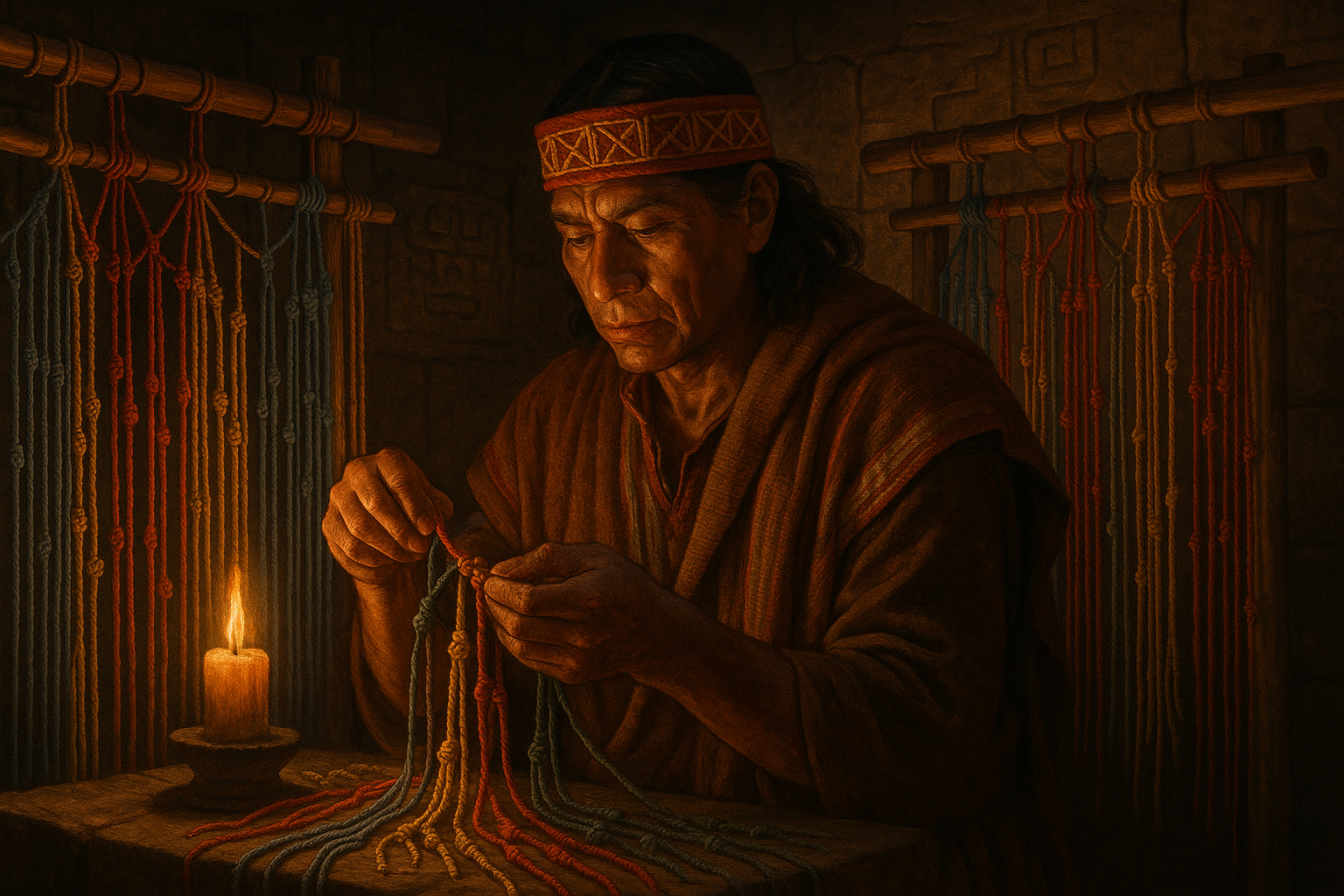
Imagine a world without writing, without a single letter or character. How would you rule over millions of people, build monumental cities, and manage a complex economy? The Inca had an answer, a device as elegant as it was powerful: the quipu.
These weren’t just knotted cords; they were a sophisticated system of information storage, a three-dimensional language of color, texture, and intricate knots. Each knot, each color, each twist of the cord represented a piece of data: the number of births in a village, the amount of grain in a storehouse, the loyalty of a conquered tribe.
And at the center of this web of information were the Quipucamayoc, the “knot-keepers.” They were the high priests of data, the masters of the imperial narrative. They were the only ones who could read the knotted cords, the only ones who could interpret the will of the Sapa Inca, the emperor. They were the most powerful men in the empire, for they controlled not just the numbers, but the truth itself.
The Parallel Revelation
Now, let’s return to the present day, to the sterile corridors of Washington D.C. The Quipucamayoc are gone, replaced by men and women in suits, armed not with knotted cords but with spreadsheets and algorithms. But the game is the same.

When the President fires the head of the Bureau of Labor Statistics, he is not just firing an individual. He is sending a message: the numbers must serve the narrative. The data must bend to the will of power. He is, in effect, appointing his own Quipucamayoc, his own keepers of the official truth.
When the Federal Reserve is pressured to alter its course for political gain, it is a modern-day echo of the Sapa Inca demanding that the quipu show a bountiful harvest when the reality is famine. It is the manipulation of economic reality for the preservation of power.
And when the government takes stakes in private companies, it is not just an economic transaction. It is the state weaving its own threads into the fabric of the private sector, creating a system of patronage and control that would have been the envy of any Inca emperor. The quipu of today is not made of colored cords, but of stock certificates and regulatory decrees, a complex web of dependencies that ensures compliance.
The faces have changed, the technology has evolved, but the fundamental strategy is identical. The centralization of information, the creation of an official narrative, and the punishment of those who dare to question it. This is the timeless art of imperial control, as potent in the digital age as it was in the age of stone and sinew.
The Pattern Recognition
Why does this pattern repeat itself with such chilling precision across the millennia? The answer lies in a fundamental truth about human nature: the insatiable thirst for control.
Power, once tasted, is a potent drug. And the ultimate power is not the power to command armies or build monuments, but the power to define reality itself. To control the narrative, to shape the perception of the world, is to control the thoughts and actions of the people within it.
The Inca, for all their architectural and agricultural genius, understood this on a primal level. Their empire was not held together by force alone, but by a shared reality, a reality meticulously crafted and controlled by the Quipucamayoc. The knotted cords were not just a tool of administration; they were an instrument of social engineering, a way to ensure that every individual, from the highest noble to the lowliest peasant, saw the world through the eyes of the emperor.
Today, the tools are different, but the impulse is the same. The firehose of information that bombards us daily, the curated feeds of social media, the relentless spin of the 24-hour news cycle – these are the modern-day quipus, the knotted cords that shape our perception of reality. And those who control them, those who can manipulate the data and craft the narrative, hold a power that would make the Sapa Inca blush.
The Ancient Warning
So what happened to the Inca, this empire built on a foundation of absolute information control? When the Spanish conquistadors arrived, a mere handful of men, they did not just bring guns and steel. They brought a different kind of weapon: a different narrative.
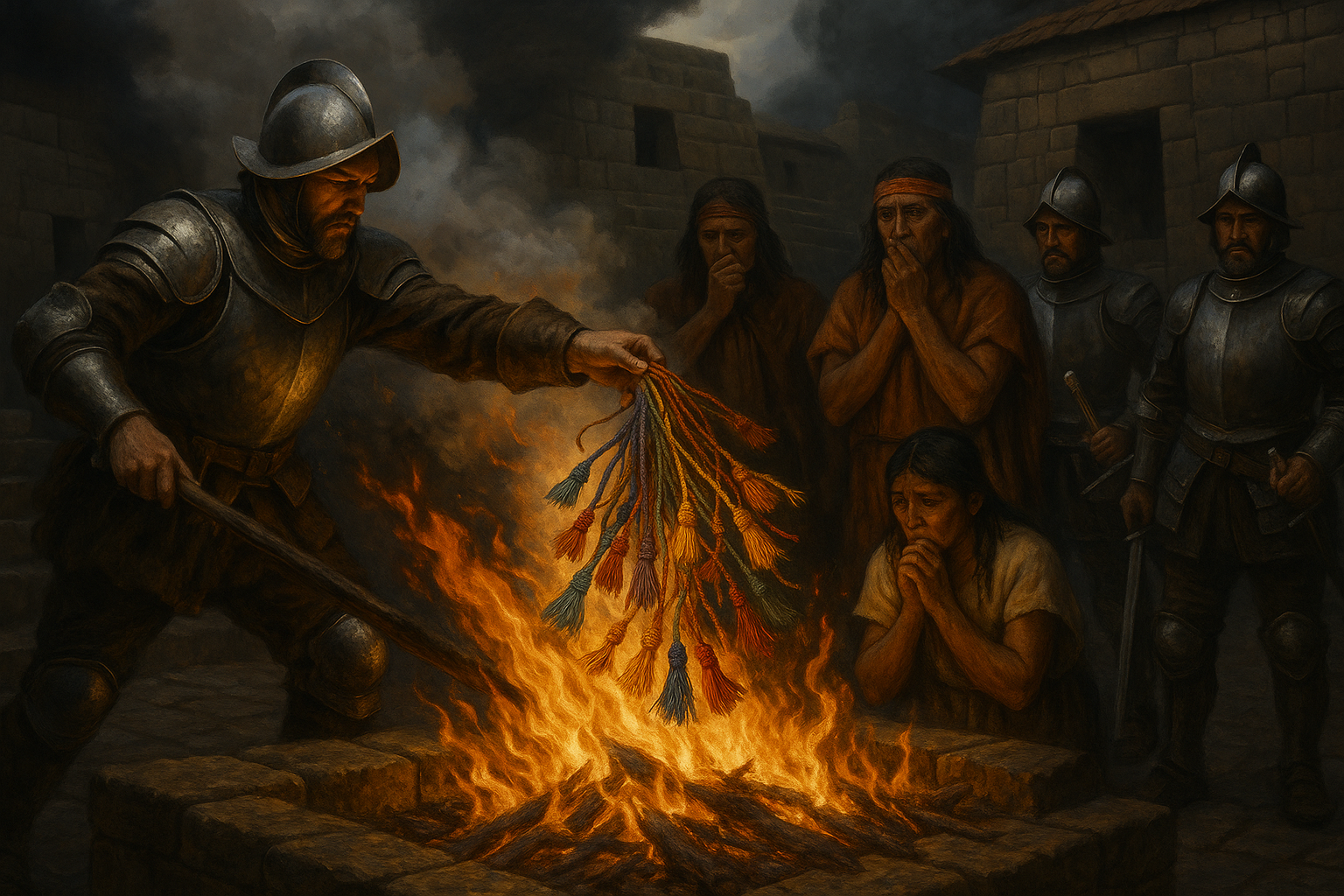
They targeted the Quipucamayoc, the keepers of the knotted cords. They burned the quipus, the sacred records of the empire. And in doing so, they did not just destroy a system of administration; they shattered the very reality of the Inca world.
Without their knotted cords, without their shared narrative, the Inca were lost. Their empire, which had seemed so invincible, so eternal, crumbled into dust. The very system that had given them their strength, their absolute control of information, became their fatal weakness. A civilization that had forgotten how to think for itself, how to question the official narrative, was no match for an enemy that brought a new story, a new reality.
This is the ancient warning of the Inca: a society that surrenders its control of information to a centralized authority, a society that allows its data to be manipulated and its narrative to be controlled, is a society that is building its own prison. It is a society that is weaving its own knotted cord, a cord that will eventually be used to strangle its own freedom.
5 Things You Can Do This Week to Reclaim Your Information Sovereignty
History is not a spectator sport. The story of the Inca is a cautionary tale, but it is also a call to action. Here are five simple things you can do this week to start reclaiming your own information sovereignty and build a more resilient future:
1. Question the Official Narrative: Don’t take the official story at face value. When you hear a government announcement or a media report, ask yourself: Who benefits from this narrative? What is being left out? Start practicing the art of critical thinking. For a deeper dive into this, check out the resources at Self-Reliance Report.
2. Build Your Own Knowledge Base: Don’t rely on a single source of information. Diversify your news diet. Read books, listen to podcasts, and seek out independent journalists who are not beholden to corporate or political interests. Start building your own personal library of knowledge, a fortress of information that cannot be easily manipulated. Explore the vast world of independent media and alternative viewpoints.
3. Secure Your Food Supply: A person who is dependent on the state for their daily bread is a person who can be easily controlled. Start a garden, learn to can and preserve food, and build a well-stocked pantry. A full belly is the first step towards a free mind. For practical tips on food security, visit Homesteader Depot.
4. Take Control of Your Health: The medical establishment is increasingly becoming an arm of the state. Learn about natural remedies, alternative therapies, and how to build a robust immune system. Take responsibility for your own health and well-being. For more information on health freedom, explore the articles at Freedom Health Daily and Seven Holistics.
5. Build a Community of Trust: In a world of disinformation and propaganda, trust is the most valuable currency. Get to know your neighbors, build local networks of mutual support, and create a community of people who share your values. A strong community is the ultimate defense against tyranny. For more on building resilient communities, check out the articles at Survival Stronghold.
A Message From Our Sponsor
Ready to take the first step towards true self-reliance? The 4ft Farm Blueprint is a revolutionary system that allows you to grow your own food, even in a small space. Click here to learn more and start your journey towards food freedom today.
By Shamus Gerry III


