

The Scholar’s Warning: How a 670-Year-Old Battle Predicted Today’s Fed Crisis
Author: Shamus Gerry III
The Modern Mystery
In the silent, wood-paneled chambers of American power, a battle for control is raging. It’s not a conflict fought with armies, but with legal briefs and political threats. In the last 24 hours, the Trump administration has escalated its war against the Federal Reserve, filing an emergency request with a federal appeals court. Their demand? The power to fire Fed Governor Lisa Cook before the central bank’s critical policy meeting next Tuesday.
A lower court judge, in a stunning rebuke, has already blocked the move, citing the “public interest in Federal Reserve independence.” But the administration is relentless. They are pushing for a final decision by Monday, a move that would shatter a century of precedent and place the nation’s monetary policy directly under political command.
This isn’t just a political squabble; it’s an existential threat to the financial architecture of the modern world. Yet, this high-stakes drama of a political leader attempting to seize control of a nation’s money supply is not new. This exact scenario, this fundamental clash between political will and financial integrity, played out with astonishing precision almost 700 years ago.
The Time Portal
Let’s travel back to 1355. France is a kingdom tearing itself apart. The Hundred Years’ War is draining the royal coffers, and King Charles V, known as “the Wise,” is desperate for funds to fight the English. In the flickering torchlight of his royal court, a grim solution is forged: the debasement of the currency.
Deep within the royal mints, workers toil under immense pressure. They melt down the kingdom’s silver coins, mixing them with cheaper metals before re-stamping them. Each new coin contains less silver, yet it is decreed to hold the same value. It is a stealth tax, a way for the king to create money from nothing to fund his wars.
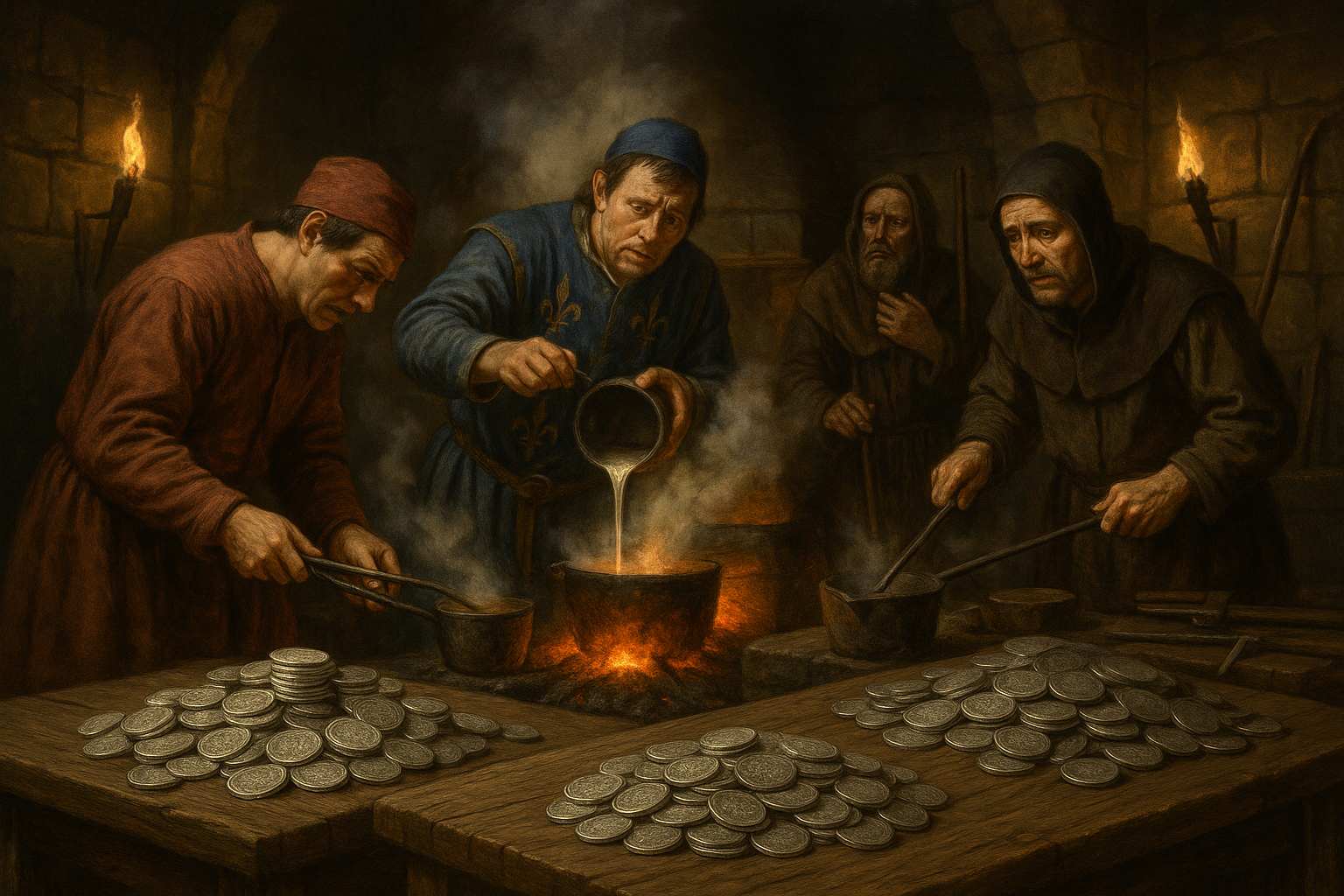
But one man in the king’s inner circle sees the catastrophic danger. Nicole Oresme, a brilliant bishop, economist, and the king’s own confessor, watches with growing alarm. He is a man of books and numbers, one of the greatest minds of the 14th century, and he understands a truth that the king, in his desperation, chooses to ignore: a nation’s money belongs to its people, not its ruler.
The Parallel Revelation
The standoff between the scholar Oresme and King Charles V is a haunting echo of the drama unfolding today between the Federal Reserve and the White House. Oresme, armed with logic and ethics, argued that the king had no right to manipulate the currency for his own fiscal benefit. He saw it as a form of tyranny.
In his groundbreaking treatise, De Moneta—the world’s first great work on monetary economics—Oresme laid out a revolutionary idea: the money of a kingdom is a public good, and its integrity must be independent of the ruler’s will. He argued that altering the coinage was “a fraudulent and tyrannical act” that impoverished the people and destabilized the realm.

Compare this to the current crisis. President Trump, seeking to boost the economy and lower the cost of national debt, demands the Federal Reserve slash interest rates. He threatens to fire officials who dissent, seeking to stack the board with loyalists. Like Charles V, he views the monetary authority not as an independent steward, but as a tool to achieve his short-term political objectives.
Oresme’s De Moneta was the 14th-century equivalent of the Federal Reserve Act of 1913. It was a declaration of monetary independence, a radical assertion that the principles of sound money must stand above the whims of even the most powerful rulers. The core conflict is identical: who controls the money?
The Pattern Recognition
Why does this pattern—the political assault on monetary independence—repeat itself across seven centuries? The answer lies in the unchanging fundamentals of human nature and power. Rulers, whether medieval kings or modern presidents, always face the temptation to use the creation of money as a shortcut to achieving their goals.
Financing a war, stimulating an economy, or paying off massive debts is difficult. It requires hard choices and fiscal discipline. Manipulating the currency, on the other hand, offers the illusion of a painless solution. Oresme was the first to diagnose this moral hazard with stunning clarity.
He understood that when a ruler controls the money, he can tax his people without their consent through inflation. He can reward his allies and punish his enemies. This power, Oresme warned, is too dangerous for any single person to hold. It is a truth that echoes from the medieval mints of Paris to the modern printing presses of Washington D.C.
The Ancient Warning
For a time, Charles V ignored Oresme’s counsel. The debasements continued, and the French economy spiraled into chaos. Public trust evaporated, trade ground to a halt, and the kingdom was wracked by instability that was as damaging as the English armies.

But eventually, the wisdom of Oresme’s warning became undeniable. In a remarkable turn of events, King Charles V reversed course. He adhered to Oresme’s principles, stabilized the currency, and for the remainder of his reign, refrained from using the inflation tax. The result was a period of relative economic stability that helped France regain its footing in the war.
History’s lesson is stark and unforgiving. When monetary policy is subordinated to political power, disaster follows. When it is allowed to operate independently, based on sound principles, a nation has a chance to prosper. Oresme’s 670-year-old warning is not an academic curiosity; it is a survival guide for republics.
5 Things You Can Do This Week
History is not a spectator sport. The patterns of the past offer a roadmap for the present, and the wise prepare. Here are five steps you can take this week to build your own resilience in the face of repeating history.
1. Declare Your Financial Independence. The same principles of independence that apply to nations apply to families. Learn how to build a financial fortress that can withstand economic storms. Start by reading “The Modern Homesteader’s Guide to Financial Freedom” on Self-Reliance Report.
2. Secure Your Food Supply. When currency is debased, the cost of everything rises. A well-stocked pantry is a powerful hedge against inflation. Homesteader Depot has a comprehensive guide, “The Inflation-Proof Pantry: What to Stockpile Now,” that can help you get started.
3. Take Control of Your Health. Economic stress and societal instability take a toll on your well-being. Prioritize your health now to build resilience for whatever comes next. Freedom Health Daily offers practical advice in their article, “Building Mental and Physical Resilience in Uncertain Times.”
4. Master a Critical Survival Skill. True security comes from what you can do, not just what you have. Learn a skill that will always be in demand. Survival Stronghold’s “Top 10 Survival Skills for the 21st Century” is an excellent place to begin.
5. Fortify Your Inner Peace. In times of chaos, a calm mind is your greatest asset. Explore ancient techniques for managing stress and maintaining balance. Seven Holistics provides a wonderful introduction in “Ancient Stoic Wisdom for Modern-Day Crises.”
Sponsor: The 4ft Farm Blueprint
Worried about food security? You don’t need acres of land to feed your family. The 4ft Farm Blueprint shows you how to turn a tiny 4×8 foot space into a high-yield food-producing powerhouse. Secure your family’s food supply, no matter what happens in the world. Click here to learn more.
This article is for informational purposes only and does not constitute financial or medical advice. Please consult with a professional for your specific needs.


