
The Modern Mystery
Just this week, President Trump stood on a stage in Pennsylvania, a state ravaged by the economic whiplash of his own policies, and declared with a straight face that concerns about affordability are a “hoax.”
Mere hours later, his administration announced a $12 billion bailout for American farmers, the very people decimated by the trade wars he initiated. The contradiction is staggering. On one hand, we’re told the economy is roaring, that tariffs are filling the nation’s coffers with trillions. On the other, the government is printing money to patch the holes blown in the economy by those same tariffs.
It feels like a shell game, a grand economic experiment where the rules change by the day. But what if this isn’t an experiment at all? What if this has all happened before?
What if the blueprint for this exact brand of economic self-sabotage was written not in a modern economics textbook, but on the dusty scrolls of an ancient African kingdom?
The Time Portal
Let’s travel back in time, not to Rome or Greece, but to the highlands of modern-day Ethiopia, to the heart of a kingdom that, in the 4th century AD, was considered one of the four great powers of the world, alongside Rome, Persia, and China.
This was the Kingdom of Aksum.
Imagine a bustling port city, Adulis, on the coast of the Red Sea. The air is thick with the scent of frankincense and myrrh, the chatter of merchants from a dozen different lands. Towering stone stelae, monuments to the kingdom’s power, pierce the sky. This is the gateway to a trading empire that stretches from the heart of Africa to the shores of India and beyond.
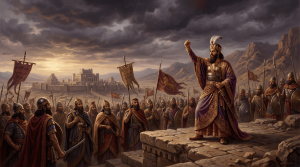
At the center of this web of commerce sits King Ezana, a ruler of immense power and vision. He has consolidated his kingdom, expanded its borders, and, most importantly, he has made Aksum fabulously wealthy. And he has done it through a simple, powerful mechanism: tariffs.
The Parallel Revelation
Every ship that docks in Adulis, every caravan that passes through Aksumite territory, pays a heavy tax. These “stiff tariffs,” as a 1st-century Greek merchant described them, filled the royal coffers to overflowing. Aksum minted its own currency, a sign of its economic might. The kingdom was a global player, a testament to the power of controlling trade.
But this reliance on tariffs, this addiction to the easy money that flowed from controlling the trade routes, was a double-edged sword. It made Aksum powerful, but it also made it vulnerable.
The kingdom’s prosperity was not built on the productivity of its own people, but on the taxes it extracted from the productivity of others. The farmers and artisans of Aksum were secondary to the merchants and tax collectors.
And then, the world changed.
In the 7th century, a new power rose in the East. The Arab expansion swept across the Middle East and North Africa, and with it, they seized control of the Red Sea trade routes. Suddenly, the ships that had once filled the port of Adulis with goods and gold were gone. The caravans found new paths, new markets. The lifeblood of Aksum’s economy was cut off.
The Pattern Recognition
The collapse was not immediate, but it was inevitable. The tariff revenue dried up. The kingdom, which had grown fat and complacent on the easy money of trade, found itself economically isolated. The once-mighty Aksum, one of the four great powers of the world, slowly withered and died.
Does this sound familiar? A nation that builds its economic strategy on tariffs, on taxing the flow of goods rather than fostering true domestic production. A nation that becomes so reliant on this revenue that it becomes blind to the underlying weaknesses in its own economy. A nation that, when faced with the consequences of its own policies, resorts to printing money to bail out the very people it has harmed.
This is the pattern of history, the echo across the centuries. The same human impulses, the same political calculations, the same economic fallacies, playing out in different times and different places, but always with the same disastrous results.
The Ancient Warning
The story of Aksum is a warning, a cautionary tale written in the ruins of a forgotten empire. It teaches us that there is no shortcut to prosperity, that a nation cannot tax its way to greatness. It teaches us that true wealth comes from production, from innovation, from the creative energy of a free people, not from the heavy hand of government control.
And it teaches us that when a nation turns its back on the principles of free trade and sound money, when it embraces the siren song of tariffs and bailouts, it sets itself on a path to economic ruin.
5 Things Readers Can Do This Week
1. Secure Your Food Supply: The government’s need to bail out farmers is a sign of the fragility of our food supply chain. Learn how to grow your own food, even in a small space, with the 4ft Farm Blueprint.
2. Diversify Your Assets: Just as Aksum’s economy was too reliant on a single source of revenue, your personal finances shouldn’t be either. Explore alternative assets and strategies at Survival Stronghold.
3. Become More Self-Reliant: The lesson of Aksum is that you can’t always rely on the government to protect you. Learn the skills you need to be self-sufficient at Self Reliance Report.
4. Take Control of Your Health: In times of economic uncertainty, your health is your most important asset. Discover natural and holistic approaches to wellness at Seven Holistics.
5. Build a Resilient Homestead: Whether you have a sprawling farm or a small urban apartment, you can take steps to make your home more resilient. Find the tools and knowledge you need at Homesteader Depot.