

The Modern Mystery
Something extraordinary happened on Friday afternoon that should make every American’s blood run cold. At 2 PM Eastern, President Trump announced he was firing the head of the Bureau of Labor Statistics—the person responsible for collecting and reporting America’s employment data—over what he claimed were “errors” in jobs numbers and accusations that the agency had “manipulated” employment data prior to the 2024 election.
Neither allegation has been corroborated by any evidence.
The timing was telling. Just hours earlier, a dismal jobs report had shown unemployment trends that economists called “alarming,” with some warning we’re “on the precipice of a recession.” The job market, once considered robust, was showing cracks that threatened the administration’s economic narrative. New tariffs were squeezing businesses and consumers. The economic picture was darkening.
So what did the most powerful man in America do? He fired the person whose job it was to count and report the truth about jobs.
If this pattern feels familiar, if it sends a chill down your spine, there’s a reason. This exact scenario—a paranoid leader firing economic officials over unfavorable data during times of crisis—has played out before in human history. Not just once, but repeatedly, across millennia and civilizations.
The most chilling parallel happened exactly 2,000 years ago, in ancient China, when another powerful ruler faced similar economic pressures and made an eerily identical choice. What happened next should terrify every American who values truth over propaganda.
The Time Portal
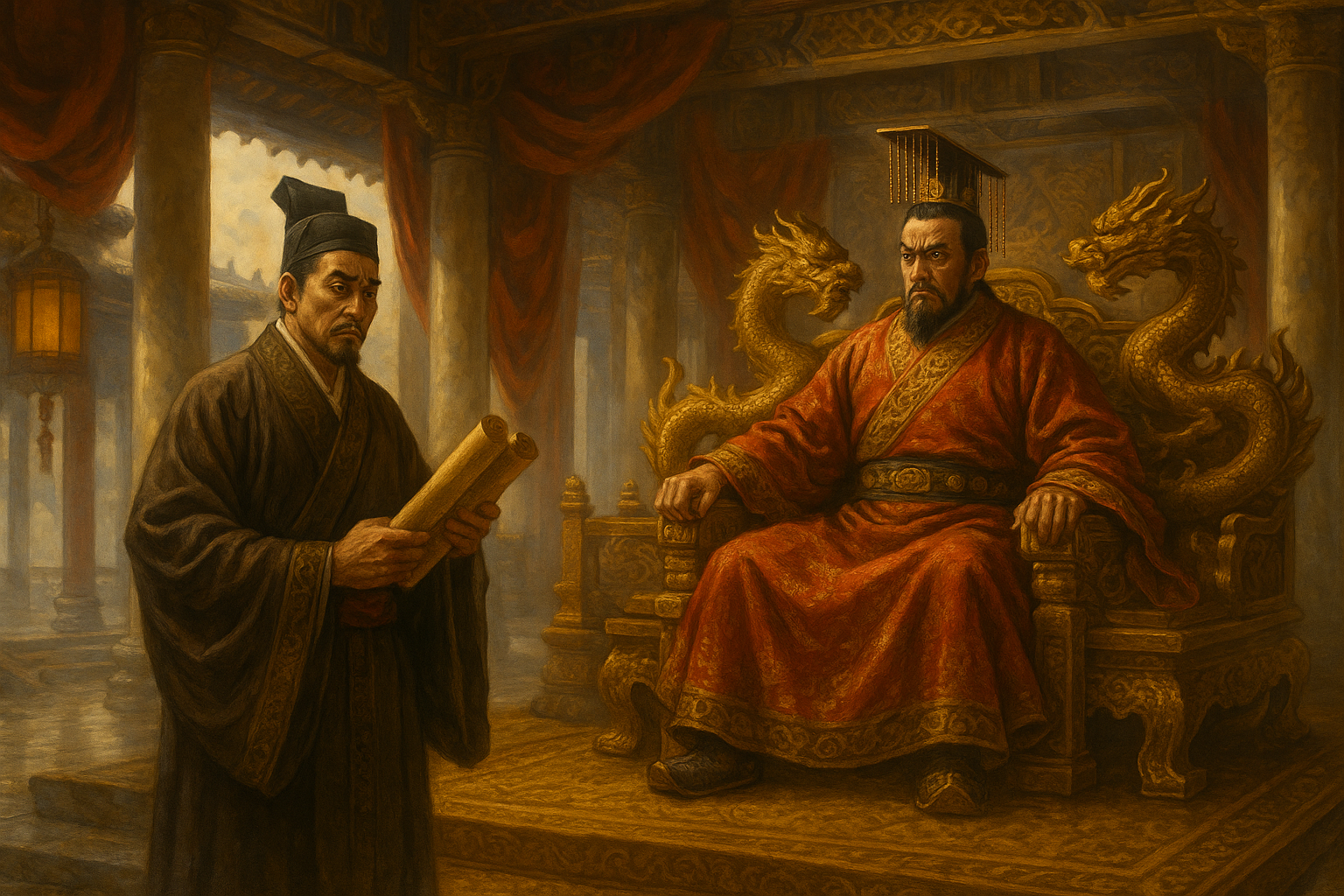
Chang’an, China – 117 BC
The morning mist hung heavy over the imperial capital as Minister Yan Yi (颜异) walked through the marble corridors of the Han Dynasty palace, clutching scrolls of agricultural reports that would seal his fate. At 39 years old, Yan Yi was one of the most respected officials in the empire—the Minister of Agriculture, responsible for tracking crop yields, food distribution, and the economic data that kept the vast Han Empire fed.
Emperor Wu of Han, now in his 24th year of rule, had transformed China into the largest empire the world had ever seen. His armies had conquered territories spanning from modern-day Korea to Vietnam, from the Taklamakan Desert to the South China Sea. But conquest came at a price. The imperial treasury was hemorrhaging silver. Military campaigns had drained the national coffers. Heavy taxation was crushing farmers and merchants alike.
And the economic reports Yan Yi carried told a story the emperor didn’t want to hear.
The agriculture minister had served faithfully for over a decade, meticulously documenting harvest yields, tracking food stores, and reporting honestly on the empire’s economic health. He was known throughout the court for his integrity—a man who would never falsify data to please his superiors. In the Confucian tradition, he believed that honest reporting was a sacred duty to both emperor and people.
But Emperor Wu had changed. Once a brilliant young ruler, he had grown paranoid and suspicious in his middle age. The constant pressure of managing an overextended empire, combined with mounting economic problems, had transformed him into a leader who increasingly blamed his advisors for bringing him unwelcome news.
As Yan Yi approached the throne room that fateful morning, he had no idea he was walking into a trap that would echo across two millennia.
The Parallel Revelation
The similarities between Trump’s firing of the Bureau of Labor Statistics chief and Emperor Wu’s treatment of Yan Yi are so precise they’re almost supernatural. Both leaders faced identical pressures, made identical accusations, and chose identical solutions—with identical results.
The Economic Crisis: Just as Trump faces mounting economic uncertainty with tariffs squeezing businesses and recession warnings mounting, Emperor Wu confronted a treasury crisis caused by expensive military campaigns and overextension. Both empires were spending beyond their means.
The Unfavorable Data: Trump received jobs numbers showing economic weakness just as Yan Yi’s agricultural reports revealed declining harvests and economic strain. Both officials were simply doing their jobs—accurately reporting economic reality.
The Paranoid Response: Both leaders, instead of addressing the underlying problems, turned their fury on the messengers. Trump accused the Bureau of Labor Statistics of “manipulation” without evidence. Emperor Wu accused Yan Yi of “internal defamation”—essentially claiming the minister was deliberately making him look bad by reporting accurate but unfavorable data.
The Scapegoating: Rather than take responsibility for economic policies that weren’t working, both leaders blamed the people whose job it was to measure and report economic reality. The pattern is identical: when the data looks bad, attack the data collectors.
The Institutional Assault: Both actions represented direct attacks on independent institutions responsible for providing objective information. Trump’s firing undermines the credibility of federal economic statistics. Emperor Wu’s execution sent a chilling message to all officials: tell the emperor what he wants to hear, or face death.
The psychological pattern is identical across 2,000 years. When powerful leaders face economic pressure and unfavorable data, their first instinct isn’t to fix the problems—it’s to silence the people reporting the problems. Human nature, it seems, hasn’t evolved at all.
The Pattern Recognition

Why does this pattern repeat across millennia? Because it taps into the most fundamental human psychological defense mechanism: denial.
When leaders are confronted with data that threatens their narrative, their power, or their legacy, the primitive brain kicks in with a simple solution: eliminate the source of the threatening information. It’s easier to fire the statistician than fix the economy. It’s simpler to execute the agriculture minister than address the harvest failures.
This isn’t rational thinking—it’s emotional self-preservation. And it’s exactly what happens when leaders become so isolated by power that they lose touch with reality. They begin to believe their own propaganda and see accurate reporting as personal attacks.
The pattern always follows the same steps:
- Economic problems emerge
- Officials report the problems accurately
- Leader feels threatened by the data
- Leader blames the messenger instead of addressing the message
- Institutions lose credibility and independence
- Problems get worse because accurate information is suppressed
Emperor Wu’s China and Trump’s America are separated by two thousand years, but the human psychology driving both leaders is identical. Power corrupts not just through greed or ambition, but through the gradual erosion of a leader’s ability to accept uncomfortable truths.
The most terrifying part? Both leaders genuinely believed they were protecting their empires by silencing accurate reporting. They convinced themselves that the problem wasn’t the economic reality—it was the people reporting that reality.
The Ancient Warning
What happened to Yan Yi should serve as a stark warning for modern America. The agriculture minister was executed on trumped-up charges of “internal defamation.” His crime? Doing his job honestly and reporting economic data that made the emperor look bad.
But Emperor Wu’s assault on honest reporting didn’t solve his economic problems—it made them catastrophically worse. Without accurate information, the emperor made increasingly poor decisions. Economic policies failed because they were based on false data. Military campaigns collapsed because resource planning relied on fabricated reports. The empire’s decline accelerated precisely because the emperor had eliminated the people who could have warned him about problems before they became disasters.
Within decades of Yan Yi’s execution, the Han Dynasty began its long decline. Historians directly link the empire’s fall to Emperor Wu’s later years, when paranoia and the suppression of honest reporting led to a cascade of policy failures. The emperor who had built the greatest empire in history destroyed it by refusing to hear the truth about its problems.
The lesson is clear: when leaders attack the institutions responsible for providing accurate information, they don’t eliminate the problems—they eliminate their ability to solve the problems. Reality doesn’t change just because you silence the people reporting it.
Yan Yi’s execution marked the beginning of the end for one of history’s greatest empires. The question for Americans today is whether we’ll learn from this ancient warning or repeat this catastrophic pattern.
5 Things You Can Do This Week
History doesn’t have to repeat itself, but only if we act now to protect the institutions that provide accurate information and hold power accountable:
1. Demand Transparency: Contact your representatives and demand they protect the independence of federal statistical agencies. The Bureau of Labor Statistics, Census Bureau, and other data-collecting institutions must remain free from political interference.
2. Support Independent Media: Subscribe to and financially support news organizations that prioritize factual reporting over partisan narratives. A free press is the modern equivalent of honest court officials like Yan Yi.
3. Learn to Recognize Propaganda: Study how authoritarian leaders throughout history have attacked data and institutions when the facts didn’t support their narratives. Understanding these patterns helps you recognize them in real time.
4. Build Local Resilience: Start preparing your family and community for economic uncertainty. Learn skills, build networks, and create backup plans that don’t depend on government statistics or promises.
5. Preserve Truth: Document and share accurate information about current events. When institutions are under attack, ordinary citizens must become the guardians of truth and historical memory.
The pattern that destroyed Emperor Wu’s empire is playing out again in modern America. But unlike Yan Yi, we still have the power to resist. The question is whether we’ll use it before it’s too late.
Ready to build real security for your family while the institutions crumble? The 4ft Farm Blueprint shows you how to grow a year’s worth of food in just 4 square feet, giving you independence from both government statistics and grocery store supply chains. Because when the data gets manipulated and the systems fail, the families who can feed themselves are the ones who survive.


