
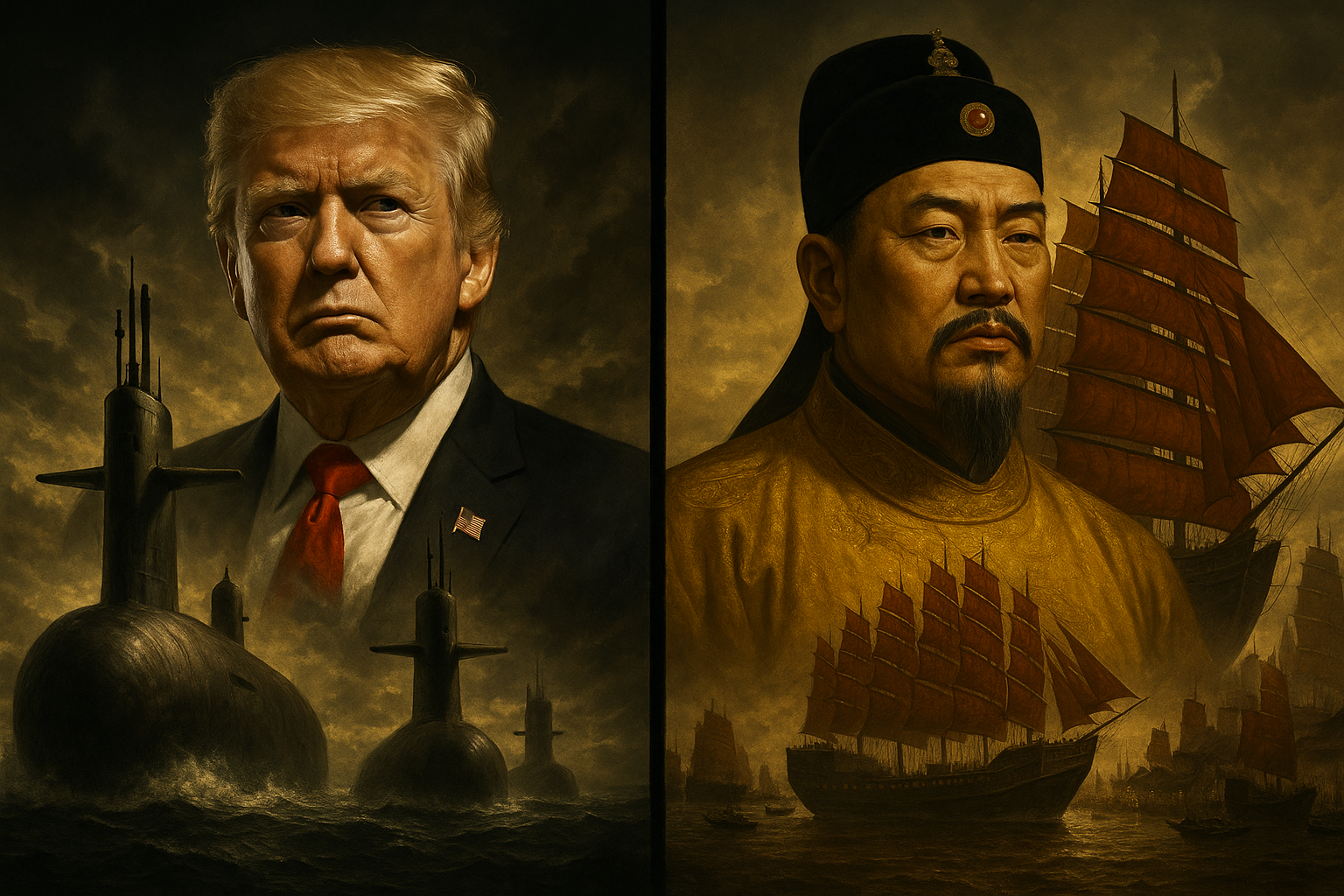
Trump Moves Nuclear Submarines to Intimidate Russia… and the Chinese Emperor Who Did the Same Thing with the World’s Largest Fleet 600 Years Ago
The Modern Mystery
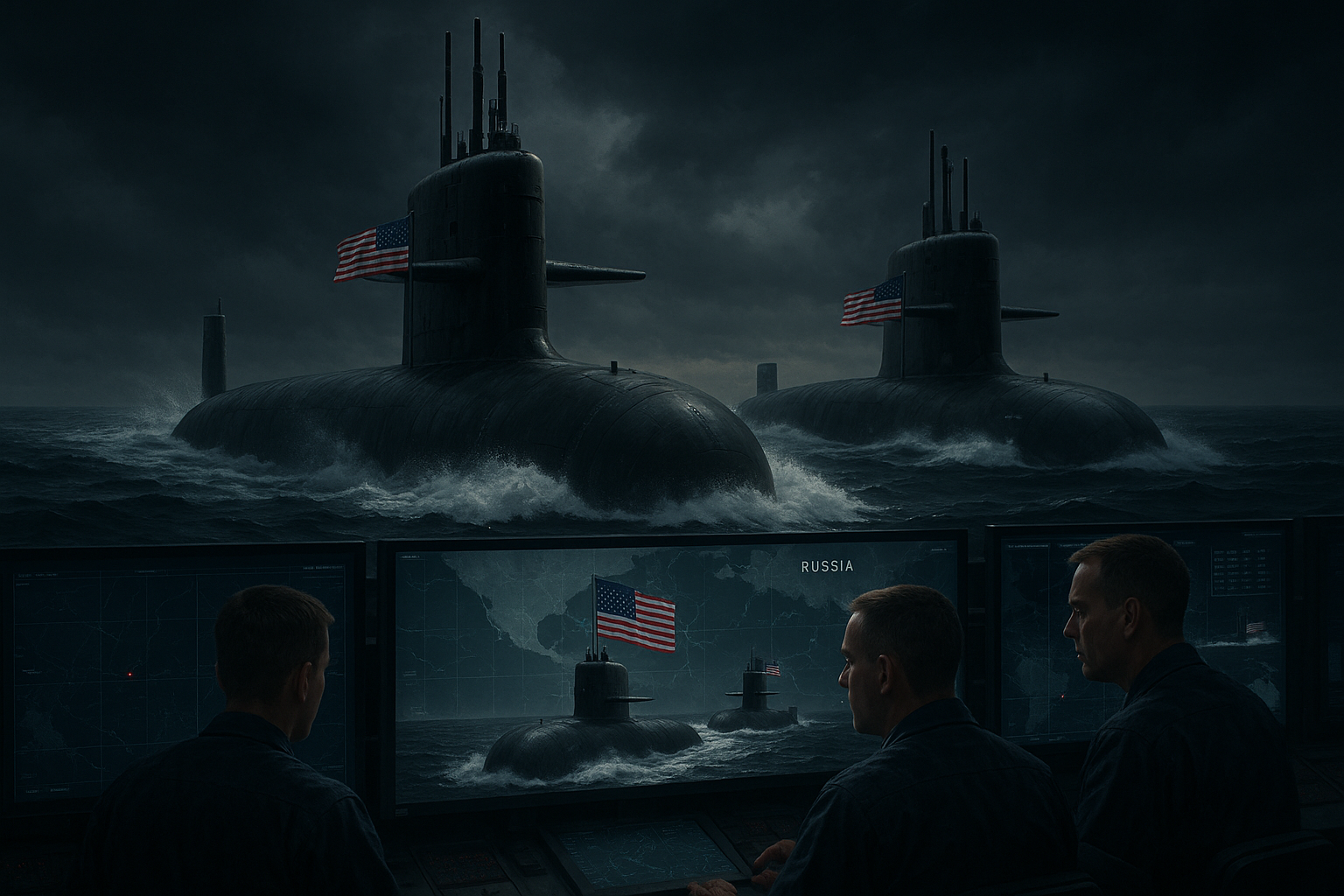
President Trump just escalated global tensions by ordering two nuclear submarines to move “closer to Russia” in response to what he called “highly provocative statements” from former Russian President Dmitry Medvedev. The submarines—among the most powerful weapons in the American arsenal—are being repositioned to “appropriate regions” as a direct show of force.
This isn’t subtle diplomacy. This is naval intimidation at its most raw. Trump is using America’s most advanced underwater weapons as floating threats, sending a clear message: cross us, and these nuclear-armed leviathans are already in position to respond. The submarines can launch ballistic missiles capable of obliterating entire cities, and now they’re prowling closer to Russian waters.
But here’s what makes this moment electrifying: we’ve witnessed this exact power play before. Not in recent naval history, but in the treasure-laden waters of the Indian Ocean, where another ruler discovered that massive fleets could bend entire civilizations to his will. The year was 1405, and Chinese Emperor Yongle was about to demonstrate how naval supremacy could intimidate half the known world.
The Time Portal
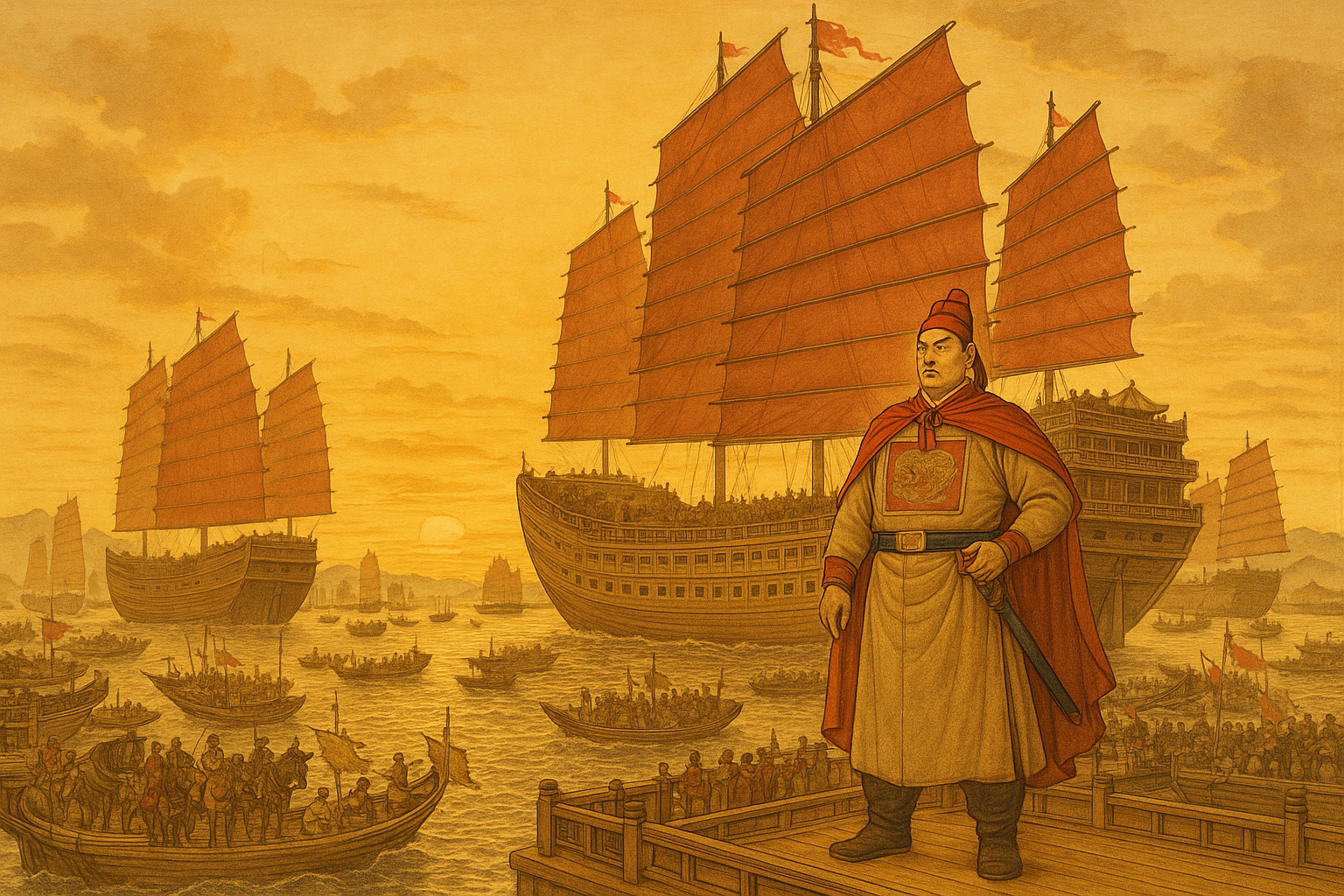
Picture the bustling shipyards of Nanjing in 1405, where the sound of hammers on wood echoes across the Yangtze River. Emperor Zhu Di—known to history as the Yongle Emperor—stands before the largest naval construction project in human history. Before him rise the frames of ships so massive they defy imagination: treasure ships over 400 feet long and 160 feet wide, with nine towering masts and twelve billowing sails.
These aren’t just ships. They’re floating cities designed to overwhelm anyone who sees them.
The Yongle Emperor has a problem that sounds remarkably familiar: he needs the world to respect Chinese power, but distant kingdoms keep testing his authority. Mongol tribes threaten from the north. Southeast Asian rulers question Chinese supremacy. The traditional tribute system—where foreign nations acknowledge China as the supreme power in exchange for trade and protection—is crumbling.
His solution is breathtakingly audacious: build the largest navy in human history and sail it to every corner of the known world as a demonstration of unstoppable power.
The emperor summons his most trusted admiral, a Muslim eunuch named Zheng He, and gives him command of a fleet that makes modern navies look like fishing expeditions. The first treasure fleet consists of 317 ships carrying 27,800 crew members. The flagship treasure ships are larger than Christopher Columbus’s entire fleet combined. Each one can carry 2,500 tons of cargo and is armed with dozens of cannons.
But here’s the genius of Yongle’s strategy: these ships aren’t just weapons. They’re psychological warfare machines loaded with China’s finest silks, porcelains, lacquerware, tea, and ironworks. The message is unmistakable—China is so wealthy and powerful that it can afford to give away treasures worth fortunes while simultaneously demonstrating the naval force to destroy anyone who refuses Chinese authority.
The first expedition sets sail in 1405, and the results are immediate and devastating to Chinese rivals. When this armada appears off the coast of Southeast Asian kingdoms, local rulers don’t just submit—they compete to offer the most elaborate tributes to avoid Chinese displeasure. The sight of hundreds of massive Chinese ships filling their harbors is so overwhelming that resistance becomes unthinkable.
Sound familiar?
The Parallel Revelation
The precision of this historical parallel is staggering. Both Trump and Emperor Yongle faced the same fundamental challenge: how do you make distant adversaries respect your power when they’re testing your authority? Both discovered the same solution: deploy your most advanced naval assets as floating threats.
The mechanics are identical across six centuries. Trump’s nuclear submarines are the modern equivalent of Yongle’s treasure ships—both represent the absolute pinnacle of their era’s naval technology. Just as Trump’s submarines can launch nuclear missiles from hidden positions, Yongle’s treasure ships could appear anywhere in the Indian Ocean with overwhelming force and advanced weaponry.
The psychological impact is the same too. When Trump announces that nuclear submarines are moving “closer to Russia,” he’s not just repositioning military assets—he’s sending a message that America’s most devastating weapons are now within striking distance. Similarly, when Yongle’s massive fleets appeared off foreign coasts, they weren’t just diplomatic missions—they were demonstrations that China could project overwhelming force anywhere in the known world.
Both leaders understood that the mere presence of superior naval power often eliminates the need to use it. Trump’s submarines don’t need to fire their missiles to be effective; their proximity to Russian waters is the threat. Yongle’s treasure ships rarely engaged in actual combat because their sheer size and number made resistance futile.
The scale of both operations is breathtaking. Trump’s nuclear submarines represent billions of dollars in advanced technology and can remain submerged for months while carrying enough firepower to devastate entire regions. Yongle’s treasure fleets represented the wealth of the world’s largest economy and could remain at sea for years while carrying enough troops and weapons to conquer kingdoms.
Both leaders also used their naval demonstrations to reinforce domestic authority. Trump’s submarine deployment shows American voters that he’s willing to confront foreign threats decisively. Yongle’s treasure voyages demonstrated to Chinese subjects that their emperor commanded respect from the entire known world.
The timing is crucial in both cases. Trump ordered the submarine repositioning immediately after Russian provocations, showing rapid response capability. Yongle launched his treasure fleets during a period when Chinese authority was being questioned, demonstrating that challenges to Chinese power would be met with overwhelming force.
The Pattern Recognition
This pattern—the powerful ruler who uses naval supremacy to intimidate distant rivals—repeats across history because it exploits a fundamental truth about human psychology: nothing demonstrates power quite like the ability to project devastating force anywhere in the world.
Naval power is uniquely suited for intimidation because it’s mobile, mysterious, and overwhelming. Unlike armies that must march across land borders, naval forces can appear suddenly off any coastline. Unlike air power that’s visible and temporary, naval assets can lurk unseen for extended periods. The ocean itself becomes a weapon of psychological warfare.
Yongle and Trump both recognized that naval intimidation works because it forces adversaries to imagine the worst-case scenario. When Chinese treasure ships appeared in Southeast Asian harbors, local rulers had to consider what would happen if they refused Chinese demands. When Trump’s nuclear submarines move closer to Russia, Russian leaders must calculate the risks of further provocation.
The pattern works because it appears both reasonable and terrifying. Yongle claimed his treasure fleets were peaceful diplomatic missions bringing gifts and trade opportunities. Trump frames his submarine deployment as a defensive response to Russian threats. Both leaders maintain plausible deniability while making unmistakable threats.
But the deeper pattern is about the psychology of overwhelming force. When adversaries see naval assets that clearly outclass their own capabilities, they face a stark choice: submit to the superior power or risk catastrophic consequences. Most rational leaders choose submission, which is exactly what both Yongle and Trump are counting on.
The naval intimidation approach is particularly effective because it demonstrates both capability and restraint. By positioning powerful naval assets near adversaries without actually attacking, leaders show they have the power to destroy but the wisdom to prefer submission. This makes compliance seem like the smart choice rather than cowardly surrender.
The Ancient Warning
What happened to China after Yongle’s treasure fleet intimidation campaign serves as a crucial warning for America’s future. The immediate effects seemed spectacularly successful from the emperor’s perspective—foreign kingdoms submitted, tribute flowed into Chinese coffers, and Chinese authority was acknowledged across the known world.
For nearly three decades, the treasure fleets maintained Chinese dominance through naval intimidation. Seven massive expeditions between 1405 and 1433 established China as the undisputed naval superpower, with fleets that dwarfed anything Europe would produce for centuries. The psychological impact was so profound that many Southeast Asian kingdoms continued paying tribute to China long after the fleets stopped sailing.
But the long-term consequences were catastrophic. The treasure fleets were staggeringly expensive—each expedition cost the equivalent of billions in today’s money. The ships required massive amounts of timber, depleting Chinese forests. The crews demanded enormous resources, straining the imperial treasury. The construction projects diverted labor from agriculture and manufacturing.
More critically, the naval intimidation strategy created a dangerous dependency. Chinese authority became tied to the continued presence of overwhelming naval force. When economic pressures forced the cancellation of the treasure voyages, Chinese influence collapsed almost immediately. Kingdoms that had submitted to Chinese power began asserting independence. Trade routes that had been secured by Chinese naval presence became contested waters.
The political costs were equally severe. Court factions that had opposed the expensive treasure fleets gained power after Yongle’s death. By 1525, the government ordered the destruction of all oceangoing ships. The greatest navy in history—which once had 3,500 ships compared to the U.S. Navy’s current 324—was deliberately dismantled.
The strategic consequences lasted for centuries. China’s withdrawal from naval power projection left a vacuum that was eventually filled by European powers. The same sea routes that Chinese treasure fleets had dominated became highways for European colonization. Nations that had once acknowledged Chinese supremacy became European colonies or trading partners.
The economic impact was devastating too. The treasure fleets had established China as the center of global trade networks, with tribute and commerce flowing to Chinese ports. When the naval intimidation ended, these economic relationships collapsed. China’s economy, which had been the world’s largest and most sophisticated, began a long decline that lasted until the modern era.
By the time Chinese leaders recognized their mistake and tried to rebuild naval power, it was too late. The institutional knowledge had been lost, the shipbuilding infrastructure had been dismantled, and the economic resources had been depleted. The empire that had once intimidated the world with its naval supremacy found itself vulnerable to foreign powers with superior maritime capabilities.
5 Things You Can Do This Week
History’s warning is clear: when rulers start using naval intimidation as their primary tool of foreign policy, prepare for economic strain and eventual strategic overextension. Here are five practical steps to protect yourself and your family:
1. **Diversify Your Economic Dependencies**: Don’t rely solely on systems that depend on American naval supremacy. Learn skills and build relationships that remain valuable regardless of geopolitical shifts. The [Self Reliance Report](https://selfreliancereport.com/feed/) offers excellent guidance on building economic independence that doesn’t depend on global power projection.
2. **Develop Regional Networks**: When global powers overextend themselves, local and regional relationships become more important. Build connections with neighbors, local businesses, and community organizations. These networks provide stability when larger systems become unreliable.
3. **Invest in Tangible Skills**: Naval intimidation campaigns are expensive and unsustainable. When they end, practical skills become more valuable than financial assets tied to global systems. The [Homesteader Depot](https://homesteaderdepot.com/feed/) provides comprehensive training in self-sufficient capabilities that remain useful regardless of political changes.
4. **Prepare for Supply Chain Disruptions**: Naval power projection requires enormous resources that eventually strain domestic systems. Build stockpiles of essential goods and learn to produce necessities locally. [Seven Holistics](https://sevenholistics.com/feed) offers guidance on creating resilient supply systems that don’t depend on global trade routes.
5. **Start Food Production Now**: The [4ft Farm Blueprint](https://4ftfarmblueprint.com/clean1-vid.html) shows you how to produce substantial food yields in minimal space, reducing your dependence on agricultural systems that require global stability. Food security provides the foundation for independence from unsustainable power projection strategies.
Remember: the goal isn’t to panic, but to prepare. History teaches us that when leaders start using expensive naval intimidation as their primary foreign policy tool, wise individuals start building local resilience before the inevitable overextension hits. The Chinese who survived their empire’s naval decline were those who had developed independent capabilities before the treasure fleets stopped sailing.
Don’t wait for the submarines to come home. By then, the economic and strategic costs of naval intimidation will have already begun undermining the systems that support them. Start building your own resilience today.


