

# Trump’s Flag Burning Ban… and the Babylonian King Who Defied Sacred Law
**By Shamus Gerry III**
The Modern Mystery
In a move that sent shockwaves through the American legal and political landscape, President Donald Trump signed an executive order on August 25, 2025, directing the Justice Department to prosecute individuals who burn the American flag, with a recommended sentence of one year in jail. The order, framed as a defense of national honor and a stand against civil unrest, represents a direct and audacious challenge to a cornerstone of American civil liberties: the First Amendment’s protection of free speech.
For over three decades, the law of the land has been clear. In the landmark 1989 case *Texas v. Johnson*, the Supreme Court ruled 5-4 that flag burning, however offensive to some, is a form of symbolic speech protected by the Constitution. The court affirmed that the government cannot mandate patriotism by punishing those who disrespect the flag. Yet, with this new executive order, the Trump administration has thrown down the gauntlet, creating a constitutional crisis that pits executive power against judicial precedent.
This isn’t just a legal debate; it’s a high-stakes drama about the very nature of American democracy. Can a president unilaterally override a Supreme Court ruling? What happens when a leader, citing national pride and public order, seeks to curtail a fundamental right? The questions hang heavy in the air, and as the nation braces for the inevitable legal battles, it feels like we’re in uncharted territory. But are we? Or is this a story that has played out before, in a different time, with a different empire, and a different king who dared to defy the sacred laws of his land?

The Time Portal
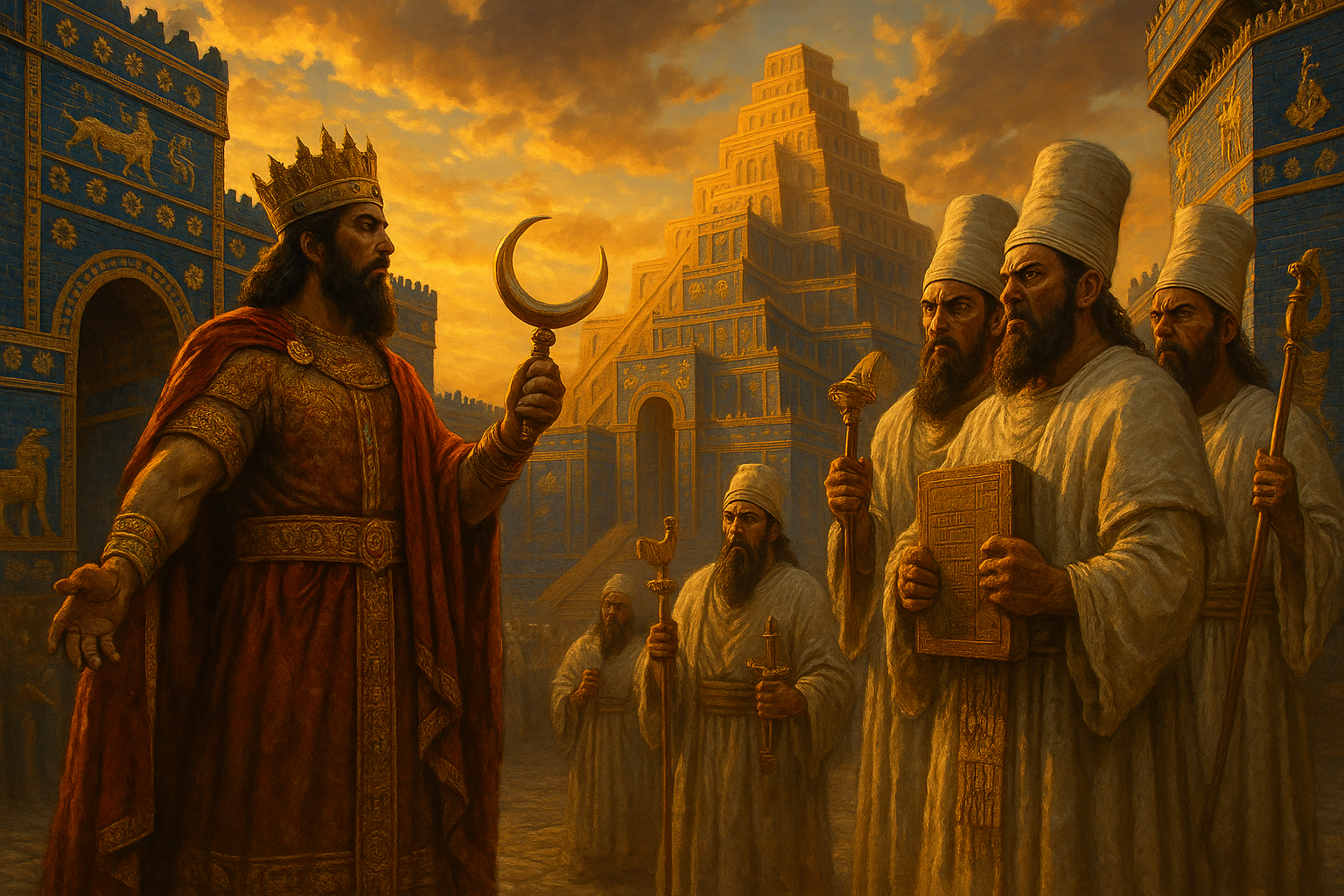
Let’s wind the clock back 2,500 years, to the heart of the ancient world: Babylon, 556 BCE. The city is a symphony of power and devotion, its sun-scorched bricks rising to form the magnificent Ishtar Gate, adorned with vibrant blue-glazed tiles and golden reliefs of mythical beasts. The air is thick with the scent of incense and the murmur of a thousand languages, a testament to the city’s status as the center of a sprawling empire. For over a millennium, the people of Babylon have worshipped at the feet of Marduk, the city’s patron deity, whose golden statue resides in the Esagila temple complex, the religious heart of the empire. The Marduk priesthood, a powerful and deeply entrenched institution, are the guardians of this sacred tradition, their authority second only to the king himself.
But a new king has ascended the throne, and he is a man of different tastes. Nabonidus, a scholar and an antiquarian, hails from Harran, a city in the north where the moon god, Sin, holds sway. He is a man out of step with the ancient rhythms of Babylon, more interested in excavating ancient temples and deciphering forgotten inscriptions than in the grand ceremonies of the capital. He sees the empire not as a divine mandate from Marduk, but as a collection of diverse peoples, each with their own gods and traditions. And in his heart, he carries a dangerous ambition: to elevate his own patron deity, the moon god Sin, to the pinnacle of the Babylonian pantheon, a position held by Marduk for centuries.
The Parallel Revelation
Nabonidus’s reign began with a series of subtle but significant challenges to the established religious order. He started by rebuilding the temple of Sin in his hometown of Harran on a lavish scale, diverting resources and attention from the temples of Marduk in Babylon. He then began to neglect the Akitu, the New Year festival dedicated to Marduk, an omission that was deeply offensive to the Babylonian people and a direct affront to the priesthood. The Akitu was not just a religious ceremony; it was a cosmic re-enactment of creation, a reaffirmation of the divine order that placed Marduk at the center of the universe. To neglect it was to invite chaos.
But Nabonidus didn’t stop there. He began to move the sacred statues of other gods from their ancestral shrines to Babylon, a move he claimed was for their own protection, but which the priests saw as a sacrilegious act of centralization, a way of diminishing the authority of the local cults and concentrating all religious power in his own hands. The final straw came when he declared Sin to be the “king of the gods,” effectively demoting Marduk and attempting to impose his own personal faith on the entire empire. The parallel to Trump’s flag burning order is striking. Just as Trump is attempting to override a Supreme Court ruling with an executive order, Nabonidus was attempting to override centuries of religious tradition with a royal decree. Both leaders, driven by their own personal convictions, sought to impose their will on a deeply entrenched system of beliefs and laws, and in doing so, they both ignited a firestorm of opposition from the guardians of that system.

The Pattern Recognition
Why does this pattern repeat itself across the millennia? Why do leaders, separated by thousands of years and vastly different cultures, feel compelled to challenge the very foundations of their societies? The answer lies in a timeless struggle between two opposing forces: the centralizing impulse of power and the resilient grip of tradition. Leaders, by their very nature, seek to consolidate their authority, to streamline and simplify the complex web of laws, customs, and beliefs that govern a society. They see tradition not as a source of stability, but as an obstacle to progress, a relic of a bygone era that stands in the way of their own vision for the future.
On the other side of this eternal conflict are the guardians of tradition: the priests, the judges, the scholars, the keepers of the sacred texts and the ancient laws. They see tradition not as an obstacle, but as a bulwark against tyranny, a repository of collective wisdom that has been accumulated over centuries. They understand that the law is not something to be trifled with, that it is the very glue that holds a society together. When a leader, whether it’s a Babylonian king or an American president, attempts to override the law with a personal decree, they are not just challenging a specific rule; they are challenging the very idea of a society governed by laws rather than by the whims of a single individual.
The Ancient Warning
For Nabonidus, the consequences of his actions were catastrophic. The Marduk priesthood, their authority and their very identity under threat, launched a sophisticated propaganda campaign against him, portraying him as a madman and a heretic who had abandoned the gods of his people. They painted him as an eccentric who spent his days digging in the dirt for ancient artifacts while the empire crumbled around him. When Cyrus the Great of Persia invaded Babylon in 539 BCE, he was not met with a unified resistance, but with a population that was deeply divided and a priesthood that was actively working against its own king. The priests of Marduk welcomed Cyrus as a liberator, opening the gates of the city to him and hailing him as the rightful successor to the Babylonian throne. Nabonidus was captured, and the Neo-Babylonian Empire, once the most powerful in the world, came to an ignominious end.
The story of Nabonidus is a cautionary tale, a stark reminder of what can happen when a leader, however powerful, attempts to trample on the sacred traditions and established laws of a nation. It is a warning that echoes down through the centuries, a message that is as relevant today as it was in ancient Babylon: a society that abandons its laws in favor of the arbitrary rule of a single individual is a society that is on the path to ruin.
—
5 Things You Can Do This Week
History is not just a collection of stories; it’s a roadmap to the future. The patterns of the past provide us with the tools we need to navigate the challenges of the present. Here are five things you can do this week to better prepare yourself and your family for the potential fallout from the current constitutional crisis:
1. **Know Your Rights:** The first line of defense against tyranny is a citizenry that is well-informed about its own rights and freedoms. Take some time this week to read the Bill of Rights and the Constitution. Understand what your rights are, and be prepared to defend them. For a deeper dive into the principles of self-reliance and personal liberty, check out the resources at [Self-Reliance Report](https://selfreliancereport.com).
2. **Support Independent Media:** In times of political turmoil, it’s more important than ever to have access to a wide range of news and information sources. Support independent journalists and media outlets that are committed to speaking truth to power. For a daily dose of news and analysis that is free from corporate influence, visit [Freedom Health Daily](https://freedomhealthdaily.com).
3. **Build Local Community:** Strong local communities are the bedrock of a resilient society. Get to know your neighbors, support local businesses, and get involved in local politics. When national institutions are in crisis, it’s the strength of our local communities that will see us through. For tips on how to build a more self-sufficient and resilient lifestyle, explore the resources at [Homesteader Depot](https://homesteaderdepot.com).
4. **Prepare for Economic Uncertainty:** Political instability often goes hand-in-hand with economic turmoil. Take steps to secure your own financial future by reducing debt, building up your savings, and investing in tangible assets. For practical advice on how to survive and thrive in any economic climate, check out the resources at [Survival Stronghold](https://survivalstronghold.com).
5. **Cultivate Your Own Garden:** The act of growing your own food is a powerful statement of self-reliance and a practical way to insulate yourself from disruptions in the food supply chain. Whether you have a large backyard or a small apartment balcony, you can start growing your own food today. For a step-by-step guide to creating a highly productive food garden in a small space, check out the [4ft Farm Blueprint](https://4ftfarmblueprint.com/).
—
**Sponsor:**
[Ad for 4ft Farm Blueprint]
Ready to take control of your food supply? The [4ft Farm Blueprint](https://4ftfarmblueprint.com/) is a revolutionary system that teaches you how to grow a massive amount of food in a tiny space. Click here to learn more and start your journey to food independence today!
**Sources:**
1. *Texas v. Johnson*, 491 U.S. 397 (1989).
2. Beaulieu, Paul-Alain. *The Reign of Nabonidus, King of Babylon 556-539 B.C.* Yale University Press, 1989.
3. “Nabonidus Chronicle.” *Livius.org*, www.livius.org/sources/content/mesopotamian-chronicles-content/abc-7-nabonidus-chronicle/.
4. “Cyrus Cylinder.” *British Museum*, www.britishmuseum.org/collection/object/W_1880-0617-1941.


