

Something unprecedented is happening in the halls of American academia, and it should terrify anyone who understands how empires collapse.
On a cold February morning in 2025, lawyers representing the Trump administration delivered an ultimatum to UCLA that would have made medieval warlords proud: hand over one billion dollars, or face the consequences. Not a loan. Not a negotiation. A demand. The message was crystal clear—your intellectual treasures, your research patents, your academic independence? They belong to us now.
But UCLA wasn’t alone in the crosshairs. Across the country, Harvard University found itself under siege as federal agents began systematically targeting the institution’s most valuable patents—the very innovations that represent decades of scholarly research and billions in potential revenue. These weren’t random bureaucratic actions. This was a coordinated assault on the intellectual property that makes American universities the envy of the world.
The pattern is unmistakable, yet most Americans are missing its historical significance. A powerful ruler, flush with military might and political authority, systematically targeting the greatest centers of learning in his domain. Demanding tribute. Seizing intellectual assets. Threatening the very institutions that preserve and advance human knowledge.
If this sounds familiar, it should. Because 767 years ago, in a city that was once the intellectual capital of the world, another powerful leader made similar demands of the greatest university of his time. The scholars refused. The ruler’s response was swift, brutal, and absolute.
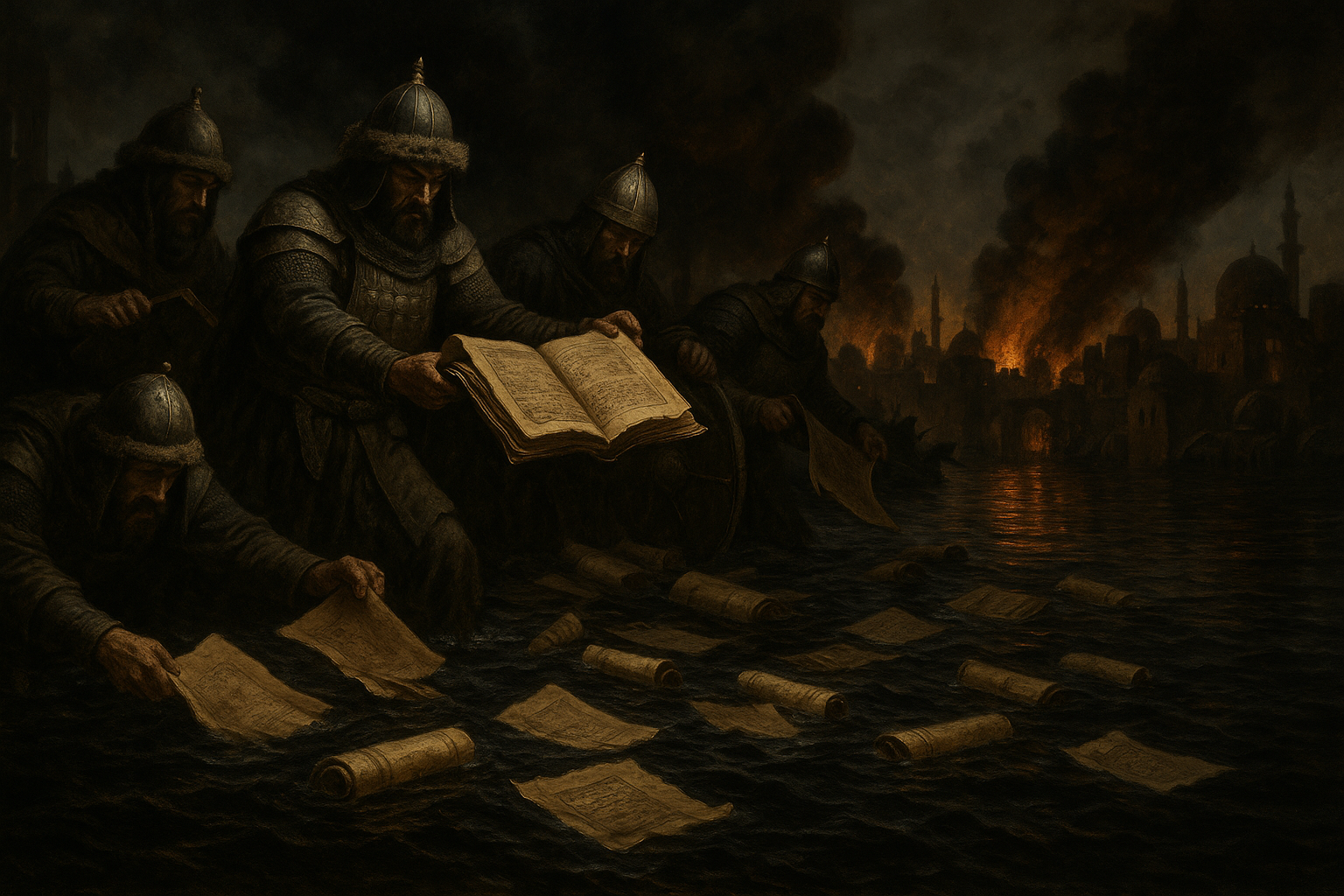
The Tigris River ran black with ink for three days.
What happened in Baghdad in 1258 wasn’t just the destruction of a city—it was the systematic annihilation of the greatest repository of human knowledge the world had ever seen. And the parallels to what’s unfolding in American universities today are so precise, so chilling, that they demand our immediate attention.
Because when rulers start treating universities like treasure vaults to be plundered rather than sanctuaries of learning to be protected, history has shown us exactly where that path leads. And it’s not somewhere any civilization wants to go.
The Time Portal
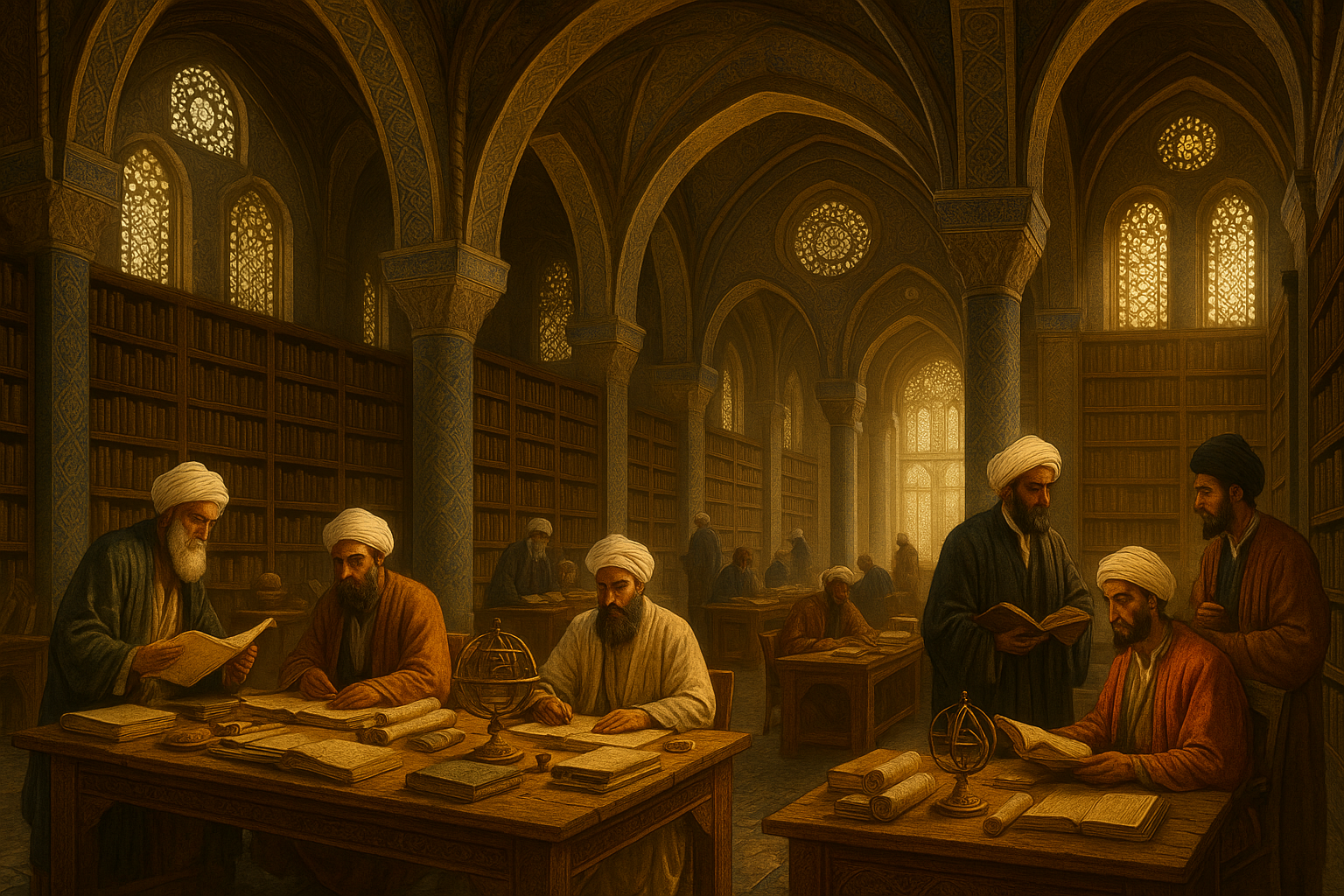
Baghdad, January 1258. The morning call to prayer echoes across a city that has been the beating heart of human civilization for five centuries. In the House of Wisdom—Bayt al-Hikmah—scholars from across the known world are already at work, their oil lamps flickering against manuscripts that contain the accumulated knowledge of Greece, Persia, India, and the Islamic world.
Picture the scene: A young translator named Ahmad ibn Muhammad carefully copies Aristotle’s Metaphysics from Greek into Arabic, his reed pen scratching against parchment that will survive longer than the empire that created it. Nearby, a Persian mathematician works through algebraic equations that won’t be understood in Europe for another three centuries. In the astronomy section, scholars debate the movements of celestial bodies using instruments so precise they make medieval European astrolabes look like children’s toys.
This isn’t just a library—it’s the Google, MIT, and Smithsonian of the medieval world, all rolled into one magnificent institution. The House of Wisdom contains an estimated 400,000 manuscripts, representing the intellectual achievements of a dozen civilizations spanning over a millennium. When European scholars want to rediscover Plato, they’ll come here. When Chinese inventors need to understand Persian engineering, they’ll send emissaries to these halls.
But outside the city walls, something terrible is approaching.
Hulegu Khan, grandson of Genghis Khan and brother to the Great Khan Möngke, commands an army of 150,000 warriors. He’s already crushed the Assassins at Alamut, burning their legendary library to ash. Now he’s set his sights on Baghdad, the jewel of the Abbasid Caliphate and the intellectual capital of the Islamic world.
The Caliph Al-Musta’sim—a man more interested in poetry than politics, more comfortable with scholars than soldiers—receives Hulegu’s ultimatum in his palace. The message is simple and brutal: Submit completely. Pay tribute. Acknowledge Mongol supremacy. Or be destroyed.
Al-Musta’sim, surrounded by advisors who still believe Baghdad is unconquerable, makes a decision that will echo through history. He refuses. Not just refuses—he insults the Mongol prince, questioning his legitimacy and threatening him with the wrath of Allah.
It’s a decision born of the same arrogance that has doomed countless civilizations throughout history: the belief that intellectual and cultural superiority can somehow shield you from raw, brutal power. The Caliph looks at his magnificent city, his unparalleled library, his centuries of accumulated wisdom, and thinks: They wouldn’t dare.
But Hulegu Khan doesn’t care about poetry. He doesn’t value manuscripts. He sees only defiance that must be crushed, wealth that must be seized, and an example that must be made.
On January 29, 1258, the siege begins. The greatest center of learning in the world has twelve days left to live.
The Parallel Revelation
The parallels between Hulegu’s demands on Baghdad and Trump’s assault on American universities are so precise they’re almost supernatural.
Both rulers came to power through conquest and intimidation, wielding unprecedented authority over vast territories. Both viewed intellectual institutions not as sacred repositories of human knowledge, but as sources of wealth and power to be exploited. And both made the same fundamental calculation: that scholars and universities, for all their prestige and cultural importance, are ultimately defenseless against raw political force.
Consider the mechanics of extortion. Hulegu didn’t just demand submission from Baghdad—he demanded tribute, treasure, and acknowledgment of his absolute authority over the city’s most valuable assets. The Mongol prince saw the House of Wisdom’s manuscripts, the Caliph’s treasury, and the city’s intellectual infrastructure as resources to be harvested, not institutions to be preserved.
Fast-forward 767 years. The Trump administration doesn’t just criticize UCLA or Harvard—it demands specific financial tribute ($1 billion from UCLA) and seizes control of their most valuable intellectual property (Harvard’s patents). The message is identical: your knowledge, your innovations, your academic independence exist only at our pleasure.
But the psychological parallels run even deeper. Both Al-Musta’sim and modern university administrators made the same fatal error: they believed their institutional prestige would protect them from political retaliation. The Caliph thought Baghdad’s status as the intellectual capital of the Islamic world made it untouchable. University presidents today believe their institutions’ contributions to American innovation and global competitiveness make them politically invulnerable.
Both were catastrophically wrong.
The Ancient Warning
What happened next in Baghdad should serve as a stark warning for anyone who believes institutional prestige can shield intellectual centers from political violence.
On February 10, 1258, after twelve days of siege, Hulegu’s forces breached Baghdad’s walls. The systematic destruction that followed wasn’t random violence—it was a carefully orchestrated campaign to eliminate the intellectual infrastructure that had made Baghdad the center of the civilized world.
The House of Wisdom was specifically targeted. Mongol soldiers didn’t just loot the manuscripts—they methodically threw them into the Tigris River, creating a scene so apocalyptic that chroniclers struggled to describe it. Ibn al-Athir wrote that the river ran black with ink for three days, as centuries of accumulated human knowledge dissolved into the current. Imagine the Library of Congress, Harvard’s archives, and the Smithsonian all being systematically dumped into the Potomac River, and you begin to grasp the magnitude of what was lost.
But the destruction went beyond books. The scholars themselves—the living repositories of knowledge who could have rebuilt the intellectual tradition—were systematically murdered. Astronomers, mathematicians, physicians, philosophers, translators: all eliminated. The Mongols understood that destroying the books wasn’t enough; they had to eliminate the human networks that created and preserved knowledge.
The Caliph Al-Musta’sim, who had refused Hulegu’s demands with such confidence, was executed in a manner designed to send a message. Wrapped in carpets and trampled by horses—a death that ensured no blood was spilled (Mongols believed spilling royal blood brought bad luck) while maximizing humiliation and terror.
The consequences extended far beyond Baghdad. The destruction of the House of Wisdom marked the end of the Islamic Golden Age, a period of scientific and cultural achievement that had lasted over 500 years. The intellectual networks that had connected scholars from Spain to Central Asia were shattered. The translation movement that had preserved and expanded upon Greek, Persian, and Indian knowledge came to an abrupt halt.
Most critically, the destruction created a knowledge vacuum that took centuries to fill. Scientific advancement in the Islamic world stagnated. Mathematical and astronomical research shifted to other regions. The intellectual leadership that had made Baghdad the Paris, London, and New York of the medieval world was permanently lost.
This is the warning history offers about what happens when rulers successfully destroy intellectual institutions: the damage isn’t just immediate—it’s generational. When you eliminate the scholars, destroy the manuscripts, and shatter the institutional networks that preserve and advance knowledge, you don’t just set back learning by a few years. You can set it back by centuries.
5 Things Readers Can Do This Week
History’s warning is clear: when intellectual institutions fall, the consequences ripple through every aspect of society. But unlike the scholars of Baghdad, we have the advantage of seeing the pattern before it’s too late. Here are five concrete steps you can take this week to prepare for the potential collapse of institutional knowledge and academic independence:
1. Build Your Personal Knowledge Archive
Just as the House of Wisdom’s manuscripts were irreplaceable once destroyed, the specialized knowledge you depend on could vanish overnight if institutions are systematically dismantled. Start building your own library of essential information—medical references, technical manuals, historical texts, and practical guides. Focus on physical books and offline resources that can’t be digitally censored or remotely deleted. The scholars who survived Baghdad’s destruction were those who had memorized critical texts or managed to save key manuscripts. Learn essential survival skills that don’t depend on institutional infrastructure.
2. Develop Self-Reliant Skills
When the Mongols destroyed Baghdad’s intellectual networks, the practical knowledge held by craftsmen, farmers, and traders became more valuable than theoretical scholarship. Start learning hands-on skills that will remain useful regardless of institutional collapse: food preservation, basic medical care, mechanical repair, and resource management. Master homesteading fundamentals that can provide security when traditional systems fail.
3. Create Local Knowledge Networks
The House of Wisdom’s greatest strength was its network of scholars who could preserve and transmit knowledge across generations. Build similar networks in your community by connecting with skilled neighbors, joining local maker spaces, and participating in knowledge-sharing groups. Prepare your home and community for scenarios where centralized systems are no longer reliable.
4. Secure Your Financial Independence
Al-Musta’sim’s greatest vulnerability was his dependence on tribute and trade relationships that the Mongols could disrupt. Don’t make the same mistake with your economic security. Diversify your income sources, reduce debt, and build emergency reserves that can sustain you through institutional disruption. Stock essential supplies that provide security during economic instability.
5. Support Alternative Information Systems
The destruction of Baghdad’s libraries created an information vacuum that lasted for centuries. Don’t let the same thing happen to modern knowledge preservation. Support independent media, decentralized information networks, and alternative educational platforms that can’t be easily controlled or eliminated by political authorities. Learn to identify and prepare for emergency situations using knowledge that doesn’t depend on official sources.
The scholars of Baghdad believed their intellectual achievements would protect them from political violence. They were wrong. But we have the advantage of their example—and the opportunity to prepare for what history suggests is coming.
Ready to take control of your food security? The 4ft Farm Blueprint shows you how to grow a year’s worth of food in just 4 square feet, ensuring your family’s nutrition doesn’t depend on vulnerable supply chains or institutional stability.
The patterns of history are clear: intellectual institutions rise and fall, but practical knowledge and personal preparation endure. The question isn’t whether institutional collapse will happen—it’s whether you’ll be ready when it does.


