
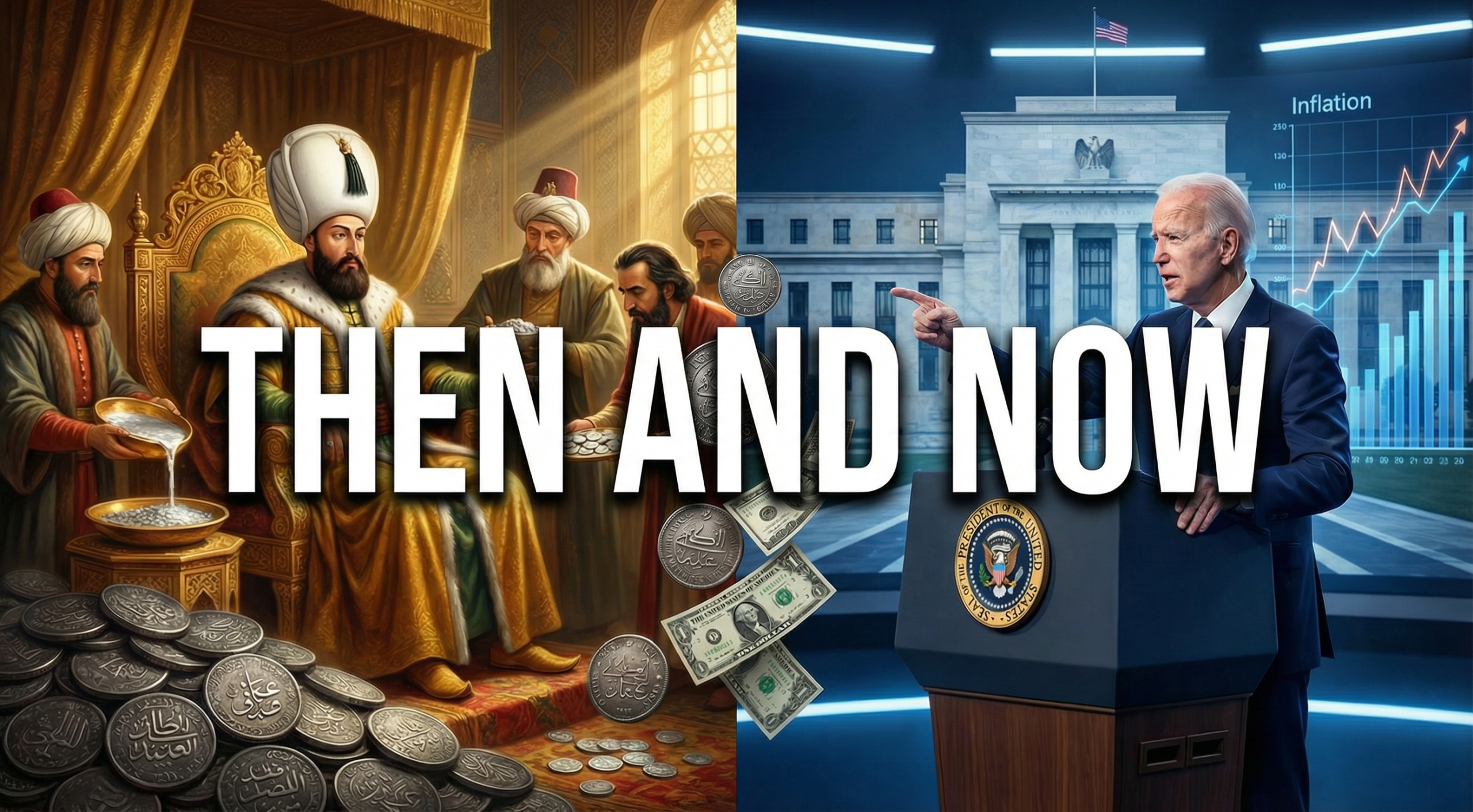
In the palaces of power, where leaders believe they can bend the laws of economics to their will, history doesn’t whisper warnings. It screams them.
And this week, that scream echoed across 440 years.
Just days ago, a chilling phrase emerged from the highest levels of American power, a phrase that should send a shiver down the spine of every citizen who understands the fragile architecture of economic stability: the President of the United States believes he “certainly should have a role” in directing the Federal Reserve.
This isn’t a policy suggestion. It’s a declaration of intent. A direct challenge to a century of American monetary independence. The President’s top economic advisor, Kevin Hassett, has even specified his expectation that the Federal Reserve would be “more accommodative” to the President’s desires.
But what if this isn’t a new idea? What if we’ve seen this exact catastrophe unfold before, not in modern America, but in the opulent throne rooms of one of history’s most powerful empires?
What if the blueprint for this disaster was written 440 years ago, in the palace of a sultan who thought he could control the money supply without consequence?
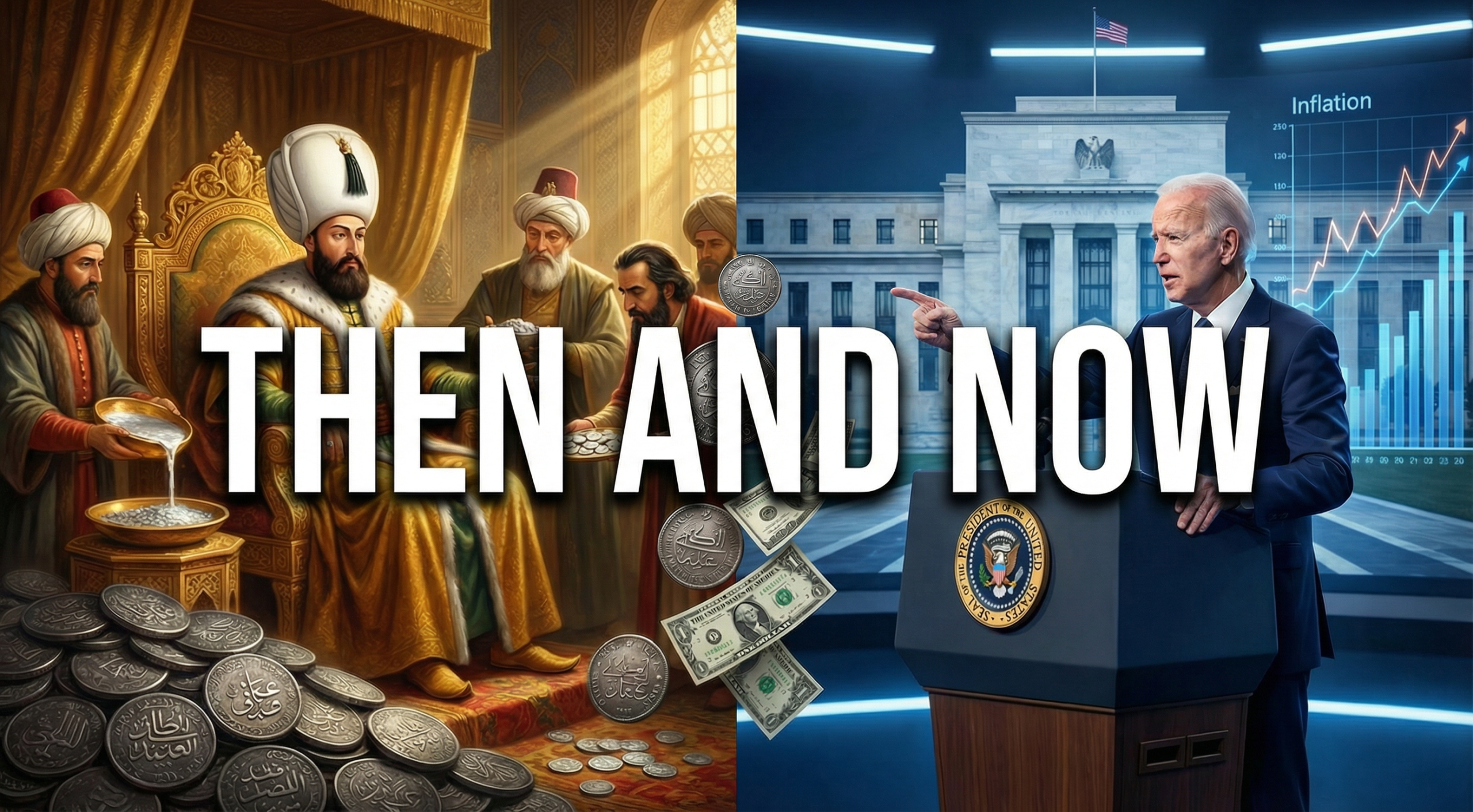
The Time Portal: Istanbul, 1585
Let’s travel back to the heart of the Ottoman Empire, to the reign of Sultan Murad III. The year is 1585, and the empire stands at a crossroads. Decades of expensive wars against the Safavid Persians and the Habsburgs have drained the imperial treasury to its foundations. The sultan needs money, and he needs it immediately.
But unlike modern presidents who must pressure and cajole independent central banks, Sultan Murad III possessed something far more dangerous: absolute control over the currency itself.
The Ottoman economy ran on the akçe, a silver coin that had been the backbone of Mediterranean trade for centuries. Its value was its integrity. Its power was its consistency. When Murad III needed to fund his wars and maintain his lavish court, he didn’t need to negotiate with any independent institution or face any institutional resistance.
He simply ordered the royal mint to debase the currency.
The silver content of the akçe was slashed by 44% in a single decree. Overnight, the coins circulating through the empire’s markets were worth half of what they had been at sunrise. The sultan could now mint twice as many coins from the same amount of silver, flooding the economy with what appeared to be wealth but was actually just diluted money.
It was the 16th-century equivalent of turning on the printing press. And like all such experiments in monetary manipulation, it worked perfectly.
For about six months.
The Parallel Revelation: When Money Becomes A Political Tool
The immediate effect was exactly what Sultan Murad III wanted: more coins in the treasury, more money to pay his soldiers, more funds for his wars. The problem would come later, he reasoned. Later could be dealt with later.
But later came fast.
Within months, prices across the empire began to skyrocket. The merchants and traders who formed the commercial backbone of Ottoman power quickly realized that the akçe in their hands was worth less than it had been. They raised their prices accordingly. Bread, meat, cloth, tools—everything became more expensive. The currency debasement rippled through the economy like a shockwave.
But the real crisis hit the very people the sultan depended on most: the Janissaries.
These weren’t ordinary soldiers. They were the elite military corps that formed the iron fist of Ottoman power, the force that had conquered Constantinople and terrified Europe for generations. They were paid in akçe, and suddenly their salaries—salaries that had fed their families for generations—were worth half of what they had been.
They could no longer afford to feed their children.
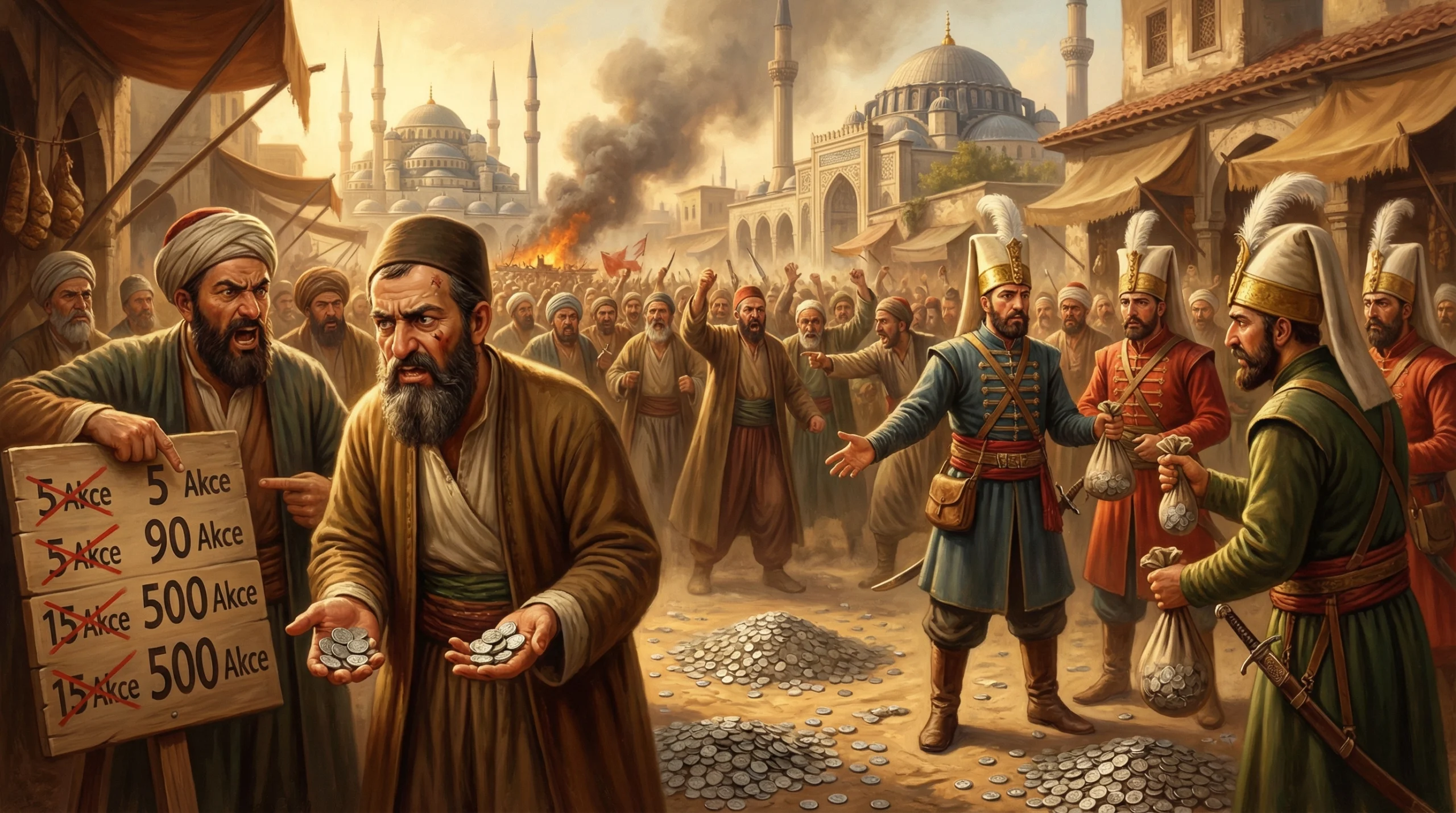
Imagine being a Janissary in 1589. You’ve spent your life defending the empire. You’ve fought in brutal campaigns, risked your life for the sultan’s glory. And now, because of a decision made in a palace you’ll never enter, your salary can’t buy enough bread to feed your family.
The result was predictable and catastrophic.
In 1589, the Janissaries revolted. They didn’t march quietly. They stormed through the streets of Istanbul like a force of nature, their rage fueled by hunger and betrayal. They demanded their back pay in real silver, not the debased coins the sultan was trying to foist on them. They weren’t asking. They were taking.
The empire was thrown into chaos. Sultan Murad III, faced with the prospect of his own elite troops tearing apart his capital, was forced to partially restore the silver content of the akçe. But the damage was done. The currency never fully recovered its value. The trust was shattered.
The Ottoman economy entered a long, slow decline that would last for more than a century and a half. What began as a “temporary measure” to solve a budget crisis became the first crack in the foundation of an empire.
The Pattern Recognition: History’s Warning
Does this sound familiar? A leader who believes he should have direct control over monetary policy. A short-term gain purchased at the price of long-term economic catastrophe. A currency that loses its credibility. An empire that begins its slow descent from the moment its leader decided to play games with the money supply.
The Ottoman Empire never fully recovered from the currency debasements that began under Murad III. Each subsequent sultan faced the same temptation, and many gave in. The akçe was debased again and again, each time providing a short-term boost to the treasury and a long-term wound to the economy.
By the 18th century, the Ottoman Empire was known throughout Europe as “the Sick Man of Europe”—an empire in terminal decline, unable to compete economically or militarily with the rising powers of the West. The currency debasement that began in 1585 was not the only cause of this decline, but historians agree it was a critical turning point.
When a ruler takes direct control of the money supply, when monetary policy becomes a tool of short-term political gain rather than long-term economic stability, the result is always the same: inflation, instability, and decline.
Always.
The Ancient Warning: The Price Of Political Money
The story of Sultan Murad III and the akçe is a warning that echoes across 440 years. It teaches us that there is no shortcut to prosperity, that a nation cannot debase its way to greatness. It teaches us that when a leader takes control of the money supply for political purposes, the consequences are devastating and irreversible.
And it teaches us that the independence of monetary institutions is not some abstract principle debated in economics textbooks. It’s a hard-won lesson from history, written in the economic ruins of empires that thought they could bend the rules of sound money to their will.
The Federal Reserve is not perfect. It has made mistakes, and it will make mistakes again. But its independence from direct political control is one of the cornerstones of American economic stability. When that independence is threatened, when a president believes he should have a “role” in directing monetary policy to serve his political timeline, we are walking down a path that has been traveled before.
And we know exactly where it leads.
It leads to Istanbul in 1589, with elite soldiers rioting in the streets because their salaries can’t buy bread.
It leads to the “Sick Man of Europe,” an empire that once terrified the world reduced to economic irrelevance.
It leads to 150 years of decline that no amount of military power could reverse.
The parallels between Sultan Murad III’s currency debasement and modern threats to Federal Reserve independence are not just academic. They are a warning for our time. But you don’t have to be a passive observer of history repeating itself.
5 Things You Can Do This Week
1. Build Your Food Independence. When currencies collapse and inflation soars, the first thing that becomes unaffordable is food. The Janissaries revolted because they couldn’t feed their families. Don’t let yourself be in that position. The 4ft Farm Blueprint shows you how to grow a surprising amount of food in a tiny space, even if you’ve never gardened before. Start building your food security today.
2. Learn From History’s Patterns. When you understand how empires fall, you can see the warning signs before the crisis hits. Survival Stronghold tracks the historical patterns of collapse and shows you how to prepare for what’s coming. Don’t wait until it’s too late.
3. Master Self-Reliance Skills. Power without self-reliance is an illusion. When economic systems break down, the people who thrive are those who can provide for themselves. The Ready Report teaches you the essential skills for true independence. Learn what you need to know.
4. Protect Your Health Independence. When the Ottoman economy collapsed, medical care became a luxury only the wealthy could afford. Don’t let your health depend on a system that might not be there when you need it. Seven Holistics shows you natural health strategies that work regardless of what happens to the healthcare system. Take control of your health today.
5. Start Your Homesteading Journey. When the akçe collapsed, the people who survived best were those who could produce their own necessities. You don’t need a farm to start homesteading. Homesteader Depot shows you how to begin with whatever space you have, whether it’s an apartment balcony or a suburban backyard. Begin your journey to self-sufficiency.
The Ottoman Empire fell because its leaders chose short-term political gain over long-term economic stability. America doesn’t have to make the same mistake. But whether it does or not, you can choose to be prepared.
History screams its warnings. Are you listening?


