

In the corridors of power, history doesn’t just rhyme; it screams warnings. And this week, a 500-year-old echo is roaring back to life.
On December 5th, the Trump administration unveiled its new National Security Strategy, a document that tears up decades of foreign policy. Buried within it is a chilling phrase: a “Trump Corollary” to the Monroe Doctrine.
It’s a declaration that America is reasserting its dominance over the Western Hemisphere. The justification? A series of military “boat strikes” against alleged traffickers in the Caribbean and Pacific—shows of force to remind our neighbors who is in charge.
To the strategists in Washington, this is a bold move. A necessary projection of strength. A way to secure the homeland.
But to the student of history, it’s a terrifyingly familiar pattern. A pattern of a great power, blinded by its own might, planting the seeds of its own destruction.
Five centuries ago, another empire made the same fatal calculation. They were the most powerful civilization in the Americas, a military and cultural juggernaut that seemed invincible.
They were the Aztecs. And their version of the “Trump Corollary” was called the Xochiyaoyotl. The Flower War.
The Time Portal: An Empire Built on Tribute
By the early 1500s, the Aztec Triple Alliance, ruled from the magnificent island-city of Tenochtitlan, was the undisputed master of Mesoamerica. Their empire wasn’t one of direct rule, but of tribute. Conquered city-states were not absorbed; they were squeezed.
Gold, textiles, food, and most grimly, human lives for sacrifice, flowed into the Aztec capital from hundreds of vassal states. It was a system maintained by fear and the constant threat of military retribution.
But one nation refused to bow. The kingdom of Tlaxcala.

A proud and fierce people, the Tlaxcalans were one of the original seven Náhuatl tribes, just like the Mexica-Aztecs. They saw themselves as equals, not subjects. Encircled by the ever-expanding Aztec empire, they were economically strangled, cut off from vital trade goods like salt and cotton. Yet, they resisted.
To deal with this stubborn defiance, the Aztec emperor Moctezuma II and his predecessors perfected a unique and sinister form of warfare: the Flower War.
The Parallel Revelation: A War of Ritual and Resentment
A Flower War wasn’t a war of conquest. It was a spectacle. A ritual.
The armies would agree on a time and a sacred place—a cuauhtlalli. They would field an equal number of warriors, drawn heavily from the nobility. Instead of the long-range arrows and atlatl darts of a real war, they fought up close, with obsidian-bladed clubs called macuahuitl.
The goal wasn’t to take territory. It was to take captives for sacrifice, to train young warriors, and most importantly, to demonstrate Aztec superiority. It was a message: “We can bleed you whenever we wish. We can march into your lands on a whim. We are the power. You are the subject.”
For over sixty years, the Aztecs waged these Flower Wars against Tlaxcala. Each battle, each captive dragged back to the Great Temple of Tenochtitlan, was another turn of the screw. Another deposit into a growing bank of hatred.
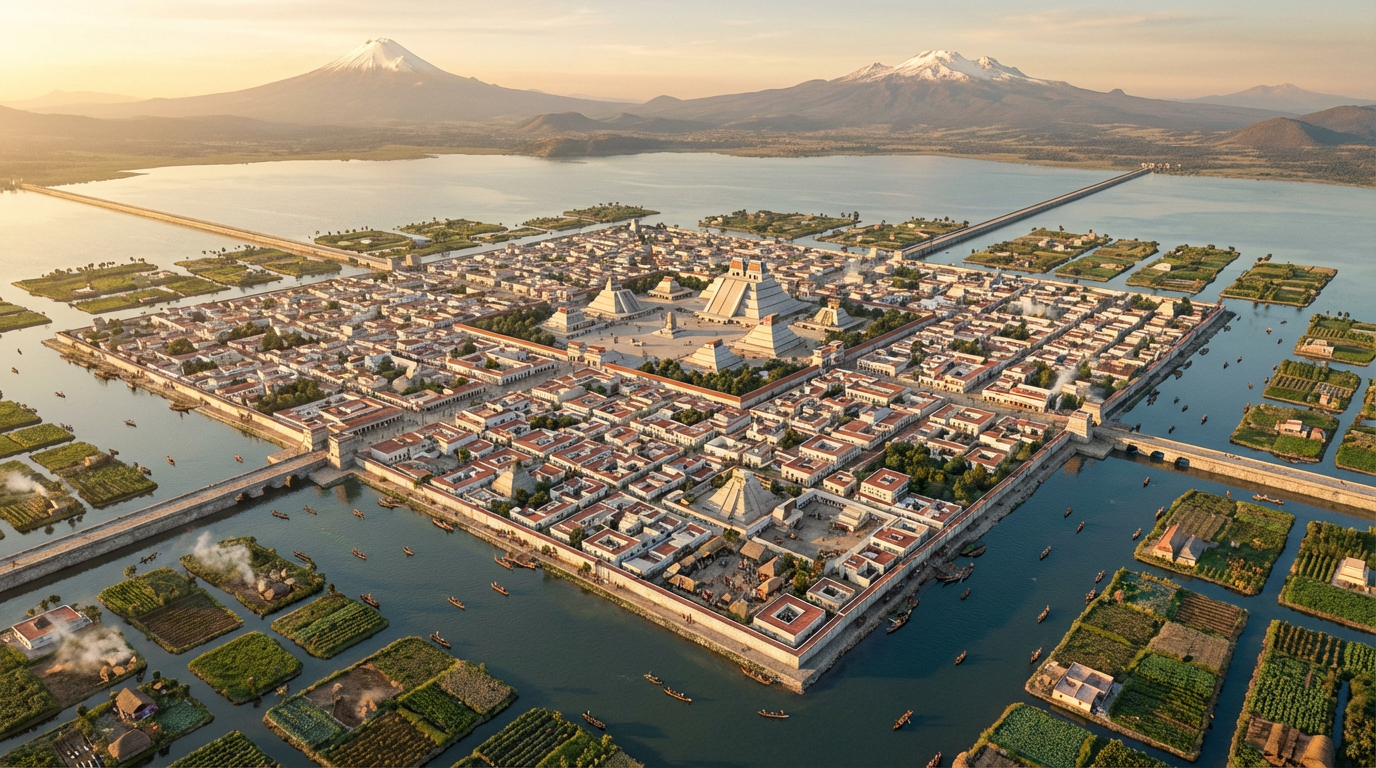
The Aztecs believed this constant, low-level pressure kept their enemies weak and intimidated. They were wrong. It was forging them into a weapon.
Every Tlaxcalan warrior who fought in a Flower War learned the Aztec way of battle. Every family that lost a son to the sacrificial altar felt a burning desire for vengeance. The Flower Wars didn’t break Tlaxcala’s spirit; they crystallized its resolve. They were creating a nation of veterans united by a single, all-consuming purpose: to see Tenochtitlan burn.
The Ancient Warning: When the Outsider Arrives
In 1519, Hernán Cortés and his small band of Spanish conquistadors landed on the coast. They were aliens, armed with thunder-sticks and riding strange beasts.
When they marched inland, they entered Tlaxcalan territory. The Tlaxcalans, true to their warrior spirit, attacked the Spanish fiercely. But after three brutal battles, the Tlaxcalan leadership recognized a new reality. The Spanish weapons were devastating. Their tactics were relentless.
And they had a common enemy.
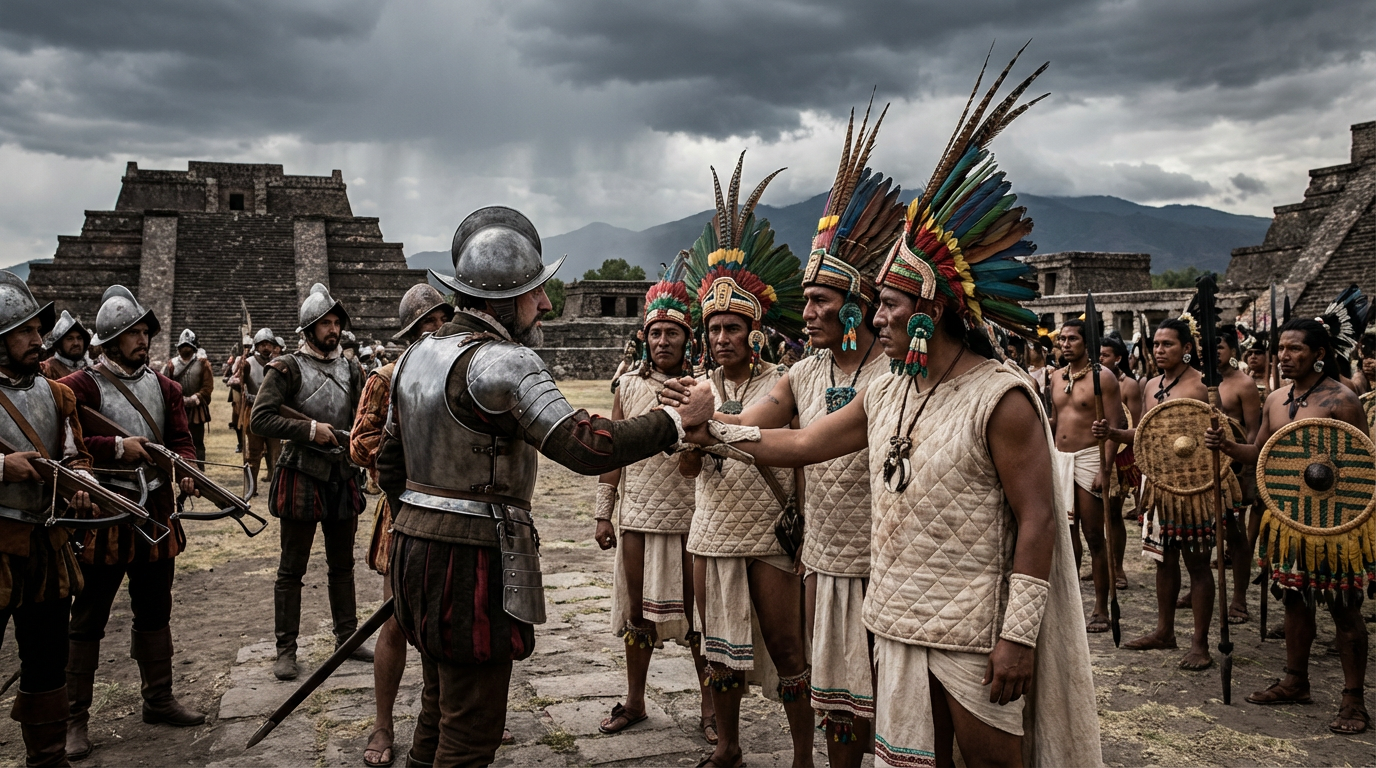
The Tlaxcalans looked at Cortés and didn’t see a conqueror. They saw an opportunity. They saw the instrument of their long-awaited revenge.
They formed an alliance. Tens of thousands of Tlaxcalan warriors, who knew the land and the enemy intimately, joined the Spanish forces. It was this alliance that proved decisive. The Spanish provided the technological edge; the Tlaxcalans provided the manpower, the logistical support, and the burning hatred that fueled the campaign.
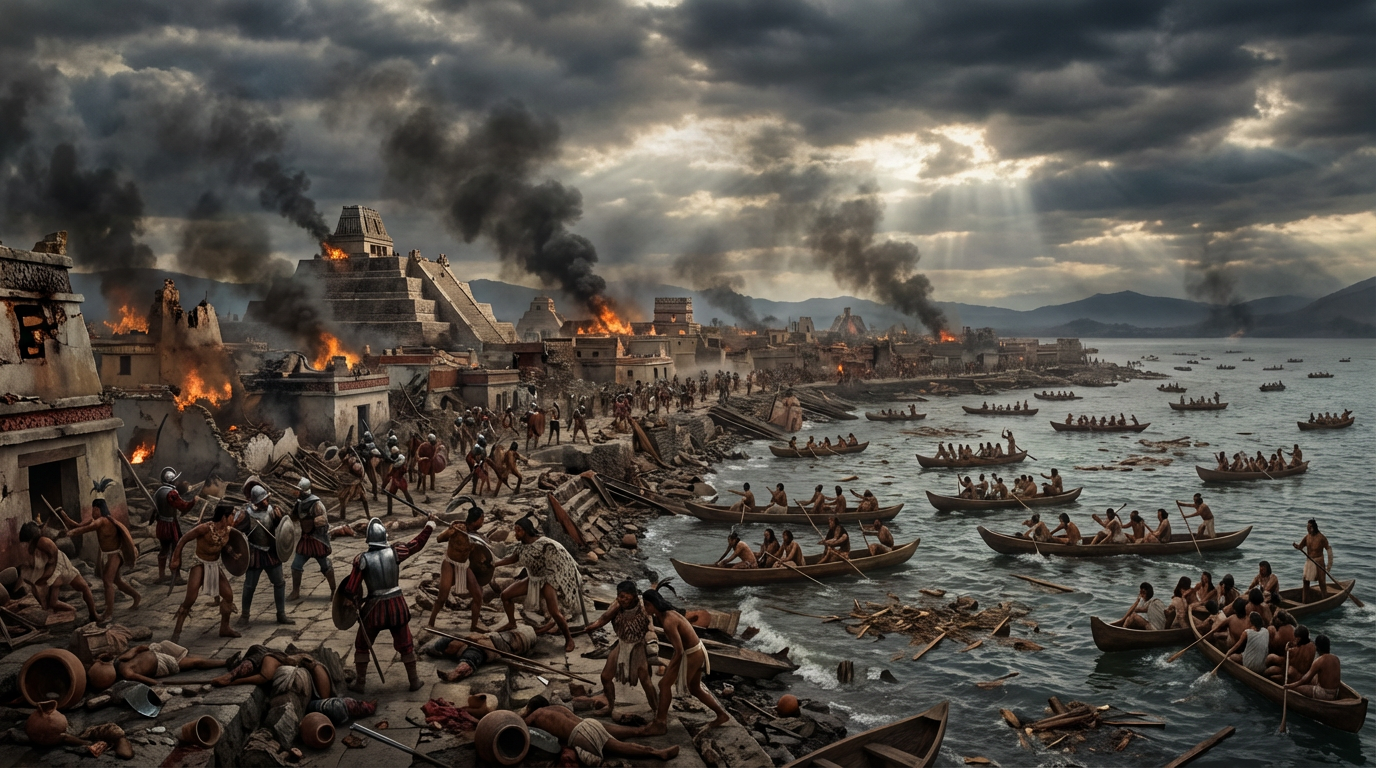
In 1521, when Tenochtitlan fell, it wasn’t just to 900 Spaniards. It was to the rage of the tens of thousands of subjugated peoples, led by the Tlaxcalans, who had endured decades of humiliation under the Aztec “Monroe Doctrine.” The Aztecs’ own strategy of intimidation had created the very weapon that destroyed them.
The Pattern Recognition: Why Hegemons Fail
This is the warning that echoes from the ruins of Tenochtitlan to the halls of Washington today.
A great power that uses its military might not for defense, but for ritualized intimidation of its smaller neighbors, is making a catastrophic miscalculation.
These “limited strikes,” these “shows of force,” are not perceived as warnings. They are perceived as acts of aggression. They don’t inspire fear; they inspire a desperate search for an equalizer.
For decades, the Tlaxcalans had no hope of defeating the Aztecs alone. But the moment an outside power arrived—one that could challenge the regional hegemon—they were the first to sign up. Their resentment had made them strategic.
As the United States revives a 200-year-old doctrine to justify military pressure in its “backyard,” it risks making the same mistake. It risks turning neighbors into enemies, and enemies into allies of our rivals.
5 Things You Must Do Before the Next Geopolitical Shockwave
The patterns of history are clear. Great powers rise and fall, and their decline is often marked by the kind of arrogant overreach we are seeing today. When the geopolitical plates shift, the tremors are felt in our supply chains, our economy, and our homes.
Here is what you can do to insulate yourself and your family from the coming instability.
1. Declare Your Food Independence. The single most fragile part of our modern world is the “just-in-time” food supply chain. A border dispute, a fuel crisis, or a trade war could empty grocery store shelves in days. The ultimate act of self-reliance is to control your own food source. The 4ft Farm Blueprint is not just a gardening guide; it’s a step-by-step plan to turn a tiny patch of your backyard into a perpetual source of fresh, organic food for your family. It’s your personal defense against systemic collapse.
2. Fortify Your Personal Health. A crisis is the worst possible time to be reliant on a fragile medical system. Your health is your wealth. Explore the ancient wisdom of natural remedies and holistic health to build a resilient body that can withstand stress and uncertainty. Discover more at Freedom Health Daily.
3. Build Your Personal Fortress. When institutions fail, your home becomes your castle. This doesn’t mean building a bunker. It means having a plan. It means knowing how to secure your property, having essential supplies on hand, and being prepared for disruptions to power and water. Get the blueprint for total home preparedness at Survival Stronghold.
4. Master the Patterns of History. The best way to prepare for the future is to understand the past. The cycles of empire, currency debasement, and political decay are not new. Continue to educate yourself on the historical parallels that give you a roadmap to what’s coming. Dive deeper into our archives at American Downfall.
5. Reclaim Practical Skills. In a world of digital abstraction, real-world skills become priceless. Learn to fix things, grow things, and build things. A society that has forgotten how to be practical is a society on the brink. Find inspiration and how-to guides for a more capable life at Homesteader Depot.
Your Financial Fortress in an Unstable World
History’s greatest lesson is that you cannot depend on distant governments or fragile systems for your security. True security is not held in a politician’s promise or a stock certificate. It’s held in your own hands.
It’s the food you grow yourself. The skills you possess. The health you cultivate. The community you build.
That is why the 4ft Farm Blueprint is more than just a product. It is the cornerstone of a truly resilient life. It is a declaration that you will not be a victim of history, but a student of it. It is the first and most important step in building your personal fortress against the storms to come.
References
- Hassig, Ross. Aztec Warfare: Imperial Expansion and Political Control. University of Oklahoma Press, 1995.
- Hicks, Frederic. “‘Flowery War’ in Aztec History.” American Ethnologist, vol. 6, no. 1, 1979, pp. 87–92.
- Schmal, John P. “The Roots of Tlaxcalan Resentment.” Indigenous Mexico, 2023.
- Townsend, Richard F. The Aztecs. Thames & Hudson, 2009.


